
Silane Coupling Market Report Scope & Overview:
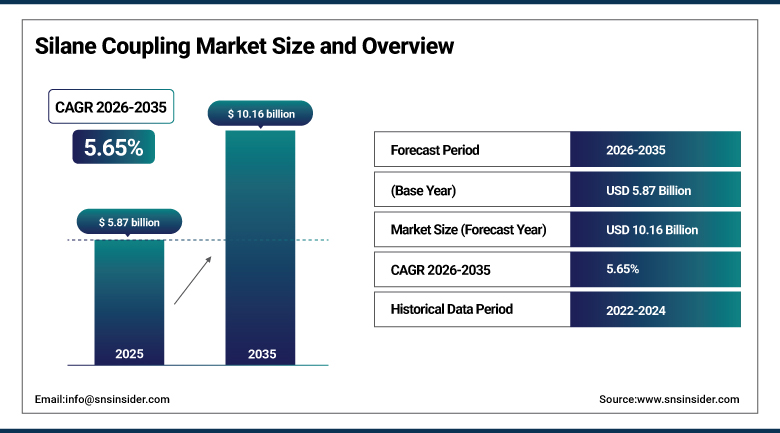
The Silane Coupling Market was valued at USD 5.87 Billion in 2025 and is expected to reach USD 10.16 Billion by 2035, growing at a CAGR of 5.65% from 2026–2035.
The main factors driving the machine learning in travel market include the increasing use of digital travel platforms, rising demand for personalized travel experiences, and the growing need for real-time data analysis and intelligent decision-making. Machine learning solutions enable travel businesses to analyze customer behavior, predict travel preferences, optimize pricing, deliver accurate recommendations, detect fraud, and improve operational efficiency. In addition, the growing use of online booking websites, travel applications, and digital customer engagement channels generates large volumes of travel-related data, further supporting the adoption of machine learning technologies.
Furthermore, advancements in artificial intelligence, cloud computing, big data analytics, natural language processing, and predictive analytics are contributing to market growth. Machine learning applications such as chatbots and virtual assistants, recommendation engines, demand forecasting, and dynamic pricing enable airlines, hotels, travel agencies, and online travel platforms to enhance customer service and optimize business operations. Finally, the increasing adoption of digital transformation initiatives, intelligent travel technologies, automated customer service, and data-driven revenue management is expected to further drive the adoption of machine learning solutions across the global travel industry.
In April 2025, Thomas Swan’s Casilane HP-669 was highlighted as a sulfur silane coupling agent designed to improve filler–rubber interaction, abrasion resistance, durability, heat resistance, and fatigue performance. The product is used in tires, hoses, belts, cables, footwear, and molded rubber components, supporting growing demand for high-performance silane solutions in the rubber and automotive industries.
To Get more information Silane Coupling Market - Request Free Sample Report
Silane Coupling Market Trends
-
Increasing demand from rubber, plastics, composites, adhesives, and sealants drives adoption of silane coupling agents across industrial applications.
-
Growing use in automotive tires and components improves demand for silane coupling agents that enhance mechanical strength, durability, and resistance to heat and moisture.
-
Expansion of construction and infrastructure activities supports demand for silane coupling agents in adhesives, sealants, coatings, and concrete additives.
-
Increasing adoption of advanced composites, electronics, renewable energy, and lightweight materials creates opportunities for high-performance silane coupling agents.
-
Technological advancements and growing demand for durable, high-performance, and sustainable materials accelerate adoption of silane coupling agents across end-use industries.
U.S. Silane Coupling Market Outlook
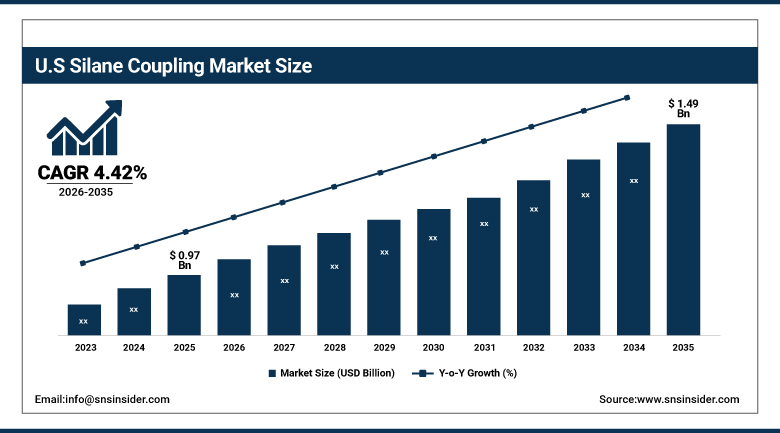
The U.S. Silane Coupling Market was valued at USD 0.97 Billion in 2025 and is expected to reach around USD 1.49 Billion by 2035, growing at a CAGR of 4.42% from 2026–2035.
The silane coupling market in the U.S. demonstrates strong potential for future development due to the widespread use of silane coupling agents across rubber, plastics, composites, adhesives, coatings, and construction applications. Increasing demand from tire manufacturers, automotive component producers, construction material suppliers, and industrial manufacturers is driving the adoption of silane coupling agents to improve adhesion, mechanical strength, durability, chemical resistance, and overall material performance.
Silane coupling agents are becoming increasingly important in the development of advanced composites, reinforced plastics, high-performance rubber compounds, and specialty coatings. In addition, growing demand for lightweight automotive materials, high-performance tires, electronic components, and durable construction materials is supporting market development. Increasing investments in infrastructure, automotive manufacturing, electronics, renewable energy, and advanced material technologies are further contributing to the adoption of silane coupling agents across the U.S. industrial sector.
In August 2026, U.S. manufacturers continued expanding advanced material technologies to improve the performance of rubber, plastics, composites, adhesives, and coatings. This trend is supporting demand for silane coupling agents in automotive, construction, electronics, and industrial applications, where improved adhesion, durability, and material compatibility are increasingly important.
Silane Coupling Market Segment Analysis
-
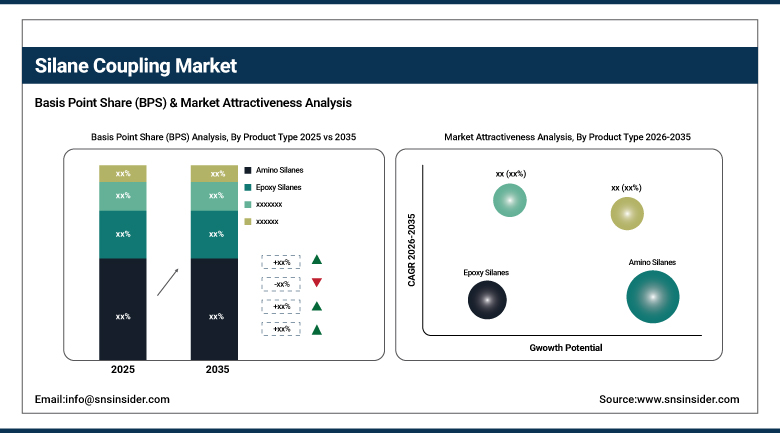
By Product Type, amino silanes is dominant at 28.60% in 2025, while methacryloxy silanes is the fastest-growing segment with an 8.56% CAGR during 2025–2035.
-
By Form, liquid is dominant at 83.40% in 2025, while solid/powder is the fastest-growing segment with an 8.13% CAGR during 2025–2035.
-
By Application, adhesives & sealants is dominant at 27.14% in 2025, while composite materials is the fastest-growing segment with a 6.89% CAGR during 2025–2035.
-
By Sales Channel, direct sales is dominant at 46.83% in 2025, while online sales is the fastest-growing segment with a 9.49% CAGR during 2025–2035.
-
By End-Use Industry, automotive & transportation is dominant at 27.86% in 2025, while electrical & electronics is the fastest-growing segment with a 6.89% CAGR during 2025–2035.
By Product Type, amino silanes dominated the silane coupling market, while methacryloxy silanes are expected to grow fastest.
Amino silanes accounted for the largest share of the market due to their extensive use in adhesives, sealants, coatings, plastics, composites, and other applications requiring strong adhesion and improved material compatibility. Amino silanes enhance bonding between organic polymers and inorganic materials, making them widely used across construction, automotive, electronics, and industrial applications. The segment is expected to remain dominant through 2035, supported by continued demand for high-performance materials and increasing use of silane coupling agents across diverse end-use industries.
Methacryloxy silanes are projected to register the fastest growth during the forecast period. Their increasing use in composites, coatings, adhesives, plastics, and reinforced polymer systems is supporting segment expansion. Growing demand for lightweight materials, improved interfacial bonding, enhanced mechanical properties, and durable composite structures is expected to further increase the adoption of methacryloxy silanes.
By Sales Channel, direct sales dominated the silane coupling market, while online sales are expected to grow fastest.
Direct sales accounted for the largest share because major manufacturers and industrial buyers typically rely on direct procurement relationships for customized formulations, technical support, bulk purchases, and consistent product quality. Direct sales are particularly important for large-volume applications in automotive, construction, rubber, plastics, and chemical manufacturing. The segment is expected to maintain its leading position through 2035.
Online sales are projected to record the fastest growth during the forecast period. Increasing digitalization of industrial procurement, greater availability of specialty chemical products through online platforms, and the growing preference for convenient product comparison and ordering are supporting segment expansion. Online channels are expected to gain further traction among small and medium-sized manufacturers and specialized users.
By End-Use Industry, automotive & transportation dominated the silane coupling market, while electrical & electronics are expected to grow fastest.
Automotive & transportation accounted for the largest share of the market due to the extensive use of silane coupling agents in tires, rubber components, plastics, adhesives, sealants, and composite materials. Silane coupling agents improve mechanical strength, durability, adhesion, abrasion resistance, and compatibility between different materials, supporting their use in automotive manufacturing and transportation applications. The segment is expected to remain dominant through 2035.
Electrical & electronics are projected to register the fastest growth during the forecast period. Increasing demand for advanced electronic components, insulating materials, encapsulation systems, adhesives, and high-performance composites is driving the adoption of silane coupling agents. Their ability to improve adhesion, moisture resistance, electrical insulation, and material durability is expected to support growing applications across electronics and electrical manufacturing.
Regional Analysis
|
Region |
Major Country |
Share within Region, 2025(%) |
|---|---|---|
|
North America |
United States |
79.70% |
|
Europe |
Germany |
27.38% |
|
Asia Pacific |
China |
45.72% |
|
Middle East & Africa |
Saudi Arabia |
22.84% |
|
Latin America |
Brazil |
21.63% |
North America Silane Coupling Market Insights
North America is expected to remain a major regional market for silane coupling agents during the forecast period from 2025 to 2035, supported by strong demand from automotive, construction, rubber, plastics, adhesives, composites, and electronics industries. The United States represents the largest market in the region, supported by its well-established automotive and chemical manufacturing industries and increasing demand for high-performance materials. Silane coupling agents are widely used to improve adhesion, mechanical strength, durability, chemical resistance, and compatibility between organic and inorganic materials. Growing demand for high-performance tires, advanced composites, construction materials, coatings, and specialty adhesives is expected to support market growth across North America.
Europe Silane Coupling Market Insights
Europe is expected to remain a significant market for silane coupling agents, supported by established automotive, construction, chemical, plastics, rubber, and electronics industries. The region accounted of the global market in 2025. Germany represents the leading country market in Europe due to its strong automotive manufacturing base, advanced chemical industry, and growing use of high-performance polymers, composites, adhesives, and coatings. Silane coupling agents are increasingly used in tire manufacturing, automotive components, construction materials, sealants, coatings, and composite applications. Furthermore, the growing emphasis on lightweight materials, energy efficiency, material durability, and advanced manufacturing technologies is expected to support the adoption of silane coupling agents across European industries.
Asia Pacific Silane Coupling Market Insights
Asia Pacific is dominating region with around 40% share and is also expected to register the fastest growth among regional markets for silane coupling agents during the forecast period, with a CAGR of 6.79% from 2025 to 2035. The region accounted for a significant share of the global market in 2025 and is projected to increase its share by 2035. Rapid industrialization, expanding automotive production, growing construction activity, increasing plastics and rubber manufacturing, and rising demand for advanced composites are key factors supporting regional growth.
China represents the largest country market in Asia Pacific, supported by its extensive automotive, tire, plastics, electronics, construction, and chemical manufacturing industries. Other major markets, including India, Japan, South Korea, and Australia, are also contributing to regional growth through increasing investments in advanced materials, electronics, automotive components, infrastructure, and specialty chemicals.
Middle East & Africa and Latin America Silane Coupling Market Insights
The Middle East & Africa and Latin America regions are expected to witness steady growth in the silane coupling market, supported by increasing industrialization, infrastructure development, automotive production, construction activities, and demand for advanced materials. Saudi Arabia represents a significant market in the Middle East & Africa due to investments in infrastructure, construction, industrial diversification, and chemical manufacturing. Latin America is also expected to expand steadily, with Brazil representing the leading country market due to its automotive, construction, rubber, plastics, and chemical industries. Increasing adoption of high-performance adhesives, coatings, composites, and rubber products is expected to support the demand for silane coupling agents across both regions.
Market Dynamics
Growth Driver: Increasing adoption of digital travel platforms and AI-enabled services driving demand for machine learning in travel
The increasing prevalence of digital travel platforms, online booking services, and artificial intelligence is among the key drivers behind the increasing demand for machine learning technology in the travel industry. The travel industry is increasingly adopting machine learning technology in order to carry out real-time analysis of customers, generate personalized recommendations, forecast demands, carry out dynamic pricing, detect fraud, and offer automated customer services. Furthermore, the increasing amount of data of travelers that is being created using online booking, mobile apps, loyalty schemes, searching behavior, and digital payment systems has resulted in an increased demand for advanced analytics and intelligent decision-making technologies.
The increasing prevalence of cloud computing technology, natural language processing, and predictive analytics is contributing to the market growth. Besides, the increasing importance of personalized experience in the travel industry and efficiency is expected to boost adoption of machine learning.
Restraint: High implementation costs and complex integration with existing travel systems hinder machine learning adoption
High costs involved in the implementation process and complexity involved in the integration of machine learning technologies into the existing travel industry infrastructure may inhibit expansion of the market. The implementation of machine learning may involve investments in data infrastructure, cloud computing platforms, software, specialized knowledge, system integration, and maintenance, thus raising the cost of implementation.
This could be an obstacle to small travel agencies and individual hotels, which have limited budgets when it comes to implementing technological innovations. Furthermore, the integration of machine learning technologies with the existing legacy systems, such as reservation systems, CRM platforms, revenue management systems, payment infrastructure, as well as many other third-party travel services can increase the complexity. Other problems that may arise include data quality, security, privacy, compliance, and other concerns.
Opportunity: Growing adoption of generative AI, predictive analytics, and personalized travel experiences creates new market opportunities
The widespread use of analytics driven by AI, generative AI, and intelligent travel management services is providing ample growth opportunities for the global Silane Coupling Market. Machine learning in travel solutions facilitate provision of personalized suggestions, customer interactions automation, demand prediction, pricing optimization, fraud detection, and increase efficiency. In addition to this, the rising use of AI chatbots, virtual assistants, recommendation systems, and predictive analytics in airlines, hotels, travel agents, and online travel portals will increase the addressable market size.
The availability of a huge volume of travel data in structured and unstructured forms is also opening up scope for more advanced machine learning solutions. Additionally, investments in cloud-based AI infrastructures and digital travel platforms are likely to create new opportunities for market players.
Recent Developments
-
2026: Huawei expanded its smart PV portfolio with advanced inverter and digital energy management capabilities, strengthening connected solar monitoring, grid support, and intelligent asset management.
-
2026: Sungrow continued expanding its smart inverter portfolio with advanced grid-forming and energy management capabilities, supporting connected solar installations and grid integration.
-
2026: SMA Solar Technology strengthened its smart solar inverter and energy management portfolio, supporting real-time monitoring, system optimization, and grid-interactive solar applications.
-
2026: Enphase Energy expanded its microinverter portfolio with advanced connectivity and monitoring capabilities, improving module-level performance tracking and intelligent energy management for solar installations.
Silane Coupling Market Key Players are:
-
Dow Inc.
-
Evonik Industries AG
-
Wacker Chemie AG
-
Shin-Etsu Chemical Co., Ltd.
-
Momentive Performance Materials Inc.
-
Gelest, Inc.
-
3M Company
-
Hubei Jianghan New Materials Co., Ltd.
-
Jiangxi Chenguang New Materials Co., Ltd.
-
Jiangxi Hungpai New Material Co., Ltd.
-
Nanjing Union Silicon Chemical Co., Ltd.
-
BRB International B.V.
-
Hubei Bluesky New Material Inc.
-
Nanjing Shuguang Chemical Group Co., Ltd.
-
Guangzhou Ecopower New Material Co., Ltd.
-
KBG Corporation
-
JNC Corporation
-
KCC Corporation
-
Nippon Shokubai Co., Ltd.
-
WD Silicone Co., Ltd.
Silane Coupling Market Report Scope:
| Report Attributes | Details |
|---|---|
| Market Size in 2025 | USD 5.87 Billion |
| Market Size by 2035 | USD 10.16 Billion |
| CAGR | CAGR of 5.65% From 2026 to 2035 |
| Base Year | 2025 |
| Forecast Period | 2026-2035 |
| Historical Data | 2022-2024 |
| Report Scope & Coverage | Market Size, Segments Analysis, Competitive Landscape, Regional Analysis, DROC & SWOT Analysis, Forecast Outlook |
| Key Segments | • By Product Type (Amino Silanes, Epoxy Silanes, Vinyl Silanes, Methacryloxy Silanes, Sulfur Silanes, Other Silanes) • By Form (Liquid, Solid/Powder) • By Application (Adhesives & Sealants, Paints & Coatings, Rubber & Plastics, Fiber Treatment, Composite Materials, Other Applications) • By Sales Channel (Direct Sales, Distributors, Online Sales) • By End-Use Industry (Automotive & Transportation, Building & Construction, Electrical & Electronics, Energy & Chemical, Healthcare, Other Industries) |
| Regional Analysis/Coverage | North America (US, Canada), Europe (Germany, UK, France, Italy, Spain, Russia, Poland, Rest of Europe), Asia Pacific (China, India, Japan, South Korea, Australia, ASEAN Countries, Rest of Asia Pacific), Middle East & Africa (UAE, Saudi Arabia, Qatar, South Africa, Rest of Middle East & Africa), Latin America (Brazil, Argentina, Mexico, Colombia, Rest of Latin America) |
| Company Profiles | Dow Inc.; Evonik Industries AG; Wacker Chemie AG; Shin-Etsu Chemical Co., Ltd.; Momentive Performance Materials Inc.; Gelest, Inc.; 3M Company; Hubei Jianghan New Materials Co., Ltd.; Jiangxi Chenguang New Materials Co., Ltd.; Jiangxi Hungpai New Material Co., Ltd.; Nanjing Union Silicon Chemical Co., Ltd.; BRB International B.V.; Hubei Bluesky New Material Inc.; Nanjing Shuguang Chemical Group Co., Ltd.; Guangzhou Ecopower New Material Co., Ltd.; KBG Corporation; JNC Corporation; KCC Corporation; Nippon Shokubai Co., Ltd.; WD Silicone Co., Ltd. |
Frequently Asked Questions
The Silane Coupling Market is expected to grow at a CAGR of 5.65% from 2026 to 2035.
The Silane Coupling Market was valued at approximately USD 5.87 billion in 2025.
The market is driven by rising demand for high-performance materials across automotive, construction, rubber, plastics, electronics, and composite industries.
Amino Silanes dominated the Silane Coupling Market in 2025, accounting for a 28.60% share.
Asia Pacific dominated the Silane Coupling Market in 2025, accounting for a 41.12% share.
