
Machine Learning in Travel Market Report Scope & Overview:
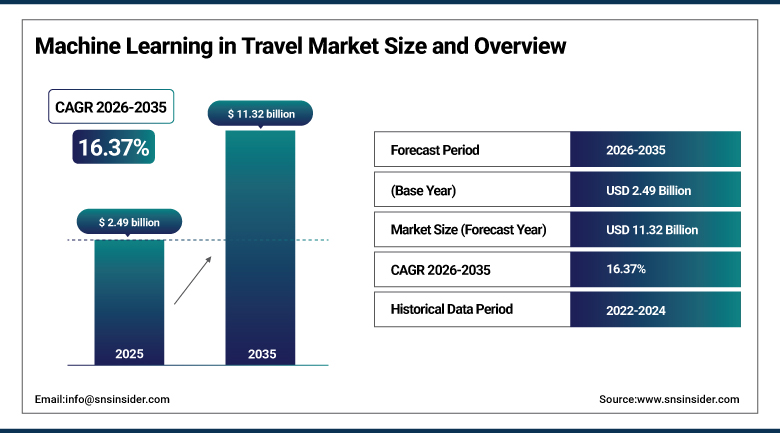
The Machine Learning in Travel Market was valued at USD 2.49 Billion in 2025 and is expected to reach USD 11.32 Billion by 2035, growing at a CAGR of 16.37% from 2026–2035.
The main factors driving the market for machine learning in travel include increasing use of digital travel platforms, the rising demand for personalized travel experience, and the requirement for real-time data analysis and intelligent decision making. Machine learning solutions allow travel businesses to analyze customer behavior, predict travel preferences, optimize prices, make accurate recommendations, identify fraud cases, and increase operational efficiency. In addition, the increasing usage of online booking sites, travel apps, and digital customer engagement channels leads to the collection of large amounts of travel data and contributes to machine learning adoption.
Additionally, artificial intelligence, cloud computing, big data analytics, natural language processing, and predictive analytics are among the factors that are contributing to the growth of the market. Machine learning solutions like chatbots and virtual assistants, recommendation engines, demand forecasting solutions, and dynamic pricing solutions help airlines, hotels, travel agencies, and online travel platforms improve customer service and optimize business operations. Finally, increasing adoption of digital transformation initiatives, intelligent travel technology, automated customer service, and data-driven revenue management will drive the adoption of machine learning solutions in the global travel industry.
In February 2026, ixigo expanded its collaboration with OpenAI to accelerate artificial intelligence integration across ixigo, ConfirmTkt, and AbhiBus. The collaboration is focused on deploying advanced AI models through OpenAI’s Enterprise API platforms to support autonomous workflows, AI-assisted processes, contextual assistants, and AI-driven travel experiences. The initiative is expected to strengthen machine learning and AI capabilities across customer service, business operations, marketing, and travel technology, while supporting ixigo’s development of more autonomous and personalized travel services.
To Get more information Machine Learning in Travel Market - Request Free Sample Report
Machine Learning in Travel Market Trends
-
Increasing adoption of digital travel platforms drives demand for machine learning-enabled services and personalization.
-
AI-powered analytics improve travel recommendations, demand forecasting, dynamic pricing, and fraud detection.
-
Integration with booking platforms, customer data, CRM systems, and travel management platforms strengthens intelligent decision-making.
-
Automated customer service and predictive analytics improve traveler engagement, operational efficiency, and service reliability.
-
Digital transformation initiatives and growing online travel activity accelerate machine learning adoption across the travel industry.
U.S. Machine Learning in Travel Market Outlook
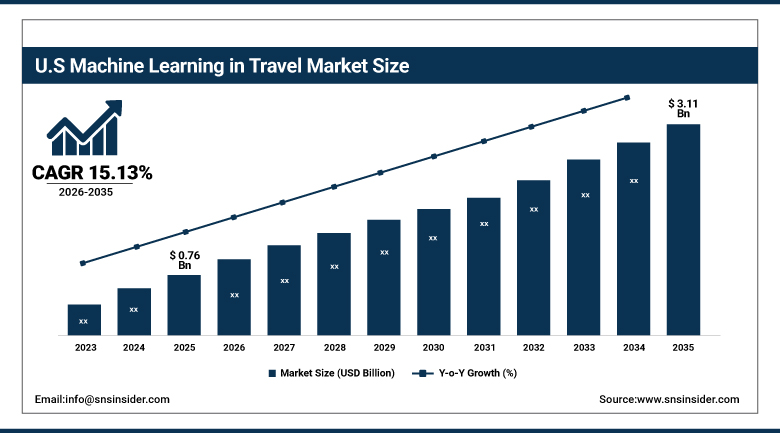
The U.S. Machine Learning in Travel Market was valued at USD 0.76 Billion in 2025 and is expected to reach around USD 3.11 Billion by 2035, growing at a CAGR of 15.13% from 2026–2035.
Machine learning technology in the travel market in the US demonstrates good potential for future development because of the wide adoption of online travel platforms, booking websites, AI technology, and data-enabled travel management solutions. More and more airlines, hotels, travel agencies, online travel platforms, and other travel providers adopt machine learning tools in order to study the behavior of their clients, create personalized suggestions, optimize prices, predict demand, and increase efficiency.
Machine learning tools become more and more relevant in terms of integration of travel data in booking portals, CRM systems, loyalty programs, revenue management platforms, and digital travel platforms. Besides, increased demand for AI-based customer service, predictive analytics, automated travel recommendation, fraud detection, and dynamic pricing drives market development. Increased level of online travel activities, need for personalized travel experience, digitalization, and cloud-based analytics are additional drivers that boost the adoption of machine learning solutions.
In August 2026, Ryanair partnered with Google Cloud to expand AI and machine learning across airline operations, including crew scheduling, fleet management, maintenance planning, and automated decision-making. The initiative is expected to improve operational efficiency and strengthen data-driven travel management.
Machine Learning in Travel Market Segment Analysis
-
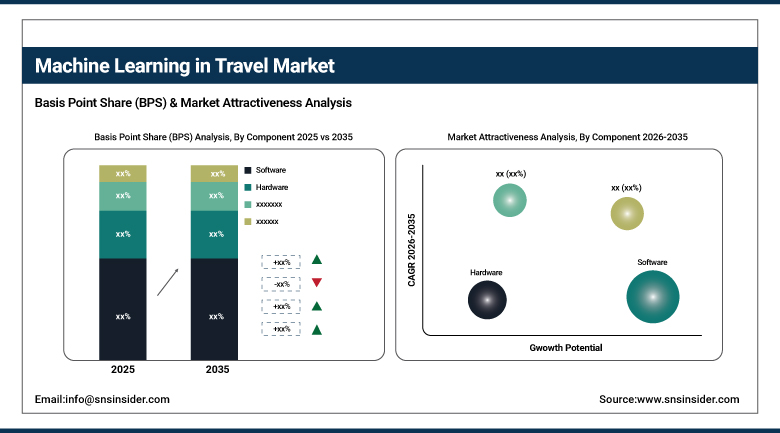
By Component, software is dominant at 57.43% in 2025, while services is the fastest-growing segment with a 19.96% CAGR during 2025–2035.
-
By Deployment Mode, cloud is dominant at 39.47% in 2025 and is also the fastest-growing segment with a 18.01% CAGR during 2025–2035.
-
By Application, personalized recommendations is dominant at 18.47% in 2025 and is also the fastest-growing segment with a 18.78% CAGR during 2025–2035.
-
By End-User, travel agencies is dominant at 32.47% in 2025, while online travel platforms is the fastest-growing segment with a 21.22% CAGR during 2025–2035.
By Component, software dominated the machine learning in travel market, while services are expected to grow fastest.
The popularity of software was attributed to its extensive uses in travel platforms, booking services, customer analytics, recommendation engines, and revenue management solutions. The software machine learning technology allows travel enterprises to analyze high amounts of customer and internal data, generate personalized travel recommendations, predict demands, optimize prices, and engage customers. This segment is predicted to remain dominant until 2035 with the continuous investments made by the travel enterprises into digital technologies and data.
The services component is forecasted to have the highest growth over the period. The growing necessity of implementation, integration, consultation, customization, training, and maintenance is prompting the travel enterprises to opt for machine learning services. With the growing integration of machine learning into existing booking, customer relationship management, revenue management, and analytics systems, there will be an increased demand for services.
By Application, personalized recommendations dominated the machine learning in travel market, while personalized recommendations are also expected to grow fastest.
Personalized recommendations ranked highest in the market due to the ability of the travel firms to adopt machine learning to analyze the tastes and preferences of the travelers, their browsing habits, booking activities, and expenditure pattern. Such ability will help the organizations to make recommendations about appropriate travel destinations, flights, hotels, tours, and holiday packages to improve customer interactions and sales potential. The segment is set to continue leading until 2035 with the growing demand for personalized travel experiences.
The personalized recommendations are also expected to have the highest growth rate during the forecast period. With the rising availability of customer data, expansion of digital platforms in the travel industry, and increasing demand for personalized travel experiences, the airlines, hotels, travel agencies, and online travel platforms are focusing on improving their recommendations for customers. Artificial intelligence and machine learning have further improved the travel recommendations.
By End-User, travel agencies dominated the machine learning in travel market, while online travel platforms are expected to grow fastest.
Travel agencies accounted for the highest share of the market since travel agencies have been making more use of machine learning in customer segmentation, destination selection, demand analysis, pricing optimization, and personalized travel planning. Machine learning enables the travel agencies to enhance customer engagement as well as effectively manage large amounts of data on bookings and travelers. However, this segment is set to lead the market until 2035 despite growing competition from digital travel platforms.
The online travel platform segment is projected to show the fastest growth rate in the coming years. Factors that will drive the adoption of machine learning among online travel platforms include higher online bookings, increasing adoption of digital travels, and the availability of large amounts of real-time customer and transactions data. Machine learning solutions enable online travel platforms to perform personalized searches, recommendations, dynamic pricing, fraud detection, chatbot services, and demand forecasting.
Regional Insights
|
Region |
Major Country |
Share within Region, 2025(%) |
|---|---|---|
|
North America |
United States |
82.64% |
|
Europe |
Germany |
27.38% |
|
Asia Pacific |
China |
45.72% |
|
Middle East & Africa |
Saudi Arabia |
22.84% |
|
Latin America |
Brazil |
21.63% |
North America Machine Learning in Travel Market Insights
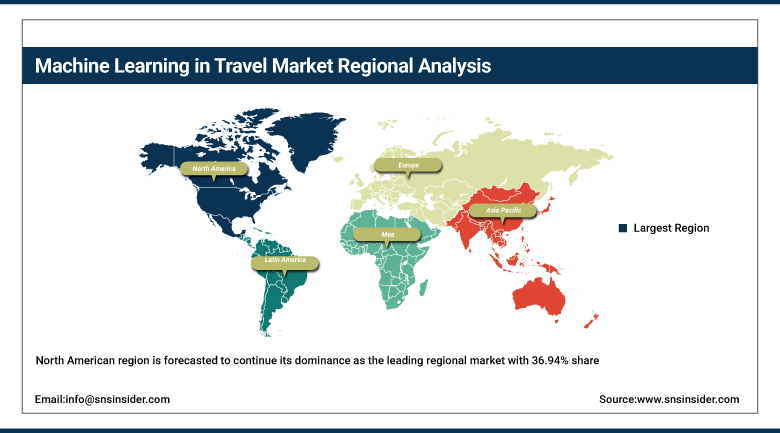
The North American region is forecasted to continue its dominance as the leading regional market for machine learning in the travel market during the forecast period between 2025 and 2035. The region had a 36.94% share of the global market in 2025 and has benefited significantly due to the adoption of technologies such as artificial intelligence, cloud computing, digital booking systems, and data analytics in the travel industry. The major market in the region is represented by the United States, which has major airlines, hotels, travel agencies, and online travel platforms operating in the region. Machine learning is anticipated to gain prominence due to its application in personalizing recommendations, dynamic pricing, forecasting of demand, fraud detection, and automation of customer service.
Get Customized Report as per Your Business Requirement - Enquiry Now
Europe Machine Learning in Travel Market Insights
Europe will continue to be a major market for machine learning in travel, owing to the rising digitalization of the travel and tourism industry, rising usage of online booking services, and investments in artificial intelligence and cloud technologies. This region held the global market in 2025. Germany is considered a major market in Europe due to its well-established tourism industry, airline and hospitality industries, and rising use of digital technology in customer engagement and operations.
Machine learning solutions are being widely used in the travel industry of Europe for providing personalized travel suggestions, revenue management, demand forecasting, fraud detection, and customer service automation among others. Furthermore, the rising trend of digitalization and the implementation of data-driven strategies are anticipated to drive the adoption of machine learning solutions.
Asia Pacific Machine Learning in Travel Market Insights
The Asia Pacific region will experience the highest growth rate amongst regional markets for machine learning in the travel sector during the forecast period, with its share rising from 28.16% in 2025 to 35.16% by 2035. Growth in the online booking portals, increased penetration of smartphones and the internet, rise in middle class travel demand, and accelerated digitalization are some of the key drivers facilitating regional growth.
China is the largest country market within the Asia Pacific region, due to its robust online travel booking market, domestic travel industry, and adoption of artificial intelligence. Some of the other countries contributing to the growth in the region include India, Japan, Australia, South Korea, and Southeast Asian countries, owing to increasing online travel bookings, digital payments, personalization of travel services, and customer engagement using artificial intelligence.
Middle East & Africa and Latin America Machine Learning in Travel Market Insights
Machine learning in the travel sector is likely to witness an increase in its adoption rate in the Middle East & Africa and Latin America regions owing to the rapid pace of digital transformation in the travel companies. The Middle East & Africa region holds the largest share of the global market in 2025, with Saudi Arabia being a significant market for machine learning in travel as a result of increased tourism infrastructure, digital transformation, and investments in smart travel technology.
Latin America also holds a considerable share of the global market in 2025, with Brazil being an important market for machine learning in travel owing to the large number of its tourism companies and increased online travel activities.
Growth Driver: Increasing adoption of digital travel platforms and AI-enabled services driving demand for machine learning in travel
The increasing prevalence of digital travel platforms, online booking services, and artificial intelligence is among the key drivers behind the increasing demand for machine learning technology in the travel industry. The travel industry is increasingly adopting machine learning technology in order to carry out real-time analysis of customers, generate personalized recommendations, forecast demands, carry out dynamic pricing, detect fraud, and offer automated customer services. Furthermore, the increasing amount of data of travelers that is being created using online booking, mobile apps, loyalty schemes, searching behavior, and digital payment systems has resulted in an increased demand for advanced analytics and intelligent decision-making technologies.
The increasing prevalence of cloud computing technology, natural language processing, and predictive analytics is contributing to the market growth. Besides, the increasing importance of personalized experience in the travel industry and efficiency is expected to boost adoption of machine learning.
Restraint: High implementation costs and complex integration with existing travel systems hinder machine learning adoption
High costs involved in the implementation process and complexity involved in the integration of machine learning technologies into the existing travel industry infrastructure may inhibit expansion of the market. The implementation of machine learning may involve investments in data infrastructure, cloud computing platforms, software, specialized knowledge, system integration, and maintenance, thus raising the cost of implementation.
This could be an obstacle to small travel agencies and individual hotels, which have limited budgets when it comes to implementing technological innovations. Furthermore, the integration of machine learning technologies with the existing legacy systems, such as reservation systems, CRM platforms, revenue management systems, payment infrastructure, as well as many other third-party travel services can increase the complexity. Other problems that may arise include data quality, security, privacy, compliance, and other concerns.
Opportunity: Growing adoption of generative AI, predictive analytics, and personalized travel experiences creates new market opportunities
The widespread use of analytics driven by AI, generative AI, and intelligent travel management services is providing ample growth opportunities for the global machine learning in travel market. Machine learning in travel solutions facilitate provision of personalized suggestions, customer interactions automation, demand prediction, pricing optimization, fraud detection, and increase efficiency. In addition to this, the rising use of AI chatbots, virtual assistants, recommendation systems, and predictive analytics in airlines, hotels, travel agents, and online travel portals will increase the addressable market size.
The availability of a huge volume of travel data in structured and unstructured forms is also opening up scope for more advanced machine learning solutions. Additionally, investments in cloud-based AI infrastructures and digital travel platforms are likely to create new opportunities for market players.
Recent Developments
-
2026: Huawei expanded its smart PV portfolio with advanced inverter and digital energy management capabilities, strengthening connected solar monitoring, grid support, and intelligent asset management.
-
2026: Sungrow continued expanding its smart inverter portfolio with advanced grid-forming and energy management capabilities, supporting connected solar installations and grid integration.
-
2026: SMA Solar Technology strengthened its smart solar inverter and energy management portfolio, supporting real-time monitoring, system optimization, and grid-interactive solar applications.
-
2026: Enphase Energy expanded its microinverter portfolio with advanced connectivity and monitoring capabilities, improving module-level performance tracking and intelligent energy management for solar installations.
Machine Learning in Travel Market Key Players:
-
Amazon.com Inc.
-
Microsoft Corporation
-
Accenture plc
-
International Business Machines Corporation
-
Oracle Corporation
-
Salesforce Inc.
-
SAP SE
-
Tata Consultancy Services Limited
-
NEC Corporation
-
Tencent Holdings Limited
-
Infosys Limited
-
DXC Technology Company
-
Expedia Group Inc.
-
Wipro Limited
-
Trip.com Group Limited
-
AMADEUS IT GROUP SOCIEDAD ANONIMA
-
LG CNS Co. Ltd.
-
Sabre Corporation.
Machine Learning in Travel Market Report Scope:
| Report Attributes | Details |
|---|---|
| Market Size in 2025 | USD 2.49 Billion |
| Market Size by 2035 | USD 11.32 Billion |
| CAGR | CAGR of 16.37% From 2026 to 2035 |
| Base Year | 2025 |
| Forecast Period | 2026-2035 |
| Historical Data | 2022-2024 |
| Report Scope & Coverage | Market Size, Segments Analysis, Competitive Landscape, Regional Analysis, DROC & SWOT Analysis, Forecast Outlook |
| Key Segments | • By Component (Software, Hardware, Services) • By Deployment Mode (On-Premises, Cloud, Cloud-Based, Hybrid, Others) • By Application (Personalized Recommendations, Dynamic Pricing, Fraud Detection, Customer Service, Predictive Analytics, Chatbots and Virtual Assistants, Demand Forecasting, Sentiment Analysis, Route Optimization, Other Applications) • By End-User (Travel Agencies, Airlines, Hotels & Resorts, Car Rental Companies, Online Travel Platforms, Other End-Users) |
| Regional Analysis/Coverage | North America (US, Canada), Europe (Germany, UK, France, Italy, Spain, Russia, Poland, Rest of Europe), Asia Pacific (China, India, Japan, South Korea, Australia, ASEAN Countries, Rest of Asia Pacific), Middle East & Africa (UAE, Saudi Arabia, Qatar, South Africa, Rest of Middle East & Africa), Latin America (Brazil, Argentina, Mexico, Colombia, Rest of Latin America) |
| Company Profiles | Amazon.com Inc.; Microsoft Corporation; Hitachi Ltd.; Accenture plc; International Business Machines Corporation; Oracle Corporation; Salesforce Inc.; SAP SE; Tata Consultancy Services Limited; NEC Corporation; Booking Holdings Inc.; Tencent Holdings Limited; Infosys Limited; DXC Technology Company; Expedia Group Inc.; Wipro Limited; Trip.com Group Limited; AMADEUS IT GROUP SOCIEDAD ANONIMA; LG CNS Co. Ltd.; Sabre Corporation. |
Frequently Asked Questions
The Machine Learning in Travel Market is expected to grow at a CAGR of 16.37% from 2026 to 2035.
The Machine Learning in Travel Market was valued at approximately USD 2.49 billion in 2025.
The market is driven by increasing adoption of digital travel platforms, growing use of artificial intelligence, personalized travel experiences, real-time data analytics, predictive demand forecasting, dynamic pricing, and automated customer service.
Software dominated the Machine Learning in Travel Market in 2025 with a 57.43% share.
North America dominated the Machine Learning in Travel Market in 2025 with a 36.94% share.
