
Silicone Fluids Market Report Scope & Overview:
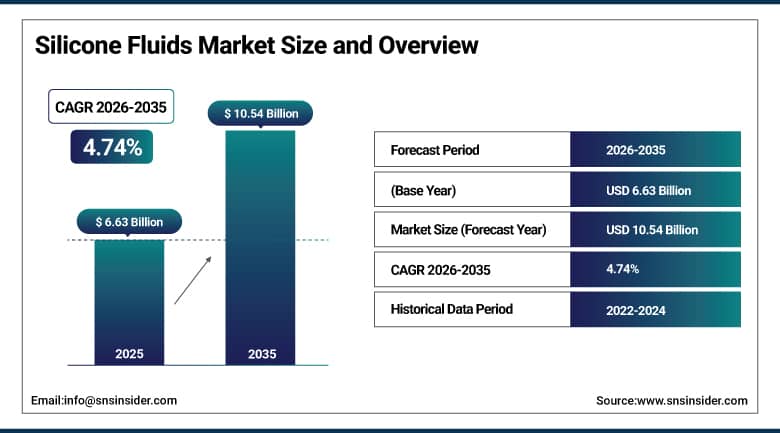
The Silicone Fluids Market was valued at USD 6.63 billion in 2025 and is expected to reach USD 10.54 billion by 2035, growing at a CAGR of 4.74% from 2026–2035.
Silicone Fluids Market has been showing steady growth due to the increasing popularity of silicone fluid-based products in diverse industries such as personal care, automotive, electronics, industrial manufacturing, and construction. The unique physical properties of silicone fluids, which include siloxane polymers with good thermal stability, minimal surface tension, hydrophobicity, high dielectric constant, and chemical resistance, have made silicone fluids popular among numerous uses. Silicone fluids are employed as skin emollients, lubricants, thermal fluids for battery cooling in electric vehicles (EVs), as well as insulators of advanced electronics devices. In addition, the rise in demand for electric cars will become one of the main factors driving the market forward since EVs require efficient cooling and lubricating of batteries and motors, which can only be provided using silicone fluids. Along with this, innovative silicone-based solutions, like 3D printed and self-healing silicones, can revolutionize the fields of biomedical implants and robotics.
In addition, the world’s leading silicone producers such as Shin-Etsu Chemical Co., Ltd., Dow, and Wacker Chemie AG have been devoting considerable resources toward R&D for the creation of advanced specialty silicone fluids that offer better environmental compatibility, broader functionality, and superior performance in various application sectors.
To Get More Information On Silicone Fluids Market - Request Free Sample Report
Silicone Fluids Market Trends
-
Faster adoption of silicone fluids for thermal management in electric vehicle batteries and power electronics cooling.
-
Higher demand for advanced silicone fluid products in personal care items like serums, conditioners, and color cosmetics due to their superior performance and durability.
-
Favorable development for specialty silicone fluids used as lubricants in industrial automation, robotics, and aerospace sectors.
-
Popularity of silicone fluid release and surfactant additives in food processing and pharmaceutical packaging businesses.
-
The invention of self-healing silicone fluids and silicone fluids that react to stimuli paving the way for innovation in areas like soft robotics and medical devices.
-
Environmental regulations compelling research into eco-friendly silicone fluids, such as bio-sourced, biodegradable, and PFAS-free silicone fluids.
-
Mergers and acquisitions by prominent Asian producers contributing to supply chain resilience and wider geographic coverage.
U.S. Silicone Fluids Market Size Outlook:
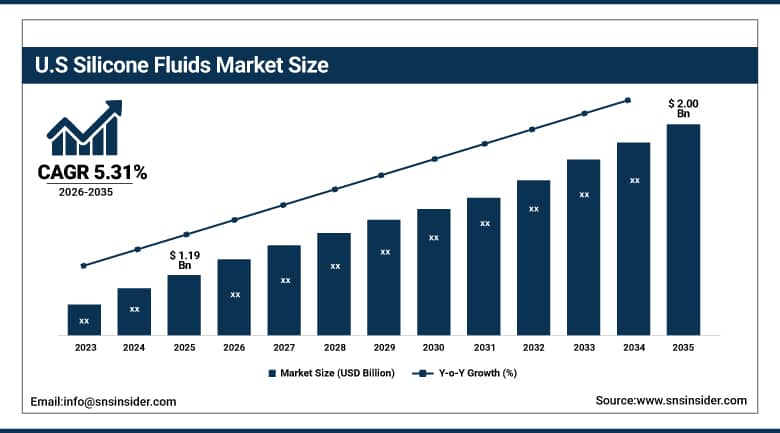
The U.S. Silicone Fluids Market was valued at USD 1.19 billion in 2025 and is expected to reach USD 2.00 billion by 2035, registering a CAGR of 5.31% during 2026–2035.
In 2025, the USA had the largest national market share in the world’s silicone fluids market because of its highly advanced industrial infrastructure, state-of-the-art manufacturing plants, and growing demand from high-end end-user industries such as personal care products, automobiles, healthcare sector, and electronics industry. Two of the topmost companies operating in the silicone industry at the global level are Dow and Momentive Performance Materials, which operate in the USA on a large scale. The use of electric vehicles by the US automobile giants including Ford, GM, and Tesla is increasing the demand for silicone fluids used in thermal management in their battery packs and electronics cooling systems.
American government initiatives for advancing manufacturing, promoting sustainable research and development, and encouraging clean energy transition are also driving demand for premium silicone fluids. Existing regulations for food-grade and medical-grade silicone fluids formulated by the FDA, along with patent protection for advanced silicone innovation, makes the United States one of the leading markets for specialty silicone fluids until 2035.
Silicone Fluids Market Segment Insights
-
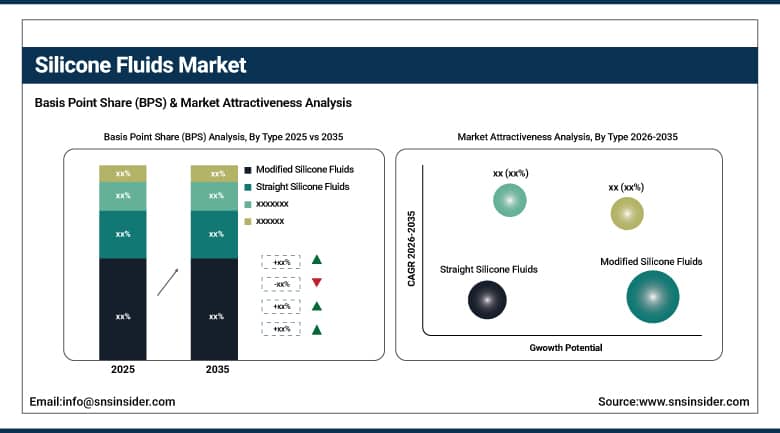
According to Type, the largest market share (~66%) in 2025 was captured by Modified Silicone Fluids, and the most prominent CAGR segment was Straight Silicone Fluids due to the increasing requirement in the industry.
-
In terms of End-Use Industry, the Personal Care & Beauty segment captured the highest market share (~24%) in 2025, while Automotive & Transportation was the fastest-growing segment due to the growing need in electric vehicles.
By Type, Modified Silicone Fluids segment dominates the Silicone Fluids Market, Straight Silicone Fluids segment expected to grow fastest
The Modified Silicone Fluids segment was the leading contributor to the market revenue and held the majority market share in the year 2025. Clearly, there is high popularity and a preference for these modified silicone fluids since they are superior to other silicone fluids, owing to their higher thermal stability, lubricity, compatibility with organic compounds, and viscosity levels. The modified silicone fluids have proven to be superior in skin care products and hair care products owing to their superior spreadability, conditioning ability, and skin feel. On the other hand, these silicones are used in damping fluids, lubricating oils, and heat transfer fluids owing to their high temperature tolerance and oxidation resistance in the automobile industry.
Straight Silicone Fluids are estimated to exhibit the highest CAGR during 2026-2035, mainly attributable to rising usage in thermal management systems for EVs, industry lubricants, and thermally conductive interfaces for electronics. Straight silicone fluids, including PDMS fluids in particular, provide a proven and inexpensive basis for reliable performance, especially for applications demanding consistency in their dielectric properties and thermal conductivity. With the increasing manufacturing of EVs worldwide, there will be considerable demand for straight silicone fluids in battery cooling and thermal management systems for power inverters and on-board chargers.
By End-Use Industry, Personal Care & Beauty segment dominates the Silicone Fluids Market, Automotive & Transportation segment expected to grow fastest
Personal Care & Beauty dominated the Silicone Fluids market in 2025. Silicone fluids, including cyclopentasiloxane, dimethicone, and phenyl trimethicone versions of the fluids, have diverse applications across the production of moisturizing skincare products, hair conditioners, serums, shampoos, antiperspirants, and color cosmetics due to their emollient properties, better spreading ability, improved shine, and superior moisture retention capabilities. The worldwide trend of premiumization in personal care products, alongside increasing consumer awareness regarding the advantages of skin care offered by silicones, drives growth in the segment. There is an upward shift toward silicone-containing products for performance-oriented results.
The Automotive & Transportation industry is anticipated to grow at the highest CAGR between 2026 and 2035 owing to the rapid shift of the world towards electric vehicles, as well as an increased utilization of silicone fluids in modern automotive thermal management systems. While in traditional automobiles silicone fluids act as specialized lubricants, damping oils, and sealants in the engine and transmission system, their application in electric cars has been extended significantly due to their usage in dielectric heat transfer fluids in immersion and cold plate systems used to cool EV batteries, inverters, and DC fast chargers. Given the global rise in EV production to tens of millions annually, the automotive industry offers the greatest potential for silicone fluid producers.
Regional Analysis:
|
Region |
Major Country |
Share within Region 2025 (%) |
|---|---|---|
|
North America |
United States |
~79.00% |
|
Europe |
Germany |
~31.00% |
|
Asia Pacific |
China |
~52.00% |
|
Middle East & Africa |
UAE |
~35.00% |
|
Latin America |
Brazil |
~52.00% |
Asia Pacific Silicone Fluids Market Insights
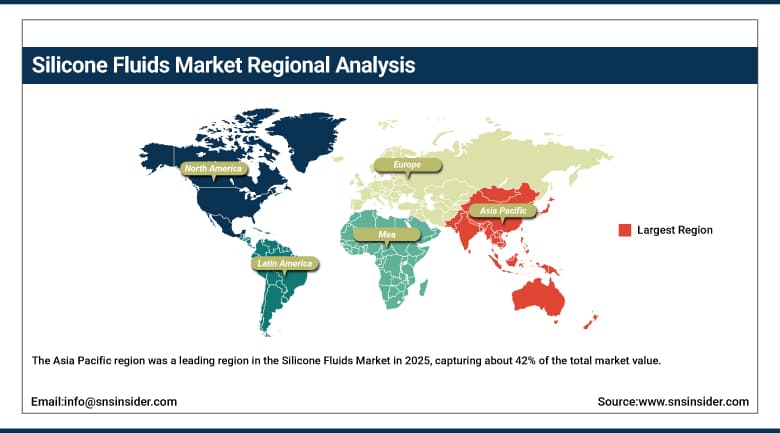
The Asia Pacific region was a leading region in the Silicone Fluids Market in 2025, capturing about 42% of the total market value. The dominance of the region in the Silicone Fluids market stems from the rapid rate of industrialization in the region, increase in manufacturing of automobiles and electronics, and increasing consumption of personal care products especially in China, India, Japan, and South Korea. China has emerged as the leading producer and consumer of silicone fluids in the world, due to the existence of several large local players including the Dongyue Group, Bluestar Silicones, and Hengye Silicone, as well as large-scale production facilities belonging to leading international players. The fast-evolving electric vehicle industry in the region, spearheaded by local brands including BYD and CATL, is expected to create strong incremental demand for premium silicone heat transfer fluids.
Get Customized Report as Per Your Business Requirement - Enquiry Now
North America Silicone Fluids Market Insights
With respect to growth potential, it is believed that North America would witness the highest CAGR compared to the rest of the regions during the forecast period from 2026 to 2035 due to advancements in silicone fluid technology, rising demand from medical devices and automotive applications, and extensive research & development activities by leading companies operating in the region. The United States will be the major market, mainly driven by the presence of prominent local producers like Dow and Momentive, besides rising demand from end-use applications such as personal care products, medical products, aerospace, and electronic devices. Increased production of electric vehicles in the country due to various measures including the Inflation Reduction Act will drive the demand for silicone thermal fluids in coming years.
Europe Silicone Fluids Market Insights
In 2025, Europe accounted for a considerable portion of the Silicone Fluids market, with the major nations being Germany, France, and the United Kingdom. Europe's market for silicone fluids has been characterized by robust demand from industries such as automotive, chemical processing, pharmaceuticals, and advanced materials. Wacker Chemie AG of Germany is one of the largest suppliers of silicone products globally and operates at the center of the European market for silicone fluids. The European Union's REACH policy and the sustainability push in chemical production are currently influencing product innovation towards silicone formulations that cause minimal environmental harm. The strong automotive industry of Europe – especially Germany, France, and Sweden – remains a key demand generator for premium silicone lubricants and heat transfer fluids.
Middle East & Africa and Latin America Silicone Fluids Market Insights
Although the Middle East and Africa, as well as the Latin American regions, still enjoy early stages of market development for silicone oils, they demonstrate steady growth due to the development of industries, construction, investments into infrastructure, and consumer markets. As for the Middle East and Africa, the growing construction activities, petrochemical sectors, and increasing personal care products consumption are among major factors stimulating demand for silicone oils. UAE and Saudi Arabia account for the leading positions in the use of the product owing to their industrial diversification plans, which are in line with the country’s Vision 2030 program. The dominant player in Latin America is Brazil thanks to the strong consumer goods market, vehicle production, and growing construction industry there.
Market Dynamics
Growth Drivers: Increasing demand for high-performance silicone fluids in automotive and electronics sectors, fueled by EV transition
The key growth drivers for the Silicone Fluids market include the increasing need for advanced thermal management and insulation materials in the automotive industry and electronics industry, driven by the growing trend towards electric vehicles globally. The electric vehicle battery pack, power inverters, on-board charger systems, and DC fast charging technologies necessitate efficient heat transfer fluids that can operate effectively within a wide temperature range and still remain non-conductive and chemically stable. Silicone heat transfer fluids and silicone dielectric coolant fluids are gradually gaining recognition as an excellent choice for such thermal management applications due to their thermal stability and wide operating temperature range. Major automobile companies and tier-one automotive suppliers have started qualifying silicone fluids for use in immersion-cooling systems and cold plate-based battery thermal management systems, thus opening up significant opportunities for growth in the Silicone Fluids market.
Moreover, the shift towards more powerful processors and the growing adoption of 5G technology and advanced data centers for better thermal management systems in the electronics industry also presents significant opportunities for growth in the Silicone Fluids market. Data from industry sources show that silicone fluids exhibit much less viscosity change over temperature ranges than mineral oil fluids.
Restraints: Elevated raw material costs and evolving environmental regulations limiting margin flexibility and market expansion
The Silicone Fluids market faces a notable constraint in the form of high fluctuations and inherent elevations in the prices of key raw materials, especially silicon metal and methyl chloride, which serve as the main starting materials for silicone polymer production. The manufacturing process of silicone is highly capital intensive and energy intensive, meaning that input prices will be heavily influenced by international dynamics in the cost of silicon metal and energy. The result could be thin profit margins, especially in commodity grades of silicone fluids due to intense pricing pressure. Moreover, rising concerns over environmentally unfriendly cyclic siloxanes such as D4 and D5 among regulators in Europe and elsewhere necessitates product reformulation and limits certain types of silicone technology in wash-off personal care products.
Opportunities: Expanding applications in renewable energy systems, EV immersion cooling, and sustainable silicone formulations
The growing usage of silicone fluids in renewable energy systems and electric vehicles' thermal management systems is another high-potential opportunity for market players until 2035. Solar energy systems incorporate silicone heat transfer fluids in concentrated solar power (CSP) plants due to their stability at elevated temperatures. Silicone lubricants can provide exceptional performance at low temperatures and long service life in comparison with regular mineral oils in wind energy systems, resulting in decreased maintenance expenses and increased wind turbine reliability. Creating bio-based and partially bio-derived silicone fluids opens another growth avenue as sustainability-focused brand owners in personal care, food, and industrial product markets are ready to purchase products at higher prices if these have enhanced environmental credentials. The manufacturers that will manage to commercialize silicone fluid alternatives with equivalent performance properties will be able to claim a share in these premium, sustainability-oriented market niches.
Recent Developments:
-
April 2025: German-based Gerresheimer launched its PFAS-free, silicone oil-free prefillable syringes featuring better safety characteristics, including particle load reduction and minimal risks associated with silicone oils for drugs in the biologics and ophthalmic categories - an important milestone for the pharmaceutical industry which is increasingly aiming to avoid silicon fluid contact with highly sensitive drug formulas.
-
April 2025: In India, scientists have invented eco-friendly hydrophobic paper coatings based on silicon oil-filled nano-silica particles with recyclable qualities, presenting a sustainable packaging solution to plastic coatings used widely today - a discovery with huge potential in food and consumer goods packaging.
Silicone Fluids Market Key Players
-
Dow
-
Wacker Chemie AG
-
Shin-Etsu Chemical Co., Ltd.
-
Momentive Performance Materials Inc.
-
Elkem ASA
-
KCC Corporation
-
Evonik Industries AG
-
BRB International
-
Siltech Corporation
-
Gelest Inc.
-
CHT Group
-
Bluestar Silicones
-
Supreme Silicones India Pvt. Ltd.
-
Iota Silicone Oil (Anhui) Co., Ltd.
-
Dongyue Group
Silicone Fluids Market Report Scope:
| Report Attributes | Details |
|---|---|
| Market Size in 2025 | USD 6.3 Billion |
| Market Size by 2035 | USD 10.54 Billion |
| CAGR | CAGR of 4.74% From 2026 to 2035 |
| Base Year | 2025 |
| Forecast Period | 2026-2035 |
| Historical Data | 2022-2024 |
| Report Scope & Coverage | Market Size, Segments Analysis, Competitive Landscape, Regional Analysis, DROC & SWOT Analysis, Forecast Outlook |
| Key Segments | • By Type (Straight Silicone Fluids, Modified Silicone Fluids) • By End-Use Industry (Personal Care & Beauty, Textiles, Automotive & Transportation, Industrial, Building & Construction, Others) |
| Regional Analysis/Coverage | North America (US, Canada), Europe (Germany, UK, France, Italy, Spain, Russia, Poland, Rest of Europe), Asia Pacific (China, India, Japan, South Korea, Australia, ASEAN Countries, Rest of Asia Pacific), Middle East & Africa (UAE, Saudi Arabia, Qatar, South Africa, Rest of Middle East & Africa), Latin America (Brazil, Argentina, Mexico, Colombia, Rest of Latin America). |
| Company Profiles | Dow, Wacker Chemie AG, Shin-Etsu Chemical Co., Ltd., Momentive Performance, Materials Inc., Elkem ASA, KCC Corporation, Evonik Industries AG, BRB International, Siltech Corporation, Gelest Inc, CHT Group, Bluestar Silicones, Supreme Silicones India Pvt. Ltd., Dongyue Group |

Frequently Asked Questions
Dow, Wacker Chemie AG, Shin-Etsu Chemical Co., Ltd., Momentive Performance Materials Inc., Elkem ASA, KCC Corporation, Evonik Industries AG, BRB International, Siltech Corporation, and Gelest Inc.
Expanding applications in EV thermal management, renewable energy systems, and sustainable silicone formulations offer major opportunities.
Increasing demand for high-performance silicone fluids in automotive and electronics, particularly for EV thermal management systems, is a major growth factor.
Modified Silicone Fluids dominated the Type segment with approximately 66% share, while Personal Care & Beauty dominated the End-Use Industry segment with approximately 24% share in 2025.
Asia Pacific dominated the Silicone Fluids Market in 2025 with approximately 42% global market share.
