
Smart Bathroom Market Size & Growth:
The Smart Bathroom Market size was valued at USD 9.48 billion in 2024 and is expected to reach USD 25.10 billion by 2032 and grow at a CAGR of 13.0% over the forecast period 2025-2032.
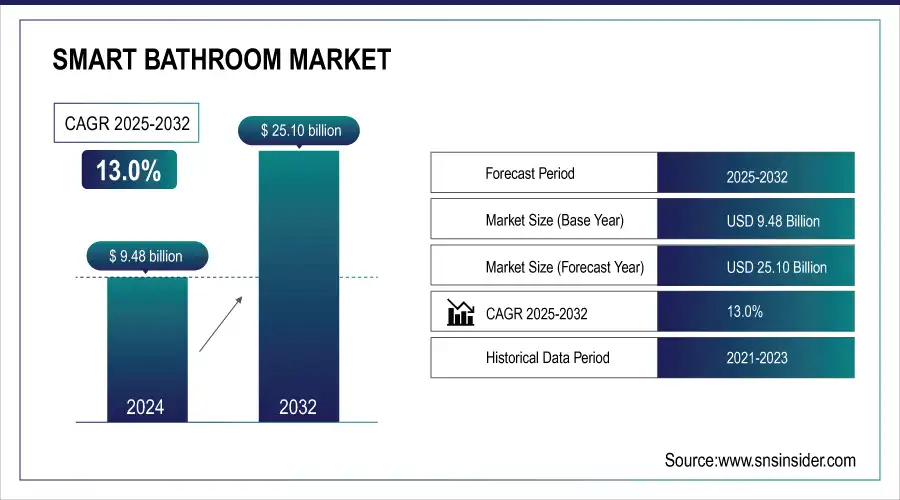
To Get more information On Smart Bathroom Market - Request Free Sample Report
The smart bathroom market is expanding at a rapid pace, on account of the growing requirement for automated and energy-efficient home solutions. The Internet of Things and smart home devices, such as smart toilets, faucets, and mirrors, are enhancing user experience and well-being with comfort, hygiene, and sustainability features. It is riding the tide of urbanisation, increasing disposable incomes, and increasing consciousness related to water conservation. Manufacturers are adding bells and whistles and paying more attention to design, and people who are buying want luxury and convenience.
According to a study, in January 2025, the luxury smart bathroom products market was gaining traction among wealthy Indian consumers, the report said. Even with obstacles, such as pervasive open defecation, sales of high-end fixtures, ranging from USD 18,500 smart toilets to high-tech faucets, soared. Companies like Kohler, Toto, and Hansgrohe scaled up in India, opening new showrooms and ramping up production to cater to a growing appetite for automatic, hygienic, and eco-friendly bathroom solutions.
The U.S. smart bathroom market size was USD 2.25 billion in 2024 and is expected to reach USD 5.17 billion by 2032, growing at a CAGR of 10.97% over the forecast period of 2025–2032.
The U.S. smart bathroom market is gaining momentum with smart home technology being in the spotlight as consumers prefer health, convenience, and environmentally friendly behavior while building and decorating their homes. Smart toilets, sensor-activated faucets, and voice-controlled mirrors are increasingly standard features in the most modern of bathrooms, especially in tech-forward urban areas. Introduction of smart bathroom experiences in luxury hotels, such as the Lake Nona Wave Hotel in Orlando, which has luxe, intelligent fixtures in its rooms to provide an over-the-top guest experience.
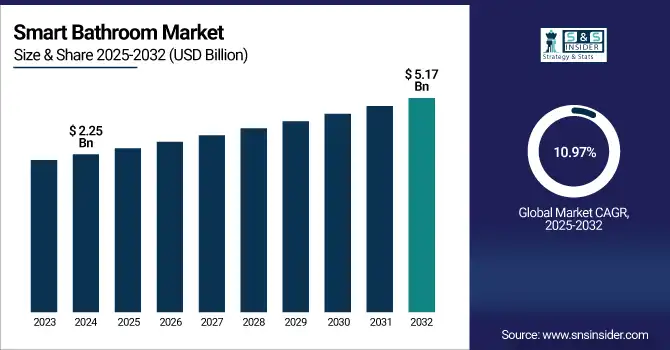
Smart Bathroom Market Dynamics:
Key Drivers:
-
Technological Advancements and Innovation in Smart Devices Fueling Growth in the Smart Bathroom Market
The smart bathroom market growth has experienced vigorous development owing to the rapid technological advancements and the advent of novel smart equipment. Recent years have seen the emergence of bathroom products like smart toilets, automatic showers, intelligent lighting, and water-efficient faucets that have put a new spin on the tired old bathroom experience. These improvements all serve to further enhance the convenience, durability, and comfort of the chairs. Intelligent toilets with self-cleaning, automatic temperature, and infrared-based motion detection are just a few examples of products that improve sanitation while reducing energy.
A company unveiled a collection of smart mirrors with voice-activated lighting and health readings in March 2025, furthering the products available from the innovative world of smart bathrooms. An increased focus on high-tech solutions comes from consumer demand for better performance, energy efficiency, and personalization.
Restraints:
-
High Initial Cost and Installation Complexity of Smart Bathroom Systems Limit Market Adoption
The smart bathroom demand is hampered by high initial cost and installation complications. Some smart bathroom gadgets, such as smart toilets, showers, and sensors, are cutting-edge tech with a prohibitively expensive price tag for much of the market. Furthermore, the modifications of such systems to the existing bathroom installations could be infeasible for several users. This is especially true in developing areas where cost and technical know-how are huge hindrances.
Opportunities:
-
Growing Focus on Water Conservation in Smart Bathroom Solutions Drives Market Growth
The market is driven by a growing focus on water conservation and sustainability, offering innovative solutions for eco-friendly living. As water stress takes hold across the globe, sustainability-minded consumers and businesses are focusing on the environmentally friendly options that can save on water usage. Simple devices that can be used to save water in bathrooms include water-saving heads, sensors, and dual-flush systems, along with water-saving showerheads, faucets with auto shut-off technology, dual-flush toilets, and so on. With the increasing relevance of sustainability, this is an attractive growth opportunity for players in the market.
In April 2025, A leading manufacturing company introduced an innovative smart-shower with smart sensors, features adjusting water flow according to actual usage profile, resulting in less water wastage. The added energy-saving features included in these appliances help to not only save on water, but also to help reduce utility bills, which is an added draw to the environmentally responsible consumer.
Challenges:
-
Integration Challenges with Smart Home Devices Hinder Seamless Functionality and Slow Adoption in the Smart Bathroom Market
A smart bathroom is the latest innovation in the wellness room. Most smart bathroom products work best when connected to smart home ecosystems, including Google Home, Amazon Alexa, or Apple HomeKit. But cross-support between devices of competing manufacturers tends to be such a mess that it can lend itself to functional limitations, if not a series of disjointed user experiences. For instance, a smart shower system may not co-function well with a smart mirror or a networked water heater, and consumers cannot control multiple devices in one interface. It not only annoys users but also prevents smart bathroom products from reaching popularity. Manufacturers must overcome these technical obstacles and establish more broadly applicable standards for the integration of smart home devices to ensure a seamless, integrated experience for consumers, one of the biggest hurdles the industry still faces.
Smart Bathroom Market Segmentation Outlook:
By Product
Smart toilet is the largest product segment, accounting for 29% of the revenue market share in 2024. A smart toilet includes advanced features, such as self-cleaning, heated seats, bidet functions, and automatic flushing, which offer enhanced hygiene, comfort, and the largest water savings. Companies including Toto and Kohler have released models, such as the Toto Neorest 750H and Kohler’s Numi 2.0, with integrated voice controls, smart sensors, and custom profiles. The increasing attention on sanitization and green bathroom options is proving a turbocharger for this segment, thereby augmenting sales in the global smart bathroom market analysis by adding to its consumer appeal through the comfort factor, environmental sustainability, and cutting-edge technologies.
The smart faucets segment is projected to grow at the fastest pace, with a CAGR of 16.2% during 2025-2032. Fitted with automation flow control, temperature regulation, and water conservation features including motion sensors and no-touch technology, these faucets. Companies, such as Moen and Delta, offer models such as the Moen U by Moen Smart Faucet and Delta’s Touch2O that provide touchless activation and allow precise control of the water temperature. All these features are in line with the growing demand for efficiency and sustainability in the bathroom and position the smart faucet as an indispensable part in the burgeoning smart bathroom market trends.
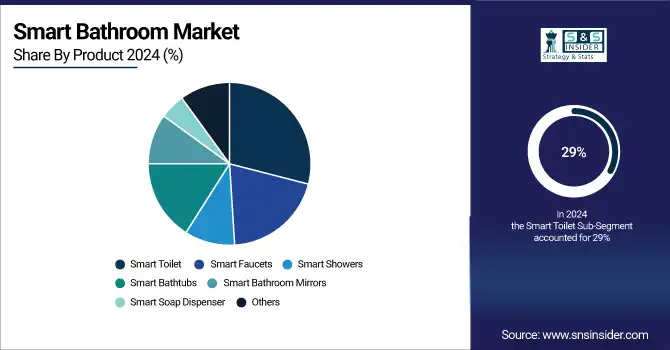
By Application
Business is the major segment, which accounted for 61% of the revenue in 2024, the market in terms of revenue, which covers hotels, restaurants, office buildings, and others. Commercial environments require high-tech, long-lasting, and low-maintenance products, such as touchless faucets, smart toilets, and hands-free soap dispensers to promote better hygiene and more efficient operation. Major companies, including American Standard and Kohler, have introduced products, with labor-saving, water-saving abilities as well. The commercial sector continues to lead as more facilities shift toward automation and hygiene innovation in public spaces.
The residential segment is anticipated to register the fastest CAGR of 15.5% during the estimated timeframe. Homeowners are also adopting smart bathroom tech, such as smart toilets, mirrors, and faucets that will make your bathroom more comfortable, convenient, and environmentally friendly than ever. Brands including Moen, Kohler, and Hansgrohe are bringing in sophisticated systems, such as Moen’s Smart Shower and Kohler’s Verdera Voice Lighted Mirror, which respond to voice commands and feature programmable settings. The expansion of the residential segment in the overall market can be attributed to growing smart home adoption and consumer demand for energy-efficient and premium bathroom solutions.
Smart Bathroom Market Regional Analysis:
North America is expected to hold the dominant smart bathroom market share in 2024, holding a significant market share of around 39%. Quick acceptance of smart home technologies and high consumer spending on bathroom renovations fuel the Market growth in North America. The U.S. is the leading country due to the rapid adoption of advanced technologies, rising demand for home automation, and a strong consumer preference for eco-friendly and luxurious bathroom solutions. Consumer demand for enhanced comfort and convenience is driving growth in this region.
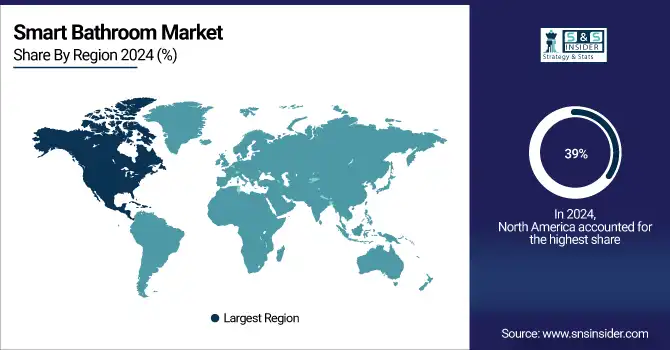
Get Customized Report as per Your Business Requirement - Enquiry Now
The Asia Pacific region is the fastest-growing market for smart bathrooms, with an estimated CAGR of around 17% during the forecasted period. Urbanization, rising nonrefundable incomes, and government initiatives endorsing smart infrastructure accelerate the market expansion across Asia-Pacific. China and Japan lead the market due to rapid development, rising disposable income, and increasing demand for energy-efficient and sustainable products. China, in particular, is witnessing a surge in demand for smart bathrooms driven by government initiatives promoting green building technologies.
In 2024, Europe continues to be a prominent player in the market, with Germany leading the region. Increasing demand for sustainable and water-efficient housing solutions across Europe drives the Market growth amid eco-conscious consumer preferences. Germany's robust economy, strong consumer demand for energy-efficient products, and the increasing trend toward home automation contribute significantly to the market's growth. Environmental concerns, alongside a preference for advanced bathroom technologies, fuel the market in this region, making it a key contributor to the smart bathroom sector.
In 2024, the Middle East and Africa region, led by the UAE, is seeing steady growth in the market due to rising demand for luxury real estate and smart home technologies, particularly in Dubai. Smart bathroom solutions are key in high-end residential and commercial projects, supported by government sustainability initiatives. Similarly, Latin America, with Brazil as the dominant country, is gradually adopting smart bathroom technologies driven by increasing urbanization and demand for energy-efficient solutions. Despite cost constraints, the region’s growing middle class is contributing to market growth.
Key Players:
The smart bathroom market companies are Jacuzzi Brands, LLC, Villeroy & Boch AG, Signature Hardware (Ferguson Enterprises, LLC), Pfister (Spectrum Brands, Inc.), Kraus USA Plumbing LLC, Delta Faucet Company, Moen Incorporated, Kohler Co., Duravit AG, Roca Sanitario, S.A., and others.
Recent Developments:
-
In 2024, Jacuzzi Brands rolled out a new line of intelligent toilets that feature functionality, such as automatic flushing, heated seats, and built-in bidets. These advancements meet the increasing consumer need for greater comfort and hygiene in the bathroom. It is seen as another confident step by Jacuzzi as it progresses towards its goal of rolling out smart technologies across its products in the bathroom.
-
In March 2024, Ideal Standard was taken over by Villeroy & Boch, boosting its smart bathroom offerings considerably. This acquisition positioned Villeroy & Boch for further expansion in European and international markets and bolstered the company's presence in the smart bathroom market, in line with growing customer demand in the area of networked and intelligent solutions for the bathroom.
| Report Attributes | Details |
|---|---|
| Market Size in 2024 | USD 9.48 Billion |
| Market Size by 2032 | USD 25.10 Billion |
| CAGR | CAGR of 13.0% From 2025 to 2032 |
| Base Year | 2024 |
| Forecast Period | 2025-2032 |
| Historical Data | 2021-2023 |
| Report Scope & Coverage | Market Size, Segments Analysis, Competitive Landscape, Regional Analysis, DROC & SWOT Analysis, Forecast Outlook |
| Key Segments | • By Product (Smart Toilet, Smart Soap Dispenser, Smart Faucets, Smart Showers, Smart Bathroom Mirrors, Smart Bathtubs, and Others) • By Application (Residential, Commercial [Hotels & Restaurants, Gyms, Spa & Wellness Centers, and Others]) |
| Regional Analysis/Coverage | North America (US, Canada, Mexico), Europe (Germany, France, UK, Italy, Spain, Poland, Turkey, Rest of Europe), Asia Pacific (China, India, Japan, South Korea, Singapore, Australia, Rest of Asia Pacific), Middle East & Africa (UAE, Saudi Arabia, Qatar, South Africa, Rest of Middle East & Africa), Latin America (Brazil, Argentina, Rest of Latin America) |
| Company Profiles | Jacuzzi Brands, LLC, Villeroy & Boch AG, Signature Hardware (Ferguson Enterprises, LLC), Pfister (Spectrum Brands, Inc.), Kraus USA Plumbing LLC, Delta Faucet Company, Moen Incorporated, Kohler Co., Duravit AG, Roca Sanitario, S.A., and others. |