
Smart Bathroom Market Report Scope & Overview:
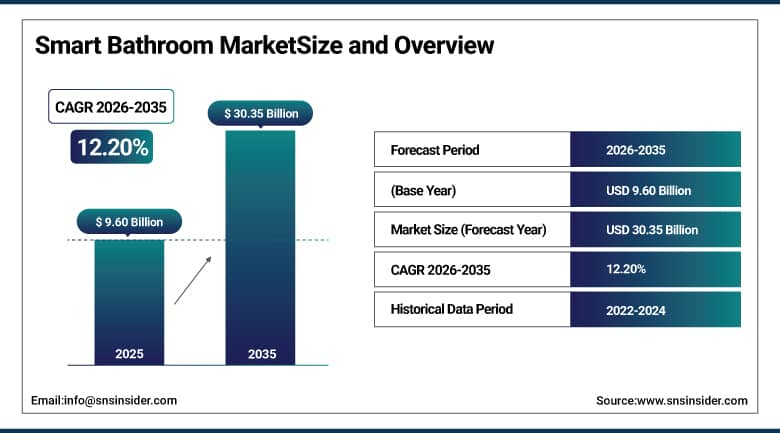
The Smart Bathroom Market size was valued at USD 9.60 Billion in 2025 and is expected to reach USD 30.35 Billion by 2035, growing at a CAGR of 12.20% from 2026-2035.
Smart Bathrooms Market includes intelligent and sensorized bathroom devices including smart toilets and bidet seats, electronic showers, touchless faucets, smart mirrors and bathtubs capable of altering temperature, conserving water, cleaning itself and learning its user’s preferences. The driving forces for the market include the renovation of bathrooms by the homeowners, the need for hygiene and reduced water consumption in hotels and office premises, and requirement for accessible and safety-friendly bathroom devices in care homes. It was Japan and South Korea which developed shower toilets first, followed by North America and Europe which are now accepting this technology due to the same reasons.
⮞In February 2026, Kohler introduced the Anthem EvoCycle Smart Shower, a recirculating system that can save up to 80% of water while keeping full flow. In Cycle mode, the shower mixes recirculated water with 0.5 gallons of fresh water and passes it through a filter in the shower base, and an ozone Rapid Clean cycle runs after every use. Users control temperature, cleaning and water goals through a digital controller or the Kohler Konnect app, and the system was shown at KBIS 2026 in Orlando.
To Get More Information On Smart Bathroom Market - Request Free Sample Report
Smart Bathroom Market Trends
-
Recirculating and water-saving showers and fixtures
-
Wider adoption of smart toilets with bidet, heated seat and self-cleaning functions
-
App and voice control with personalized user profiles
-
Touchless sensors in commercial and public restrooms
-
Connected mirrors, lighting and health monitoring in bathrooms
-
Lower-priced smart toilets that broaden the buyer base
U.S. Smart Bathroom Market Size Outlook
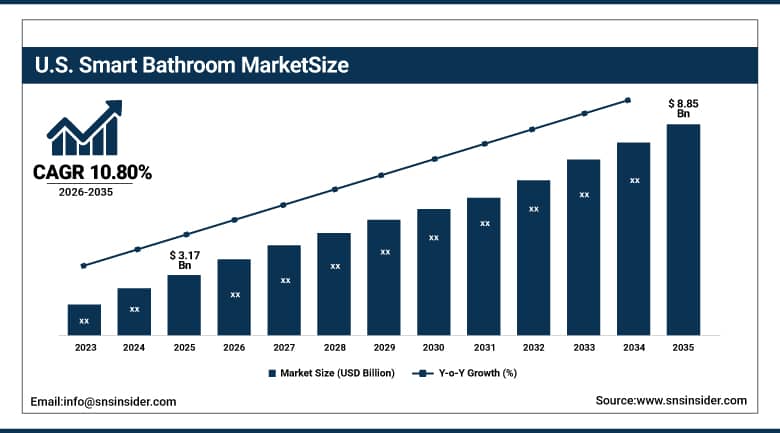
The U.S. Smart Bathroom Market was valued at USD 3.17 Billion in 2025 and is expected to reach USD 8.85 Billion by 2035, growing at a CAGR of 10.80% from 2026-2035.
The U.S. Smart Bathroom Market is the largest national market in the world for connected bathroom products outside East Asia, supported by large renovation spending, high smart home ownership and growing interest in bidet toilets. Kohler, Moen, Delta, TOTO, American Standard and LIXIL compete through plumbing wholesalers, home improvement retailers, designers and online channels. Water efficiency standards such as EPA WaterSense, accessibility rules under the ADA and rising water costs in drought-prone states influence purchases. Hotels, hospitals and offices install touchless fixtures to improve hygiene, while homeowners adopt heated, self-cleaning toilets as an upgrade.
⮞In July 2026, TOTO opened orders for the WASHLET G5A Lite integrated smart toilet, with shipping starting August 3, 2026. The all-in-one unit combines bowl, bidet seat and plumbing connections, with touchless lid, auto flush, instantaneous water heating, electrolyzed water mist cleaning, a warm air dryer and a remote that stores up to four user profiles. It is ADA compliant at universal height, targeting U.S. homeowners and builders who want a smart toilet without matching separate components.
Smart Bathroom Market Segment Analysis
-
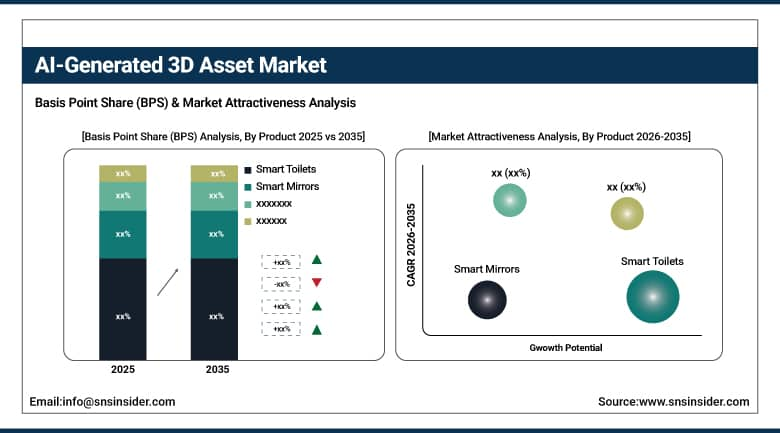
By Product, the Smart Toilets segment dominated the Smart Bathroom Market with approximately 38.00% share in 2025, while the Smart Mirrors segment is the fastest growing with a CAGR of approximately 15.80%.
-
By Technology, the Sensor-Based segment dominated the Smart Bathroom Market with approximately 38.00% share in 2025, while the Voice-Controlled segment is the fastest growing with a CAGR of approximately 16.20%.
-
By Connectivity, the Wi-Fi segment dominated the Smart Bathroom Market with approximately 46.00% share in 2025, while the Bluetooth segment is the fastest growing with a CAGR of approximately 14.00%.
-
By End-Use, the Residential segment dominated the Smart Bathroom Market with approximately 54.00% share in 2025, while the Healthcare Facilities segment is the fastest growing with a CAGR of approximately 14.20%.
-
By Distribution Channel, the Offline segment dominated the Smart Bathroom Market with approximately 62.00% share in 2025, while the Online segment is the fastest growing with a CAGR of approximately 14.60%.
By Product, Smart Toilets Dominates the Smart Bathroom Market and Smart Mirrors Grows Fastest
Smart toilets lead because they combine hygiene, comfort and water efficiency in one product and have a long history in Japan and South Korea. Features include bidet washing, heated seats, warm air drying, automatic lids, self-cleaning bowls and personalized settings. Kohler's expanded Leap collection and TOTO's WASHLET line cover premium and lower-priced options, and independent estimates put smart toilets at roughly 35% to 43% of market revenue. Higher unit prices and rising replacement of standard toilets keep the segment on top.
Smart mirrors are growing fastest because they add lighting control, displays, voice assistants and health or skincare features to a product every bathroom already has. Anti-fog heating, adjustable color temperature and app connectivity are becoming common, and hotels and luxury homes install them as design statements. Lower entry prices and compatibility with smart home platforms widen the buyer base. The segment starts from a smaller base than toilets, so double-digit growth is expected as awareness and availability rise.
By Technology, Sensor-Based Dominates the Smart Bathroom Market and Voice-Controlled Grows Fastest
Sensor-driven systems dominate the market because the availability of motion, presence, and temperature sensors allows for touch-free systems of flushing, faucets, lighting, and heating to be installed inexpensively and reliably. Moreover, these devices are hygienic and minimize water usage, which makes them suitable for both domestic and commercial properties. The users do not have to learn how to use sensors and do not require an internet connection, which increases confidence in installing sensors. Almost all smart bathroom devices from automatic flush toilets to temperature-controlled showers rely on sensors, which makes this segment account for about 38%.
The voice-controlled devices are gaining popularity rapidly since voice assistants are already common in households. The voice technology allows to activate a shower at a certain temperature, control lightings of the mirrors or ask for a bidet program without touching anything, which is very helpful both for people who cannot use some controls and for maintaining hygiene. At the moment, voice assistants are incorporated into showers, mirrors, and toilets, and privacy and reliability are still major issues.
By Connectivity, Wi-Fi Dominates the Smart Bathroom Market and Bluetooth Grows Fastest
Wi-Fi leads because it supports remote control, firmware updates, usage tracking and integration with smart home platforms. Products such as connected showers and mirrors rely on home networks to run apps like Kohler Konnect, and Wi-Fi also lets commercial operators monitor water use and maintenance across many fixtures. Reliable coverage in modern homes and building management systems makes it the default choice for higher-priced products.
Bluetooth is growing fastest because it is cheap, works without a network and pairs easily with phones for local control. Smart toilet seats, faucets and mirrors use it for presets and diagnostics, and it suits rental properties and bathrooms where Wi-Fi is weak. Lower-priced products that target first-time buyers often rely on Bluetooth, and its low power use suits battery devices. Growth is supported by the spread of lower-cost models.
By End-Use, Residential Dominates the Smart Bathroom Market and Healthcare Facilities Grows Fastest
Residential remains dominant as most of the smart bathroom devices are used in residential premises through renovations and new constructions. The residents seek comfort, cleanliness, water efficiency and resale value, while increased disposable income in Asia Pacific and active remodeling in North America will fuel sales. Bidet toilet and smart shower are popular renovations in master bathrooms and also incorporated in premium real estate projects by builders. Residential segment accounts for more than half of sales in all forecasts.
Healthcare facilities are growing fastest because hospitals, clinics and senior care homes need touchless, easy-to-clean and accessible fixtures to reduce infection risk and assist patients. Smart toilets with washing functions, sensor faucets and monitoring features help staff and improve dignity for people with limited mobility. Aging populations and stricter hygiene standards are increasing spending, and ADA-compliant designs expand eligibility. From a small base, healthcare is expected to outpace other end-uses.
By Distribution Channel, Offline Dominates the Smart Bathroom Market and Online Grows Fastest
Offline channels lead because bathroom products are high-value, need professional installation and are often chosen with plumbers, designers and builders. Showrooms, plumbing wholesalers and home improvement stores let customers see finishes and features, and installers influence brand choice. Large projects in hotels and offices are sold directly through contractors. Strong relationships between manufacturers and the trade keep offline channels in front, with roughly 62% of revenue.
Online channels are growing fastest as consumers research and buy smart toilet seats, mirrors and faucets through marketplaces and brand websites. Product videos, reviews and easier delivery of bulky items support online sales, and do-it-yourself installation of bidet seats and faucets is increasing. Manufacturers are adding direct-to-consumer stores and apps to capture data and offer service. Although installation requirements limit full online adoption, rising digital comfort should support growth well above the market.
Regional Analysis
|
Region |
Major Country |
Share within Region, 2025 (%) |
|
North America |
United States |
87.00 |
|
Asia Pacific |
Japan |
34.00 |
|
Europe |
Germany |
24.50 |
|
Middle East & Africa |
United Arab Emirates |
31.50 |
|
Latin America |
Brazil |
46.00 |
North America Smart Bathroom Market Insights
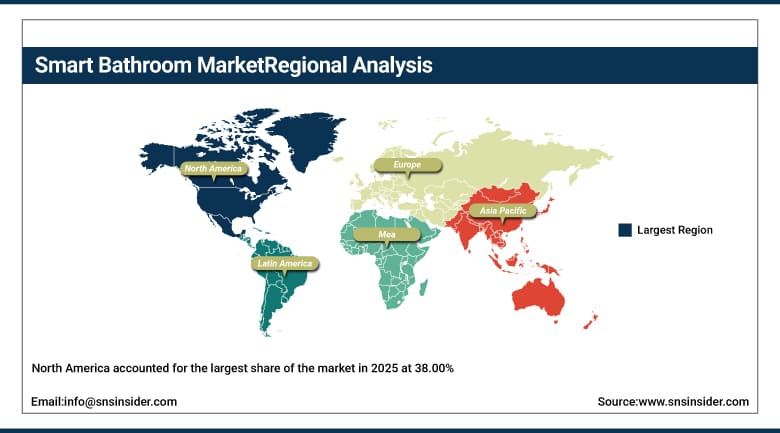
North America accounted for the largest share of the market in 2025 at 38.00%, with a CAGR of 11.00% projected through 2035. The United States holds most regional value through high renovation spending, smart home ownership and strong brands such as Kohler, Moen, Delta and American Standard. Canada adds demand from new housing and renovations.
Launches including Kohler's Anthem EvoCycle shower and Leap toilet expansion, and TOTO's G5A Lite, show active competition. Water efficiency rules, ADA accessibility standards and rising water costs shape product features. Growth is slower than in Asia Pacific because the base is large, but premium renovation and commercial hygiene projects sustain demand.
Get Customized Report as Per Your Business Requirement - Enquiry Now
Asia Pacific Smart Bathroom Market Insights
The Asia Pacific accounted for 27.00% of the market share in 2025 and is the fastest growing region, growing at a CAGR of 14.50% from 2026 to 2035. Japan and South Korea are mature markets for shower toilets, with LIXIL’s Sanitarina 61 getting the IEEE Milestone in October 2026 for the first Japanese shower toilet manufactured in 1967. China and India are witnessing rapid growth due to urbanization and income growth.
Chinese manufacturers like Jomoo and Viomi are competing on the basis of pricing and features, while TOTO, LIXIL, and Panasonic are leading the way technologically in the Japanese market. Demand is being driven by new construction projects and growing middle classes. Premium products are not favored by smaller apartment sizes and price sensitivity in some regions, though local production reduces prices.
Europe Smart Bathroom Market Insights
Europe held 26.00% of the market in 2025 and is growing at a CAGR of 11.20% through 2035. Germany, the United Kingdom, France, Italy and Spain lead through renovation activity and strong sanitaryware brands including Grohe, Hansgrohe, Geberit, Duravit, Roca and Villeroy & Boch.
Water saving and energy efficiency drive adoption, and shower toilets are gaining acceptance, particularly in Germany, Switzerland and the Nordic countries. Consolidation, such as Villeroy & Boch's acquisition of Ideal Standard in 2024, strengthens brands. High product prices and installation costs restrain adoption in some countries, but regulation and design preferences support steady growth.
MEA & Latin America Smart Bathroom Market Insights
The Middle East and Africa held 5.00% of the market and is growing at a CAGR of 12.80%. The United Arab Emirates and Saudi Arabia lead through luxury residential projects, hotels and large commercial developments, while bidet use is already common in many countries. Water scarcity in the Gulf supports demand for water-saving fixtures.
The Latin American region accounts for 4.00% of the market, growing at a CAGR of 11.80%. In this market, Brazil and Mexico dominate through the construction of premium housing and hotels, whereas Chile and Colombia contribute to small volumes. The volatility in currency and cost of imports hinder the sale of premium products.
Market Dynamics
Growth Drivers: Hygiene Awareness, Water Efficiency and Smart Home Adoption
Hygiene awareness is a major driver. Touchless fixtures, self-cleaning toilets and electrolyzed water mist reduce contact and improve cleanliness, which interests homeowners and commercial operators alike. Products such as TOTO's G5A Lite use touchless lids, auto flush and cleaning mist, and more consumers now view bidet washing as a health and comfort upgrade rather than a luxury.
Increased water efficiency and smarter homes contribute to the trend. For instance, Kohler has launched Anthem EvoCycle that saves up to 80% water. Also, there are water-efficient WaterSense toilets including the Leap line that assist consumers save money and comply with requirements. Voice assistants and hubs are becoming increasingly common; thus, it facilitates the transition to the connected bathroom.
Restraints: High Cost, Installation Complexity and Privacy Concerns
High cost is one of the leading constraints. Smart toilets, showerheads that recycle water, and connected mirrors are not only expensive compared to conventional bathrooms but also need to be plugged into the electrical supply and may require plumbing modifications. Such issues pose problems to those with limited budgets or old buildings.
Complicated installations and privacy issues present another challenge. Connectivity requires access to a wireless network, constant software maintenance, and updates. Consumers have reservations on the data collected through the bathroom sensors or video cameras. There are also concerns over reliability when there is an outage in electrical power or internet connection.
Opportunities: Lower-Priced Models, Healthcare Facilities and Recirculation Technology
Lower-cost alternatives represent another important growth area. The introduction by Kohler of its Leap Lite in June 2026, without a built-in bidet at a lower cost, represents an option that is expanding sales into areas outside luxury homes. Units that streamline the installation process represent additional opportunities in adoption of smart toilets.
Healthcare facilities and recirculation technology provide further opportunities. Hospitals and senior living communities need hygienic, accessible fixtures, and recirculating showers fit regions facing water scarcity. Companies that combine certified water savings, easy installation and app control can serve both consumer and commercial buyers. New standards for accessibility and sustainability should favor suppliers with proven products.
Recent Developments:
-
2026: Kohler expanded its Leap smart toilet collection with a Dune color, a Leap model with a dual front and rear wand, and the lower-priced Leap Lite, all WaterSense certified and ADA compliant.
-
2026: LIXIL's Sanitarina 61, Japan's first shower toilet launched in 1967, received an IEEE Milestone, jointly recognizing TOTO and Panasonic for their roles in electric bidet toilet technology.
Smart Bathroom Companies are
-
Kohler Co.
-
TOTO Ltd.
-
Roca Sanitario, S.A.
-
Duravit AG
-
Grohe (LIXIL Group)
-
Geberit AG
-
Villeroy & Boch AG
-
Moen Incorporated (Fortune Brands)
-
Delta Faucet Company (Masco)
-
American Standard Brands
-
Jacuzzi Brands, LLC
-
Panasonic Holdings Corporation
-
Rinnai Corporation
-
Brondell, Inc.
-
Jomoo Group
-
Viomi Technology Co., Ltd.
-
Orans Sanitary Ware
-
Jaquar Group
-
Sloan Valve Company
Smart Bathroom Market Report Scope:
| Report Attributes | Details |
|---|---|
| Market Size in 2025 | USD 9.60 Billion |
| Market Size by 2035 | USD 30.35 Billion |
| CAGR | CAGR of 12.20% From 2026 to 2035 |
| Base Year | 2025 |
| Forecast Period | 2026-2035 |
| Historical Data | 2022-2024 |
| Report Scope & Coverage | Market Size, Segments Analysis, Competitive Landscape, Regional Analysis, DROC & SWOT Analysis, Forecast Outlook |
| Key Segments | • By Product (Smart Toilets, Smart Showers, Smart Faucets, Smart Mirrors, Smart Bathtubs, Others) • By Technology (Sensor-Based, Voice-Controlled, App-Controlled, Others) • By Connectivity (Wi-Fi, Bluetooth, Others) • By End-Use (Residential, Commercial, Healthcare Facilities, Others) • By Distribution Channel (Offline, Online) |
| Regional Analysis/Coverage | North America (US, Canada), Europe (Germany, UK, France, Italy, Spain, Russia, Poland, Rest of Europe), Asia Pacific (China, India, Japan, South Korea, Australia, ASEAN Countries, Rest of Asia Pacific), Middle East & Africa (UAE, Saudi Arabia, Qatar, South Africa, Rest of Middle East & Africa), Latin America (Brazil, Argentina, Mexico, Colombia, Rest of Latin America). |
| Company Profiles | Kohler Co., LIXIL Corporation, TOTO Ltd., Roca Sanitario, S.A., Duravit AG, Grohe (LIXIL Group), Hansgrohe SE, Geberit AG, Villeroy & Boch AG, Moen Incorporated (Fortune Brands), Delta Faucet Company (Masco), American Standard Brands, Jacuzzi Brands, LLC, Panasonic Holdings Corporation, Rinnai Corporation, Brondell, Inc., Jomoo Group, Viomi Technology Co., Ltd., Orans Sanitary Ware, Jaquar Group, Sloan Valve Company |

Frequently Asked Questions
Key players include Kohler, LIXIL, TOTO, Roca, Duravit, Grohe, Hansgrohe, Geberit, Villeroy & Boch, Moen, Delta Faucet, American Standard, Jacuzzi, Panasonic, Jomoo and Viomi.
Key opportunities include lower-priced and integrated smart toilets, healthcare facility installations, and recirculating showers that save water in regions facing scarcity.
The major growth factor is rising hygiene awareness and water-efficiency demand, supported by smart home adoption and renovation spending.
By Product, the Smart Toilets segment dominated the market with approximately 38.00% share in 2025, owing to bidet, heated seat and self-cleaning features.
North America dominated the market with a share of 38.00% in 2025, supported by renovation spending, smart home ownership and strong brands in the United States.
