
Smart Appliances Market Report Scope & Overview:
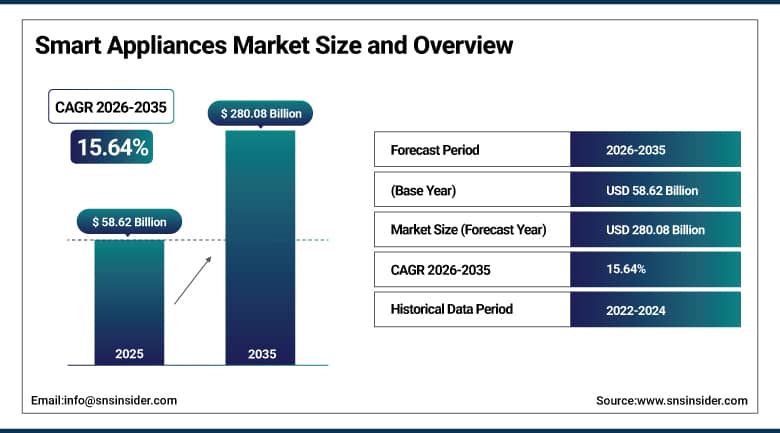
The Smart Appliances Market size was valued at USD 58.62 Billion in 2025 and is expected to reach USD 280.08 Billion by 2035, growing at a CAGR of 15.64% from 2026–2035.
The global smart appliances market is growing at an exceptional pace. Smart appliances are advanced household and commercial devices integrated with internet connectivity, sensors, AI-driven automation, and voice assistant compatibility that enable remote control, real-time monitoring, predictive maintenance, and adaptive energy management. The market is driven by the increasing adoption of IoT, AI-driven automation, and energy-efficient solutions that enhance convenience, connectivity, and sustainability in modern households. The rapid digitalization of households through surging smartphone penetration, Wi-Fi connectivity, and AI-powered assistant integration has created an ecosystem where smart appliances deliver seamless automated experiences.
In 2024, Samsung launched the Bespoke AI Washer and Dryer with AI-powered wash cycle optimization, AI Energy Mode reducing power consumption by up to 30%, and SmartThings integration for scheduling, monitoring, and maintenance alerts through the Samsung smart home ecosystem. The product demonstrates the commercial direction of premium smart appliance development toward AI-powered operational intelligence whose energy saving measurement creates tangible ROI that sustains consumer willingness to pay premium prices above conventional appliance alternatives.
To Get More Information On Smart Appliances Market - Request Free Sample Report
Smart Appliances Market Trends:
-
Adoption of the Matter smart home standard is improving device interoperability across major ecosystems, increasing consumer confidence and accelerating smart appliance adoption
-
AI-powered predictive maintenance capabilities are helping detect potential equipment failures early, reducing service costs and enhancing appliance reliability
-
Integration of energy management features is enabling consumers to optimize electricity consumption, manage utility costs, and maximize renewable energy utilization
-
Subscription-based services for connectivity, advanced AI functions, and remote monitoring are creating recurring revenue opportunities for smart appliance manufacturers
-
Growing deployment of smart appliances in commercial environments such as hotels, restaurants, and offices is driving demand through operational efficiency and maintenance optimization benefits
U.S. Smart Appliances Market Size Outlook:
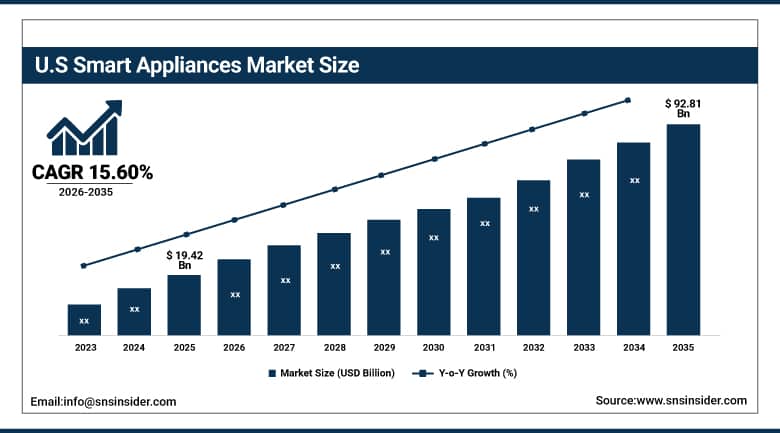
The U.S. Smart Appliances Market was valued at approximately USD 19.42 Billion in 2025 and is expected to reach approximately USD 92.81 Billion by 2035, growing at a CAGR of approximately 15.60%.
The U.S. is the most commercially sophisticated smart appliances market within North America’s dominant revenue position. Samsung, LG, GE Appliances, Whirlpool, and Bosch’s U.S. commercial operations collectively define the domestic smart appliance landscape. The U.S. consumer’s above-average technology adoption culture, the smart home ecosystem’s extraordinary Amazon Echo and Google Home penetration, and the energy efficiency incentive programme’s ENERGY STAR certification create structured consumer motivation for smart appliance investment. The U.S.’s high household income creates premium smart appliance specification accessibility that creates above-average per-unit commercial value.
LG Electronics launched its LG ThinQ AI-powered smart appliance range expansion in 2024 with new AI Home energy monitoring integration, allowing homeowners to track real-time energy consumption across all connected appliances and receive personalized efficiency recommendations through the LG ThinQ app. The platform’s integration with smart utility programmes that provide time-of-use electricity pricing creates demand response capability whose bill reduction creates measurable financial benefit that sustains consumer adoption.
Smart Appliances Market Segment Analysis:
-
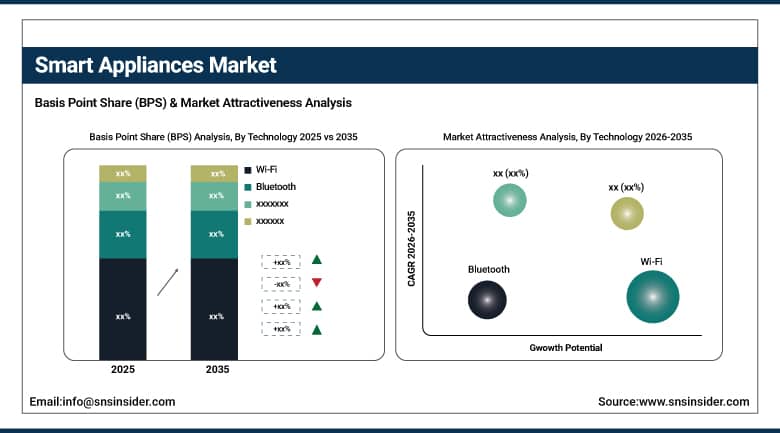
By Technology, the Wi-Fi segment dominated the Smart Appliances Market with 48.6% share in 2025, while the Wi-Fi segment is also expected to grow at the highest CAGR.
-
By Product, the Smart Washing Machines segment dominated the Smart Appliances Market with approximately 32% share in 2025, while the Smart Refrigerators segment is the fastest growing.
-
By Distribution Channel, the Offline/Retail Stores segment dominated the Smart Appliances Market with approximately 58% share in 2025, while the Online/E-Commerce segment is the fastest growing.
-
By End User, the Residential segment dominated the Smart Appliances Market with approximately 72% share in 2025, while the Commercial segment is the fastest growing.
By Technology, Wi-Fi dominates and grows fastest
Wi-Fi retained the dominant and fastest-growing technology position with 48.6% of the smart appliances market in 2025. Wi-Fi’s dual commercial primacy reflects its universal infrastructure availability in the developed world’s residential and commercial buildings whose broadband internet connectivity creates the communication backbone that smart appliance remote control, monitoring, and cloud AI service access require. Each home Wi-Fi router’s bandwidth creates the connectivity infrastructure that smart appliances consume without additional hardware investment, creating specification accessibility that proprietary mesh network technologies cannot match equivalently. The Amazon Alexa, Google Home, and Apple HomeKit ecosystems’ Wi-Fi protocol foundation creates natural smart appliance integration whose voice control convenience sustains consumer adoption.
Wi-Fi’s fastest-growing status is sustained by IoT’s progressive expansion whose billions of connected devices create growing demand for Wi-Fi-enabled appliance integration. Each new Wi-Fi 6 and Wi-Fi 6E network upgrade creates improved bandwidth and device density capability whose smart appliance support sustains specification upgrade motivation. The Matter protocol’s Wi-Fi foundation creates cross-manufacturer interoperability whose standardization removes the consumer specification barrier that proprietary ecosystems previously created.
By Product, washing machines dominate, refrigerators grow fastest
Smart washing machines retained the dominant product position with approximately 32% of the smart appliances market in 2025. The laundry appliance’s relatively short replacement cycle of 8-12 years relative to refrigerator’s 15–20-year life creates more frequent purchase occasions whose new model specification sustains smart feature adoption. Each washing machine replacement creates smart specification consideration whose energy efficiency, AI cycle optimization, and remote monitoring benefits create incremental value justification at the consumer’s routine replacement decision point. Samsung’s Bespoke AI and LG’s ThinQ washing machine platforms demonstrate the commercial investment in smart laundry appliance capability that sustains the category’s dominant market position.
Smart refrigerators are the fastest-growing product because the connected kitchen ecosystem’s intelligence potential is creating premium specification motivation beyond the smart washing machine’s utility. Samsung Family Hub’s internal camera grocery inventory tracking, AI expiry date management, recipe suggestion based on available ingredients, and direct grocery ordering integration create kitchen intelligence functionality whose convenience value creates consumer specification preference. The refrigerator’s central kitchen position and always-on connectivity create a smart home hub opportunity whose screen, speaker, and connectivity create interaction frequency that other appliances cannot match.
By End User, residential dominates, commercial grows fastest
Residential end users retained the dominant position with approximately 72% of the smart appliances market in 2025. The residential consumer’s smart home ecosystem investment, driven by convenience, energy management, and lifestyle technology aspirations, creates the most commercially significant aggregate smart appliance procurement category. Each household that progresses from single smart device to comprehensive smart home ecosystem creates multi-appliance procurement whose per-household commercial value compounds with ecosystem expansion. The baby boomer and millennial homeowner populations’ respective motivations—energy cost reduction and technology convenience—create demographic breadth that sustains residential procurement across diverse age and income segments.
Commercial is the fastest-growing end user because hotel smart room management, restaurant kitchen efficiency, and corporate office energy management create operational ROI whose financial measurement sustains institutional investment beyond consumer lifestyle motivation. Each hotel that deploys smart room appliances for guest experience personalization, energy consumption optimization, and predictive maintenance creates per-room commercial procurement whose aggregate across hotel portfolios creates institutional scale. The commercial segment’s ROI-driven procurement creates premium specification that sustains above-residential commercial value.
Regional Analysis:
|
Region |
Major Country |
Share within Region, 2025 (%) |
|---|---|---|
|
North America |
United States |
87.4% |
|
Europe |
Germany |
22.3% |
|
Asia Pacific |
China |
44.8% |
|
Middle East & Africa |
UAE |
38.4% |
|
Latin America |
Brazil |
44.2% |
North America Smart Appliances Market Insights
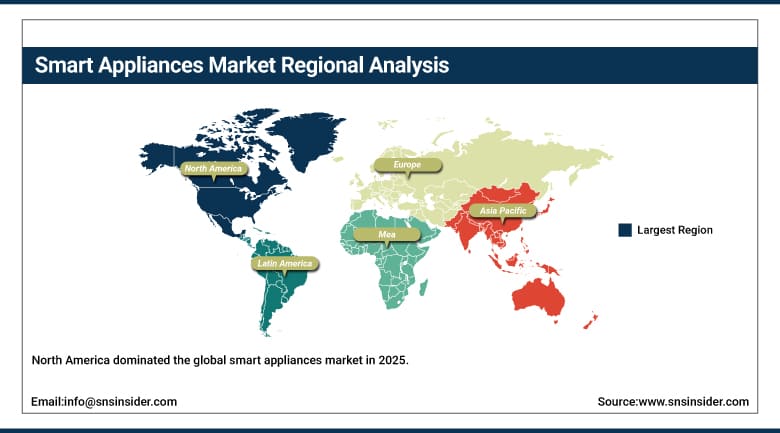
North America dominated the global smart appliances market in 2025 with the highest per-household smart technology investment. The United States accounts for approximately 87.4% of North American revenues through Samsung, LG, GE Appliances, Whirlpool, and Bosch’s commercial operations. The Amazon Echo and Google Home smart speaker ecosystems’ extraordinary penetration creates the voice assistant infrastructure whose smart appliance integration creates natural adoption motivation.
Canada contributes approximately 12.6% of North American revenues through its high household income market, the smart home technology adoption culture, and the energy efficiency incentive programme’s smart appliance specification motivation.
Get Customized Report as Per Your Business Requirement - Enquiry Now
Europe Smart Appliances Market Insights
Europe is a technically sophisticated smart appliances market where EU Energy Efficiency Directive, ENERGY STAR equivalent labelling, and Siemens Home Appliances’, Bosch’s, and Miele’s commercial leadership create structured institutional demand. Germany accounts for approximately 22.3% of European revenues through its above-average consumer technology investment, BSH Hausgerate’s (Bosch-Siemens) domestic commercial presence, and the premium appliance market’s advanced feature specification.
France, the United Kingdom, and Italy are significant secondary markets where smart home adoption, premium appliance market’s growth, and energy efficiency regulation create consistent smart appliance procurement.
Asia Pacific Smart Appliances Market Insights
Asia Pacific is the fastest-growing regional smart appliances market, driven by China’s extraordinary consumer electronics market, South Korea’s Samsung and LG’s technology leadership, Japan’s advanced appliance innovation, and India’s rapidly growing urban middle class. China accounts for approximately 44.8% of Asia Pacific revenues through its enormous consumer electronics market, the domestic appliance manufacturer’s smart feature competition, and the government’s smart home standardization programme.
South Korea’s Samsung and LG’s global smart appliance leadership, Japan’s Panasonic and Sharp’s innovative appliance development, and India’s rapidly growing urban consumer market create significant secondary markets whose combined procurement sustains Asia Pacific’s fastest-growing regional status.
MEA & Latin America Smart Appliances Market Insights
UAE leads MEA revenues at approximately 38.4% through its premium consumer technology adoption, the luxury real estate sector’s smart home integration, and the government’s smart city initiative creating smart building appliance procurement. Brazil leads Latin American revenues at approximately 44.2% through its large consumer electronics market, the growing urban middle class’s smart home adoption, and the commercial sector’s energy management smart appliance investment.
Market Dynamics:
Growth Drivers: IoT and AI-driven automation adoption and energy efficiency regulation creating smart appliance investment
The increasing adoption of IoT, AI-driven automation, and energy-efficient solutions is the smart appliances market’s most commercially certain structural growth driver. Each new IoT device that connects to the household network creates ecosystem expansion motivation whose incremental smart appliance addition creates natural purchase consideration. The AI assistant’s progressive capability improvement, whose natural language understanding creates conversation quality that sustains daily interaction frequency, creates the platform whose smart appliance integration creates convenience value. Amazon Echo’s and Google Nest’s extraordinary household penetration creates the activation infrastructure whose smart appliance integration opportunity sustains consumer adoption motivation.
Energy efficiency regulation’s progressive tightening creates compliance motivation that sustains smart appliance specification beyond lifestyle technology enthusiasm. Each energy efficiency regulation that requires smart load management, demand response capability, or real-time consumption monitoring creates government-mandated smart appliance feature adoption whose compliance character creates demand independent of discretionary consumer budget cycles.
Restraints: Privacy and data security concerns and interoperability fragmentation moderating adoption
Connected appliance’s continuous data collection, encompassing household occupancy patterns, food consumption, laundry habits, and energy usage, creates consumer privacy concern whose data security and commercial use transparency requirements create adoption hesitation in privacy-sensitive consumer segments. Each smart appliance data breach that creates household routine exposure creates temporary adoption hesitation whose recovery requires security capability demonstration investment.
Smart home platform fragmentation creating incompatible ecosystems whose appliance specification creates platform lock-in moderated consumer adoption before Matter protocol standardization’s progressive implementation. Each consumer whose appliance choice was constrained by existing smart home platform investment created specification limitation that moderates market growth below the addressable consumer preference universe.
Opportunities: Matter protocol adoption and commercial smart building deployment
Matter protocol’s cross-manufacturer interoperability creates the most commercially transformative consumer smart appliance adoption enabler whose standardization eliminates the platform lock-in hesitation that previously moderated smart appliance market growth. Each Matter-certified smart appliance that works seamlessly across Apple, Amazon, and Google ecosystems creates consumer specification confidence whose adoption creates market expansion beyond the previously platform-committed consumer segment.
Commercial smart building deployment creating hotel, restaurant, and office smart appliance procurement represents the most commercially scalable institutional opportunity whose operational efficiency ROI creates procurement independent of consumer lifestyle discretion. Each commercial property developer that specifies smart appliances for energy management, predictive maintenance, and guest experience creates institutional procurement whose per-building scale creates commercial concentration that sustains manufacturer investment in commercial-grade smart appliance development.
Recent Developments:
-
2024: Samsung launched the Bespoke AI Washer and Dryer in 2024 with AI-powered wash cycle optimization, AI Energy Mode reducing power consumption by up to 30%, and SmartThings integration for scheduling, monitoring, and maintenance alerts through the Samsung connected home ecosystem.
-
2024: LG Electronics launched its LG ThinQ AI Home energy monitoring platform expansion in 2024 with real-time energy consumption tracking across all connected appliances and personalized efficiency recommendations integrated with smart utility time-of-use pricing programmes.
-
2024: Whirlpool expanded its smart appliance portfolio in 2024 with Matter protocol certification across its connected appliance range, enabling seamless integration with Apple HomeKit, Amazon Alexa, and Google Home without proprietary hub requirements for simplified consumer smart home setup.
Smart Appliances Companies are:
-
Samsung Electronics Co., Ltd.
-
LG Electronics Inc.
-
BSH Hausgerate GmbH
-
GE Appliances
-
Electrolux AB
-
Miele & Cie. KG
-
Haier Group Corporation
-
Midea Group Co., Ltd.
-
Hisense Group
-
TCL Technology Group Corporation
-
Apple Inc.
-
Amazon.com Inc.
-
Google LLC
-
Honeywell International Inc.
-
Philips N.V.
-
Siemens AG
-
Xiaomi Corporation
-
Dyson Ltd.
Smart Appliances Market Report Scope:
| Report Attributes | Details |
|---|---|
| Market Size in 2025 | USD 58.62 Billion |
| Market Size by 2035 | USD 280.08 Billion |
| CAGR | CAGR of 15.64% From 2026 to 2035 |
| Base Year | 2025 |
| Forecast Period | 2026-2035 |
| Historical Data | 2022-2024 |
| Report Scope & Coverage | Market Size, Segments Analysis, Competitive Landscape, Regional Analysis, DROC & SWOT Analysis, Forecast Outlook |
| Key Segments | • by Product (Smart Washing Machines, Smart Refrigerators, Smart Air Conditioners/HVAC, Smart Ovens & Cooking Appliances, Smart Dishwashers, Smart Televisions, Others) • by Technology (Wi-Fi, Bluetooth, Zigbee, Z-Wave, Others), Distribution Channel (Offline/Retail Stores, Online/E-Commerce) • by End User (Residential, Commercial) |
| Regional Analysis/Coverage | North America (US, Canada, Mexico), Europe (Eastern Europe [Poland, Romania, Hungary, Turkey, Rest of Eastern Europe] Western Europe] Germany, France, UK, Italy, Spain, Netherlands, Switzerland, Austria, Rest of Western Europe]), Asia Pacific (China, India, Japan, South Korea, Vietnam, Singapore, Australia, Rest of Asia Pacific), Middle East & Africa (Middle East [UAE, Egypt, Saudi Arabia, Qatar, Rest of Middle East], Africa [Nigeria, South Africa, Rest of Africa], Latin America (Brazil, Argentina, Colombia, Rest of Latin America) |
| Company Profiles | Samsung Electronics Co., Ltd., LG Electronics Inc., Whirlpool Corporation, BSH Hausgerate GmbH, GE Appliances, Electrolux AB, Miele & Cie. KG, Panasonic Corporation, Haier Group Corporation, Midea Group Co., Ltd., Hisense Group, TCL Technology Group Corporation, Apple Inc., Amazon.com Inc., Google LLC, Honeywell International Inc., Philips N.V. , Siemens AG, Xiaomi Corporation, Dyson Ltd. |
Frequently Asked Questions
The Smart Appliances Market is expected to grow at a CAGR of 15.64% from 2026 to 2035.
The Smart Appliances Market was valued at USD 58.62 Billion in 2025.
Increasing adoption of IoT, AI-driven automation, and energy-efficient solutions enhancing convenience, connectivity, and sustainability in modern households, and the rapid digitalization of households through smartphone penetration and AI assistant integration creating seamless automated experiences.
Wi-Fi dominated the Smart Appliances Market with 48.6% share in 2025 as confirmed by SNS Insider, and is also expected to grow at the highest CAGR over the forecast period.
Residential dominated the Smart Appliances Market with approximately 72% share in 2025, while Commercial is the fastest growing end-user segment.
