
Sports Officiating Technologies Market Report Scope & Overview:
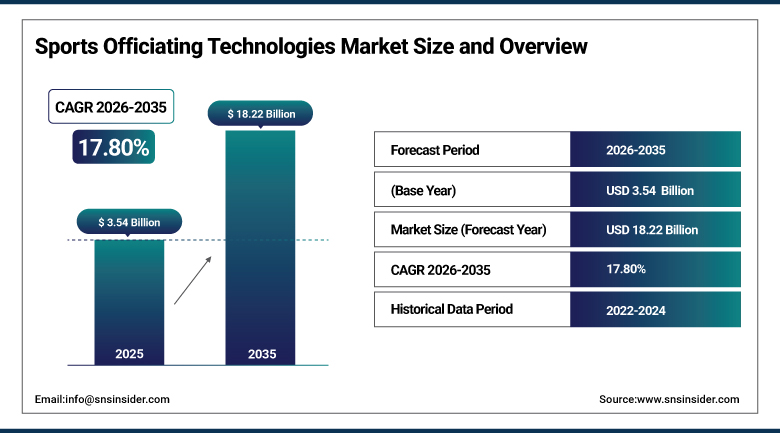
The Sports Officiating Technologies Market was valued at USD 3.54 Billion in 2025 and is expected to reach USD 18.22 Billion by 2035, growing at a CAGR of 17.80% from 2026-2035.
The Sports Officiating Technologies Market is growing as leagues, federations and tournament organizers use cameras, sensors and software to make faster and fairer decisions. Optical tracking, video assistant referee rooms, goal-line systems, electronic line calling and automated ball-strike challenges now sit inside the rules of many major sports. Machine learning is moving decisions from human review toward automatic calls made in seconds. Wearable communication links, referee body cameras and performance analytics are widening the scope beyond the single call. Lower-cost systems are starting to reach second divisions and grassroots competitions.
⮞In June 2026, FIFA said the World Cup would use 16 optical tracking cameras in each of its 16 stadiums, collecting more than 150 million data points per match, with semi-automated offside debuting at a World Cup. The scale shows officiating becoming a data-driven operation.
To Get more information Sports Officiating Technologies Market - Request Free Sample Report
Sports Officiating Technologies Market Trends
-
Semi-automated offside and automated line calling across football, tennis and cricket
-
Centralized and remote video review hubs serving several stadiums
-
Sensor-equipped balls and wearable communication links for officials
-
Machine learning for ball-strike, foul and handball classification
-
Referee body cameras and data-based officiating performance programs
U.S. Sports Officiating Technologies Market Outlook
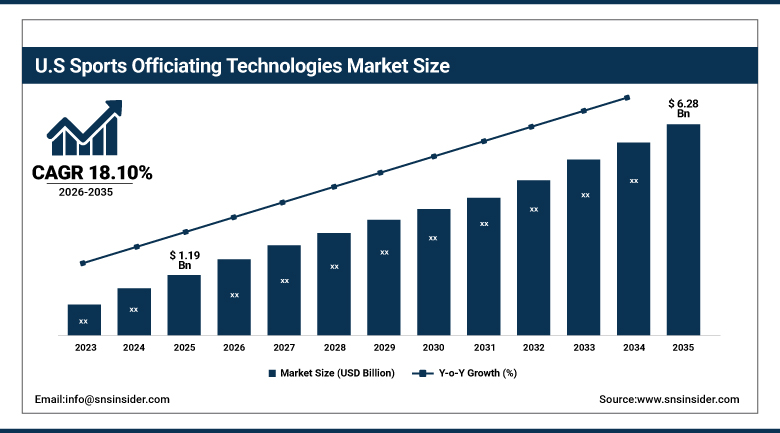
The U.S. Sports Officiating Technologies Market was valued at USD 1.19 Billion in 2025 and is expected to reach USD 6.28 Billion by 2035, growing at a CAGR of 18.10% from 2026-2035.
The U.S. Sports Officiating Technologies Market is the largest national market, supported by wealthy professional leagues in football, baseball, basketball, hockey and tennis, strong media exposure and a large base of stadium camera networks. Leagues use replay centers, optical measurement and automated ball-strike challenges. College conferences and high school associations are testing video review. Vendors of tracking, replay and communication equipment are concentrated in the country. Collective bargaining agreements with officials shape how fast new tools are adopted.
⮞In April 2025, the National Football League announced a line-to-gain measurement system using six 8K cameras in all 30 stadiums, taking about 30 seconds per measurement and saving up to 40 seconds compared with the chain method. League-wide installation shows how quickly large leagues scale camera-based officiating.
Sports Officiating Technologies Market Segment Analysis
-
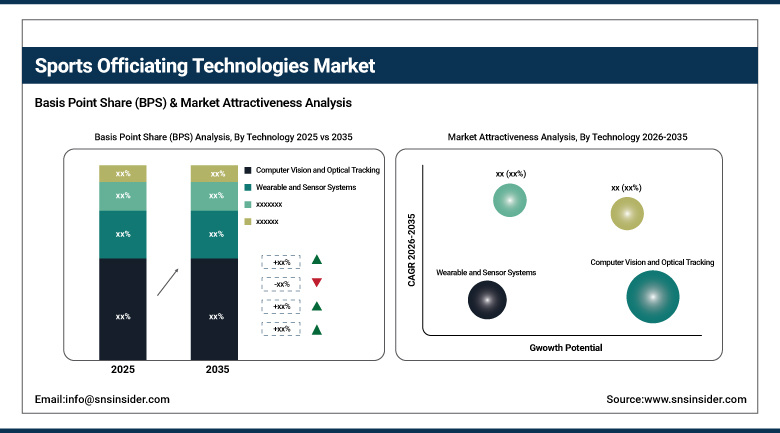
By Technology, the Computer Vision and Optical Tracking segment dominated the Sports Officiating Technologies Market with approximately 31.20% share in 2025, while the AI-Native and Automated Officiating Platforms segment is the fastest growing with a CAGR of approximately 24.80%.
-
By Sport, the Football segment dominated the Sports Officiating Technologies Market with approximately 37.10% share in 2025, while the Swimming and Aquatics segment is the fastest growing with a CAGR of approximately 20.10%.
-
By Application, the Decision Review Systems segment dominated the Sports Officiating Technologies Market with approximately 30.65% share in 2025, while the Officiating Analytics and Training segment is the fastest growing with a CAGR of approximately 21.35%.
-
By End User, the Professional Leagues segment dominated the Sports Officiating Technologies Market with approximately 41.38% share in 2025, while the Amateur and Grassroots segment is the fastest growing with a CAGR of approximately 21.70%.
By Technology, Computer Vision and Optical Tracking Dominates the Sports Officiating Technologies Market and AI-Native and Automated Officiating Platforms Grows Fastest
Computer vision and optical tracking lead because modern officiating decisions depend on precise positions of players, balls and lines. Multi-camera arrays rebuild body models and ball paths in three dimensions, supporting offside, goal-line and line-calling decisions. Federations favor systems with published accuracy certification, and stadium cameras also serve broadcasting and analytics, which spreads the cost.
AI-native and automated officiating platforms grow fastest as leagues move from human review toward decisions generated automatically in seconds. Machine learning models classify fouls, handballs and ball-strike zones, and cloud processing enables remote review hubs. Shorter delays and consistent rulings appeal to broadcasters and fans, and sports with frequent stoppages are testing automated calls first.
⮞On 1 April 2025, the Premier League announced that semi-automated offside technology would go live from Matchweek 32, and it began operating on 12 April 2025. The rollout shows leading competitions adopting automated decisions at scale.
By Sport, Football Dominates the Sports Officiating Technologies Market and Swimming and Aquatics Grows Fastest
Football leads because it is the most widely played sport and has the most developed officiating stack, including goal-line systems, video assistant referees and semi-automated offside. Governing bodies mandate approved systems for top competitions, and national leagues in Europe, South America and Asia have licensed them. Tournaments add large temporary installations.
Swimming and aquatics grow fastest from a smaller base as touchpads, start sensors and underwater cameras expand into judging of turns, strokes and relay takeoffs. National and school meets are adopting automated timing and video review, and para-sport events require precise reaction measurement. Organizers also reuse footage for coaching and broadcast graphics.
⮞In October 2025, CricTracker reported International Cricket Council figures showing 25 on-field decisions overturned in 36 innings at the Women's World Cup, or 0.67 per innings, against 0.46 at the 2023 ODI World Cup. The rise points to growing reliance on review technology.
By Application, Decision Review Systems Dominates the Sports Officiating Technologies Market and Officiating Analytics and Training Grows Fastest
Decision review systems lead because video assistant referee, challenge and replay procedures are written into competition rules across football, rugby, cricket, hockey, baseball and tennis. Each competition needs review rooms, trained operators, camera feeds and communication links, so spending recurs every season. Rule makers keep widening the situations that can be reviewed.
Officiating analytics and training grow fastest as governing bodies measure referee performance with data. Tracking and video tools score decision accuracy, wearables record positioning and workload, and simulators train officials on difficult calls. Leagues use the findings to assign matches and improve consistency, and amateur federations adopt low-cost apps for education.
⮞In February 2026, the International Football Association Board widened video review to second-yellow red cards, corner kicks and mistaken identity, and allowed referee body cameras from 1 July 2026. Broader scope increases the number of decisions that need review infrastructure.
By End User, Professional Leagues Dominates the Sports Officiating Technologies Market and Amateur and Grassroots Grows Fastest
Professional leagues lead because they have the budgets, broadcast exposure and integrity pressure that justify installing certified systems in every stadium. Contracts run for several seasons and cover hardware, operators and software updates. Fan expectations and betting data rights raise the cost of visible errors, which pushes leagues to adopt new tools early.
Amateur and grassroots sport grows fastest as low-cost camera systems, smartphone apps and cloud services make officiating technology affordable below elite level. Regional federations and school associations adopt automated line calling and video review for finals, and referee education platforms reach many match officials. Portable setups suit small venues that cannot host permanent installations.
⮞In August 2026, LaLiga said Connected Ball technology would be used in all matches from the 2026/27 season, with about 12 antennas in each stadium and 14 sensor balls prepared for every match. The league-wide installation shows professional competitions treating sensor-based decisions as standard.
Regional Analysis
|
Region |
Major Country |
Share within Region, 2025 (%) |
|---|---|---|
|
North America |
U.S. |
84.40 |
|
Europe |
Germany |
22.63 |
|
Asia Pacific |
China |
35.92 |
|
Latin America |
Brazil |
47.35 |
|
Middle East & Africa |
Saudi Arabia |
30.19 |
North America Sports Officiating Technologies Market Insights
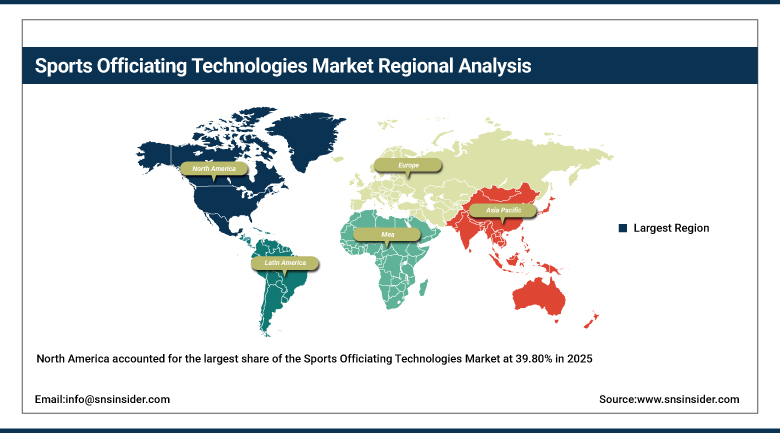
North America accounted for the largest share of the Sports Officiating Technologies Market at 39.80% in 2025, led by the United States and followed by Canada. Major leagues in football, baseball, basketball, hockey and tennis have adopted review and tracking systems, and strong media rights fund stadium camera networks. The region also hosts several technology vendors.
Baseball's automated ball-strike challenge, optical measurement in football and league replay centers keep demand high. College conferences and school federations are starting to trial video review. Agreements with officials shape rollouts, and venue owners weigh installation costs against fan expectations.
⮞In August 2025, Zebra Technologies said its player tracking has covered every NFL game, with more than 15,000 players and 550,000 plays tracked since 2014. Established sensor data now supports measurement and officiating tools.
Get Customized Report as per Your Business Requirement - Enquiry Now
Europe Sports Officiating Technologies Market Insights
Europe held significant share of the Sports Officiating Technologies Market in 2025, led by Germany, the United Kingdom, France, Italy and Spain. Football leagues were early adopters of goal-line technology, video review and semi-automated offside, and national associations are extending systems to second divisions and cup competitions.
Regional governing bodies set common standards, so certified technologies move easily between countries. Cost is the main brake in lower divisions, where clubs resist paying for review systems. Rugby, tennis, cricket and winter sports add demand, and large events bring temporary installations.
⮞In April 2026, clubs in England's EFL Championship rejected VAR for the next season, reportedly with no appetite for any version, including a lower-cost option with two challenges per game. The decision shows how cost sensitivity limits adoption below the top tier.
Asia Pacific Sports Officiating Technologies Market Insights
Asia Pacific is projected to be the fastest growing region in the Sports Officiating Technologies Market, at a CAGR of 20.90% over 2026-2035. China, Japan, India, Australia and South Korea lead. New stadiums, expanding football and cricket leagues and government sport investment support installations.
Football leagues in Australia, Japan, South Korea and Malaysia run video review, while cricket leagues in India and elsewhere rely on ball tracking and third-umpire systems. Training of local review officials and tight budgets in newer leagues remain limiting factors.
⮞In May 2026, Football Australia reported that A-League video reviews fell from 48 to 38 in the 2025/26 season, and errors halved from 18 to 9 after 11 new video match officials were added. Better-trained operators are raising the value of review systems.
MEA & Latin America Sports Officiating Technologies Market Insights
Latin America and the Middle East and Africa together hold the modest share of the Sports Officiating Technologies Market. In Latin America, Brazil, Mexico, Argentina and Colombia lead, supported by confederation competitions and national leagues that are centralizing video review in operations rooms.
In the Middle East and Africa, Saudi Arabia, the United Arab Emirates, Qatar, Egypt and South Africa lead. Gulf states host international tournaments and invest in stadium technology, while many African federations depend on equipment supplied through confederations. Cost and operator training limit adoption in lower leagues.
⮞In November 2025, CONMEBOL used semi-automated offside and goal-line technology in the Copa Libertadores and Copa Sudamericana finals, supported by 24 high-speed cameras. Continental finals are becoming a showcase for automated officiating.
Market Dynamics
Growth Drivers: Video Review Adoption and Automated Decision Technology Drive Growth in the Sports Officiating Technologies Market
Video review adoption is the main driver. Leagues and federations in football, rugby, cricket, hockey, baseball and tennis have written review procedures into competition rules, and each competition needs cameras, operators and communication links. Fans expect visible errors to be corrected, so rule makers keep widening the scope of reviewable decisions.
Automated decision technology adds momentum. Optical tracking, sensors and machine learning now produce offside, line-calling and ball-strike decisions in seconds, shortening delays that irritate crowds. Certification programs give federations confidence in accuracy, and permanent camera networks installed for broadcasting and analytics lower the effective cost of each use.
⮞In March 2026, Major League Baseball reported 175 automated ball-strike challenges over the opening weekend of the season, with 54% overturning the umpire call. The high overturn rate shows demand for automated accuracy checks.
Restraints: High Deployment Costs and Fan Skepticism Restrain Growth in the Sports Officiating Technologies Market
High deployment costs restrain growth. Camera arrays, operations rooms, connectivity and certified calibration need large upfront and annual spending, which smaller leagues and lower divisions struggle to fund. Stadiums differ in layout and tournaments need temporary installations, which adds effort and slows rollouts outside elite competitions.
Fan skepticism and technology errors add limits. Long review delays, unclear explanations and operator mistakes have drawn criticism from players and supporters, and some competitions have voted against review. Officials also worry about authority and job security, so governing bodies move slowly and require long trial periods before approval.
⮞In 2026, the Football Supporters Association surveyed nearly 8,000 Premier League fans and found that 75.71% oppose VAR, while fewer than 3% agree that decisions are reached in a reasonable time. Public trust remains a hurdle for review technology.
Opportunities: Grassroots Rollouts and Remote Review Hubs Create Opportunities in the Sports Officiating Technologies Market
Grassroots rollouts offer a major opportunity. Low-cost camera systems, smartphone apps and cloud processing make officiating technology affordable for national federations, school associations and amateur leagues. Vendors can sell subscription services and training, and confederation development programs reach many countries that have no review capacity today.
Remote review hubs and analytics offer further potential. Centralized operations rooms let one team review matches from several stadiums, cutting equipment and staffing needs. Performance data can guide referee selection and training, and wearable communication links improve coordination. Suppliers that bundle hardware, software and training can win multi-year contracts.
⮞In July 2026, World Rugby introduced a fully remote television match official hub in Basingstoke, England, and said international competitions must meet four minimum standards for television match official systems by August 2027. Standards create a clear buying schedule for suppliers.
Recent Developments:
-
In July 2026, Hawk-Eye Innovations signed a five-year video assistant referee contract with the Croatian Football Federation, covering the 2026-27 to 2030-31 seasons. The agreement covers up to 188 matches a season across 10 stadiums and includes a training programme for officials.
-
In November 2025, Genius Sports was selected by the Brazilian Football Confederation to provide semi-automated offside technology for the Brasileirao Serie A and the Copa do Brasil in 2026. The deployment covers all top-flight stadiums from the 2026 season.
-
In June 2025, EVS was selected by the Royal Belgian Football Association to supply its Xeebra system for a centralized video assistant referee center with six booths. The center gives Belgian match officials a single operations hub for review.
Sports Officiating Technologies Market Key Players
-
Hawk-Eye Innovations Ltd (Sony Group Corporation)
-
Genius Sports Limited
-
EVS Broadcast Equipment SA
-
Kinexon GmbH
-
Sportec Solutions AG
-
Zebra Technologies Corporation
-
Swiss Timing Ltd (Swatch Group)
-
VOGO SA
-
Riedel Communications GmbH & Co. KG
-
TRACAB (Chyron Corporation)
-
TRACKMAN A/S
-
REFSIX
Sports Officiating Technologies Market Report Scope:
| Report Attributes | Details |
|---|---|
| Market Size in 2025 | USD 3.54 Billion |
| Market Size by 2035 | USD 18.22 Billion |
| CAGR | CAGR of 17.80% From 2026 to 2035 |
| Base Year | 2025 |
| Forecast Period | 2026-2035 |
| Historical Data | 2022-2024 |
| Report Scope & Coverage | Market Size, Segments Analysis, Competitive Landscape, Regional Analysis, DROC & SWOT Analysis, Forecast Outlook |
| Key Segments | • By Technology (Computer Vision and Optical Tracking, Wearable and Sensor Systems, Video Assistant Referee Systems, AI-Native and Automated Officiating Platforms, and Others) • By Sport (Football, Basketball, Cricket, Tennis, Baseball, Swimming and Aquatics, and Others) • By Application (Decision Review Systems, Goal-Line and Line-Calling, Officiating Analytics and Training, Communication and Wearables, and Others) • By End User (Professional Leagues, Governing Bodies and Federations, Amateur and Grassroots, and Others) |
| Regional Analysis/Coverage | North America (US, Canada), Europe (Germany, UK, France, Italy, Spain, Russia, Poland, Rest of Europe), Asia Pacific (China, India, Japan, South Korea, Australia, ASEAN Countries, Rest of Asia Pacific), Middle East & Africa (UAE, Saudi Arabia, Qatar, South Africa, Rest of Middle East & Africa), Latin America (Brazil, Argentina, Mexico, Colombia, Rest of Latin America). |
| Company Profiles | Hawk-Eye Innovations Ltd (Sony Group Corporation), Genius Sports Limited, EVS Broadcast Equipment SA, Kinexon GmbH, Sportec Solutions AG, Zebra Technologies Corporation, Swiss Timing Ltd (Swatch Group), VOGO SA, Riedel Communications GmbH & Co. KG, TRACAB (Chyron Corporation), TRACKMAN A/S, REFSIX |

Frequently Asked Questions
Key players include Hawk-Eye Innovations, Genius Sports, EVS Broadcast Equipment, Kinexon, Sportec Solutions, Zebra Technologies, Swiss Timing, VOGO, Riedel Communications, TRACAB, TRACKMAN and REFSIX.
Key opportunities include low-cost grassroots systems, remote and centralized review hubs, referee analytics and training platforms, and fast-growing Asia Pacific demand.
Wider adoption of video review and automated decision technology, driven by fan demand for accurate calls and by rule changes, is the main growth factor.
By Technology, the Computer Vision and Optical Tracking segment dominated the market in 2025 with an estimated 31.20% share, supported by its role in offside, goal-line and line-calling decisions.
North America dominated the market with a share of 39.80% in 2025, driven by wealthy professional leagues and extensive stadium camera networks.
