
Substation Automation Market Report Scope and Overview:
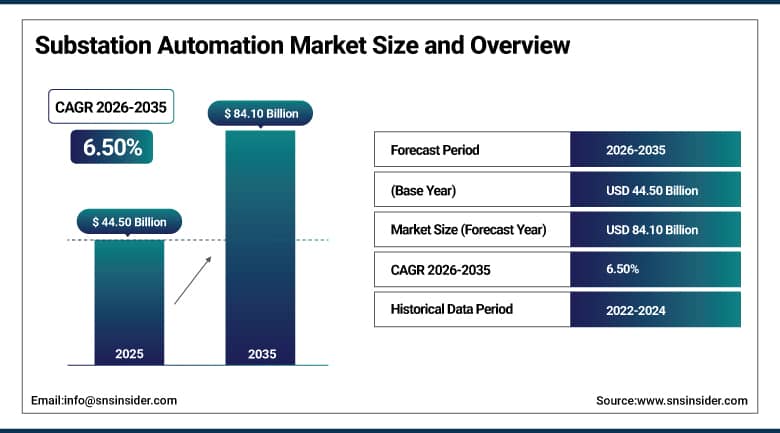
The Substation Automation Market was valued at USD 44.50 Billion in 2025 and is projected to reach USD 84.10 Billion by 2035, registering a CAGR of 6.50% from 2026 to 2035.
The Substation Automation market segment is driven by increasing investments in the modernization of smart grids, increasing renewable integration that necessitates flexible control of substations, increasing replacement of aging electromechanical systems, and different kinds of deployments ranging from utility substations to industrial and commercial substations. The concept of Substation Automation has emerged as one of the fundamental enablers for the current generation of power transmission and distribution grids that enable utilities to control, monitor, and protect their substations using intelligent electronic devices, digital relays, and SCADA system.
Increasing use of IEC 61850-based digital substations, collaborations between automation suppliers and grid operators, and increasing use of fiber optic and Ethernet-based communication networks is due to heavy investments made by utilities, industrial power consumers, and systems integrators in digital grid initiatives.
To Get More Information On Substation Automation Market - Request Free Sample Report
Substation Automation Market Trends
-
Rising deployment of IEC 61850-compliant digital substations continues accelerating automation software and hardware procurement.
-
Growing utility investment in predictive maintenance analytics continues expanding intelligent electronic device adoption.
-
Expanding renewable energy interconnection is broadening demand for flexible substation control and protection systems.
-
Increasing preference for Ethernet and optical fiber communication continues reducing reliance on legacy copper-wire networks.
-
Growing utility focus on cybersecurity hardening continues shaping investment in secure substation communication architecture.
U.S. Substation Automation Market Size Outlook
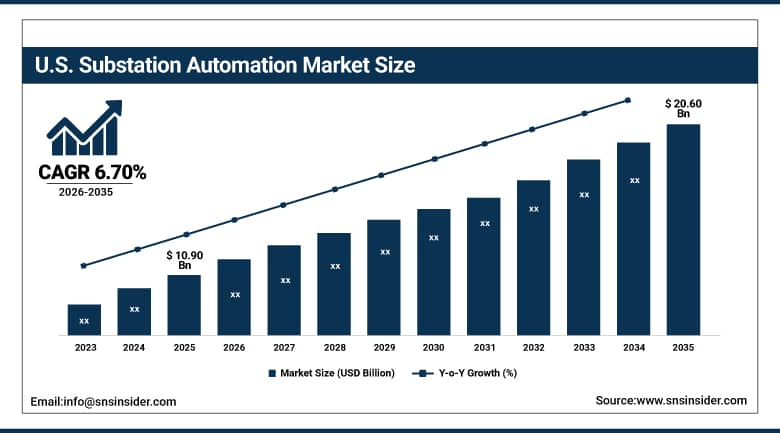
The U.S. Substation Automation Market was valued at approximately USD 10.90 Billion in 2025 and is projected to reach approximately USD 20.60 Billion by 2035, registering a CAGR of approximately 6.70% from 2026 to 2035.
The demand in the U.S. has been boosted by a large-scale investment by utilities in digital substations upgrades, grid modernization requirements associated with renewable power connections and data centers' loads increase, and increased adoption of intelligent electronic devices compliant with IEC 61850 standards by both investor-owned and municipal utilities.
The adoption of AI-powered predictive maintenance and diagnostics solutions played an especially significant role in strengthening the market leadership of substation automation market of the U.S. Moreover, the increased adoption of optical and Ethernet-based communication systems in interconnection queues management and renewable energy integration projects boosted the demand for the solution.
Substation Automation Market Segment Analysis
-
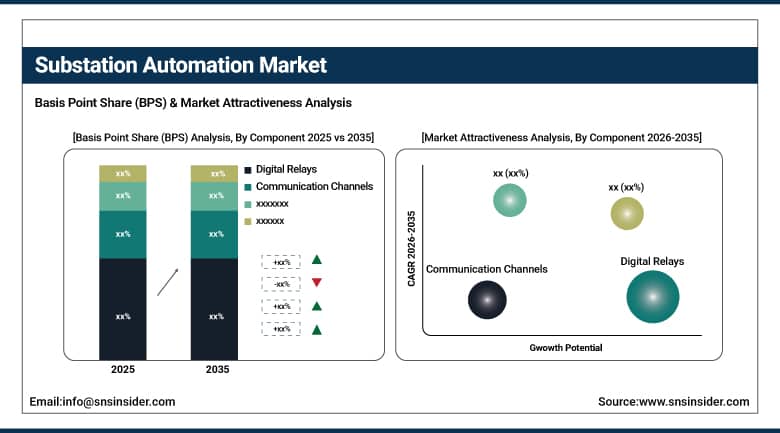
By Component, Digital Relays segment dominated the Market in 2025 with 18.60% share; Communication Channels segment is the fastest growing segment, registering a CAGR of approximately 9.40%.
-
By Module, Communication Network Technology segment dominated the market in 2025 with 40.20% share; SCADA segment is the fastest growing segment, registering a CAGR of approximately 8.70%.
-
By Application, Ethernet segment dominated the market in 2025 with 26.40% share; Optical Fiber Communication segment is the fastest growing segment, registering a CAGR of approximately 9.10%.
-
By End User, Utilities segment dominated the market in 2025 with 58.30% share; Industrial segment is the fastest growing segment, registering a CAGR of approximately 8.20%.
By Component, Digital Relays Dominate While Communication Channels Accelerate Fastest
Digital Relays accounted for the largest market share of about 18.60% in the Substation Automation Market in 2025 on account of their established performance in detecting faults quickly, protecting the system, and enabling automatic switching at substations of the transmission and distribution network. The launch of the SEL-451 protection and automation relay from Schweitzer Engineering Laboratories that provides both bus differential and breaker-failure protection highlights the rationale behind the utilities continuing to invest in digital relay systems before switching to the electromechanical system.
The Communication Channels are forecast to witness a compounded annual growth rate of about 9.40%, which is the fastest growing segment within the Component category, on account of the rising shift of the utilities from copper wire-based to Ethernet and fiber-optic communications networks that enable real-time data transfer between intelligent electronic devices and the control room. The increased need for redundant communication channels in support of IEC 61850 process bus architecture is aiding this growth trend.
By Module, Communication Network Technology Leads While SCADA Grows Fastest
The Communication Network Technology module accounted for the highest market share in 2025 at roughly 40.20% due to its crucial importance in the connections made between sensors, intelligent electronic devices, and control systems in highly digitized substation designs. Increased trust by utilities in IEC 61850 process-bus networks and redundant fiber optic rings has led to a continued focus on investing in communication network technology modules as the key components linking all processes for protection, control, and monitoring in substations.
The SCADA module is expected to be the fastest-growing module with a CAGR of approximately 8.70% in the coming years due to increased demand by utilities for real-time monitoring and alarm management, as well as remote-control functionality across geographically distributed substation fleets. The vendors are constantly making improvements towards SCADA interoperability with intelligent electronic devices and other platforms.
By Application, Ethernet Dominates While Optical Fiber Grows Fastest
Ethernet had the highest market share in terms of applications with a share of around 26.40% in 2025 as Ethernet is considered as the most suitable communication technology for faster and reliable communication among intelligent electronic devices, programmable logic controllers, and SCADA systems in modern substations. The use of IEC 61850 protocols, reduced latency rates, and ease of integration with existing IT infrastructure made Ethernet the right choice for utility companies that are upgrading their communication network in substations.
Optical Fiber Communication is expected to register the highest growth with a CAGR of about 9.10%. It is the fastest-growing application segment in the market as utility companies are adopting optical fiber communication systems for interference-free and long-distance data transmission from substations situated far away from each other. Digital substation systems from platforms such as Hitachi Energy, which use IEC 61850 process bus technology extensively, depend on optical fibers for connectivity.
By End User, Utilities Lead While Industrial Users Gain Fastest Traction
Utilities constituted the most dominant end-user group in 2025 as they represented around 58.30% of the market revenue owing to their direct responsibility for ensuring the reliability of the grid, integrating renewables, and managing huge substation portfolio. The wide spread deployment of automation systems by utilities in North America, Europe, and Asia Pacific due to renewable interconnection backlogs and grid modernization needs represents direct investments in the digital substations as an essential part of smart grid initiatives of transmission and distribution companies.
The industrial end users were expected to witness fastest growth at a CAGR of around 8.20%. This was attributed to increasing usage of substation automation among industrial establishments such as steel plants, oil and gas facilities, mines and manufacturing industries that wanted uninterrupted supply of electricity. Availability of modular, easy to install automation systems reduced the complexity of installing the digital protection and control in industrial facilities.
Regional Analysis:
|
Region |
Major Country |
Share within Region, 2025 (%) |
|---|---|---|
|
North America |
United States |
83.00% |
|
Europe |
Germany |
34.50% |
|
Asia Pacific |
China |
39.80% |
|
Middle East and Africa |
Saudi Arabia |
27.20% |
|
Latin America |
Brazil |
33.40% |
North America Substation Automation Market Insights
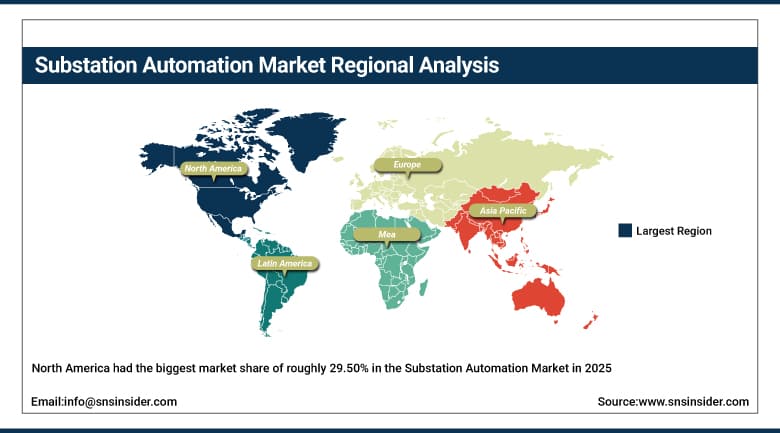
North America had the biggest market share of roughly 29.50% in the Substation Automation Market in 2025, mainly due to extensive investments made by utilities on digital substation upgrades, robust government support for improving grid resilience and modernizing projects, and the presence of top automation vendors in the region. The synergy created by utilities, system integrators, and technology companies along with increased interconnections of renewable energy and growth in loads at data centers contributed to the dominance of North America in the forecast period.
The U.S. contributed approximately 83.00% to the total revenue share of North America owing to fast-paced installations of IEC 61850 compliant digital substations within the investor-owned utilities and rising incentives from the federal and state governments to modernize the grids, along with a higher need for predictive maintenance and diagnostic software among utilities owning aged transmission and distribution assets along with renewable interconnections.
Get Customized Report as Per Your Business Requirement - Enquiry Now
Europe Substation Automation Market Insights
Europe accounted for a significant portion of the Substation Automation Market, due to the presence of supportive regulations and guidelines, decarbonization efforts, and increased investments in cross-border power grid synchronization infrastructure. The presence of a standardized framework of grid codes along with mandates for renewable integration in the member nations has resulted in utilities in Europe opting for vendor-neutral automation platforms, compliant with the IEC 61850 standard, which is able to support modernization programs for both T&D.
In terms of revenue generation, Germany was leading the European market due to the rapid digitalization of the nation through its energy transition program, and the increasing need for space-saving substation automation systems. The United Kingdom contributed significantly to regional demand because of its automated distribution networks and renewable energy integration programs.
Asia Pacific Substation Automation Market Insights
Asia Pacific is anticipated to emerge as the fastest-growing region with a projected CAGR of about 7.80% during 2026-2035. The rapid growth in the region has been primarily driven by the rapid rate of urbanization and industrialization that increases the demand for electricity in countries, such as China and India, substantial government investments in grid modernization and rural electrification projects, and increased adoption of renewable energy capacity necessitating automation and control solutions.
In Asia Pacific, China constituted the largest share of revenue of about 39.80% due to substantial government investment in the development of smart grids and increased domestic manufacturing capabilities for automation software and hardware solutions. The rapid electrification and smart grid missions in India backed by government-funded projects were behind the accelerated growth in the Asia Pacific region.
MEA and Latin America Substation Automation Market Insights
Steady growth in the Middle East & Africa and Latin America was attributed to the increasing investments in the development of smart city projects and grid infrastructure, renewable diversification initiatives backed by government support, and increasing cooperation between local utilities and automation technology companies. The growing need for efficient power distribution coupled with an increase in renewables installations, which requires monitoring and control, has made the two regions attractive markets for substation automation solutions for the next ten years.
In the Middle East & Africa, Saudi Arabia emerged as the leading country in terms of regional demand due to significant investments in smart grids that form part of energy diversification initiatives in the country, while the UAE gained regionally due to modernization of utilities. In Latin America, Brazil became the largest market due to its advanced transmission system as well as increased demand for predictive maintenance and IoT-based monitoring of substations.
Market Dynamics:
Growth Drivers: Rising Grid Modernization and Reliability Requirements
Market progression comes from rising need for consistent power availability, investments by utility companies in smart grids technology and substations that comply with IEC 61850 standards, increased interconnection of renewables needing flexible automated control, and replacement of aging electromechanical components. Considering increasing announcements for modernization of grids by utility companies and governments, demand for substation automation will be on the rise during the forecast period.
Other drivers include the increasing collaboration of substation automation vendors and grid operators and funding by governments in several regions for the development of smart grid infrastructure. Another important driver behind increasing demand and growth momentum during the forecast period is the focus worldwide on improving fault response and outage duration along with infrastructure upgrades without expensive reconstruction.
Restraints: High Deployment Costs and Cybersecurity Complexity
The comparatively higher initial cost that would be incurred in the installation of intelligent electronic devices, SCADA systems, and communication networks is one of the reasons why their adoption has been slower in the market, especially among smaller players who do not have substantial budgets. With the increasing number of digitized and networked substations, there is an increased threat of cyber-attacks, necessitating even more investment into firewalls, intrusions detection and prevention, and access control mechanisms.
Another issue that arises when automating substations is in the compatibility of the existing electromechanical devices and the SCADA systems with the newly installed automated devices, and this often involves costly retrofits and engineering efforts, as well as difficulties in finding enough automation engineers in light of the existing scarcity of this type of specialists.
Opportunities: Renewable Integration and Grid Security Enhancement
The increasing use of renewable energy sources, microgrids, and decentralized power generation creates an opportunity for those vendors who can supply automation systems that can sustain the process of operation and integration of solar, wind, and energy storage into the power grid. The platform solutions supplied by vendors such as Hitachi Energy and Siemens AG, involving AI-based asset management along with digital protection and control, are examples of vendor opportunities that result from the expansion of the workflow.
Increasing cybersecurity threat to critical infrastructures opens another opportunity for vendors who can prove their value through advanced monitoring of the process, early fault detection, and remote access security. The vendors who can prove their value through security architecture and reduce exposure to risks and improve incident response will be well positioned to receive investments for their work.
Recent Developments:
-
2025: Siemens AG introduced an upgraded SICAM automation platform featuring expanded IEC 61850 process-bus support for digital substation retrofit projects.
-
2025: NovaTech, LLC enhanced its Orion platform with expanded intelligent electronic device interoperability, targeting utilities managing multi-vendor substation automation architectures.
-
2026: Hitachi Energy launched a digital substation pilot project with Türkiye Electricity Transmission Corporation to validate IEC 61850 process-bus integration alongside traditional substation architecture.
-
2026: Cisco Systems expanded its Catalyst IE series industrial networking portfolio with substation-hardened switches supporting Ethernet-based intelligent electronic device connectivity.
Substation Automation Companies are:
-
Siemens AG
-
ABB Ltd.
-
Hitachi Energy Ltd.
-
GE Vernova Inc.
-
Honeywell International Inc.
-
Eaton Corporation plc
-
Schweitzer Engineering Laboratories, Inc.
-
NovaTech, LLC
-
Mitsubishi Electric Corporation
-
Toshiba Corporation
-
Texas Instruments Incorporated
-
Itron Inc.
-
Ingeteam S.A.
-
Trilliant Inc.
-
CG Power and Industrial Solutions Limited
-
Landis+Gyr Group AG
-
OMICRON electronics GmbH
-
Emerson Electric Co.
Substation Automation Market Report Scope:
| Report Attributes | Details |
|---|---|
| Market Size in 2025 | USD 44.50 Billion |
| Market Size by 2035 | USD 84.10 Billion |
| CAGR | 6.50% from 2026 to 2035 |
| Base Year | 2025 |
| Forecast Period | 2026-2035 |
| Historical Data | 2022-2024 |
| Report Scope & Coverage | Market Size, Segments Analysis, Competitive Landscape, Regional Analysis, DROC & SWOT Analysis, Forecast Outlook |
| Key Segments | •By Component, Digital Relays segment dominated the Market in 2025 with 18.60% share; Communication Channels segment is the fastest growing segment, registering a CAGR of approximately 9.40%. •By Module, Communication Network Technology segment dominated the market in 2025 with 40.20% share; SCADA segment is the fastest growing segment, registering a CAGR of approximately 8.70%. •By Application, Ethernet segment dominated the market in 2025 with 26.40% share; Optical Fiber Communication segment is the fastest growing segment, registering a CAGR of approximately 9.10%. •By End User, Utilities segment dominated the market in 2025 with 58.30% share; Industrial segment is the fastest growing segment, registering a CAGR of approximately 8.20%. |
| Regional Analysis/Coverage | North America (US, Canada), Europe (Germany, UK, France, Italy, Spain, Russia, Poland, Rest of Europe), Asia Pacific (China, India, Japan, South Korea, Australia, ASEAN Countries, Rest of Asia Pacific), Middle East & Africa (UAE, Saudi Arabia, Qatar, South Africa, Rest of Middle East & Africa), Latin America (Brazil, Argentina, Mexico, Colombia, Rest of Latin America). |
| Company Profiles | Schneider Electric SE, Siemens AG, ABB Ltd., Hitachi Energy Ltd., GE Vernova Inc., Honeywell International Inc., Cisco Systems, Inc., Eaton Corporation plc, Schweitzer Engineering Laboratories, Inc., NovaTech, LLC, Mitsubishi Electric Corporation, Toshiba Corporation, Texas Instruments Incorporated, Itron Inc., Ingeteam S.A., Trilliant Inc., CG Power and Industrial Solutions Limited, Landis+Gyr Group AG, OMICRON electronics GmbH, Emerson Electric Co. |

Frequently Asked Questions
Key players in the Substation Automation Market include Schneider Electric SE, Siemens AG, ABB Ltd., Hitachi Energy Ltd., and GE Vernova Inc., among others.
Key opportunities in the Substation Automation Market include expansion of renewable energy integration and microgrid-enabled substations, alongside growing demand for enhanced grid cybersecurity and AI-driven predictive maintenance solutions.
The market is driven by increasing demand for consistent and reliable power supply, rising utility investment in smart grid technologies, and growing replacement of aging electromechanical infrastructure with IEC 61850-compliant digital substations.
The Digital Relays segment dominated the Substation Automation Market, accounting for approximately 18.60% market share.
The North America region dominated the Substation Automation Market in 2025 with a 29.50% share, driven by extensive utility investment in digital substation retrofits and strong grid resilience funding.
