
Surgical Instrument Reprocessing Automation Market Report Scope & Overview:
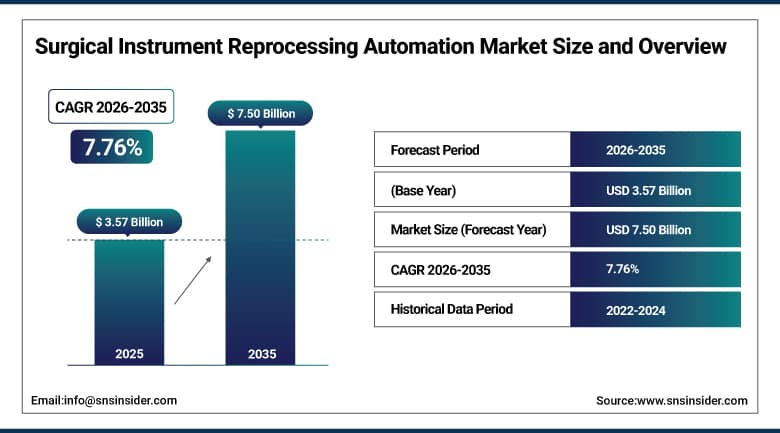
Surgical Instrument Reprocessing Automation Market was valued at USD 3.57 billion in 2025 and is expected to reach USD 7.50 billion by 2035, growing at a CAGR of 7.76% from 2026-2035.
The Surgical Instrument Reprocessing Automation Market is growing steadily because of increased surgical operations, focus on preventing infections, and the requirement of effective and standard processing of instruments. These systems allow healthcare organizations to improve the cleaning, disinfection, sterilization, and tracking of the instruments with minimal human interference and standardization of the processes. The increasing worries about healthcare-associated infections are also helping the market grow. Increased spending on healthcare, increasing number of hospitals and ASCs, and developments in the automated washer disinfectors, endoscope reprocessor, and tracking systems are also helping the market to grow.
⮞In December 2025, Getinge introduced Automatiq, a modular sterile-reprocessing automation platform combining autonomous mobile robots, automated loading systems, intelligent conveyors, and workflow software. The solution is designed to reduce manual instrument handling and improve efficiency across central sterile supply departments (CSSDs).
To Get More Information On This Market - Request Free Sample Report
Surgical Instrument Reprocessing Automation Market Trends
-
Rising surgical volumes and increasing instrument workloads are driving demand for automated reprocessing systems that improve efficiency, consistency, and throughput.
-
Growing concerns regarding healthcare-associated infections are encouraging hospitals to adopt automated cleaning, disinfection, sterilization, and tracking technologies.
-
Increasing healthcare labor shortages are accelerating automation adoption by reducing manual workload and improving staff productivity across sterile processing departments.
-
Advancements in robotics, artificial intelligence, and automated tracking are enhancing process accuracy, instrument identification, workflow monitoring, and quality control.
U.S. Surgical Instrument Reprocessing Automation Market Outlook
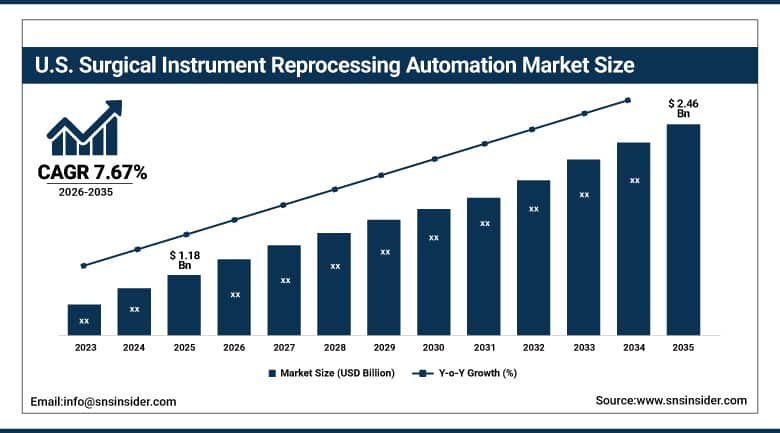
U.S. Surgical Instrument Reprocessing Automation Market was valued at USD 1.18 billion in 2025 and is expected to reach USD 2.46 billion by 2035, growing at a CAGR of 7.67% from 2026-2035.
The U.S. Surgical Instrument Reprocessing Automation Market is experiencing continuous growth as a result of increased surgical procedures, heightened awareness about the importance of infection control, and the need for efficient instrument reprocessing. More institutions are embracing automation to ensure that the process of cleaning, disinfection, sterilization, and instrument tracking is done effectively while at the same time minimizing human intervention. Increased fear of healthcare associated infections and the strictness of infection control protocols are additional factors driving adoption. Other factors that are propelling the growth of this market include the growth in hospitals and ambulatory surgical centers, increased health care spending, and advances in washer-disinfectors, endoscope reprocessors, and instrument tracking systems.
⮞In April 2025, RAD Technology Medical Systems and Belimed announced the first installation of their FlexSPD modular sterile processing facility for the U.S. Defense Health Agency. Equipped with washer-disinfectors, sterilizers, and other processing equipment, the facility was deployed to maintain surgical instrument reprocessing capacity during hospital renovation.
Surgical Instrument Reprocessing Automation Market Segment Analysis
-
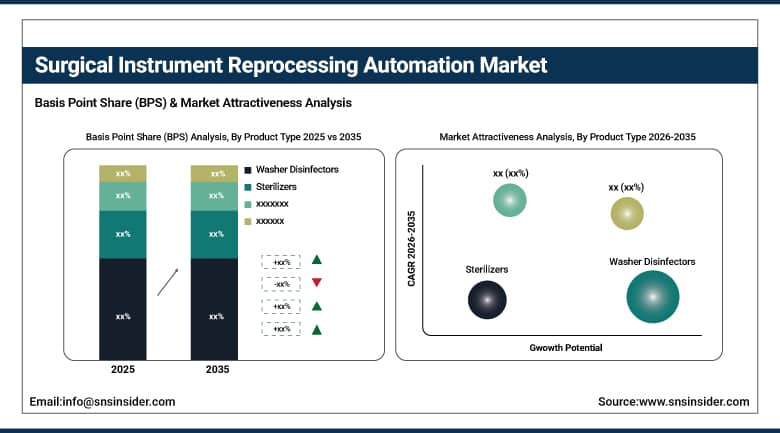
By Product Type, Washer Disinfectors dominated the Surgical Instrument Reprocessing Automation Market with 31% share in 2025; Automated Endoscope Reprocessors are expected to grow at the fastest CAGR of 9.51% from 2026–2035.
-
By Process, Sterilization dominated the Surgical Instrument Reprocessing Automation Market with 36% share in 2025; Sterilization is expected to grow at the fastest CAGR of 8.44% from 2026–2035.
-
By End-User, Hospitals dominated the Surgical Instrument Reprocessing Automation Market with 65% share in 2025; Ambulatory Surgical Centers are expected to grow at the fastest CAGR of 9.08% from 2026–2035.
By Product Type, Washer Disinfectors dominates the surgical instrument reprocessing automation market, Automated Endoscope Reprocessors grow fastest.
Washer Disinfectors segment dominated the Surgical Instrument Reprocessing Automation Market with the highest revenue share of about 31% in 2025 because of rising demands for automatic washing and sterilization of reusable surgical instruments. They offer less manual work and more efficient process flow. Increased numbers of surgical procedures and increased investments in healthcare are also contributing to their rising usage worldwide.
Automated Endoscope Reprocessors segment is expected to grow at the fastest CAGR of 9.51% from 2026-2035 because of increased use of endoscopic techniques and increasing focus on standardization, automation, and efficiency of reprocessing systems. Such systems help decrease risks of contamination while improving efficiency and turnaround time. Growth in number of minimally invasive techniques, endoscopies, and stricter infection control needs will drive adoption worldwide.
⮞In November 2025, Getinge launched the Aquadis 44 washer-disinfector, featuring adaptive water filling that automatically adjusts water and detergent use according to the load. The technology demonstrates continued innovation in automated instrument cleaning, with an emphasis on consistent processing and lower resource consumption.
By Process, Sterilization dominates the surgical instrument reprocessing automation market and grows fastest.
Sterilization segment dominated the Surgical Instrument Reprocessing Automation Market with the highest revenue share of about 36% in 2025 as it is extremely important for killing the microbes from reusable surgical instruments. Sterilization equipment helps to ensure efficient processing and higher traceability. The rising numbers of surgeries and the increasing investments in healthcare facilities increase the demand for automation of sterilization equipment.
Sterilization segment is expected to grow at the fastest CAGR of 8.44% from 2026-2035 As a result of an increase in the number of surgeries being conducted, stricter infection control norms, and increasing use of automated sterilization equipment. Increasing worries about health-care associated infections and construction of additional surgical facilities will boost demand for automated sterilization products around the world.
⮞In April 2026, STERIS launched the VHP LTS60 Low Temperature Sterilizer in North America, using vaporized hydrogen peroxide technology for terminal surface sterilization of heat-sensitive materials. The launch illustrates continued development of automated low-temperature sterilization technologies.
By End-User, Hospitals dominates the surgical instrument reprocessing automation market, Ambulatory Surgical Centers grow fastest.
Hospitals segment dominated the Surgical Instrument Reprocessing Automation Market with the highest revenue share of about 65% in 2025 automated due to high number of surgeries, many reusable instruments, and established sterile processing departments. Efficient automation is necessary in hospitals in order to ensure that the instruments remain safe and quality throughout the process. Higher costs associated with healthcare, surgical volume, and increased infection control needs reinforce automation.
Ambulatory Surgical Centers segment is expected to grow at the fastest CAGR of 9.08% from 2026-2035 Due to the increase in outpatient surgery and rising need for fast instrument turnover. Automated reprocessing systems are becoming increasingly popular in ASCs. Growth in outpatient healthcare facilities, shortened hospital stay, and cost-effective surgical care will facilitate their acceptance in other countries as well.
⮞In January 2026, SteelcoBelimed highlighted an endoscopy reprocessing equipment modernization project at James Cook Hospital in the United Kingdom, undertaken with its local partner iM Med. The project involved washer-disinfector technology and a connection system designed to support efficient instrument processing.
Regional Analysis
|
Region |
Major Country |
Share within Region, 2025 (%) |
|---|---|---|
|
North America |
United States |
91.0% |
|
Europe |
Germany |
23.5% |
|
Asia Pacific |
China |
39.5% |
|
Middle East & Africa |
UAE |
15.0% |
|
Latin America |
Brazil |
34.5% |
North America Surgical Instrument Reprocessing Automation Market Insights
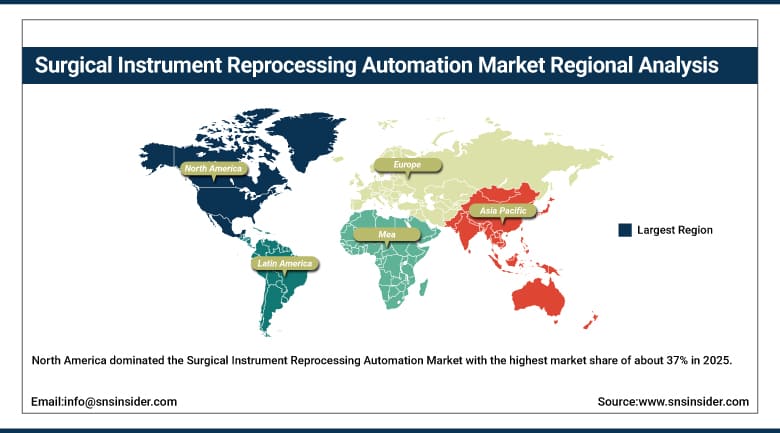
North America dominated the Surgical Instrument Reprocessing Automation Market with the highest market share of about 37% in 2025, The factors driving growth include the presence of an advanced healthcare infrastructure, large volumes of surgeries conducted, and rigorous infection control measures. Automation of reprocessing equipment, patient safety considerations, lack of labor, and investments in hospital automation technology are additional factors contributing to regional market leadership.
The U.S. Surgical Instrument Reprocessing Automation Market accounted for a market share of 91.0%, backed by the presence of sophisticated healthcare facilities, large number of surgeries, and strict standards regarding infection control. The increasing use of automated sterilization and reprocessing systems has been enhancing the efficiency and safety for patients. The modernization of hospitals, shortage of staff, technological improvements, and huge investments in healthcare automation have been fueling the market.
⮞In August 2026, STERIS announced a USD 600 million investment in a new formulated chemistries manufacturing and distribution center in North Carolina. The facility will support the production of infection-prevention and contamination-control chemistries used across healthcare and pharmaceutical applications, strengthening the domestic supply infrastructure supporting reprocessing activities.
Get Customized Report as Per Your Business Requirement - Enquiry Now
Europe Surgical Instrument Reprocessing Automation Market Insights
Europe Surgical Instrument Reprocessing Automation Market is experiencing constant growth backed by its strong healthcare system infrastructure, large number of surgical procedures, and infection control regulations. The usage of automated sterilization and reprocessing devices has increased efficiency and reliability of the process, while the trend of hospital renovation, healthcare automation spending, lower cost of labor, and standardization of instrument processing is driving market growth in Europe.
The Germany Surgical Instrument Reprocessing Automation Market accounted for a market share of 23.5%, These include a well-developed healthcare infrastructure, quality infection control practices, and increased surgeries. Increasing adoption of automated sterilization and instrument processing systems is expected to fuel demand. The need for hospital upgrades, strong regulatory requirements, labor costs, and efficient healthcare technology investment will propel growth in the market in Germany.
⮞In July 2025, Switzerland-based SteelcoBelimed opened its Innovation Hub in Zug, strengthening its European infrastructure for developing cleaning, disinfection, and sterilization solutions. The investment demonstrates continued technology development among European suppliers serving hospital sterile-processing departments, including those in Germany.
Asia Pacific Surgical Instrument Reprocessing Automation Market Insights
Asia Pacific is expected to grow at the fastest CAGR of about 8.87% from 2026–2035, These factors are supported by increased healthcare infrastructure, growing number of surgeries performed, and heightened awareness regarding infection prevention. Hospital modernization, automation in sterilization process, healthcare spending, and government measures aimed at improving the quality of healthcare in China, India, Japan, and South Korea are fueling market growth in the region.
The China Surgical Instrument Reprocessing Automation Market accounted for a market share of 39.5%, backed by the expansion of the health care facilities infrastructure, rising number of surgeries and increased focus on infection prevention. Increasing modernization of hospitals and increasing usage of automated sterilization equipment is boosting the demand. Government healthcare programs, stringent patient safety norms, technology upgradation and spending on medical devices is fueling the market growth in China.
⮞In June 2026, SteelcoBelimed announced that In Vitro Technologies would become its exclusive distributor across Australia and New Zealand, effective from January 2026. The agreement expands regional access to cleaning, disinfection, and sterilization equipment, reflecting efforts by international suppliers to strengthen their Asia-Pacific distribution networks.
Middle East & Africa and Latin America Surgical Instrument Reprocessing Automation Market Insights
The Middle East & Africa and Latin America Surgical Instrument Reprocessing Automation Market It is slowly gaining momentum owing to advancements in the health care sector, increase in surgical operations, and increased awareness of infection control. Increased spending on hospital modernization and sterilization systems, government’s health care programs, establishment of more health care facilities, patient safety demands, and increased use of sophisticated medical equipment have provided impetus to the regional market.
The UAE Surgical Instrument Reprocessing Automation Market accounted for a market share of 15.0%, This is facilitated by improved healthcare infrastructure, increased surgical facilities, and greater focus on infection control. Investments made in hospital automation and sterilization technology are facilitating this. The government’s efforts to develop healthcare facilities, increased safety standards for patients, and high demand for efficient instrument processing are driving market growth in the UAE.
⮞In 2025, Abu Dhabi's Department of Health issued a medical-device safety circular that included the Getinge 88-5 washer-disinfector among listed products. The notice highlights the importance of equipment surveillance and regulatory oversight for technologies used in healthcare instrument reprocessing.
Market Dynamics
Growth Drivers: Increasing surgical volumes and stringent infection-control requirements are accelerating adoption of automated instrument reprocessing systems globally
Growing surgical procedure volumes are significantly increasing demand for efficient and standardized surgical instrument reprocessing. Reprocessing of all such instruments should be done in an efficient manner so that they could be used again after proper cleaning, disinfection, inspection, packaging, and sterilization. Automated reprocessing systems will standardize these procedures and decrease manual intervention. Growing concern about infections in healthcare settings is another factor leading to improved sterilization capacity of hospitals. Automated instrument washers, disinfectors, sterilizers, and inspection systems may help hospitals achieve better consistency, efficiency, and documentation of the process. In addition to this, increasing requirements of the regulators and improved quality standards also push healthcare providers to use automated validated processes more than manual ones.
⮞In May 2026, the Association for the Advancement of Medical Instrumentation (AAMI) highlighted developments in the reprocessing of robotic surgical instruments at its annual eXchange conference. The discussion emphasized the specialized cleaning, sterilization, and validation challenges associated with increasingly complex reusable robotic instruments.
Restraints: High capital investment and complex infrastructure requirements can limit adoption of automated reprocessing systems among smaller healthcare facilities
High upfront investment remains a significant barrier to adoption of surgical instrument reprocessing automation. In addition, there may be a need to purchase washing-disinfectors, sterilizers, ultrasonic cleaning devices, automatic processing systems, tracking systems, changes to the facility itself, installation, validation, and training of the staff. The cost associated with all this could especially be difficult for small hospitals, ambulatory surgical centers, and other healthcare facilities operating with tight budgets. There will also be the need for regular maintenance, as well as regular software updates and technical support of the automated processing systems. This is something that should be budgeted for not only capital expenses but operating expenses as well.
Opportunities: Increasing demand for automated and integrated sterile-processing workflows creates significant opportunities for advanced reprocessing equipment providers
Healthcare facilities are increasingly seeking integrated workflows that connect cleaning, disinfection, inspection, packaging, sterilization, and sterile-supply management. This presents substantial potential for the suppliers of end-to-end automation as opposed to individual pieces of equipment. Loading and unloading automation solutions can increase efficiency, alleviate bottlenecks, and avoid human error, whereas workflow solutions can increase consistency within processes. Dashboard technology, automated cycle recording, instrument tracking, and integration with hospital information systems can enhance traceability and process management as well. With hospitals upgrading their CSSDs and aiming at increased capacity using minimum human intervention, there are numerous business opportunities available for companies that can provide connected and scalable automation solutions.
⮞In July 2026, RAD Technology Medical Systems and SteelcoBelimed announced a modular sterile-processing installation designed to maintain surgical instrument reprocessing operations during hospital renovation. The project demonstrates opportunities for integrated, flexible sterile-processing infrastructure that can support healthcare facilities during modernization and capacity upgrades.
Recent Developments:
-
2026 : STERIS advanced automated instrument reprocessing solutions integrating cleaning, sterilization, tracking, and workflow technologies to improve efficiency, traceability, standardization, and infection control.
-
2026 : Getinge expanded automated sterile processing solutions with advanced washers, sterilizers, and digital workflow technologies, improving instrument turnaround, process consistency, and operational efficiency.
-
2026 : Belimed strengthened automated cleaning and sterilization technologies with connected equipment and monitoring capabilities, supporting better process documentation, traceability, and workflow efficiency.
-
2026 : Steelco expanded automated surgical instrument and endoscope reprocessing solutions, combining washing, disinfection, sterilization, and digital tracking to improve safety, productivity, and processing consistency.
Surgical Instrument Reprocessing Automation Market key players are:
-
Steelco S.p.A.
-
Miele Group
-
Olympus Corporation
-
Advanced Sterilization Products
-
Tuttnauer Ltd.
-
Aesculap AG, B. Braun
-
Sotera Health Company
-
Skytron LLC
-
Matachana Group
-
Wassenburg Medical
-
SciCan Ltd.
-
Shinva Medical Instrument Co., Ltd.
-
Laoken Medical Technology Co., Ltd.
-
MMM Group
-
Medline Industries, LP
-
Metrex Research, LLC
-
Andersen Products, Inc.
Surgical Instrument Reprocessing Automation Market Report Scope:
| Report Attributes | Details |
|---|---|
| Market Size in 2025 | USD 3.57 Billion |
| Market Size by 2035 | USD 7.50 Billion |
| CAGR | CAGR of 7.76% From 2026 to 2035 |
| Base Year | 2025 |
| Forecast Period | 2026-2035 |
| Historical Data | 2022-2024 |
| Report Scope & Coverage | Market Size, Segments Analysis, Competitive Landscape, Regional Analysis, DROC & SWOT Analysis, Forecast Outlook |
| Key Segments | • By Product Type (Washer Disinfectors, Sterilizers, Automated Endoscope Reprocessors, Ultrasonic Cleaners, Others) • By Process (Cleaning, Disinfection, Sterilization, Others) • By End-User (Hospitals, Ambulatory Surgical Centers, Specialty Clinics, Others) |
| Regional Analysis/Coverage | North America (US, Canada), Europe (Germany, UK, France, Italy, Spain, Russia, Poland, Rest of Europe), Asia Pacific (China, India, Japan, South Korea, Australia, ASEAN Countries, Rest of Asia Pacific), Middle East & Africa (UAE, Saudi Arabia, Qatar, South Africa, Rest of Middle East & Africa), Latin America (Brazil, Argentina, Mexico, Colombia, Rest of Latin America). |
| Company Profiles | STERIS Corporation, Getinge AB, Belimed AG, Steelco S.p.A., Miele Group, Olympus Corporation, Advanced Sterilization Products, Tuttnauer Ltd., Aesculap AG, B. Braun, Sotera Health Company, Skytron LLC, Matachana Group, Wassenburg Medical, SciCan Ltd., Shinva Medical Instrument Co., Ltd., Laoken Medical Technology Co., Ltd., MMM Group, Medline Industries, LP, Metrex Research, LLC, and Andersen Products, Inc. |

Frequently Asked Questions
The Surgical Instrument Reprocessing Automation Market is expected to grow at a CAGR of 7.76% from 2026 to 2035.
The major growth factor is rising surgical volumes and stringent infection-control requirements, driving healthcare facilities to adopt automated reprocessing systems that reduce manual errors, improve efficiency, and ensure consistent sterilization.
North America dominated the Surgical Instrument Reprocessing Automation Market in 2025.
