
Substation Wide Area Monitoring Systems Market Report Scope and Overview:
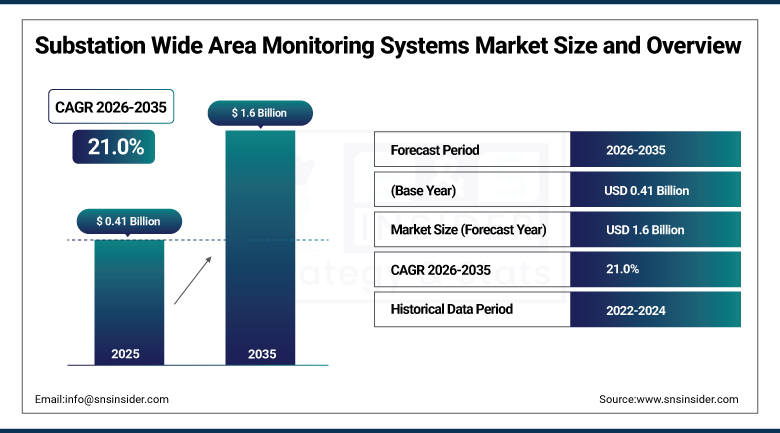
The Substation Wide Area Monitoring Systems Market was valued at USD 0.41 Billion in 2025 and is projected to reach USD 1.6 Billion by 2035, registering a CAGR of 21.0% from 2026 to 2035.
Substation Wide Area Monitoring Systems Market is revolutionizing the visibility of the transmission and distribution network through the installation of GPS-synchronized Phasor Measurement Units, Phasor Data Concentrators, and communication technologies that offer real-time, wide area situational awareness of geographically separated substations. The market is defined by increasing incidents of grid instability due to the use of intermittent renewable energy sources, increasing development of high voltage power grids, increasing use of synchrophasor systems for capturing disturbances and estimating states, and the increasing use of synchrophasors in fault detection, protection against islanding, and prevention of cascading failures. Increasing deployments of synchrophasor systems, system integration activities of utilities and vendors, and launches of analytics platforms have been observed owing to significant investments.
In 2026, Hitachi Energy further develops its Network Manager WAMS software that combines wide area monitoring and SCADA/EMS to give control room operators increased visibility of the grid and manage grid conditions proactively.
To Get more information On Substation Wide Area Monitoring Systems Market - Request Free Sample Report
Substation Wide Area Monitoring Systems Market Trends
-
Expanding deployment of GPS-synchronized phasor measurement units continues improving real-time visibility across interconnected transmission networks.
-
Growing integration of AI-enabled synchrophasor analytics continues accelerating disturbance detection and cascading failure prevention.
-
Rising utility investment in high-voltage network expansion continues strengthening demand for wide-area situational awareness platforms.
-
Increasing renewable energy penetration continues driving adoption of PMU-based islanding detection and grid stability monitoring.
-
Growing embedding of PMU functionality within protection relays continues lowering deployment costs and accelerating utility adoption.
U.S. Substation Wide Area Monitoring Systems Market Outlook
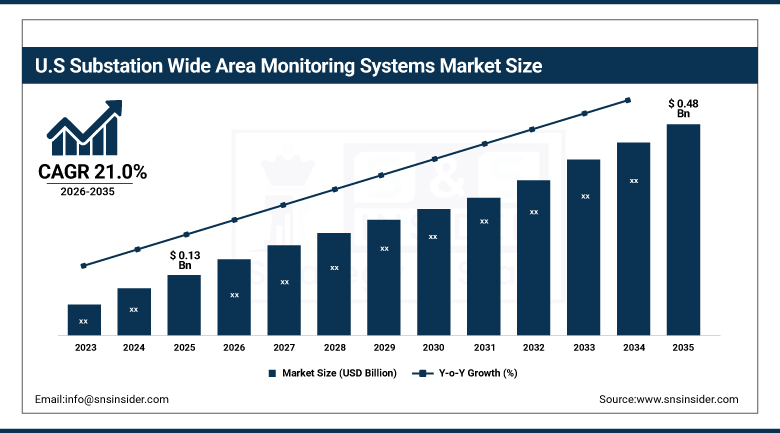
The U.S. Substation Wide Area Monitoring Systems Market was valued at USD 0.13 Billion in 2025 and is projected to reach approximately USD 0.48 Billion by 2035, registering an indicative CAGR of 21.0% from 2026 to 2035.
The U.S. demand was also fueled by the huge investments made by utilities in synchrophasor infrastructure in the country’s bulk power systems, government initiatives for improving the resilience of the power grid and preventing blackouts, and the rising demand for real-time wide-area monitoring systems from transmission companies facing higher levels of renewable and distributed generation penetrations. The use of PMU-based disturbance recording and phasor data concentrators in the territories of the independent system operators contributed significantly to the position of the U.S. as the largest market for substation wide area monitoring systems globally. The applications of WAMS in islanding detection, state estimation, and interconnection frequency control were fueling the high domestic demand for this technology.
In 2026, Electric Power Group, U.S.-based Electric Power Group collaborated with Siemens to integrate its synchrophasor analysis technology with Siemens grid automation technologies for improving real-time monitoring and resilience capabilities of U.S. and international power utility companies.
Substation Wide Area Monitoring Systems Market Segment Analysis
-
By Component, Phasor Measurement Units segment dominated the Substation Wide Area Monitoring Systems Market in 2025 with 42% share; Software & Analytics segment is the fastest growing segment, registering a CAGR of 23.4% from 2026 to 2035.
-
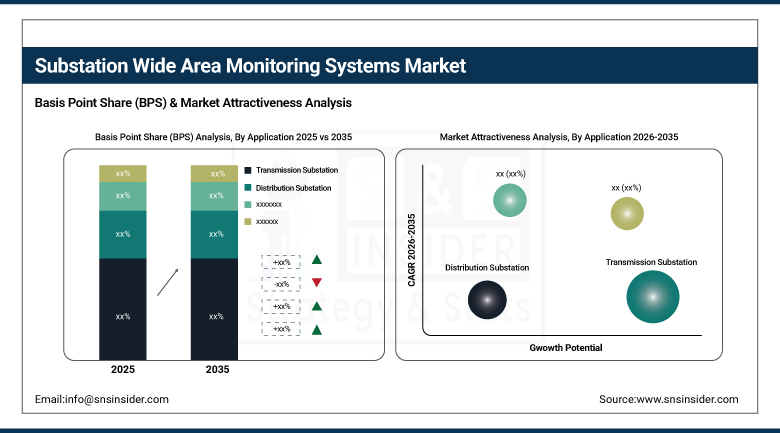
By Application, Transmission Substation segment dominated the market in 2025 with 61% share; Distribution Substation segment is the fastest growing segment, registering a CAGR of 23.0% from 2026 to 2035.
-
By Deployment, New Installation segment dominated the market in 2025 with 57% share; Retrofit segment is the fastest growing segment, registering a CAGR of 23.6% from 2026 to 2035.
-
By Function, Fault Detection & Disturbance Recording segment dominated the market in 2025 with 34% share; Renewable Integration Monitoring segment is the fastest growing segment, registering a CAGR of 24.1% from 2026 to 2035.
-
By End User, Utilities segment dominated the market in 2025 with 76% share; Independent System Operators segment is the fastest growing segment, registering a CAGR of 23.2% from 2026 to 2035.
By Component, Phasor Measurement Units Lead, While Software & Analytics Grow Fastest
Phasor Measurement Units accounted for the major share of Substation Wide Area Monitoring Systems Market in 2025 owing to their core function of acting as the first line of sensor, measuring GPS synchronized voltages and currents in terms of phasors at substations. The all-encompassing range of PMUs offered by Schweitzer Engineering Laboratories including in-built PMU functionality of protection relays and meters without any extra cost demonstrates how PMU installations have become an affordable choice for utilities looking to develop wide area monitoring systems, thereby positioning this segment as the top revenue generator.
Software & Analytics segment is anticipated to exhibit the fastest growth in the Substation Wide Area Monitoring Systems Market owing to utilities’ increasing use of AI-powered software solutions to derive value out of the increased amount of synchrophasor data. The Big Data Synchrophasor Analysis project by the U.S. Department of Energy dealing with the huge amounts of data generated through the installation of over 2,500 PMUs on the country’s bulk power systems indicates a growing need for analytics software solutions.
By Application, Transmission Substation Leads, Distribution Substation Grows Fastest
In 2025, the majority of spending in the Substation Wide Area Monitoring Systems Market was on Transmission Substation applications owing to the importance of high voltage transmission systems in keeping the bulk power system stable and avoiding the occurrence of cascading events. The use of PMU-based stability monitoring by National Grid ESO for its high voltage substations highlights the extent to which the deployment of wide area monitoring technology at the transmission level has kept the lion's share of investments.
The Distribution Substation is likely to be fastest growing application as utilities test localized PMU networks to deal with the proliferation of distributed energy resources in distribution networks. Arup and UK Power Networks testing localized PMU networks in the NIC-funded Unified Platform project is an example of utilities' interest in monitoring capability beyond the scope of transmission level substation installations.
By Deployment, New Installation Dominates, Retrofit Grows Fastest
New Installation accounted for the dominant share of the Substation Wide Area Monitoring Systems Market in 2025 the increasing inclusion of PMU and communication system directly into new substation installation and grid extension efforts. Synchrophasor deployments on a large scale related to the nation’s grid resilience programs remain responsible for the largest market share as utilities install monitoring systems in new substation networks from their very beginning.
The Retrofit installation category is expected to grow the fastest due to utilities’ growing need to install the PMU and monitoring system into the existing substations to bridge the visibility gap in aging infrastructure. In addition, the inclusion of the PMU functions in protection relays without any extra costs makes the retrofit installations very cost effective for utilities.
By Function, Fault Detection & Disturbance Recording Leads, Renewable Integration Monitoring Grows Fastest
Fault Detection & Disturbance Recording had the largest market share in the Substation Wide Area Monitoring Systems Market in 2025 due to utilities' attempts to avoid cascading effects and save themselves from outage-related financial losses of about USD 100 billion per year across the world. It is backed by years of engineering practice based on the analysis of synchrophasors and is the most financially supported wide-area monitoring function segment in the utilities' grid reliability programs.
The Renewable Integration Monitoring is the fastest growing one, since utilities are using PMUs more and more often to perform islanding detection and inertia estimation as a result of increasing renewable energy sources penetration. PMUs' usage in interconnection frequency control related to distributed energy resources penetration and storm resilience programs illustrates how important it is to perform renewable integration monitoring.
By End User, Utilities Dominate, Independent System Operators Gain Fastest Traction
Utilities constituted the leading end-user segment in the Substation Wide Area Monitoring Systems Market in 2025 since it is the utilities who are accountable for power grid reliability, disturbances and management of assets in substations. Large scale implementation of synchrophasor technologies through utilities in North America, Europe and Asia Pacific highlights the fact that utilities are incorporating investments in wide-area monitoring technologies as an integral part of their strategies for reliable and resilient power grids.
Independent System Operators are projected to become the fastest growing end-user segments due to increased reliance by regional grid operators on wide area synchrophasor data for coordinating control and automated response operations across multi utility territories. Usage of real-time phasor data for automated control of ISO systems indicates how wide area monitoring technology has evolved into an essential part of inter-regional power grid management and hence growing faster than traditional utility level deployments.
Regional Analysis:
|
Region |
Major Country |
Share within Region, 2025 (%) |
|---|---|---|
|
North America |
United States |
85.00% |
|
Europe |
Germany |
22.30% |
|
Asia Pacific |
China |
34.80% |
|
Middle East and Africa |
Saudi Arabia |
27.60% |
|
Latin America |
Brazil |
31.40% |
North America Substation Wide Area Monitoring Systems Market Insights
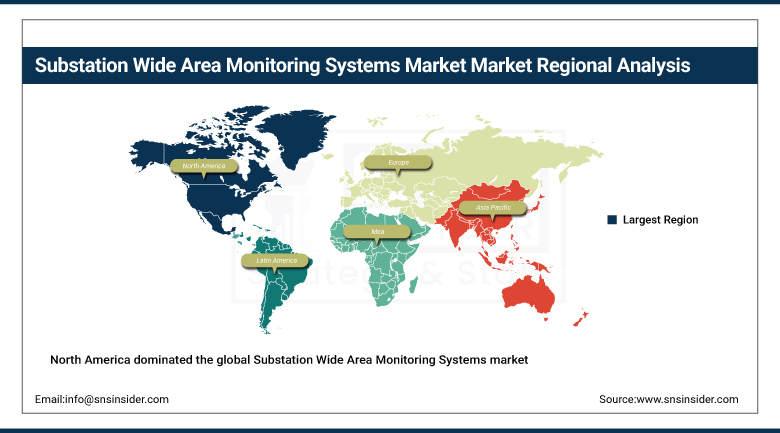
North America dominated the global Substation Wide Area Monitoring Systems market, accounting for the highest market share of 36.0% in 2025. Key factors driving the expansion included significant investments made in synchrophasor infrastructure in the bulk power systems of the country, robust backing from the federal government for various resilience programs to prevent blackouts, and presence of major manufacturers of PMU and protection relay manufacturers in the region. The active cooperation between the utilities and local suppliers of synchrophasors further contributed to the leadership position of North America.
The U.S. accounted for majority of North America's total revenue share owing to extensive adoption of embedded PMU technology of Schweitzer Engineering Laboratories in the country, with more than 2,500 installations of phasor measurement units in the bulk power systems of the country through various U.S. Department of Energy initiatives for synchrophasor analysis. Further growth of the funding for grid resilience in Canada aided the region contribute to North America's dominance in the market.
Get Customized Report as per Your Business Requirement - Enquiry Now
Europe Substation Wide Area Monitoring Systems Market Insights
Europe continued to hold a sustainable market share of revenues generated from Substation Wide Area Monitoring Systems Market globally due to advanced power infrastructure, high-level adoption of smart grids technology, and increasing PMU-based stability monitoring deployments in the transmission networks of the region. The rising importance of the reliability of interconnections has also been an impetus for grid operators in the region to invest in wide-area synchrophasor visibility systems.
Germany was the leading country in terms of market demand owing to the extensive investment by transmission system operators in synchrophasors, as part of the efforts towards expanding renewable energy capacity in the country. In the United Kingdom, the market demand has been boosted by the deployment of PMU-based stability monitoring in high-voltage substations by National Grid ESO and by the NIC-backed project of the Unified Platform localized PMU network.
Asia Pacific Substation Wide Area Monitoring Systems Market Insights
The Asia Pacific region records the fastest-growing rate of 11.8% CAGR due to mega-infrastructure construction, increase in energy demands, and initiatives from governments to upgrade their aging power grids and incorporate large-scale solar and wind energy capacity. It is anticipated that India and China are going to take up more than 40% of the expected market size due to their rapidly growing renewable capacities and investments in the transmission networks in the region.
China dominated this market due to high investments in the upgrading of the power grids and increase in the production of synchrophasors. The other important countries include India due to its installation of wide-area monitoring systems for the fast-growing solar and wind capacities, and Japan and South Korea due to their well-developed power grids focused on smart grids.
MEA and Latin America Substation Wide Area Monitoring Systems Market Insights
The Middle East and Africa and Latin America both showed steady growth in the Substation Wide Area Monitoring Systems Market demonstrated a stable increase due to increasing investments in grid infrastructure modernization projects, government diversification initiatives of renewable energy resources, and partnership between local utilities companies and vendors of synchrophasors technology, even though both regions are still lagging behind North America, Europe, and APAC in terms of adoption of the system.
In the ME&A region, the largest national market in terms of revenues became Saudi Arabia, which is related to high investments in the development of the grid infrastructure connected with the national solar and renewable energy diversification initiatives. At the same time, in the LATAM region, the leader in terms of revenues was Brazil due to the large number of transmission grids within the country.
Market Dynamics:
Growth Drivers: Rising Grid Instability Events and Expanding High-Voltage Network Investment
The market is growing as there is an increase in grid instability incidents caused by the presence of intermittent renewable energy resources, rise in investments in high voltage grid infrastructures, increase in substation automation programs, and an increasing number of applications such as fault detection, load balancing, and preventing cascading failures. With more and more utilities coming up with a roadmap in order to achieve grid resiliency and prevent outages, the demand for synchrophasor visibility is anticipated to be strong in the supply chain, considering that financial losses related to outage have been over USD 100 billion annually globally.
Integrations made between PMU manufacturers and protection relays vendors along with growing utility commitment towards embedded synchrophasor capabilities before stringent grid reliability standards come into existence is additional indication pointing towards the aforementioned trend. Investments made by government in synchrophasor infrastructure and Big Data analytics projects are also adding to the growth of baseline deployment capabilities, which together lead to increasing demand.
Restraints: High Initial Investment and Legacy System Integration Complexity
The high cost of the initial investment needed for WAMS deployment remains an actual obstacle preventing more rapid growth of the market due to the significant expenses associated with the cost of the PMU equipment, communication network, and analytical software that may be quite considerable especially for small utilities or utilities located in developing areas with constrained budgets. As a consequence, the most advanced WAMS deployments have been implemented mainly by large and well-funded transmission utilities and system operators.
Compatibility with legacy systems remains a problem for utilities since many utilities own substations that were not built with the capability of synchronous data transmission using the GPS timing. Solving this problem involves either upgrading or replacement of the existing equipment, which is an ongoing process that may be rather difficult and expensive.
Opportunities: AI-Driven Synchrophasor Analytics and Distribution-Level Expansion
The emergence of AI-powered synchrophasor analysis is an important opportunity amid the increasing demand by utilities to gain actionable insights from the burgeoning repository of PMU data that is being collected through their networks. Providers offering proven and scalable analytics solutions for processing vast amounts of synchronized phasor measurements will be poised to make significant gains as utilities move beyond merely collecting data to predictive grid management and automated disturbance handling.
Another opportunity is the application of wide-area monitoring solutions at the level of distribution substations, which distribution network operators are increasingly testing via local PMU networks amid the increasing integration of distributed energy resources into their systems. Providers offering low-cost PMU solutions for distribution-level installations will make outsized gains amid new market expenditures during the forecast period.
Recent Developments:
-
2026: GE Vernova continues expanding its wide-area monitoring solutions, using synchrophasor technologies to improve system availability, reliability, stability analysis, and operational decision-making across increasingly complex power networks.
-
2025: National Grid ESO implemented PMU-based stability monitoring across high-voltage substations in the UK, extending synchrophasor visibility to strengthen frequency-sensitive grid zones amid rising renewable penetration.
-
2025: Arup and UK Power Networks tested localized PMU networks in urban substations under the NIC-funded Unified Platform project, evaluating distribution-level synchrophasor deployment for growing DER integration needs.
Substation Wide Area Monitoring Systems Market key players are:
-
ABB Ltd
-
Electric Power Group, LLC
-
GE Vernova Inc.
-
Schneider Electric SE
-
Siemens AG
-
Hitachi Energy Ltd.
-
Honeywell International Inc.
-
Toshiba Energy Systems & Solutions Corporation
-
Mitsubishi Electric Corporation
-
Schweitzer Engineering Laboratories, Inc.
-
Arbiter Systems, Inc.
-
Doble Engineering Company
-
NR Electric Co., Ltd.
-
RuggedCom Inc. (a Siemens Company)
-
Itron, Inc.
-
Landis+Gyr Group AG
-
Kalki Communication Technologies Pvt. Ltd. (Kalkitech)
-
NARI Technology Co., Ltd.
-
Eaton Corporation plc
-
Megger Group Limited
Substation Wide Area Monitoring Systems Market Report Scope:
| Report Attributes | Details |
|---|---|
| Market Size in 2025 | USD 0.41 Billion |
| Market Size by 2035 | USD 1.6 Billion |
| CAGR | 21.0% from 2026 to 2035 |
| Base Year | 2025 |
| Forecast Period | 2026-2035 |
| Historical Data | 2022-2024 |
| Report Scope & Coverage | Market Size, Segments Analysis, Competitive Landscape, Regional Analysis, DROC & SWOT Analysis, Forecast Outlook |
| Key Segments |
• By Component (Phasor Measurement Units, Software & Analytics, Phasor Data Concentrators, Communication Networks) • By Application (Transmission Substation, Distribution Substation, Collector Substation, Converter & Switching Station) • By Deployment (New Installation, Retrofit) • By Function (Fault Detection & Disturbance Recording, Renewable Integration Monitoring, Load Balancing & Grid Stabilization, State Estimation & Situational Awareness) • By End User (Utilities, Independent System Operators, industrial) |
| Regional Analysis/Coverage | North America (US, Canada), Europe (Germany, UK, France, Italy, Spain, Russia, Poland, Rest of Europe), Asia Pacific (China, India, Japan, South Korea, Australia, ASEAN Countries, Rest of Asia Pacific), Middle East & Africa (UAE, Saudi Arabia, Qatar, South Africa, Rest of Middle East & Africa), Latin America (Brazil, Argentina, Mexico, Colombia, Rest of Latin America). |
| Company Profiles | ABB Ltd, Electric Power Group, LLC, GE Vernova Inc., Schneider Electric SE, Siemens AG, Hitachi Energy Ltd., Honeywell International Inc., Toshiba Energy Systems & Solutions Corporation, Mitsubishi Electric Corporation, Schweitzer Engineering Laboratories, Inc., Arbiter Systems, Inc., Doble Engineering Company, NR Electric Co., Ltd., RuggedCom Inc. (a Siemens Company, Itron, Inc., Landis+Gyr Group AG, Kalki Communication Technologies Pvt. Ltd. (Kalkitech), NARI Technology Co., Ltd., Eaton Corporation plc, and Megger Group Limited. |

Frequently Asked Questions
Key players include ABB Ltd, Electric Power Group, LLC, GE Vernova Inc., Schneider Electric SE, and Siemens AG, among others.
Key opportunities include increasing grid modernization, renewable energy integration, real-time situational awareness, synchrophasor adoption, predictive grid management, and growing demand for enhanced substation reliability.
The major growth factor is rising grid instability events driven by intermittent renewable generation, expanding high-voltage network investment, and growing utility demand for real-time synchrophasor visibility to prevent cascading failures and reduce outage-related losses.
The Phasor Measurement Units segment dominated the Substation Wide Area Monitoring Systems Market by component, representing the largest share of revenue in 2025.
North America dominated the Substation Wide Area Monitoring Systems Market in 2025, holding an estimated 36.0% share of total market revenue, while Asia Pacific is projected to be the fastest-growing region, registering a CAGR of approximately 11.8% from 2026 to 2035.
