
Substation Network Digital Twin Market Report Scope and Overview:
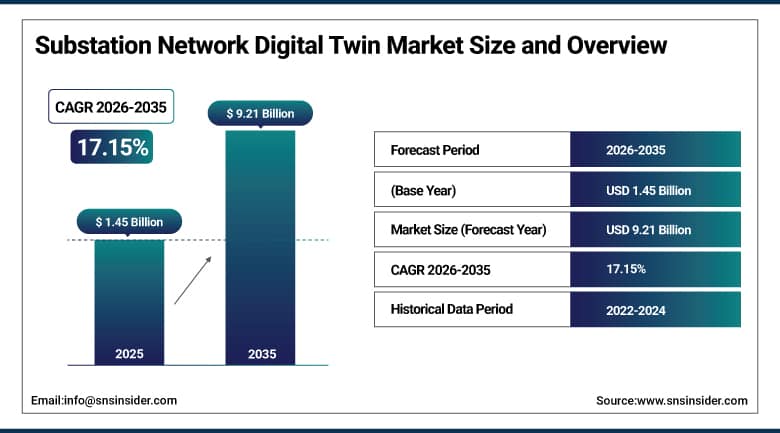
The Substation Network Digital Twin Market was valued at USD 1.45 Billion in 2025 and is projected to reach USD 9.21 Billion by 2035, registering a CAGR of 17.15% from 2026 to 2035.
Substation Network Digital Twin Market is marked by swift smart grid transformation, increasing incorporation of renewable energy sources calling for complete visibility of operations, increasing use of artificial intelligence and machine learning for predictive analytics and diverse applications in utility, industrial and commercial substation networks. Cloud-native architecture of software solutions, cooperation of technology vendors with utilities and increasing capabilities of AI-based predictive analytics emerged after substantial investments made by utilities, industrial companies and commercial entities into enhancing reliability and efficiency of grids.
Substation Network Digital Twin Market allows creating virtual duplicates of substations which help to perform simulation, predictive analysis and planning scenarios to spot potential problems, to maximize the efficiency of assets and minimize downtimes. Utilizing IoT sensors and sophisticated communication protocols, collecting huge volumes of data that is processed through digital twin solutions allows utilities to manage assets in a proactive way and avoid unexpected downtimes.
To Get More Information On Substation Network Digital Twin Market - Request Free Sample Report
Substation Network Digital Twin Market Trends
-
Rising adoption of AI and machine learning continues improving predictive analytics accuracy for substation assets.
-
Growing IoT sensor deployment continues capturing richer operational data for digital twin modeling.
-
Expanding renewable energy integration is broadening demand for real-time grid optimization capabilities.
-
Increasing preference for cloud-native platforms continues simplifying deployment and scalability for smaller utilities.
-
Growing emphasis on interoperability and cybersecurity continues shaping digital twin platform architecture decisions.
U.S. Substation Network Digital Twin Market Outlook
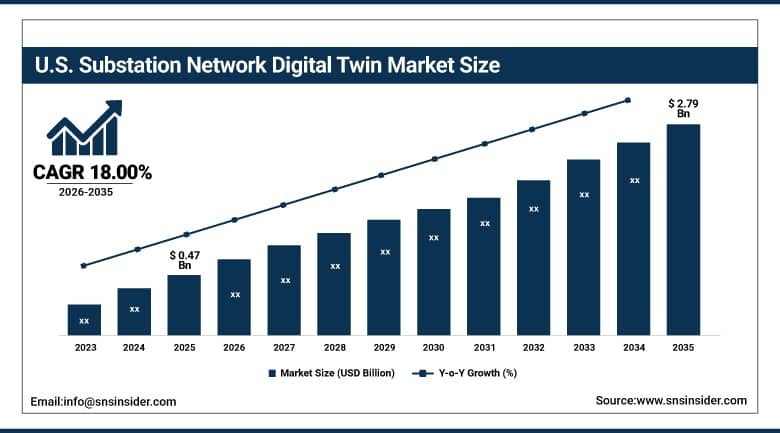
The U.S. Substation Network Digital Twin Market was valued at approximately USD 0.47 Billion in 2025 and is projected to reach approximately USD 2.79 Billion by 2035, registering a CAGR of approximately 18.00% from 2026 to 2035.
High investment in the modernization of electricity grids, smart grid usage, and government regulations promoting digitalization initiatives were key drivers for demand in the U.S. Digital twins of grid assets have been used by leading utility companies to improve the reliability of grids, optimize asset management and renewable energy integration with the help of a mature technology environment and high digital literacy within the utility industry.
AI-based predictive analytics and remote diagnostics software became especially significant tools for strengthening the position of the digital twin market for substations in the U.S. Moreover, deployment of cloud platforms by small and medium utilities became another driver for the growth of the market.
Substation Network Digital Twin Market Segment Analysis
-
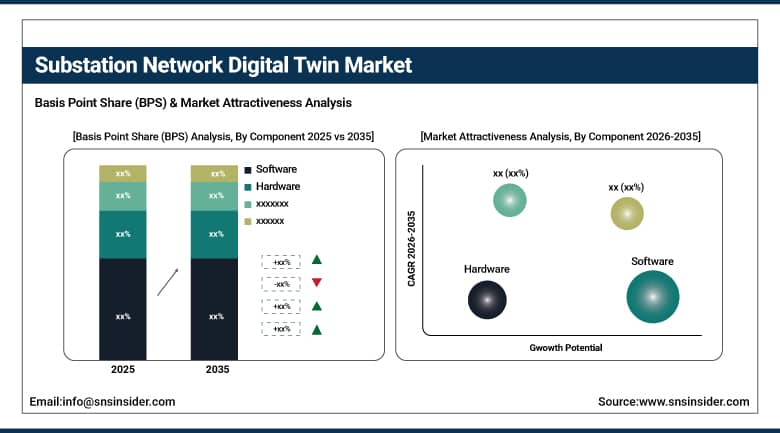
By Component, Software segment dominated the Market in 2025 with 47.80% share; Hardware segment is the fastest growing segment, registering a CAGR of approximately 29.40%.
-
By Application, Asset Management segment dominated the market in 2025 with 29.60% share; Grid Optimization segment is the fastest growing segment, registering a CAGR of approximately 30.80%.
-
By Deployment Mode, On-Premises segment dominated the market in 2025 with 56.40% share; Cloud segment is the fastest growing segment, registering a CAGR of approximately 33.20%.
-
By End User, Utilities segment dominated the market in 2025 with 52.70% share; Industrial segment is the fastest growing segment, registering a CAGR of approximately 28.90%.
By Component, Software Dominates the Substation Network Digital Twin Market While Hardware Grows Fastest
Software accounted for the largest market share in Substation Network Digital Twin Market at around 47.80% in 2025 owing to simulation, visualization and analytics features that are essential for creation of an exact digital twin model of substations. The launch of the AVEVA's predictive analytics platform that brings together real-time data and scenario-based modelling for asset management serves as an example of why utilities and integrators keep giving priority to software investments rather than purchasing of hardware in their new deployments of digital twins.
Hardware is expected to grow at a CAGR of around 29.40%, the highest rate in the Component segment, due to the increasing availability of IoT-enabled sensors and smart devices that greatly increases the accuracy of data collected and used in digital twins. Growing need for highly efficient, robust and secure edge computing solutions fuels this rapid growth even more.
By Application, Asset Management Dominates the Substation Network Digital Twin Market While Grid Optimization Grows Fastest
The share of Asset Management was the highest in 2025 at around 29.60%, due to efforts by utilities and industry to extend the life cycle and efficiency of substation assets through tracking and condition-based monitoring. Digital twins allow for obtaining a comprehensive understanding of the health status and performance of assets, which, in turn, reduces the risks of asset failure and increases capital expenditures efficiency, making this application dominant in the market.
Grid Optimization is expected to grow at a CAGR of around 30.80% and to be the fastest-growing category among applications. The increasing complexity of grids and their decentralization driven by growth in the penetration of renewable and electric vehicle sources makes grid optimization the fastest growing demand driver in the substation digital twins market.
By Deployment Mode, On-Premises Leads the Substation Network Digital Twin Market While Cloud Grows Fastest
On-premises deployment has been the largest deployment mode with about 56.40% market share in 2025 due to the high preference for this model by utilities and industrial players who have very high security and compliance considerations, which necessitate the ability to control data processing, storage, and accessibility. This deployment model is common in places where there are data sovereignty regulations or organizations having legacy IT systems.
The cloud deployment model is expected to record the highest growth rate with CAGR of approximately 33.20% owing to the high need for scalability and flexibility, which allows quick deployment and scalability of the solutions without the need for setting up an elaborate on-premises infrastructure. The increasing trust in cloud technology security and reliability continue to spur adoption among utilities and industrial players.
By End User, Utilities Lead the Substation Network Digital Twin Market While Industrial Grows Fastest
The Utilities were major end-users in 2025, representing about 52.70% of the overall revenue, because of the role that they play in maintaining and managing large and complicated power networks. The implementation of digital twin technologies helps utilities companies improve grid stability, manage assets more efficiently, and facilitates the implementation of renewable power generation under increasing regulatory pressure and higher customer expectations.
Among all end-users, the Industrial end-users are expected to witness the highest growth rate and is expected to increase at a CAGR of 28.90%. The segment’s growth is driven by the increased adoption among oil and gas producers, miners, chemical producers, and manufacturing industries who use substations to power their operations that require highly reliable infrastructure.
Regional Analysis:
|
Region |
Major Country |
Share within Region, 2025 (%) |
|---|---|---|
|
North America |
United States |
83.00% |
|
Europe |
Germany |
26.00% |
|
Asia Pacific |
China |
34.00% |
|
Middle East and Africa |
Saudi Arabia |
28.00% |
|
Latin America |
Brazil |
58.00% |
North America Substation Network Digital Twin Market Insights
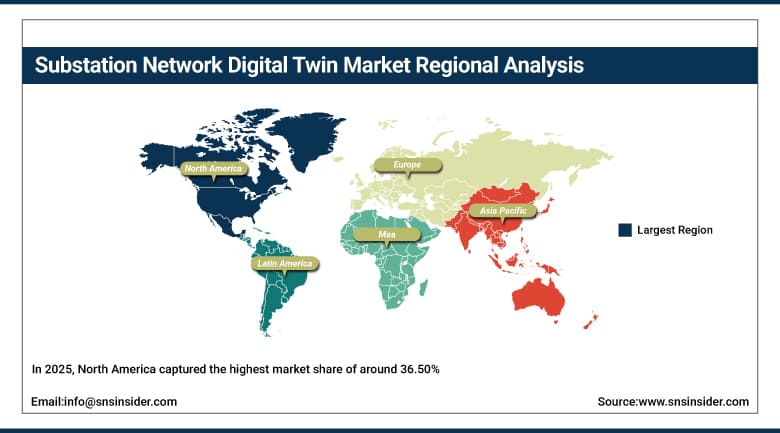
In 2025, North America captured the highest market share of around 36.50%, driven by strong investments in grid modernization, extensive use of smart grid technologies, and favorable regulation for digital transformation projects. Key utilities in the U.S. and Canada are among the frontrunners in adopting digital twin solutions, which are being used to improve grid reliability and manage assets as well as incorporate renewable energy sources.
The U.S. captured an estimated 83.00% revenue share of the North American region, owing to the presence of advanced technology ecosystem, digital literacy, and the fact that major digital twin providers are headquartered in the region. Increased government and state-level incentives for grid modernization have further solidified the position of the country within the region.
Get Customized Report as Per Your Business Requirement - Enquiry Now
Europe Substation Network Digital Twin Market Insights
In the Substation Network Digital Twin Market, Europe had a considerable share due to the high decarbonization goals set in the country, regulatory compliance, and investment in the smart grid infrastructure. In Europe, countries like Germany, United Kingdom, and France are playing leading roles in the implementation of digital twin solutions for renewable energy transition and grid resiliency, focusing on interoperability, standardization, and cybersecurity.
Germany was the leader in the European market in terms of revenue, which had a 26.00% regional share. Germany's leadership in the European substation network digital twin market is primarily attributed to its national commitment to smart grid infrastructure and renewable energy deployment. The United Kingdom and France were also notable in the European market owing to vendor-utility collaboration on interoperability and cybersecurity.
Asia Pacific Substation Network Digital Twin Market Insights
The Asia-Pacific region will emerge as the fastest-growing regional market, registering a CAGR of about 32.80% between 2026 and 2035, while also contributing about 22.80% to the market share in 2025. Rapid urbanization, rising energy needs, and huge investments in power infrastructure in China, India, Japan, and South Korea have been the key factors behind such impressive growth in the region.
China accounted for the majority share of Asia Pacific revenue at approximately 34.00%, attributed to large-scale power infrastructure investment and growing domestic technology capability for digital twin platforms. Rapid smart grid and renewable energy expansion in India, Japan, and South Korea were similarly responsible for accelerating Asia Pacific's overall growth trajectory across the forecast period.
MEA and Latin America Substation Network Digital Twin Market Insights
The Middle East & Africa and Latin America witnessed steady growth aided by the government’s efforts in promoting modernization initiatives and understanding the advantages of digital twin technologies. The increased investments in modernizing their power infrastructure along with more renewable energy additions, which require more monitoring and optimization software, will continue to make these two regions a major market for substation network digital twins during the forecast period.
In Middle East & Africa, the leading country was Saudi Arabia, contributing about 28.00% to regional shares because of its investments in grid modernization for its energy diversification program. The largest market in Latin America continued to be Brazil, which accounted for about 58.00% of the regional share due to its vast power infrastructure and need for substation monitoring optimization.
Market Dynamics:
Growth Drivers: Rising Demand for Enhanced Grid Reliability and Resilience
The market is driven by the increasing demand for better reliability and resilience of the power grid in response to the ever-growing demand for electricity globally, resulting in high pressure on power grids to operate without interruption. Digital twin helps power utilities build virtual versions of their substations and perform simulations and predictive analytics which are essential for identifying possible faults, maximizing use of assets and reducing downtime.
Supporting data also include the quick development of smart grids and shift towards renewable energy sources which require power utilities to upgrade their infrastructure to integrate new distributed generation sources like solar and wind. Advanced analytics, AI and machine learning are other important trends driving demand.
Restraints: High Initial Investment and Legacy System Interoperability
The other major issue that arises with the use of digital twins is the fact that there is a lot of investment that needs to be made at the outset in order to make the technology feasible. The problem here is worsened by the fact that digital twins require quite complicated implementation due to the necessity of a sensor network, communication system, and software platform. Another obstacle related to the use of digital twins is that of security and privacy, as well as interoperability with older systems, which might prevent the widespread adoption of the technology in certain jurisdictions with strict regulations.
Opportunities: AI Integration and Emerging Market Expansion
The integration of artificial intelligence and machine learning features in digital twins provides a huge opportunity for vendors that are able to derive insights from operational data in order to make accurate predictions and optimize the performance of the substations. For example, platform products from such companies as Siemens AG and Hitachi Energy, featuring asset management through AI in addition to digital twin models, are examples of the way vendors are utilizing this expanding workflow.
Moreover, the development of digital twins in emerging regions in Asia Pacific, Latin America, and Middle East & Africa provides numerous opportunities for vendors who are able to offer scalable, affordable, and easy-to-install solutions for specific region demands. The cooperation of technology companies, utilities, and governmental institutions will be crucial for the adoption of digital twins in emerging regions.
Recent Developments:
-
2025: Bentley Systems upgraded its iTwin platform with expanded infrastructure modeling capabilities purpose-built for complex substation network simulation.
-
2025: AVEVA Group introduced enhanced predictive analytics features within its industrial software suite, targeting substation asset performance optimization.
-
2026: GE Vernova expanded its digital twin software portfolio with new AI-driven predictive maintenance algorithms for substation equipment monitoring.
-
2026: IBM Corporation integrated Maximo asset management capabilities with digital twin modeling to support utility-scale substation lifecycle management.
Substation Network Digital Twin Market key players are:
-
Siemens AG
-
GE Vernova Inc.
-
ABB Ltd.
-
Schneider Electric SE
-
Eaton Corporation plc
-
Hitachi Energy Ltd.
-
Emerson Electric Co.
-
Mitsubishi Electric Corporation
-
Toshiba Energy Systems & Solutions Corporation
-
Bentley Systems, Incorporated
-
Honeywell International Inc.
-
Schweitzer Engineering Laboratories, Inc.
-
Wipro Limited
-
Capgemini SE
-
IBM Corporation
-
AVEVA Group plc
-
Siemens Energy AG
-
Infosys Limited
-
DXC Technology Company
-
Atos SE
Substation Network Digital Twin Market Report Scope:
| Report Attributes | Details |
|---|---|
| Market Size in 2025 | USD 1.45 Billion |
| Market Size by 2035 | USD 9.21 Billion |
| CAGR | 17.15% from 2026 to 2035 |
| Base Year | 2025 |
| Forecast Period | 2026-2035 |
| Historical Data | 2022-2024 |
| Report Scope & Coverage | Market Size, Segments Analysis, Competitive Landscape, Regional Analysis, DROC & SWOT Analysis, Forecast Outlook |
| Key Segments | •Component (Software, Hardware, and Services) •Application (Asset Management, Grid Optimization, Predictive Maintenance, Real-Time Monitoring, and Others) •Deployment Mode (On-Premises and Cloud) •End User (Utilities, Industrial, Commercial, and Others) |
| Regional Analysis/Coverage | North America (US, Canada), Europe (Germany, UK, France, Italy, Spain, Russia, Poland, Rest of Europe), Asia Pacific (China, India, Japan, South Korea, Australia, ASEAN Countries, Rest of Asia Pacific), Middle East & Africa (UAE, Saudi Arabia, Qatar, South Africa, Rest of Middle East & Africa), Latin America (Brazil, Argentina, Mexico, Colombia, Rest of Latin America). |
| Company Profiles | Siemens AG, GE Vernova Inc., ABB Ltd., Schneider Electric SE, Eaton Corporation plc, Hitachi Energy Ltd., Emerson Electric Co., Mitsubishi Electric Corporation, Toshiba Energy Systems & Solutions Corporation, Bentley Systems, Incorporated, Honeywell International Inc., Schweitzer Engineering Laboratories, Inc., Wipro Limited, Capgemini SE, IBM Corporation, AVEVA Group plc, Siemens Energy AG, Infosys Limited, DXC Technology Company, Atos SE. |

Frequently Asked Questions
Key players in the Substation Network Digital Twin Market include Siemens AG, GE Vernova Inc., ABB Ltd., Schneider Electric SE, and Hitachi Energy Ltd., among others.
Key opportunities in the Substation Network Digital Twin Market include integration of artificial intelligence and machine learning capabilities, alongside expansion of digital twin solutions into emerging markets across Asia Pacific, Latin America, and the Middle East & Africa.
The market is driven by escalating demand for enhanced grid reliability and resilience, rapid evolution of smart grid initiatives, and increasing integration of renewable energy sources requiring comprehensive operational visibility.
The Software segment dominated the Substation Network Digital Twin Market, accounting for approximately 47.80% market share.
The North America region dominated the Substation Network Digital Twin Market in 2025 with a 36.50% share, driven by robust investment in grid modernization and strong regulatory support for digital transformation.
