
Brain Monitoring Market Report Scope & Overview:
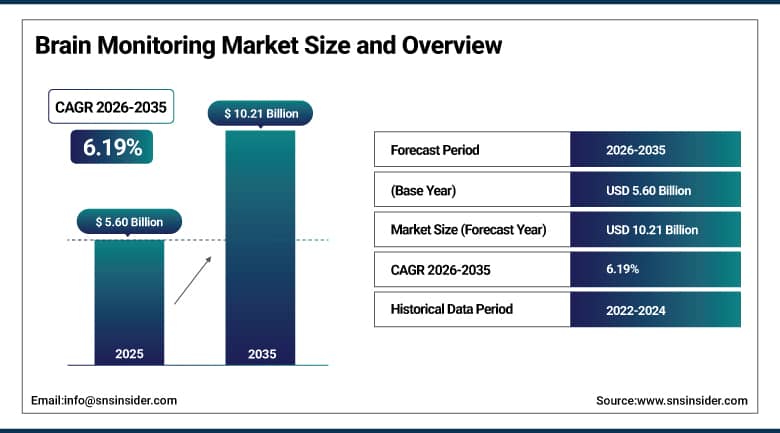
The Brain Monitoring Market was valued at USD 5.60 Billion in 2025 and is projected to reach USD 10.21 Billion by 2035, expanding at a CAGR of 6.19% during the forecast period 2026–2035.
The brain monitoring market is undergoing a steady growth due to the prevalent neurological disorders, growing incidence of traumatic brain injury, stroke, epilepsy and neurodegenerative diseases and also the growing requirement of continuous evaluation of brain function in critical care. The applications of brain monitoring techniques are extensively used in ICU, surgical room and emergency room and neurology centers to check the level of cerebral function in real-time and to discover the changes on neurological function and maintain the patients better.
Continued expansion of the brain monitoring market is also being driven by the faster advancement in AI-based neurodiagnostics software, cloud connection to the patient monitoring systems, wirelessly connected EEG devices and integral hospital monitoring network. Healthcare professionals are steadily funding the digital ICUs, remote neurological monitoring capabilities, automated interpretation algorithms and multimodal data integration platform to elevate workflow efficiency and to ensure the patient outcomes. In Jan 2026, The US FDA approved enhancements of additional AI-based neurological monitoring software to ensure faster interpretation of brain monitoring data and enhanced decision making in critical care, solidifying continued growth of the US neurologostics market.
To Get More Information On Brain Monitoring Market - Request Free Sample Report
Brain Monitoring Market Trends
-
Growing adoption of AI-enabled neurological monitoring and diagnostic interpretation platforms.
-
Rising utilization of non-invasive multimodal brain monitoring technologies globally.
-
Increasing investments in portable and wireless EEG monitoring solutions.
-
Expansion of cloud-connected neurocritical care monitoring infrastructure across hospitals.
-
Greater integration of real-time cerebral monitoring into precision neurological care.
The U.S. Brain Monitoring Market Size Outlook
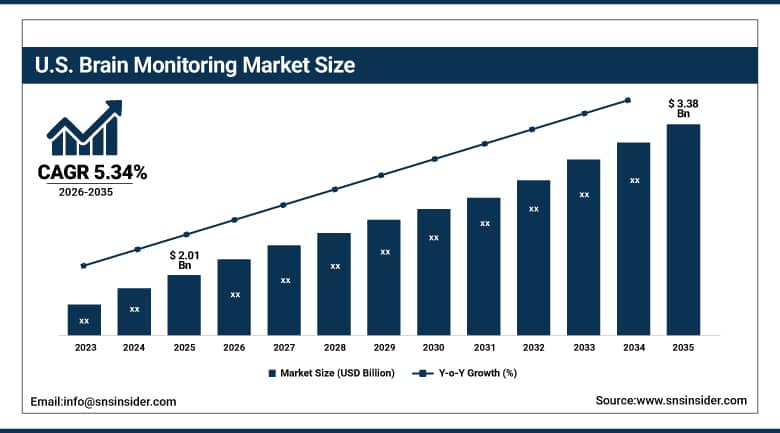
The U.S. Brain Monitoring Market was valued at USD 2.01 billion in 2025 and is expected to reach approximately USD 3.38 billion by 2035, expanding at a CAGR of 5.34% during 2026–2035.
The U.S. Leads North American market for brain monitoring devices due to highly advanced neurological care infrastructure, increased number of tertiary care hospitals, dense neurocritical care networks, and early adoption of latest medical technology. Increasing incidence of stroke, traumatic brain injury, epilepsy, Alzheimer's, Parkinson's and other neurological disorders drive continued demand in ED, OR, ICU and outpatient neurology departments for continuous monitoring of the brain. Many hospitals in the country are investing heavily in multi-modal neuromonitoring platforms, wireless EEG solutions, cerebral oxygenation technologies, AI driven diagnostic software for better clinical outcome and reduction of diagnostic delays.
Cloud-based neurological monitoring platforms, AI driven waveform interpretation, predictive analytics and remote patient monitoring are being widely incorporated into the U.S. Healthcare system. In 2025 the National Institute of Health continued to increase investment in neuroscience research programs under the BRAIN initiative, facilitating faster development of advanced neurotechnology, brain mapping applications and next-generation neurophysiological monitoring devices.
Brain Monitoring Market Segment Analysis
-
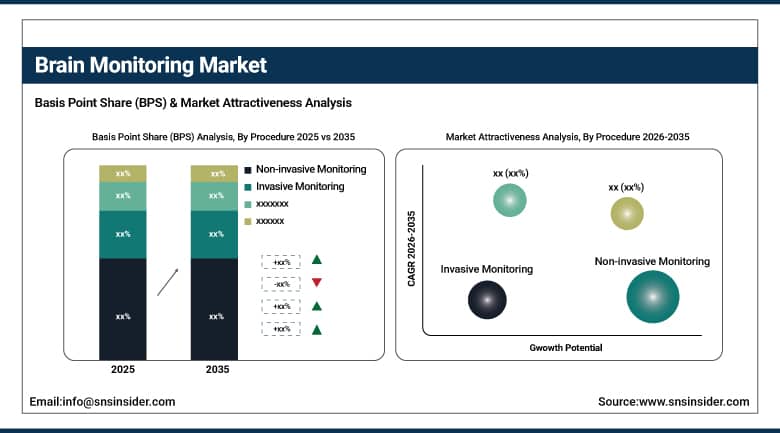
By Procedure, non-invasive monitoring dominated the market with 69.00% share in 2025 and is also projected to register the fastest growth with 6.64% CAGR during the forecast period.
-
By Product Type, electroencephalography (EEG) systems dominated the market with 36.00% share in 2025, while cerebral oximeters are projected to witness the fastest growth with 8.03% CAGR during the forecast period.
-
By Application, traumatic brain injury (TBI) dominated the market with 24.00% share in 2025, while stroke monitoring is projected to witness the fastest growth with 7.08% CAGR during the forecast period.
-
By End User, hospitals dominated the market with 48.00% share in 2025, while ambulatory surgical centers are projected to witness the fastest growth with 7.93% CAGR during the forecast period.
By Procedure, Non-invasive Monitoring dominated and is expected to remain the fastest-growing segment.
Non-invasive monitoring grabbed 69% of the global market in 2025, and it’s on track for the fastest growth—about 6.64% a year. More and more, healthcare providers turn to non-invasive neurological monitoring because it’s safer for patients, more comfortable, and allows for repeated or continuous checks no need for surgery. Tools like EEG, cerebral oximetry, Transcranial Doppler, functional brain imaging, and wearable neurodiagnostic gear are popping up everywhere: hospitals, outpatient neurology clinics, even at home or in ambulatory care.
This surge comes from rising demand for early neurological diagnosis, remote monitoring, better digital healthcare systems, and a push toward value-based clinical care. Today, neuro data platforms in clouds, smart predictive algorithms, and multimodal monitoring enable medical practitioners to better monitor patients while keeping costs low through shorter hospital stays. In 2026, Koninklijke Philips N.V. strengthened its connected patient monitoring platform through the deployment of AI-driven neurological monitoring across its critical care platform.
By Product Type, electroencephalography (EEG) systems dominated, while cerebral oximeters grows fastest.
EEG systems held onto their spot as the biggest player in the global brain monitoring market in 2025, making up 36% of total revenue. People trust EEGs because they work—they’re the go-to tool for diagnosing things like epilepsy, sleep issues, encephalopathy, and a ton of other neurological problems. Hospitals, neurology clinics, and even emergency rooms rely on them since EEGs give real-time brain activity feedback and are both affordable and easy to access.
Cerebral oximeters will continue to increase. This category of devices is expected to experience the highest growth rate in the period from 2026 to 2035, registering an estimated CAGR of 8.03%. There is an increasing need to ensure that there is no brain oxygen deficiency during operations, in NICU wards, and at any critical care unit, which is why this technology will be embraced in many places. With new technologies such as near-infrared spectroscopy, non-invasive sensors, and compact monitors for cerebral oxygen saturation measurements, monitoring is now much easier and faster. Masimo did not stop its efforts of innovating in 2025. Their cerebral oximetry devices became even better as a result of improved signal processing.
By End User, hospitals dominated, while ambulatory surgical centers grows fastest.
In 2025, hospitals dominated the brain monitoring market with a 48.00% share. They’re handling a huge number of neurological procedures, and they have the advantage of specialized neurocritical care units, advanced diagnostics, and teams that cover every angle of treatment. Big tertiary hospitals keep pouring resources into the latest brain monitoring tech—think AI-powered diagnostic software, continuous EEGs, cerebral oximetry, and patient monitoring networks that keep everything connected. With more neurosurgeries, critical care cases, stroke treatments, and epilepsy monitoring on their plate, hospitals stay at the center of the global brain monitoring landscape.
ASCs are rapidly catching up. It is expected that the segment would record the highest growth rate at a CAGR of 7.93% between 2026 and 2035. Increasing preference for minimally invasive surgeries and availability of affordable, quicker, and technologically advanced outpatient services is prompting patients to choose ambulatory surgery centers for their neurosurgeries. Medtronic plc. kept its momentum in 2026, rolling out smarter neuromonitoring solutions that fit seamlessly into both complex hospital workflows and the faster pace of outpatient care.
Regional Analysis
|
Region |
Major Country |
Share within Region, 2025 (%) |
|---|---|---|
|
North America |
United States |
92.00% |
|
Europe |
Germany |
27.00% |
|
Asia Pacific |
China |
27.00% |
|
Middle East & Africa |
UAE |
4.00% |
|
Latin America |
Brazil |
3.00% |
North America Brain Monitoring Market Insights
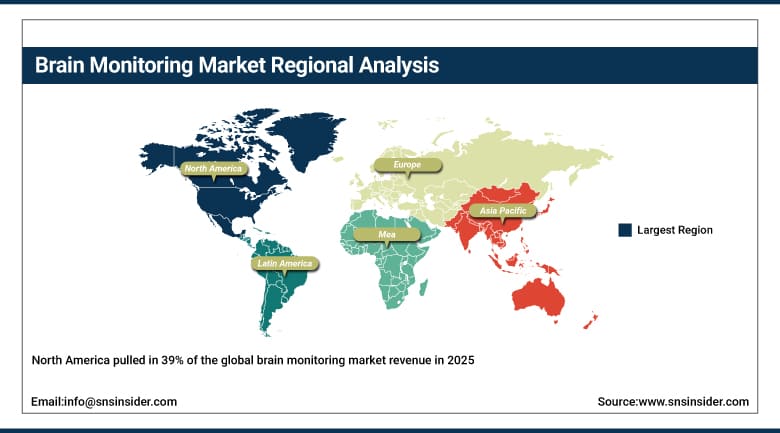
North America pulled in 39% of the global brain monitoring market revenue in 2025, holding onto its lead thanks to strong healthcare systems, lots of neurocritical care units, and a real appetite for high-tech brain monitoring gear. The region keeps seeing more cases of stroke, traumatic brain injuries, epilepsy, Parkinson’s, Alzheimer’s—basically, a steady need for round-the-clock neurological checks.
Hospitals throughout the US and Canada keep pouring money into new neuromonitoring platforms, smart EEG software powered by AI, cerebral oximetry gadgets, intracranial pressure monitors, and connected critical care setups. By 2026, the National Institutes of Health pushed even further, pouring more funding into the BRAIN Initiative. Their goal: speed up the creation of next-gen neurotech, AI-backed neurological diagnostics, and smarter brain monitoring platforms.
Get Customized Report as Per Your Business Requirement - Enquiry Now
Europe Brain Monitoring Market Insights
Europe’s a key market for brain monitoring tech—the region’s got strong healthcare systems, a growing focus on neurological research, and more hospitals are using cutting-edge diagnostic tools. Countries like Germany, France, the UK, Italy, and Spain keep pouring money into neurocritical care, building specialized stroke centers, and upgrading epilepsy treatment facilities. As more people develop age-related neurological problems, and as public health insurance kicks in, hospitals keep updating their equipment. That’s why we’re seeing EEG systems, cerebral oximeters, ICP monitors, and all kinds of advanced neurological monitoring gear becoming standard across European medical centers.
Governments are pushing for better patient safety, digital healthcare, and moves toward precision medicine, so tech adoption just gets faster every year. In 2025, the European Brain Council took things further by backing all sorts of partnerships to drive innovation in neurological care, improve digital diagnostics, and boost research. Everything is aimed at managing neurological diseases more effectively across the continent.
Asia Pacific Brain Monitoring Market Insights
The Asia Pacific Brain Monitoring market will experience the highest growth rate of 8.34% over the forecast period due to the development of healthcare infrastructure, rise in the burden of neurological disorders, rising healthcare spending, and increased investments by governments into modernization of medical equipment. Urbanization trends, improved access to neurological treatment centers, and development of critical care centers in countries such as China, Japan, India, South Korea, and Southeast Asia are greatly driving the adoption of brain monitoring equipment.
Hospitals are increasingly adopting portable EEG machines, cerebral oximeters, multimodal brain monitoring equipment, and AI-based brain diagnostic software for achieving better results while dealing with rising patient load. In 2025, Nihon Kohden Corporation introduced new products in the field of neurological monitoring including advanced EEG equipment and patient monitoring equipment.
Middle East & Africa and Latin America Brain Monitoring Market Insights
The demand for neurology devices and solutions in the Middle East and Africa brain monitoring market is continuously rising owing to investments being made in the tertiary healthcare infrastructure, availability of neurological facilities and advanced patient monitoring systems among others. Countries like UAE, Saudi Arabia, and South Africa are enhancing their neuro-critical care capacity through modernization of ICU, hospital digitization and advancement in diagnostic equipment. The growth in awareness about early neurological disease diagnosis, development of stroke centers and partnerships between international medtech companies and local healthcare providers is likely to drive the market's growth during the forecast period.
The Latin American brain monitoring market continues to show steady growth with better access to neurological healthcare facilities, hospital infrastructure modernization, and rising government initiatives focused on enhancing critical care capacity. Brazil, Mexico, Argentina, and Chile have been seeing higher adoption of EEG systems, cerebral monitoring systems and neuro-diagnostic systems in order to provide improved care for patients suffering from stroke, epilepsy, traumatic brain injury, and neuro-degenerative diseases. In 2025, Natus Medical Incorporated enhanced its neuro-diagnostic products distribution network in international markets, thereby widening access to EEG and neurological monitoring systems in emerging healthcare markets.
Market Dynamics
Growth Drivers: Increased frequency of neurological disorders and growth in advanced neurocritical care monitoring solutions.
The increasing number of incidences of neurological conditions like stroke, traumatic brain injury, epilepsy, Alzheimer's disease, Parkinson's disease, and other neurodegeneration conditions have been among the primary reasons behind the growth in the worldwide market demand for brain monitoring solutions. Increasing adoption of neurologic monitoring tools by healthcare professionals to identify early indications of disease, support decision-making, and improve survival rates has been driving the demand for brain monitoring technology.
Healthcare organizations are turning towards multi-modal brain monitoring systems that combine EEG, cerebral oximetry, intracranial pressure monitoring, and AI-based analytical capabilities to provide a precise diagnosis and decision-making in real-time. Growing aging population, emergencies, and the installation of neurological infrastructure in developed as well as developing nations are expected to support the demand for brain monitoring technology in the coming years. In May 2026, GE Healthcare launched advanced patient monitoring solutions for neurological assessment as part of its critical care monitoring solutions.
Restraints: Expensive equipment and lack of specialized neurological knowledge.
Although the market has good growth potential, the uptake of brain monitoring systems is hindered by the expensive cost of acquiring the devices, maintenance costs, and need for highly trained neurological experts who can read complicated neurological data. Complex EEG machines, multimodal neuromonitoring systems, intracranial pressure monitoring systems, and diagnostic software systems based on artificial intelligence technology involve heavy capital expenditure which might hinder their usage among small hospitals and health institutions, especially those found in developing countries. Other factors such as inconsistency in insurance policies, lack of infrastructure, and scarcity of neurocritical care experts further impede the implementation of the technology. In 2025, Nihon Kohden Corporation initiated educational programs for physicians to increase the utilization of neurological monitoring technologies.
Opportunities: Artificial intelligence-based multimodal brain monitoring and expansion of remote neurological care.
The rapid advancements in the realms of artificial intelligence, cloud computing, wearable neurotechnologies, and digital health care infrastructure will provide significant growth opportunities for the global brain monitoring market. The use of AI in interpreting neurological waveforms, predicting clinical events, patient monitoring applications, and wireless electroencephalograms will improve the speed and accuracy of diagnosis while allowing continuous monitoring of neurological events outside the traditional medical setting.
The rise in tele-neurology services, digital ICUs, and precision medicine programs will prompt the health care organizations to make investments in connected brain monitoring systems that will allow personalized neurological treatments. The further development of portable monitoring systems, hospital platforms, and machine learning-enabled neurodiagnostics will create considerable commercial opportunities over the forecast period. In March 2026, Koninklijke Philips N.V. enhanced AI-enabled connected monitoring solutions supporting predictive neurological care, cloud-based patient management, and critical care workflows.
Recent Developments
-
2026: Medtronic plc showcased new long-term evidence supporting its neuromodulation portfolio and advanced brain monitoring technologies at the North American Neuromodulation Society Annual Meeting, reinforcing the clinical value of sensing-enabled neurological therapies and intelligent neurotechnology platforms.
-
2025: Koninklijke Philips N.V. and Medtronic plc expanded their long-standing strategic partnership to integrate next-generation patient monitoring technologies, including BIS brain monitoring, into Philips' monitoring ecosystem, improving access to validated neurological monitoring solutions worldwide.
-
2025: Medtronic plc received U.S. FDA approval for BrainSense Adaptive Deep Brain Stimulation (aDBS), the world's first adaptive closed-loop DBS system that automatically adjusts therapy based on real-time brain activity, representing a significant advancement in precision neurological care.
-
2025: Medtronic plc obtained CE Mark approval for BrainSense Adaptive Deep Brain Stimulation and Electrode Identifier technologies, enabling real-time sensing and personalized brain stimulation for patients with Parkinson's disease across European markets.
Brain Monitoring Market Key Players are:
-
Nihon Kohden Corporation
-
Natus Medical Incorporated
-
Siemens Healthineers AG
-
Masimo Corporation
-
Compumedics Limited
-
Cadwell Industries, Inc.
-
Advanced Brain Monitoring, Inc.
-
Neurosoft LLC
-
Drägerwerk AG & Co. KGaA
-
NeuroWave Systems Inc.
-
Inomed Medizintechnik GmbH
-
Lifelines Neuro Company LLC
-
EMS Biomedical Ltd.
-
Micromed S.p.A.
-
Neuroelectrics S.L.
-
Brain Scientific Inc.
-
Magstim Company Limited
Brain Monitoring Market Report Scope:
| Report Attributes | Details |
|---|---|
| Market Size in 2025 | USD 5.60 Billion |
| Market Size by 2035 | USD 10.21 Billion |
| CAGR | CAGR of 6.19% From 2026 to 2035 |
| Base Year | 2025 |
| Forecast Period | 2026-2035 |
| Historical Data | 2022-2024 |
| Report Scope & Coverage | Market Size, Segments Analysis, Competitive Landscape, Regional Analysis, DROC & SWOT Analysis, Forecast Outlook |
| Key Segments | • By Product Type (Electroencephalography (EEG) Systems, Intracranial Pressure (ICP) Monitors, Cerebral Oximeters, Transcranial Doppler (TCD) Systems, Others) • By Procedure (Non-invasive Monitoring, Invasive Monitoring) • By Application (Traumatic Brain Injury (TBI), Stroke Monitoring, Epilepsy Monitoring, Neurosurgery, Others) • By End User (Hospitals, Neurology Clinics, Ambulatory Surgical Centers, Research Institutes, Others) |
| Regional Analysis/Coverage | North America (US, Canada), Europe (Germany, UK, France, Italy, Spain, Russia, Poland, Rest of Europe), Asia Pacific (China, India, Japan, South Korea, Australia, ASEAN Countries, Rest of Asia Pacific), Middle East & Africa (UAE, Saudi Arabia, Qatar, South Africa, Rest of Middle East & Africa), Latin America (Brazil, Argentina, Mexico, Colombia, Rest of Latin America). |
| Company Profiles | Medtronic plc, Koninklijke Philips N.V., Nihon Kohden Corporation, Natus Medical Incorporated, GE HealthCare Technologies Inc., Siemens Healthineers AG, Masimo Corporation, Compumedics Limited, Cadwell Industries, Inc., Advanced Brain Monitoring, Inc., Neurosoft LLC, Drägerwerk AG & Co. KGaA, NeuroWave Systems Inc., Inomed Medizintechnik GmbH, Lifelines Neuro Company LLC, EMS Biomedical Ltd., Micromed S.p.A., Neuroelectrics S.L., Brain Scientific Inc., Magstim Company Limited |
Frequently Asked Questions
The Brain Monitoring Market was valued at USD 5.60 Billion in 2025.
The market is anticipated to expand at a CAGR of 6.19% during the forecast period.
North America dominated the global Brain Monitoring Market in 2025 with a 39.00% revenue share.
Electroencephalography (EEG) Systems accounted for the largest revenue share of 36.00% in 2025.
