
Superhot Rock Geothermal Market Report Scope and Overview:
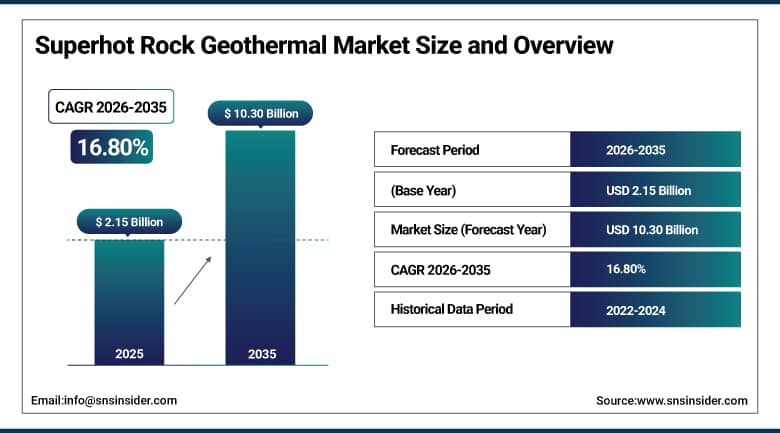
The Superhot Rock Geothermal Market was valued at USD 2.15 Billion in 2025 and is projected to reach USD 10.30 Billion by 2035, registering a CAGR of 16.80% from 2026 to 2035.
SuperHot Rock Geothermal Market can be described in terms of increased adoption of new drilling and well construction technologies, demand from utilities and industries for constant baseload energy, increased government initiatives to explore deep and high-temperature reservoirs, and various applications including utility scale power production, industrial heat production, and hydrogen production. This market represents next stage of renewable energy technology that utilizes extremely hot rock formations in the earth’s subsurface at temperatures greater than 400 degrees Celsius to produce consistent power with large capacity and low emissions. With injection of water at such levels, it becomes supercritical, allowing for better energy production than traditional geothermal methods and even offering possibilities in areas where it was not possible before.
Advanced supercritical fluid handling systems, partnerships between drilling technology vendors and geothermal developers, and expansion of high-temperature reservoir engineering capability have followed heavy investment from utilities, industrial enterprises, and technology companies pursuing always-on, low-carbon baseload power.
To Get More Information On Superhot Rock Geothermal Market - Request Free Sample Report
Superhot Rock Geothermal Market Trends
-
Rising demand for always-on, low-emission baseload power continues accelerating superhot rock geothermal project development.
-
Growing investment in advanced drilling and heat-resistant materials continues expanding access to deeper, higher-temperature reservoirs.
-
Expanding partnerships between energy firms and research institutions are broadening exploration and resource-discovery activity.
-
Increasing utility and hyperscale data center demand for firm clean power continues shaping large-scale offtake agreements.
-
Growing interest in supercritical fluid handling and power conversion technology continues improving overall project economics.
U.S. Superhot Rock Geothermal Market Outlook
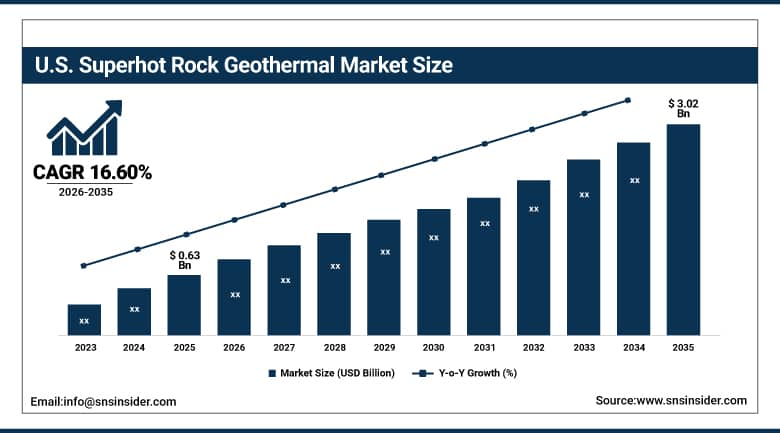
The U.S. Superhot Rock Geothermal Market was valued at approximately USD 0.63 Billion in 2025 and is projected to reach approximately USD 3.02 Billion by 2035, registering a CAGR of approximately 16.60% from 2026 to 2035.
Demand in the United States has been driven by heavy investment in deep geothermal exploration, innovative drilling methods, and enhanced geothermal systems by both established energy companies and well-funded technology startups. Growing collaboration between government bodies, private developers, and research organizations continues accelerating technological progress, while favorable regulations and early corporate offtake commitments from hyperscale data center operators have reinforced U.S. leadership in developing and deploying superhot rock geothermal solutions.
The use of advanced drilling and heat-resistant well-construction technology was highly important for consolidating the leadership of the U.S. superhot rock geothermal market. In addition, growing deployment of supercritical fluid handling and monitoring systems in pilot and early commercial projects drove further demand for the product across the domestic market.
Superhot Rock Geothermal Market Segment Analysis
-
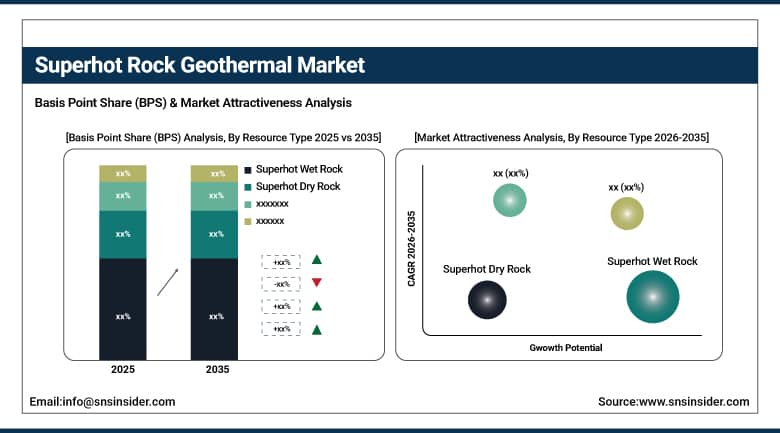
By Resource Type, Superhot Wet Rock segment dominated the Market in 2025 with 57.80% share; Superhot Dry Rock segment is the fastest growing segment, registering a CAGR of approximately 19.20%.
-
By Power Capacity, Above 200 MW segment dominated the market in 2025 with 42.60% share; Up to 50 MW segment is the fastest growing segment, registering a CAGR of approximately 20.40%.
-
By Technology, Advanced Drilling & Well Construction segment dominated the market in 2025 with 29.80% share; Supercritical Fluid Handling Systems segment is the fastest growing segment, registering a CAGR of approximately 21.30%.
-
By Application, Utility-Scale Power Generation segment dominated the market in 2025 with 48.70% share; Hydrogen Production segment is the fastest growing segment, registering a CAGR of approximately 22.60%.
-
By End User, Power Utilities segment dominated the market in 2025 with 41.50% share; Industrial Enterprises segment is the fastest growing segment, registering a CAGR of approximately 19.80%.
By Resource Type, Superhot Wet Rock Dominates While Superhot Dry Rock Accelerates Fastest
Superhot Wet Rock dominated the Superhot Rock Geothermal Market in 2025 with a market share of around 57.80% since the existence of water within these geothermal rocks is an advantage for efficient heat transfer and energy production. There is no need to inject any fluids from outside to make the process easier, providing reliable energy output and making wet rock formations the optimal choice for the initial stages of development of superhot rock energy.
It is expected that the Superhot Dry Rock will grow with a CAGR of around 19.20%, which is the highest among all segments of the Resource Type. This is because with technological developments in drilling and reservoir stimulation, these dry rock reservoirs will become economically feasible. Further, there has been increased investment in creating artificial reservoirs and developing fluid circulation systems, courtesy of companies like Quaise Energy and Sage Geosystems.
By Power Capacity, Above 200 MW Leads While Up to 50 MW Grows Fastest
Above 200 MW capacity category has been the leader in terms of market share in 2025, which is around 42.60%, due to utility offtakes of power and energy by power generators and hyperscale data centers requiring large amounts of baseload capacity with less carbon footprints. Economies of scale for drilling and reservoir development favor this segment.
Up to 50 MW capacity are expected to grow at the fastest CAGR of about 20.40% as developers are becoming more inclined towards developing small-sized, pilot, and early commercial plants to test drill technologies before building larger capacities. This has become a critical testing arena for emerging super-hot rock developers entering into new geological areas.
By Technology, Advanced Drilling & Well Construction Dominates While Supercritical Fluid Handling Grows Fastest
Advanced Drilling & Well Construction accounted for the highest market share in terms of technologies in 2025, amounting to about 29.80%, due to ultra-deep drilling being able to drill into super-hot reservoirs, which entails expensive equipment and skilled technical workforce. Advanced Drilling & Well Construction technology is one of the most expensive components in the whole market.
Supercritical Fluid Handling Systems are expected to grow at the highest Compound Annual Growth Rate (CAGR) of approximately 21.30% due to the increasing application of specialized devices for handling water in the supercritical stage in order to extract maximum heat and energy. Increased R&D spending on materials and equipment that resist corrosion under high temperatures and pressures is another contributing factor.
By Application, Utility-Scale Power Generation Dominates While Hydrogen Production Grows Fastest
Utility-Scale Power Generation dominated the application share segment in 2025 at around 48.70%, due to the fact that utility companies and electricity suppliers are becoming more reliant on superhot rock geothermal to generate constant base load power unlike power produced through solar or wind. Commitments for off-takes from companies such as data centers and industrial facilities looking for reliable and clean energy have contributed towards making this segment dominant.
Application Hydrogen Production is estimated to grow at a CAGR of approximately 22.60%, which is the highest rate of all applications, owing to the use of super-hot rock as a high-temperature and high-yield source of clean energy for hydrogen production using electrolysis. Increasing demand for co-location of hydrogen production plants along with geothermal power plants due to stable base load output is another factor driving this application to emerge quickly.
By End User, Power Utilities Lead While Industrial Enterprises Gain Fastest Traction
Power Utilities turned out to be the biggest end-user sector in 2025, contributing about 41.50% of the revenue, since they were directly concerned about grid reliability and their growing interests in deep geothermal energy as a source to cut their reliance on fossil fuels. The extensive investments made by utilities in developing geothermal technologies and new ways of drilling, driven by the demands of portfolio and grid reliability laws, are indicative of investment in superhot rock technology.
Industrial Enterprises are anticipated to witness the fastest growth rate with a CAGR of around 19.80% owing to increasing demand for a dependable, clean, and uninterrupted source of power for companies operating in manufacturing, chemicals, and heavy industries, who are under constant pressure to cut down carbon emissions. With the increasing use of baseload power along with high heat generation through superhot rock geothermal energy, industrial enterprises have become a key customer segment.
Regional Analysis:
|
Region |
Major Country |
Share within Region, 2025 (%) |
|---|---|---|
|
North America |
United States |
85.00% |
|
Europe |
Germany |
22.00% |
|
Asia Pacific |
China |
32.00% |
|
Middle East and Africa |
Saudi Arabia |
30.00% |
|
Latin America |
Brazil |
38.00% |
North America Superhot Rock Geothermal Market Insights
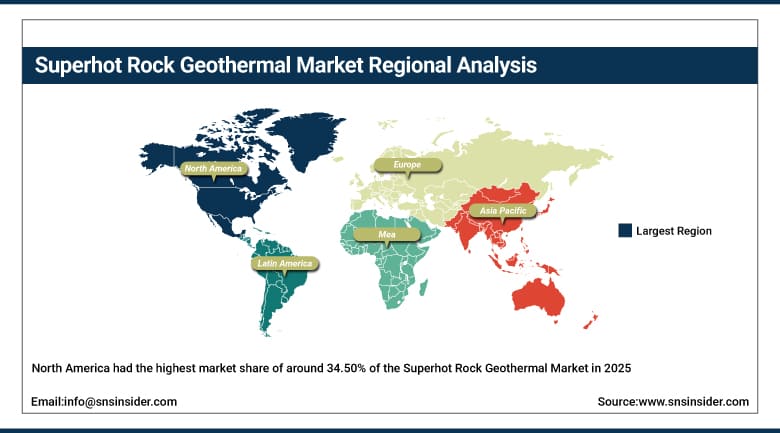
North America had the highest market share of around 34.50% of the Superhot Rock Geothermal Market in 2025 due to advanced technology infrastructure, a solid research environment, and favorable policies regarding renewable energy. The U.S. has been making huge investments in terms of deep geothermal exploration and drilling technologies, with extensive coordination between the government and businesses helping to develop technology further.
The U.S. accounted for approximately 85.00% of the overall North American revenue share, primarily because of favorable regulations, early adoption of emerging geothermal technologies, and concentration of leading superhot rock developers headquartered in the country. Rising corporate offtake agreements with hyperscale data center operators seeking firm, low-carbon baseload power have further reinforced U.S. dominance within the regional market.
Get Customized Report as Per Your Business Requirement - Enquiry Now
Europe Superhot Rock Geothermal Market Insights
Europe constituted a sizeable portion of the Superhot Rock Geothermal Market, due to its decarbonization pledges, increasing worries about energy security, and investments in sophisticated geothermal exploration technologies. There is an ongoing trend for government-led research initiatives and regional collaborations in deep well drilling technology that contribute to the growth of technology vendors and pilot projects.
Germany led the European market in revenue terms, driven by strong national commitment to renewable energy diversification and growing investment in deep geothermal exploration technology. Other Western European markets remained important contributors to regional demand owing to rising energy security concerns and expanding government-backed research funding for next-generation geothermal technology.
Asia Pacific Superhot Rock Geothermal Market Insights
Asia-Pacific Region is expected to be the leading region growing with an estimated CAGR of 19.60% from 2026 to 2035. The main driving factor behind such growth has been high energy demands, fast-paced industrialization, and supportive policies in favor of transition to clean energy among countries like China, Japan, Indonesia, and Australia, making huge investments in exploration of geothermal energy sources.
China represented the largest revenue share in Asia Pacific region with an approximate revenue share of 32.00%. This was due to the presence of huge untapped geothermal potential and increased investments in renewable energy infrastructure. Favorable policies from government and international collaboration in Japan, Indonesia, and Australia were instrumental in boosting the growth rate of Asia Pacific region.
MEA and Latin America Superhot Rock Geothermal Market Insights
The Middle East & Africa, as well as Latin America, experienced consistent growth due to higher investments in renewable energy diversification initiatives, greater geological exploration efforts, and increased cooperation between domestic energy companies and international geothermal technology suppliers. Areas with strong geothermal potential in volcanic and tectonically active regions made it possible to identify both regions as major destinations for superhot rock geothermal developments during the next ten years.
Middle East & Africa witnessed Saudi Arabia take the lead with respect to regional demand, with investments in renewables diversification projects as a part of the country’s energy transition policies along with exploration operations in UAE aiding in the growth of regional market share. Latin America was dominated by Brazil due to increasing government interest in geothermal resource evaluation and clean baseload power generation capacity demands.
Market Dynamics:
Growth Drivers: Rising Demand for Clean, Reliable Baseload Power
As the increasing need for reliable and clean energy arises in relation to the growing demand for electricity around the world owing to urbanization and industrialization, pressure on using reliable and eco-friendly energy sources, and the capability of super-hot rock geothermal energy to offer stable base-load electricity unlike solar and wind energy, the market will progress further. Considering the increase in announcements from energy suppliers and government authorities regarding exploration and offtake agreements, the demand for super-hot rock geothermal will continue to be high over the forecast period.
Further supporting evidence lies in the strengthening relationship between drilling technology providers and geothermal companies, as well as government initiatives for the exploration of deep geothermal resources in various parts of the world. Another very important point is the ongoing trend towards reduction in the use of fossil fuels and the provision of high output energy with minimal emissions.
Restraints: High Capital and Drilling Costs
A very expensive initial cost and drilling cost still stand out as one of the main challenges when it comes to quick penetration of the market because it is essential to drill into very deep geological formations that require extremely expensive equipment. With increasing depths, the costs increase dramatically owing to the difficult underground situations.
One more difficulty that needs to be mentioned is related to long development periods and advanced infrastructure required, increasing financial burden and complicating the deployment process. In connection with all these difficulties, the widespread application of such technologies is complicated due to insufficient funding in certain regions.
Opportunities: Expansion of Deep Geothermal Exploration Programs
The increased emphasis on exploring deep geothermal sources has created excellent growth prospects for the Superhot Rock Geothermal Market because the increasing demand for energy worldwide will make countries explore hot rock sources through advanced geological and seismic techniques. Improved exploration activities that are being backed by the government and research agencies have increased the probability of discovering the energy sources, along with partnerships formed between energy companies and scientific agencies, including Fervo Energy's agreement with Vallourec for supply.
In addition, increased demand from tech companies looking for dependable low carbon power sources to support data centers opens up immense opportunities for developers to obtain long-term power purchase agreements. Companies that show economic viability for their projects by having efficient drilling and the ability to manage supercritical fluids would easily attract investments from utility companies and industrial users looking to diversify their energy portfolio.
Recent Developments:
-
2024: Baker Hughes expanded its geothermal drilling technology portfolio with enhanced heat-resistant components designed for ultra-deep superhot rock well construction.
-
2024: Eavor Technologies advanced its closed-loop Eavor-Loop system with expanded pilot deployments targeting high-temperature geological formations.
-
2025: Sage Geosystems and ABB signed a Memorandum of Understanding to collaborate on geothermal power generation and energy storage facilities, supporting Sage's agreement to deliver up to 150 MW of geothermal baseload power to Meta.
-
2025: Quaise Energy advanced its millimeter-wave drilling technology with expanded field testing aimed at reaching superhot rock formations at previously inaccessible depths.
-
2025: AltaRock Energy expanded its enhanced geothermal systems research program, targeting improved reservoir stimulation techniques for superhot dry rock formations.
-
2025: Mazama Energy advanced its superhot rock exploration program in the Pacific Northwest, targeting utility-scale power generation from ultra-high-temperature reservoirs.
-
2026: Fervo Energy and Vallourec announced a five-year supply agreement worth up to $800 million to support scaled deployment of geothermal energy across the United States, establishing a domestic supply chain for tubular well infrastructure.
-
2026: CeraPhi Energy expanded its geothermal heat recovery technology into new industrial heat supply applications, targeting manufacturing and district heating customers.
Superhot Rock Geothermal Market key players are:
-
Ormat Technologies Inc.
-
AltaRock Energy Inc.
-
Baker Hughes Company
-
SLB (Schlumberger)
-
Halliburton Company
-
Fervo Energy
-
Eavor Technologies Inc.
-
Quaise Energy, Inc.
-
Mazama Energy
-
CeraPhi Energy Limited
-
Sage Geosystems Inc.
-
Reykjavík Energy (Orkuveita Reykjavíkur)
-
ABB Ltd.
-
Vallourec S.A.
-
Chevron New Energies
-
Devon Energy Corporation
-
GreenFire Energy Inc.
-
Dandelion Energy, Inc.
-
Bedrock Energy, Inc.
-
XGS Energy, Inc.
Superhot Rock Geothermal Market Report Scope:
| Report Attributes | Details |
|---|---|
| Market Size in 2025 | USD 2.15 Billion |
| Market Size by 2035 | USD 10.30 Billion |
| CAGR | 16.80% from 2026 to 2035 |
| Base Year | 2025 |
| Forecast Period | 2026-2035 |
| Historical Data | 2022-2024 |
| Report Scope & Coverage | Market Size, Segments Analysis, Competitive Landscape, Regional Analysis, DROC & SWOT Analysis, Forecast Outlook |
| Key Segments | •By Resource Type, Superhot Wet Rock segment dominated the Market in 2025 with 57.80% share; Superhot Dry Rock segment is the fastest growing segment, registering a CAGR of approximately 19.20%. •By Power Capacity, Above 200 MW segment dominated the market in 2025 with 42.60% share; Up to 50 MW segment is the fastest growing segment, registering a CAGR of approximately 20.40%. •By Technology, Advanced Drilling & Well Construction segment dominated the market in 2025 with 29.80% share; Supercritical Fluid Handling Systems segment is the fastest growing segment, registering a CAGR of approximately 21.30%. •By Application, Utility-Scale Power Generation segment dominated the market in 2025 with 48.70% share; Hydrogen Production segment is the fastest growing segment, registering a CAGR of approximately 22.60%. •By End User, Power Utilities segment dominated the market in 2025 with 41.50% share; Industrial Enterprises segment is the fastest growing segment, registering a CAGR of approximately 19.80%. |
| Regional Analysis/Coverage | North America (US, Canada), Europe (Germany, UK, France, Italy, Spain, Russia, Poland, Rest of Europe), Asia Pacific (China, India, Japan, South Korea, Australia, ASEAN Countries, Rest of Asia Pacific), Middle East & Africa (UAE, Saudi Arabia, Qatar, South Africa, Rest of Middle East & Africa), Latin America (Brazil, Argentina, Mexico, Colombia, Rest of Latin America). |
| Company Profiles | Ormat Technologies Inc., AltaRock Energy Inc., Baker Hughes Company, SLB (Schlumberger), Halliburton Company, Fervo Energy, Eavor Technologies Inc., Quaise Energy, Inc., Mazama Energy, CeraPhi Energy Limited, Sage Geosystems Inc., Reykjavík Energy (Orkuveita Reykjavíkur), ABB Ltd., Vallourec S.A., Chevron New Energies, Devon Energy Corporation, GreenFire Energy Inc., Dandelion Energy, Inc., Bedrock Energy, Inc., XGS Energy, Inc. |

Frequently Asked Questions
Key players in the Superhot Rock Geothermal Market include Ormat Technologies Inc., AltaRock Energy Inc., Baker Hughes Company, Fervo Energy, and Sage Geosystems Inc., among others.
Key opportunities in the Superhot Rock Geothermal Market include expansion of deep geothermal exploration programs supported by governments and research organizations, alongside growing corporate offtake demand from technology companies seeking firm, low-carbon power for data center operations.
The market is driven by rising demand for clean and reliable energy, growing requirements for steady baseload power to support grid reliability, and increasing government and private investment in deep geothermal exploration technology.
The Superhot Wet Rock segment dominated the Superhot Rock Geothermal Market, accounting for approximately 57.80% market share.
The North America region dominated the Superhot Rock Geothermal Market in 2025 with a 34.50% share, driven by an advanced technological base and heavy investment in deep geothermal exploration.
