
Telepsychiatry Market Report Scope & Overview:
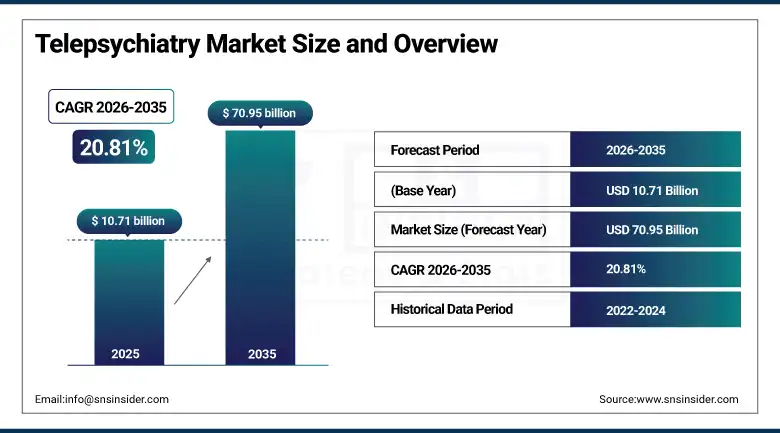
The Telepsychiatry Market was valued at USD 10.71 Billion in 2025 and is expected to reach USD 70.95 Billion by 2035, growing at a CAGR of 20.81% from 2026 to 2035.
Telepsychiatry is the provision of psychiatric assessment, diagnosis, medication management, psychotherapy, and mental health crisis intervention services through videoconferencing, telephony, and digital communication platforms. The technology's commercial and clinical significance rests on its ability to bridge the most acute gap in the global healthcare system. The World Health Organization estimates that more than 70% of individuals with mental health disorders in low- and middle-income countries receive no treatment whatsoever, a treatment gap whose primary driver is not lack of patient willingness but lack of accessible psychiatric service provision that telepsychiatry can structurally address.
When regulatory agencies progressively made pandemic-era telehealth flexibilities permanent, telepsychiatry retained its dramatically expanded role. The U.S. mental health telehealth visits grew from approximately 700,000 monthly before the pandemic to over 5 million monthly by 2025, confirming that the pandemic-era adoption reflected a structural preference shift rather than temporary necessity.
According to Teladoc Health’s statement, the total number of monthly therapy sessions offered by the firm’s platform “BetterHelp” reached 10 million in 2025 and it became the largest online platform offering services related to mental health. The use of an artificial intelligence algorithm helped the firm match therapists to patients better.
Market Size and Forecast
-
Market Size in 2026E: USD 12.94 Billion
-
Market Size by 2035: USD 70.95 Billion
-
CAGR: 20.81% from 2026 to 2035
-
Fastest Growing Region: Asia Pacific
-
Largest Region: North America
To Get more information On Telepsychiatry Market - Request Free Sample Report
Telepsychiatry Market Trends
-
AI tools are improving telepsychiatry by enhancing symptom screening, clinical documentation, and diagnostic efficiency.
-
Employer-sponsored mental health programs are expanding access through workplace-based telepsychiatry benefits.
-
Pediatric and adolescent telepsychiatry is growing due to rising youth mental health demand and psychiatrist shortages.
-
Integration with primary care is expanding psychiatric access through collaborative care models.
-
Digital therapeutics are complementing telepsychiatry by supporting ongoing treatment for mental health conditions.
The U.S. Telepsychiatry Market Outlook
The U.S. telepsychiatry market accounted for approximately 32% of global market revenues in 2025, with North America dominating the global market. The United States has the most commercially advanced telepsychiatry ecosystem globally, driven by the permanent extension of pandemic-era telehealth flexibilities including audio-only psychiatric services, interstate practice authority, and Medicare and Medicaid reimbursement parity for telepsychiatry services.
The Association of American Medical Colleges projects a shortage of up to 6,090 to 10,420 psychiatrists in the United States by 2025. The Mental Health Parity and Addiction Equity Act's reimbursement requirements, enforced by Department of Labor guidance and state insurance regulations, mandate that insurers cover telemental health services at parity with medical and surgical care, removing a historical reimbursement barrier that had constrained commercial telepsychiatry adoption.
Talkspace, one of the leading U.S. telepsychiatry and digital therapy platforms, expanded its employer health plan integration in 2025 to cover psychiatric medication management services. The expansion reflected growing employer recognition that mental health benefits whose scope includes psychiatric medication access address the full spectrum of employee mental health need rather than the primarily therapy-accessible portion that many workplaces mental health programmes had previously covered.
Telepsychiatry Market Segment Analysis
-
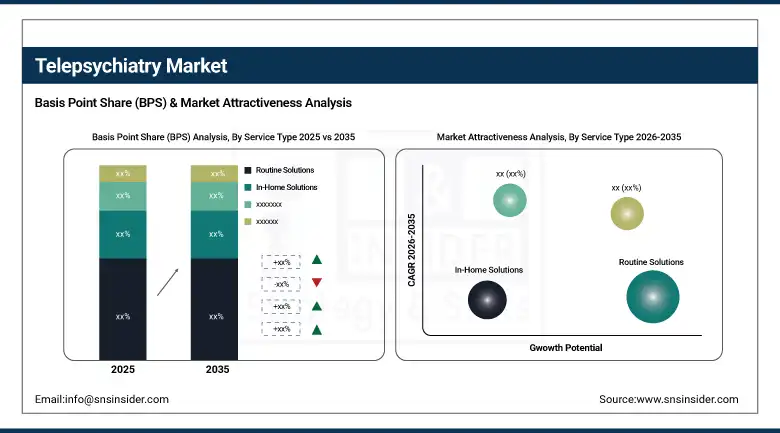
By Service Type, the routine solutions segment dominated the market in 2025, while crisis solutions are growing rapidly.
-
By Delivery Mode, the video conferencing segment dominated the market in 2025, while online platforms & messaging are the fastest growing delivery mode during 2026 to 2035.
-
By End User, the community mental health centers segment dominated the market in 2025, while hospitals & clinics are the fastest growing end user during 2026 to 2035.
By Service Type, routine solutions dominate, crisis solutions grow rapidly
Routine telepsychiatry solutions, encompassing scheduled psychiatric evaluations, ongoing medication management appointments, follow-up monitoring, and planned psychotherapy sessions, generated the dominant market revenue in 2025. Their commercial leadership reflects the enormous volume of recurring appointments that constitute the primary business model of telepsychiatry platforms. The predictable recurring nature of routine psychiatric care revenue also provides the business model stability that investor-backed telepsychiatry platforms require for sustainable operations.
Crisis telepsychiatry solutions are growing rapidly as the inadequacy of conventional emergency department-based mental health crisis response for the volume and acuity of mental health emergencies is well-documented, and as digital crisis intervention platforms that provide immediate psychiatric assessment and de-escalation through video consultations demonstrate superior patient experience and clinical outcome metrics compared to emergency department waiting room-based alternatives.
By Delivery Mode, video conferencing dominates, digital messaging grows fastest
Video conferencing generated the dominant delivery mode revenue in 2025. It reflects both patient and provider clinical preference for synchronous audio-visual interaction that most closely approximates the in-person psychiatric consultation. The clinical dynamics, including non-verbal communication observation, therapeutic rapport building, and medication management decision-making, are replicated through high-quality video connection.
Online platforms and messaging-based delivery modes are growing fastest as asynchronous text-based and messaging-supported mental health services demonstrate clinical efficacy for mild-to-moderate anxiety and depression conditions, and as patient preference for low-barrier, stigma-reduced text-based initial mental health engagement creates a commercially significant gateway service category whose patients graduate to synchronous video consultation for more intensive treatment.
Regional Analysis
|
Region |
Major Country |
Share within Region, 2025 (%) |
|---|---|---|
|
North America |
United States |
82.47% |
|
Europe |
United Kingdom |
28.47% |
|
Asia Pacific |
India |
32.84% |
|
Middle East & Africa |
UAE |
22.84% |
|
Latin America |
Brazil |
43.84% |
North America Telepsychiatry Market Insights
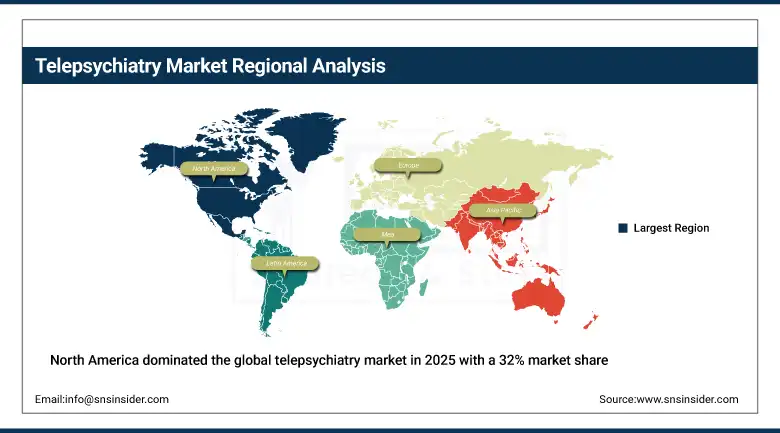
North America dominated the global telepsychiatry market in 2025 with a 32% market share, with the United States accounting for approximately 82.47% of regional revenue. The United States leads through permanent telehealth reimbursement reform, the commercial maturity of its telepsychiatry platform ecosystem, documented psychiatrist shortage driving demand for telemedicine-enabled service expansion, and the large employer wellness benefit market whose corporate mental health programme investment is creating a substantial B2B telepsychiatry distribution channel.
Canada contributes supplementary demand through its provincial health authority telehealth infrastructure investment and its growing commercial telepsychiatry platform adoption among privately insured employees.
Get Customized Report as per Your Business Requirement - Enquiry Now
Europe Telepsychiatry Market Insights
Europe held a significant share of global Telepsychiatry revenues in 2025. The UK NHS's implementation of online mental health waiting list management and digital psychological therapies programmes represents the most commercially advanced public health system telepsychiatry integration in Europe. Germany's e-mental health regulatory framework and the progressive expansion of statutory health insurance reimbursement for video-based psychiatric consultations are creating growing commercial telepsychiatry demand. European mental health prevalence data confirming that one in six Europeans experiences a mental health condition each year documents the size of the structural demand that telepsychiatry is positioned to help address.
Asia Pacific Telepsychiatry Market Insights
Asia Pacific is the fastest-growing regional telepsychiatry market, driven by rapid economic growth creating expanding digital health investment, growing investments in digital health technologies by both government and private sectors, and favorable government policies including national telehealth frameworks adopted across India, China, Australia, Singapore, and Japan.
India accounts for approximately 32.84% of Asia Pacific revenues through its enormous underserved mental health population, the National Telehealth Programme that has extended psychiatric service access to rural areas, and growing commercial telepsychiatry platform development, whose urban middle-class adoption is growing rapidly. China's government digital health investment and its vast psychiatrist shortage relative to population are creating substantial structural telepsychiatry demand.
MEA & Latin America Telepsychiatry Market Insights
Middle East and Latin America are growing telepsychiatry markets where mental health awareness increases, smartphone penetration improvements, and government digital health programme investment are progressively expanding commercial service delivery. The UAE leads MEA revenues at approximately 22.84% of the regional total through its advanced digital health infrastructure, the Dubai Health Authority's telehealth regulatory framework, and growing corporate mental health benefit programmes adoption among UAE-based multinational employers.
Brazil leads Latin American revenues at approximately 43.84% of the regional total through the CFM regulation that formalized telepsychiatry practice standards, its large urban middle-class population's growing mental health awareness, and commercial platform development serving both private insurance-covered and out-of-pocket paying patients.
Market Dynamics
Growth Drivers: Rising mental health disorders and expanded telehealth reimbursement policies are driving demand for telepsychiatry services.
Telepsychiatry's powerful growth driver is the structural mismatch between mental health condition prevalence and psychiatric service availability whose severity has been documented across global health data and is growing with urbanization, the chronic disease burden of an ageing global population. The WHO's Global Burden of Disease data documenting mental, neurological, and substance use disorders as responsible for 13% of the global disease burden, combined with treatment gap estimates indicating that 76 to 85% of people with serious mental health disorders in low- and middle-income countries receive no treatment, creates the most compelling public health access argument for any healthcare technology category.
Telepsychiatry's ability to address geographic, economic, and stigma barriers to mental health care simultaneously, by bringing professional psychiatric services to patients wherever they are located at lower cost and higher confidentiality than in-person alternatives, makes it the most scalable available solution to the global mental health treatment gap.
Restraints: Controlled substance prescribing restrictions and strict mental health data privacy regulations limit telepsychiatry service scope and operational flexibility.
The prescribing of controlled substances including benzodiazepines, stimulants, and buprenorphine for addiction treatment through telehealth remains subject to regulatory constraints. In the United States, the DEA's telehealth prescribing rule whose final form was still under development in 2025 creates regulatory uncertainty for platforms providing psychiatric medication management services whose ability to prescribe controlled substances via telemedicine without a prior in-person visit affects the completeness of care they can offer. Mental health data's heightened sensitivity relative to general health information creates data governance and privacy compliance requirements whose management adds regulatory complexity for platforms operating across multiple jurisdictions.
Opportunities: Integration with collaborative care models and matching systems represent commercial frontiers for telepsychiatry platform scaling.
The integration of collaborative care is among the biggest scalability opportunities for telepsychiatry. Telepsychiatrists will work with general practitioners in conducting case reviews and treatment planning. It helps expand the number of people that can access psychiatric help compared to face-to-face interactions with each patient individually. The federal qualified health centers, rural healthcare settings, and the general practice networks constitute some of the key opportunities for adoption.
An AI-assisted triage process will ensure efficient routing of individuals to the most suitable level of care. Patients may choose to engage in self-care initiatives or be referred to a specialized telepsychiatrist or crisis management.
Recent Developments:
-
2025: Teladoc Health reported BetterHelp delivering over 10 million monthly therapy sessions, with AI-powered provider improving therapeutic alliance formation and session continuation rates, validating the commercial investment in personalization technology.
-
2025: Talkspace expanded its employer health plan integration to include psychiatric medication management services, enabling comprehensive mental health care from initial assessment through ongoing medication management and therapy.
-
2024: Headspace expanded its enterprise mental health benefit platform with integrated telepsychiatry consultation access, combining its established digital mental wellness content with licensed psychiatrist video consultation capability.
Telepsychiatry Market key players are:
-
Teladoc Health Inc. (BetterHelp, Teladoc Mental Health)
-
Talkspace Inc.
-
MDLive Inc. (Evernorth, Cigna)
-
Cerebral Inc.
-
Doctor on Demand (Included Health)
-
Brightside Health Inc.
-
Array Behavioral Care
-
Headspace Inc.
-
Spring Health
-
Lyra Health Inc.
-
Calm (Calm Health Enterprise)
-
Quartet Health Inc.
-
Beacon Health Options (Carelon Behavioral Health)
-
Optum Health (UnitedHealth Group)
-
LifeStance Health Group Inc.
-
Wellfleet Group LLC
-
Mindpath Health
-
Rula Health
-
Amwell
-
InSight + Regroup Telehealth
Telepsychiatry Market Report Scope:
| Report Attributes | Details |
|---|---|
| Market Size in 2025 | USD 10.71 Billion |
| Market Size by 2035 | USD 70.95 Billion |
| CAGR | CAGR of 20.81% From 2026 to 2035 |
| Base Year | 2025 |
| Forecast Period | 2026-2035 |
| Historical Data | 2022-2024 |
| Report Scope & Coverage | Market Size, Segments Analysis, Competitive Landscape, Regional Analysis, DROC & SWOT Analysis, Forecast Outlook |
| Key Segments | • By Service Type (In-Home Solutions, Crisis Solutions, Routine Solutions, Forensic Solutions, Others) • By Delivery Mode (Video Conferencing, Phone Consultations, Online Platforms & Messaging, Others) • By End User (Community Mental Health Centers, Specialty Care Settings, Hospitals & Clinics, Skilled Nursing Facilities, Correctional Facilities, Homecare) |
| Regional Analysis/Coverage | North America (US, Canada), Europe (Germany, UK, France, Italy, Spain, Russia, Poland, Rest of Europe), Asia Pacific (China, India, Japan, South Korea, Australia, ASEAN Countries, Rest of Asia Pacific), Middle East & Africa (UAE, Saudi Arabia, Qatar, South Africa, Rest of Middle East & Africa), Latin America (Brazil, Argentina, Mexico, Colombia, Rest of Latin America). |
| Company Profiles | Teladoc Health Inc. (BetterHelp, Teladoc Mental Health), Talkspace Inc., MDLive Inc. (Evernorth, Cigna), Cerebral Inc., Doctor on Demand (Included Health), Brightside Health Inc., Array Behavioral Care, Headspace Inc., Spring Health, Lyra Health Inc., Calm (Calm Health Enterprise), Quartet Health Inc., Beacon Health Options (Carelon Behavioral Health), Optum Health (UnitedHealth Group), LifeStance Health Group Inc., Wellfleet Group LLC, Mindpath Health, Rula Health, Amwell, InSight + Regroup Telehealth |
Frequently Asked Questions
The Telepsychiatry Market is expected to grow at a CAGR of 20.81% from 2026 to 2035.
The Telepsychiatry Market was valued at USD 10.71 Billion in 2025.
The primary growth factors are the global mental health crisis creating massive unmet psychiatric care demand.
The video conferencing segment dominated the Telepsychiatry Market in2025.
North America dominated the Telepsychiatry Market, with the region holding a 32% global market share in 2025.
