
Transactive Energy Platform Market Report Scope and Overview:
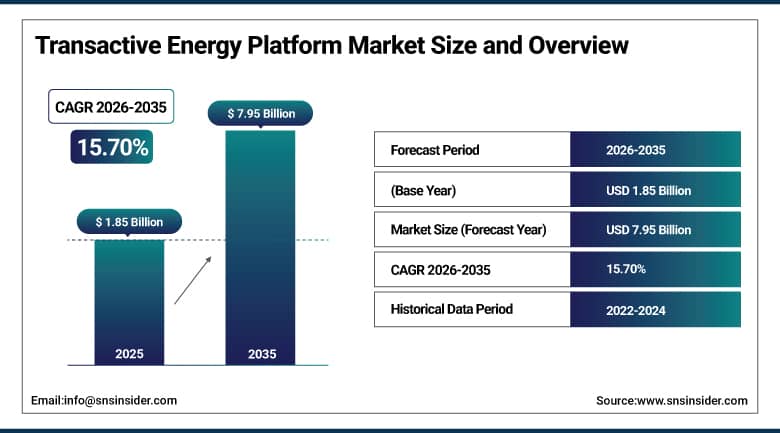
The Transactive Energy Platform Market was valued at USD 1.85 Billion in 2025 and is projected to reach USD 7.95 Billion by 2035, registering a CAGR of 15.70% from 2026 to 2035.
The Transactive Energy Platform market is propelled by digital transformation occurring at a rapid pace in the energy industry, prosumer investments in rooftop solar and batteries, increased regulatory mandate for decarbonization and liberalization, and numerous use cases such as demand response, energy storage management, and electric vehicle integration. The technology allows for trading, direct peer-to-peer interactions, and dynamic pricing among the parties involved, enabling utilities and grid operators to update their outdated systems for dealing with new renewable energy production sources. This is done through blockchain-enabled transaction management, IoT-based information gathering, and machine learning algorithms.
Peer-to-peer transactions based on blockchain technology, strategic alliances between technology companies and utilities, as well as cloud-based grid management systems, resulted from large-scale investments made by the stakeholders in the decentralized energy market.
To Get More Information On Transactive Energy Platform Market - Request Free Sample Report
Transactive Energy Platform Market Trends
-
Rising prosumer participation continues accelerating demand for peer-to-peer energy trading platforms.
-
Growing blockchain adoption continues expanding secure, automated, and transparent energy transaction settlement.
-
Expanding distributed energy resource integration is broadening demand for real-time grid coordination platforms.
-
Increasing electric vehicle and vehicle-to-grid adoption continues creating new transactive energy use cases.
-
Growing utility investment in demand response programs continues shaping platform functionality and market design.
U.S. Transactive Energy Platform Market Outlook
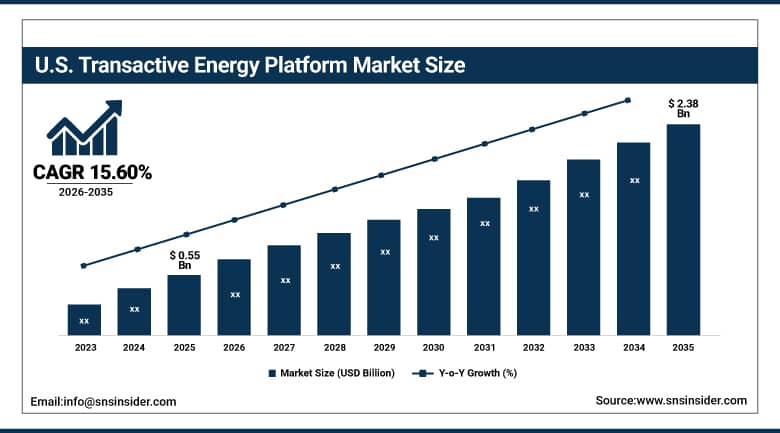
The U.S. Transactive Energy Platform Market was valued at approximately USD 0.55 Billion in 2025 and is projected to reach approximately USD 2.38 Billion by 2035, registering a CAGR of approximately 15.60% from 2026 to 2035.
The U.S. demand has been boosted by advanced grid infrastructure, favorable regulatory policies, and large investments into renewable energy integration. States, such as California, New York, and Texas have been leading in implementing transactive energy projects through using platforms that allow for peer-to-peer transactions, demand response, and grid modernization. Increased utility spending on prosumer engagement and coordination of distributed energy resources became an additional factor contributing to the platform adoption.
Use of transaction processing via blockchain and AI analytics has been crucial in forming the leadership of the U.S. transactive energy platform market. Moreover, increasing deployment of cloud-based platforms in smaller utilities and energy communities became a strong driver of demand for the product.
Market Segment Analysis
-
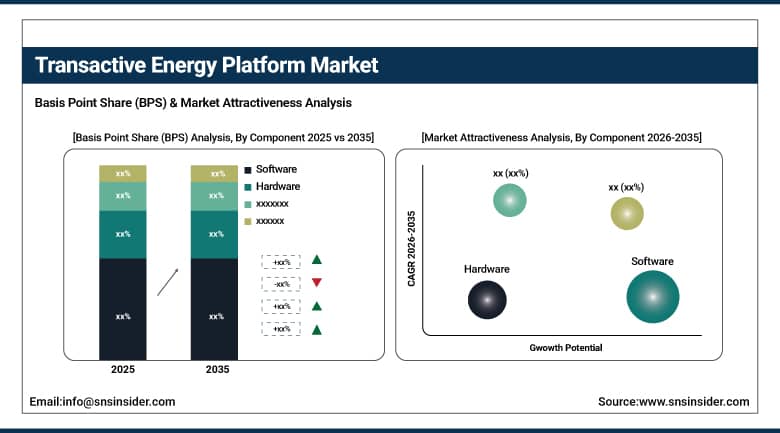
By Component, Software segment dominated the Market in 2025 with 52.40% share; Hardware segment is the fastest growing segment, registering a CAGR of approximately 18.20%.
-
By Application, Utilities segment dominated the market in 2025 with 34.60% share; Residential segment is the fastest growing segment, registering a CAGR of approximately 18.90%.
-
By Deployment Mode, On-Premises segment dominated the market in 2025 with 57.80% share; Cloud-Based segment is the fastest growing segment, registering a CAGR of approximately 19.40%.
-
By End User, Energy Providers segment dominated the market in 2025 with 44.70% share; Consumers segment is the fastest growing segment, registering a CAGR of approximately 18.60%.
By Component, Software Dominates While Hardware Accelerates Fastest
Software held the maximum market share of 52.40% in the Transactive Energy Platform Market in 2025 owing to the core role played by software solutions in real-time data analytics, energy trading algorithms, and blockchain transactions within these platforms. The introduction of Power Ledger's xGrid platform that automates settlement and dynamic pricing in decentralized energy communities is just one example highlighting why utilities and tech firms continue to emphasize software investments over hardware purchases in new platform implementations.
Hardware is expected to grow with the highest CAGR of 18.20% amongst all other components in the Component segment on account of increasing adoption of smart meters, sensors, and edge computing technologies required to capture energy data and relay it to the platform. Growing investments in AMI in regions with robust smart grid programs will only add fuel to this growth trajectory.
By Application, Utilities Dominate While Residential Grows Fastest
In 2025, the utilities segment had the largest market share of around 34.60% because the utilities sector lies at the very core of the market where energy transaction and distribution occur through transactive energy platforms by utilities and grid companies in order to engage in energy trading between the prosumers, to overcome the problems of grid congestion and implement demand response programs.
Residential application is expected to grow at a CAGR of about 18.90%, which is the highest growth rate among all application segments because consumers are increasingly opting for rooftop solar panels, battery storage and smart home technology, allowing them to participate in the peer-to-peer energy trade. The Pando Platform from LO3 Energy is one of the examples of a prosumer driven energy market.
By Deployment Mode, On-Premises Leads While Cloud-Based Grows Fastest
The On-Premises deployment category accounted for the largest market share of around 57.80% in 2025 due to the need for complete control of the architecture of the platform, data security, and integration with existing infrastructures preferred by utilities and grid operators. Ongoing investments in upgrading the on-premises platforms for critical and regulated operations have cemented the leadership of this deployment model in terms of utility and grid operator deployments.
Cloud-Based deployment is expected to continue being the fastest growing deployment mode with a CAGR of about 19.40%, owing to the preference among smaller utilities, energy communities, and new entrants in energy markets for quick deployment, updates, and remote accessibility with minimal internal IT capabilities required. The vendors are continually developing API-enabled modular platform architecture to meet this demand.
By End User, Energy Providers Lead While Consumers Gain Fastest Traction
Energy Providers became the biggest end-user segment by 2025, capturing nearly 44.70% of total revenues owing to their role as leaders in adopting the platform for managing the distributed energy resources, energy trading, and customer services provision. With the growing shift towards renewables and requirements for grid flexibility, the energy providers have been compelled to make significant investments in the development of the transactive platforms with real-time analytics and transactions.
The Consumers are forecast to grow at the highest CAGR of approximately 18.60%, with increasing number of consumers opting for the transactive platforms for facilitating peer-to-peer energy trading, participating in demand response programs, and flexibility management. The increase in the consumer engagement owing to their friendly user interface makes them an important market participant.
Regional Analysis:
|
Region |
Major Country |
Share within Region, 2025 (%) |
|---|---|---|
|
North America |
United States |
82.00% |
|
Europe |
Germany |
22.50% |
|
Asia Pacific |
China |
35.00% |
|
Middle East and Africa |
Saudi Arabia |
28.00% |
|
Latin America |
Brazil |
34.00% |
North America Transactive Energy Platform Market Insights
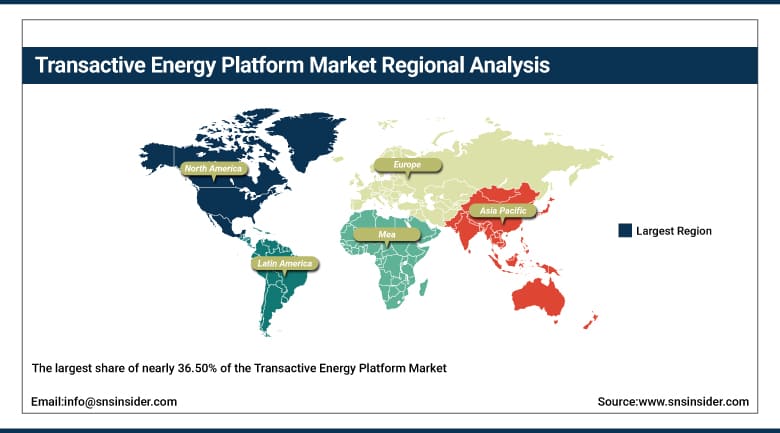
The largest share of nearly 36.50% of the Transactive Energy Platform Market was captured by North America due to the presence of sophisticated grid systems, supportive regulations, and significant investments in renewable energy systems. The U.S. states, such as California, New York, and Texas have been at the forefront of deploying the concepts of transactive energy with the help of transactive energy platforms to facilitate peer-to-peer transactions, demand responses, and grid modernization.
Canada has also made progress in deploying transactive energy platforms with the help of pilot schemes implemented in various provinces with high levels of renewable penetration. The United States constituted a significant share of about 82.00% of the total North America revenue share owing to the presence of a mature technology ecosystem, conducive regulatory scenario, and leading transactive energy platform vendors in the region.
Get Customized Report as Per Your Business Requirement - Enquiry Now
Europe Transactive Energy Platform Market Insights
The forecasted fastest-growing region is Europe with a CAGR of about 16.20% during 2026 to 2035. The significant factor responsible for the growth is the aggressive climate and energy policies adopted by the European Union, Clean Energy Package, and Green Deal, which are encouraging the implementation of transactive energy platform throughout all the EU members with robust regulatory sandboxes to test the new business model.
In Europe, Germany has taken the lead in terms of revenues with a share of about 22.50%. This was due to advanced smart grid initiatives and commitment towards sustainable development and energy independence in the country. UK, Netherlands, and Denmark were some other key countries contributing to the growth in the region.
Asia Pacific Transactive Energy Platform Market Insights
Asia Pacific had a considerable market share of the Transactive Energy Platform Market in 2025 due to massive urbanization, growing energy needs, and favorable governmental programs in China, Japan, Australia, and South Korea. Heavy investments in smart grid development, coupled with high sustainability concerns, have been ensuring the position of the region as one of the contributors to global market growth.
The country's share in the Asia Pacific region revenue was the highest at approximately 35.00%, which is owing to the rapid digitalization program in China and increased investments in smart grid technology and renewable integration technologies. Similarly, urbanization, growing energy needs, and rising demands across the metropolitan cities of Japan, Australia, and South Korea have been driving the growth in the region.
MEA and Latin America Transactive Energy Platform Market Insights
The Middle East & Africa and Latin America showed constant growth as they work towards improving grid reliability and studying the possibility of integrating renewables into the system, thereby increasing the growth of the global market. The rise of government-supported smart grids and renewable diversification initiatives, along with increasing cooperation between regional utilities and foreign vendors, make the aforementioned regions promising markets for transactive energy systems in the coming years.
In the Middle East & Africa region, Saudi Arabia was the biggest contributor to the market growth due to smart grid investments associated with national energy diversification initiatives. Grid modernization in the UAE was another reason behind the increased market share of the region. For Latin America, the biggest contributor to the market growth was Brazil, which had a great power infrastructure and growing necessity for managing distributed energy resources among growing renewable fleets.
Market Dynamics:
Growth Drivers: Digital Transformation and Distributed Energy Integration
Market progress can be attributed to accelerated digital transformation in the energy industry, increased integration of distributed energy resources that need more flexible grids, increased presence of prosumers using rooftop solar and batteries, and increased regulations for decarbonization and liberalization of the energy market. In view of the rising trend of smart grid modernization by both utilities and regulatory authorities, the demand for transactive energy systems will continue to be robust along the entire value chain through the forecast period.
Other factors include partnerships among technology providers and utilities, grid modernization, and integration of renewables, funded by the government in various regions around the world. The ongoing global emphasis on optimization of distributed energy resource and grid stability continues to be yet another important driver of the market's demand and growth through the forecast period.
Restraints: Regulatory Uncertainty and Legacy Integration Complexity
The lack of standardized set of regulatory frameworks and market rules across different regions presents yet another limitation that stands in the way of more rapid market penetration as uncertainty about regulation when it comes to issues such as data privacy, cybersecurity, and participation of stakeholders makes things difficult.
It is especially hard for vendors to implement platforms in a variety of different jurisdictions with different market design requirements. Another issue relates to the integration of transactive platforms with existing grid technologies. It is going to take a concerted effort by all the stakeholders involved to deal with these limitations.
Opportunities: Blockchain Innovation and Vehicle-to-Grid Integration
The growth of technology such as blockchain, IoT, and artificial intelligence provides a great chance for vendors to provide more secure, automated, and transparent transactive energy platforms. The platform products offered by the vendors, such as LO3 Energy and Power Ledger, which includes blockchain data that is immutable with automated settlement and decentralized governance, is an example of how the vendors take advantage of the workflow to make a difference in the market.
Also, there is a good chance of vendors to show value through real-time energy transactions using vehicle-to-grid technologies and the increase in electric vehicle adoption. Vendors that are able to show value through new business models involving ancillary services and flexibility monetization among others will be well-placed to attract continuous investment from energy providers and grid operators.
Recent Developments:
-
2026: Energy Web Foundation expanded its decentralized identity framework to support secure device-level authentication across transactive energy trading networks.
-
2026: Schneider Electric launched an enhanced EcoStruxure Microgrid Flex platform featuring expanded peer-to-peer trading and demand response orchestration for commercial and industrial customers.
-
2025: Grid Singularity launched an updated blockchain-based energy market pilot supporting decentralized transaction settlement for European community energy projects.
-
2025: Siemens AG integrated a new energy trading module into its Siemens Xcelerator platform, adding transactive dispatch and dynamic pricing capabilities for utility customers.
Transactive Energy Platform Market key players are:
-
Siemens AG
-
Schneider Electric SE
-
ABB Ltd.
-
IBM Corporation
-
Oracle Corporation
-
SAP SE
-
Accenture plc
-
LO3 Energy, Inc.
-
Power Ledger Pty Ltd
-
Grid Singularity GmbH
-
Energy Web Foundation
-
Electron Technologies Ltd
-
AutoGrid Systems, Inc.
-
Opus One Solutions Energy Corp
-
Spirae, Inc.
-
Generac Grid Services, LLC
-
Kraken Technologies Ltd
-
Centrica plc
-
Tata Power Company Limited
-
Landis+Gyr Group AG
Transactive Energy Platform Market Report Scope:
| Report Attributes | Details |
|---|---|
| Market Size in 2025 | USD 1.85 Billion |
| Market Size by 2035 | USD 7.95 Billion |
| CAGR | 15.70% from 2026 to 2035 |
| Base Year | 2025 |
| Forecast Period | 2026-2035 |
| Historical Data | 2022-2024 |
| Report Scope & Coverage | Market Size, Segments Analysis, Competitive Landscape, Regional Analysis, DROC & SWOT Analysis, Forecast Outlook |
| Key Segments | •By Component, Software segment dominated the Market in 2025 with 52.40% share; Hardware segment is the fastest growing segment, registering a CAGR of approximately 18.20%. •By Application, Utilities segment dominated the market in 2025 with 34.60% share; Residential segment is the fastest growing segment, registering a CAGR of approximately 18.90%. •By Deployment Mode, On-Premises segment dominated the market in 2025 with 57.80% share; Cloud-Based segment is the fastest growing segment, registering a CAGR of approximately 19.40%. •By End User, Energy Providers segment dominated the market in 2025 with 44.70% share; Consumers segment is the fastest growing segment, registering a CAGR of approximately 18.60%. |
| Regional Analysis/Coverage | North America (US, Canada), Europe (Germany, UK, France, Italy, Spain, Russia, Poland, Rest of Europe), Asia Pacific (China, India, Japan, South Korea, Australia, ASEAN Countries, Rest of Asia Pacific), Middle East & Africa (UAE, Saudi Arabia, Qatar, South Africa, Rest of Middle East & Africa), Latin America (Brazil, Argentina, Mexico, Colombia, Rest of Latin America). |
| Company Profiles | Siemens AG, Schneider Electric SE, ABB Ltd., IBM Corporation, Oracle Corporation, SAP SE, Accenture plc, LO3 Energy, Inc., Power Ledger Pty Ltd, Grid Singularity GmbH, Energy Web Foundation, Electron Technologies Ltd, AutoGrid Systems, Inc., Opus One Solutions Energy Corp, Spirae, Inc., Generac Grid Services, LLC, Kraken Technologies Ltd, Centrica plc, Tata Power Company Limited, Landis+Gyr Group AG. |

Frequently Asked Questions
Key players in the Transactive Energy Platform Market include Siemens AG, Schneider Electric SE, ABB Ltd., LO3 Energy, Inc., and Power Ledger Pty Ltd, among others.
Key opportunities in the Transactive Energy Platform Market include expansion of blockchain-enabled peer-to-peer trading and vehicle-to-grid integration, alongside growing demand for AI-driven dynamic pricing and decentralized energy market participation.
The market is driven by rapid digital transformation within the energy sector, growing integration of distributed energy resources, and expanding regulatory mandates supporting decarbonization and energy market liberalization.
The Software segment dominated the Transactive Energy Platform Market, accounting for approximately 52.40% market share.
The North America region dominated the Transactive Energy Platform Market in 2025 with a 36.50% share, driven by advanced grid infrastructure and supportive regulatory policies.
