
Energy Storage Optimization Market Report Scope and Overview:
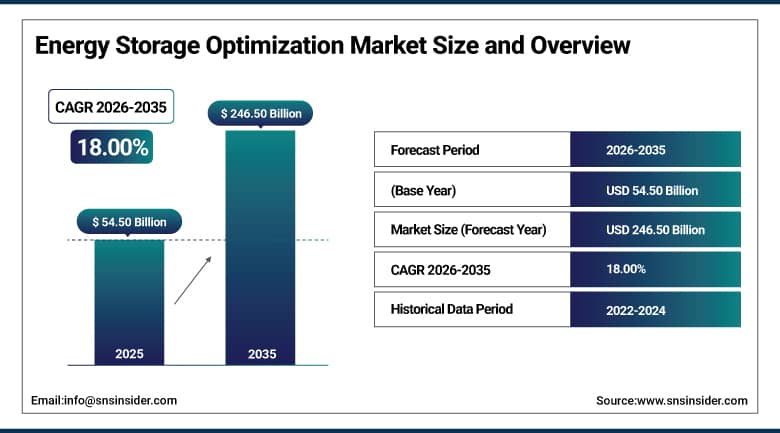
The Energy Storage Optimization Market was valued at USD 54.50 Billion in 2025 and is projected to reach USD 246.50 Billion by 2035, registering a CAGR of 18.00% from 2026 to 2035.
Energy Storage Optimization Market is marked by the rapid transition towards decarbonization across the world, increasing usage of intermittent renewable energy sources, rising demand for electricity, and improved attention to grid reliability in various applications including grid storage, renewable energy, energy backup, and electric vehicles. Energy Storage Optimization technologies make use of smart software, analytics, and battery technologies to improve the performance of energy storage systems and reduce costs, thereby providing the most efficient and seamless way to integrate renewable energy sources into today's grids. These technologies rely on advanced algorithms that help to predict future demand and optimize the dispatch of energy using AI and energy management.
AI-enabled software platform, partnership between technology providers and utilities, as well as the ability of smart grid integration have been developed due to substantial investments made by utilities, commercial companies, and technology providers into efficient energy management technologies.
To Get More Information On Energy Storage Optimization Market - Request Free Sample Report
Energy Storage Optimization Market Trends
-
Rising adoption of AI-driven energy management continues improving predictive dispatch and battery lifespan optimization.
-
Growing smart grid integration continues connecting storage assets with distributed energy resources and demand response programs.
-
Expanding vehicle-to-grid technology is broadening the role of electric vehicles as mobile energy storage assets.
-
Increasing IoT and cloud-based platform integration continues enabling remote monitoring and predictive maintenance.
-
Growing deployment of decentralized microgrids continues creating new opportunities for optimized storage solutions.
U.S. Energy Storage Optimization Market Outlook
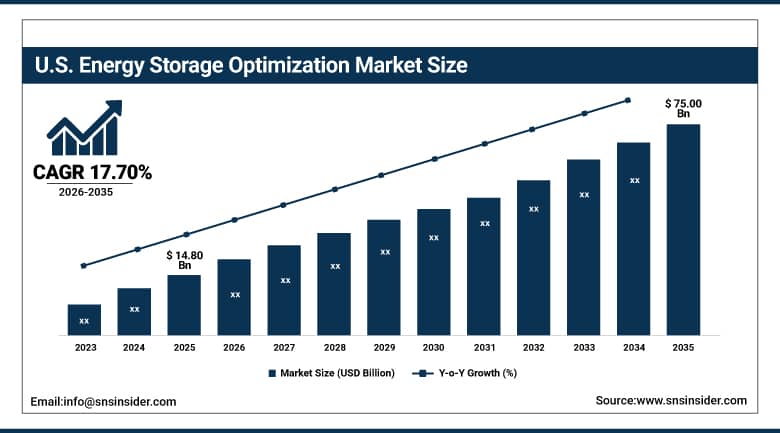
The U.S. Energy Storage Optimization Market was valued at approximately USD 14.80 Billion in 2025 and is projected to reach approximately USD 75.00 Billion by 2035, registering a CAGR of approximately 17.70% from 2026 to 2035.
The drivers for demand in the U.S. include high investment in utility-scale energy storage systems, increased solar and wind power generation, and incentives such as Investment Tax Credit for installing energy storage optimization software. Increasing adoption of distributed energy sources and microgrid technology has created additional demand for intelligent storage management solutions that can monitor and manage peak loads through predictive analysis.
AI-based grid management solution has played a significant role in securing the leadership of the U.S. energy storage optimization market. Moreover, increasing adoption of behind-the-meter storage optimization solutions by commercial and industrial users contributed to the growth in the demand for the product in the domestic market.
Energy Storage Optimization Market Segment Analysis
-
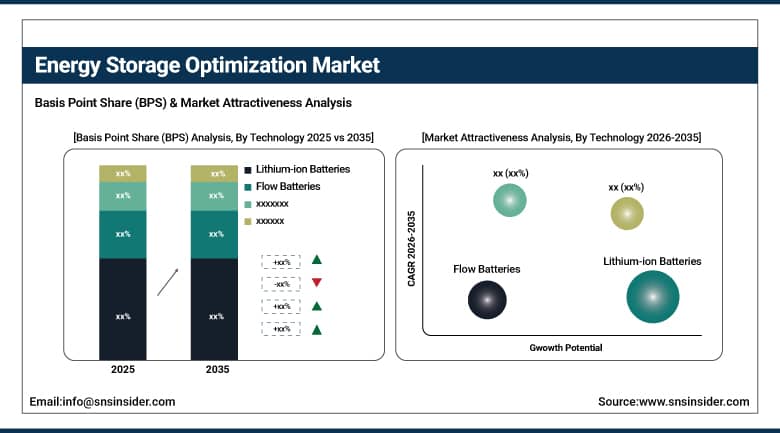
By Technology, Lithium-ion Batteries segment dominated the Market in 2025 with 60.80% share; Flow Batteries segment is the fastest growing segment, registering a CAGR of approximately 23.80%.
-
By End Use, Utility segment dominated the market in 2025 with 44.60% share; Transportation segment is the fastest growing segment, registering a CAGR of approximately 24.20%.
-
By Application, Grid Storage segment dominated the market in 2025 with 41.80% share; Electric Vehicle Charging segment is the fastest growing segment, registering a CAGR of approximately 25.60%.
-
By Energy Capacity, Medium Scale segment dominated the market in 2025 with 39.40% share; Large Scale segment is the fastest growing segment, registering a CAGR of approximately 22.90%.
By Technology, Lithium-ion Batteries Dominate While Flow Batteries Accelerate Fastest
Lithium-ion Batteries accounted for the largest market share in the Energy Storage Optimization Market in 2025 at about 60.80% due to high energy density, higher life cycle, and widespread adoption in electric vehicles, grid storage, and consumer electronics. The continuous deployment of CATL's Tener containerized energy storage solution that comes with zero-degradation warranties for utility-scale projects explains why utilities and integrators have continued to prioritize lithium-ion batteries over other chemistry options in frequency regulation, peak shaving, and renewable integration applications.
Flow Batteries are expected to grow at a CAGR of about 23.80%, the highest rate in the Technology category, due to their scalability, long-duration energy storage, and suitability for large-scale renewable energy integration. Increasing demand for long-cycle, low-degradation batteries for utility-scale projects, where long discharge time is more important than energy density of lithium-ion batteries, explains the rapid growth of flow batteries.
By End Use, Utility Leads While Transportation Grows Fastest
Utility was the leading end-use category in 2025 with around 44.60% market share because of substantial investments in grid modernization, frequency regulation, and renewable energy storage. The usage of energy storage optimization solutions is being actively employed by utility companies for peak load management and to ensure the reliability of energy.
Transportation is expected to grow at a CAGR of around 24.20%, which will be the highest growth rate among all other end-use segments. This is because of the increased adoption of electrification of public transport, logistic fleets, and electric personal vehicles. Optimization solutions in transportation help to manage batteries and energy efficiently.
By Application, Grid Storage Dominates While EV Charging Grows Fastest
The Grid Storage was the largest application with respect to market share in 2025 estimated at 41.80% due to its ability to balance peaks, frequencies, and loads of national and regional electricity grids. Storage optimization investments by utilities will remain focused on the grid storage to address the increasing complexities in balancing the variability of renewable sources versus demand in decentralizing power systems.
Electric Vehicle Charging was anticipated to be the fastest growing application category at an estimated CAGR of 25.60% as storage optimization is widely adopted to manage peak loading and grid upgrade costs in charging infrastructure operators. Increased adoption of electric vehicle corridors as well as electric vehicles across the globe made this application one of the most dynamic applications in the market.
By Energy Capacity, Medium Scale Leads While Large Scale Grows Fastest
Medium Scale category commanded the largest market share of about 39.40% in 2025, extensively used in commercial and industrial applications to shift loads and lower demand charges. This type of energy storage systems represents a good compromise between cost and efficiency, providing a perfect solution for middle-size facilities that need energy storage systems but do not want to invest heavily.
Large Scale energy storage systems will grow the fastest with a CAGR of about 22.90%, due to an increasing number of utility-scale battery farms, renewable energy storage projects, and national mandates for energy storage systems. Large scale systems need advanced optimization systems due to high-power throughput, large-duration storage capabilities, and complex interaction with the grid.
Regional Analysis:
|
Region |
Major Country |
Share within Region, 2025 (%) |
|---|---|---|
|
North America |
United States |
80.50% |
|
Europe |
Germany |
24.00% |
|
Asia Pacific |
China |
40.00% |
|
Middle East and Africa |
Saudi Arabia |
30.00% |
|
Latin America |
Brazil |
45.00% |
North America Energy Storage Optimization Market Insights
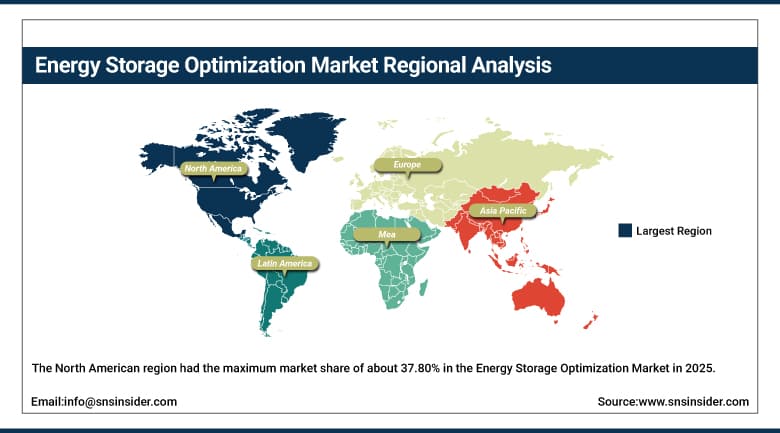
The North American region had the maximum market share of about 37.80% in the Energy Storage Optimization Market in 2025. The high market share can be attributed to the large-scale deployment of utility and behind-the-meter energy storage systems, which have been designed to increase grid resilience, facilitate renewable energy integration, and promote energy efficiency.
The U.S. dominated the regional market in terms of revenue and accounted for about 80.50% of the total revenue of the North American region. This was mainly attributed to favorable policies adopted by the federal government in the country, such as the Investment Tax Credit, advanced grid management through artificial intelligence, and dominance of companies dealing in energy storage technologies and solutions.
Get Customized Report as Per Your Business Requirement - Enquiry Now
Europe Energy Storage Optimization Market Insights
The market had a significant portion of Europe due to its goals of reducing carbon footprints and use of renewable energy sources. The increased need for flexible power grids and carbon neutrality has helped boost the growth in both domestic and utility markets as the focus towards international power exchange and smart grid integration is increasing the demand for efficient optimization services.
Germany dominated the revenue generation market within Europe due to its strong performance in the transition towards sustainable energy sources. The increasing number of decentralized energy sources and installations of residential energy systems with solar cells and batteries have been driving the demand for energy optimization solutions. The United Kingdom also contributed to the demand in the region with its net zero emission targets.
Asia Pacific Energy Storage Optimization Market Insights
The Asia Pacific is expected to register the highest CAGR of around 23.50% during 2026-2035 owing to the increasing investments in renewable energy infrastructure, urbanization, and digitalization in China, Japan, India, and South Korea, as the governments are increasingly making use of energy storage technologies to balance the power grid and satisfy the increasing demand for electricity.
The largest revenue share was contributed by China, amounting to about 40.00% in the Asia Pacific due to the government's renewable energy targets coupled with urbanization in the country, along with its manufacturing prowess in batteries and energy storage systems. In Japan, India, and South Korea, the increasing government investments and domestic tech companies' presence in clean energy helped fuel the growth of the region during the forecast period.
MEA and Latin America Energy Storage Optimization Market Insights
The Middle East & Africa and Latin America have seen consistent growth due to increased investments in renewable energy diversification initiatives, grid modernization efforts, and collaborations between the utilities operating in those regions and the global vendors of energy storage solutions. The increasing number of new renewable energy installations that require optimized storage has made both regions more significant markets for energy storage optimization technologies during the forecast period.
For the Middle East & Africa, Saudi Arabia was the biggest market in the region, thanks to the country's large investments in renewable energy diversification associated with energy transition plans. Grid modernization in the UAE helped gain a market share in the region. For Latin America, Brazil was the dominant market due to its vast energy infrastructure and increasing demand for optimized energy storage.
Market Dynamics:
Growth Drivers: Rising Demand for Efficient and Sustainable Energy Management
The growth of the market is driven by the rapid transition towards renewable energy sources globally, along with the requirements for reliability of the power grid and energy savings, pushing governments, utilities, and businesses to invest in energy storage systems to improve renewable energy integration and decrease carbon footprint. In light of the growing number of financing programs for energy storage projects provided by governments, the demand for energy storage optimization is projected to remain high through the forecast period.
Other factors include the growing popularity of electric vehicles and distributed energy resources leading to the need for battery management system optimization, as well as the rising focus on energy savings among industrial and commercial companies resulting in an increased use of energy storage systems powered by AI and IoT technologies. Expansion of the microgrids and off-grid energy systems in remote and emerging economies is yet another key driver of demand and growth.
Restraints: High Capital Expenditure and Technical Limitations
The relatively high investment needed in the case of optimizing energy storage systems, especially in terms of large-scale batteries and software, is one of the main hurdles in the implementation of such technologies in cost-sensitive regions. The latest lithium-ion battery systems coupled with AI management software may cost hundreds of dollars per kilowatt-hour of capacity, which poses an affordability problem in the case of smaller customers and developing nations.
Another hurdle relates to battery problems such as cycle degradation, inefficiency in charging and discharging, and thermal problems, among others. Issues related to recycling and disposal of batteries add additional pressure on manufacturers and policy makers, as they struggle to find a suitable solution to these problems.
Opportunities: Expansion of Renewable Integration and Smart Grid Modernization
The development of renewable energy deployment and smart grid innovation offers a great opportunity for those vendors who are able to provide AI-enabled software platforms that would enable analysis of load profiles, weather predictions, and usage of real-time data. Tesla and Siemens Energy platforms with predictive analytics as well as optimized cycles of charging and discharging show the way in which vendors leverage this growing workflow in order to create differentiation for themselves within the utility and commercial customers market segments.
Moreover, the development of hybrid energy storage systems and more effective cybersecurity practices offer significant opportunities for vendors to generate value by providing resilience and data security features of the systems. Vendors that are able to generate value using their hardware-software-service combinations would be positioned for ongoing investments by utilities and commercial customers.
Recent Developments:
-
2024: Hydrostor signed a Crown Lands agreement with the New South Wales government to develop the Silver City Energy Storage Centre, a 200 MW facility offering 8 hours of storage at full capacity.
-
2024: The U.S. Department of Energy announced USD 325 million in funding for long-duration energy storage demonstrations covering iron-air, zinc-bromine, and thermal technologies.
-
2025: Fluence Energy expanded its Mosaic AI-powered bidding platform with enhanced multi-market optimization capabilities for utility-scale battery storage operators.
-
2026: Tesla expanded its Autobidder software platform with upgraded predictive analytics, enabling coordinated dispatch of Megapack fleets into wholesale energy markets.
Energy Storage Optimization Market key players are:
-
Panasonic Holdings Corporation
-
AES Corporation
-
Saft (a TotalEnergies company)
-
Tesla, Inc.
-
Schneider Electric SE
-
BYD Company Limited
-
Samsung SDI Co., Ltd.
-
Enphase Energy, Inc.
-
Siemens Energy AG
-
VARTA AG
-
Contemporary Amperex Technology Co. Limited (CATL)
-
Hitachi, Ltd.
-
LG Energy Solution, Ltd.
-
GE Vernova Inc.
-
Fluence Energy, Inc.
-
Wärtsilä Corporation
-
NextEra Energy, Inc.
-
Stem, Inc.
-
Sungrow Power Supply Co., Ltd.
-
EnerSys
Energy Storage Optimization Market Report Scope:
| Report Attributes | Details |
|---|---|
| Market Size in 2025 | USD 54.50 Billion |
| Market Size by 2035 | USD 246.50 Billion |
| CAGR | 18.00% from 2026 to 2035 |
| Base Year | 2025 |
| Forecast Period | 2026-2035 |
| Historical Data | 2022-2024 |
| Report Scope & Coverage | Market Size, Segments Analysis, Competitive Landscape, Regional Analysis, DROC & SWOT Analysis, Forecast Outlook |
| Key Segments | •By Technology, Lithium-ion Batteries segment dominated the Market in 2025 with 60.80% share; Flow Batteries segment is the fastest growing segment, registering a CAGR of approximately 23.80%. •By End Use, Utility segment dominated the market in 2025 with 44.60% share; Transportation segment is the fastest growing segment, registering a CAGR of approximately 24.20%. •By Application, Grid Storage segment dominated the market in 2025 with 41.80% share; Electric Vehicle Charging segment is the fastest growing segment, registering a CAGR of approximately 25.60%. •By Energy Capacity, Medium Scale segment dominated the market in 2025 with 39.40% share; Large Scale segment is the fastest growing segment, registering a CAGR of approximately 22.90%. |
| Regional Analysis/Coverage | North America (US, Canada), Europe (Germany, UK, France, Italy, Spain, Russia, Poland, Rest of Europe), Asia Pacific (China, India, Japan, South Korea, Australia, ASEAN Countries, Rest of Asia Pacific), Middle East & Africa (UAE, Saudi Arabia, Qatar, South Africa, Rest of Middle East & Africa), Latin America (Brazil, Argentina, Mexico, Colombia, Rest of Latin America). |
| Company Profiles | Panasonic Holdings Corporation, AES Corporation, Saft (a TotalEnergies company), Tesla, Inc., Schneider Electric SE, BYD Company Limited, Samsung SDI Co., Ltd., Enphase Energy, Inc., Siemens Energy AG, VARTA AG, Contemporary Amperex Technology Co. Limited (CATL), Hitachi, Ltd., LG Energy Solution, Ltd., GE Vernova Inc., Fluence Energy, Inc., Wärtsilä Corporation, NextEra Energy, Inc., Stem, Inc., Sungrow Power Supply Co., Ltd., EnerSys. |

Frequently Asked Questions
Key players in the Energy Storage Optimization Market include Panasonic Holdings Corporation, AES Corporation, Saft, Tesla, Inc., and Schneider Electric SE, among others.
Key opportunities in the Energy Storage Optimization Market include expansion of renewable energy integration and smart grid modernization, alongside the emergence of hybrid energy storage systems and enhanced cybersecurity measures.
The market is driven by the accelerating global transition to renewable energy sources, growing need for grid reliability, and increasing focus on energy cost optimization through AI-powered and IoT-enabled storage management systems.
The Lithium-ion Batteries segment dominated the Energy Storage Optimization Market, accounting for approximately 60.80% market share.
The North America region dominated the Energy Storage Optimization Market in 2025 with a 37.80% share, driven by widespread deployment of utility-scale and behind-the-meter storage solutions.
