
Energy Storage Optimization Software Market Report Scope and Overview:
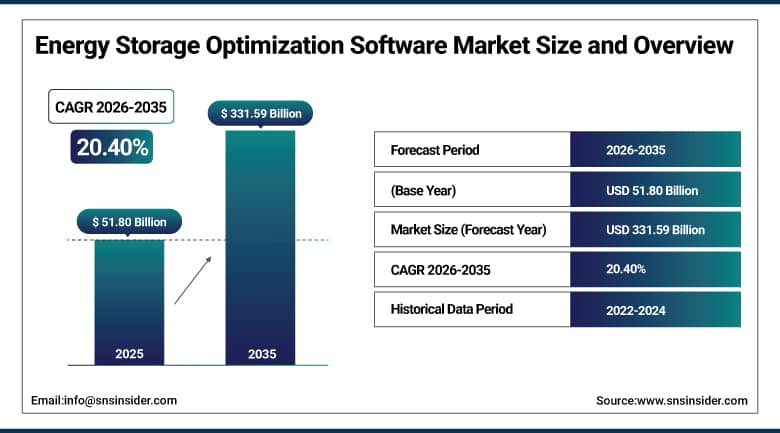
Energy Storage Optimization Software Market was valued at approximately USD 51.80 Billion in 2025 and is expected to reach approximately USD 331.59 Billion by 2035, growing at a CAGR of approximately 20.40% from 2026 to 2035.
Energy Storage Optimization Software Market has now emerged as an essential enabler for energy storage systems aiming at optimizing round-trip efficiency, maximizing lifetime, and generating revenue from multiple grid services simultaneously. These software programs use predictive dispatch algorithms, state-of-charge and state-of-health models, and real-time bidding strategies for market participation. This industry is marked by increasing deployment of battery storage systems in tandem with renewables, increasing investments of utilities and independent power producers in using AI for dispatch optimization, mandates in support of grid flexibility and carbon reduction, and more varied use cases, ranging from utility-scale transmission-connected storage to distributed commercial and residential energy storage systems that need to be coordinated via virtual power plants.
Revenue stacking through software, collaborations between energy storage optimization software providers and battery original equipment manufacturers, and the move towards cloud-based platforms has come after considerable investments made by storage solution providers, utilities, and independent power producers towards digital asset management.
To Get More Information On Energy Storage Optimization Software Market - Request Free Sample Report
Energy Storage Optimization Software Market Trends
-
Rising utility-scale battery storage deployments are accelerating demand for AI-driven dispatch optimization platforms.
-
Growing revenue-stacking strategies across ancillary services and capacity markets continue widening software adoption among storage operators.
-
Expanding virtual power plant orchestration is broadening the addressable base for distributed and residential battery optimization tools.
-
Increasing integration of optimization software with wholesale energy trading platforms continues improving cross-market bidding efficiency.
-
Growing preference for cloud-based deployment continues shortening implementation timelines for utility and commercial storage operators.
U.S. Energy Storage Optimization Software Market Outlook
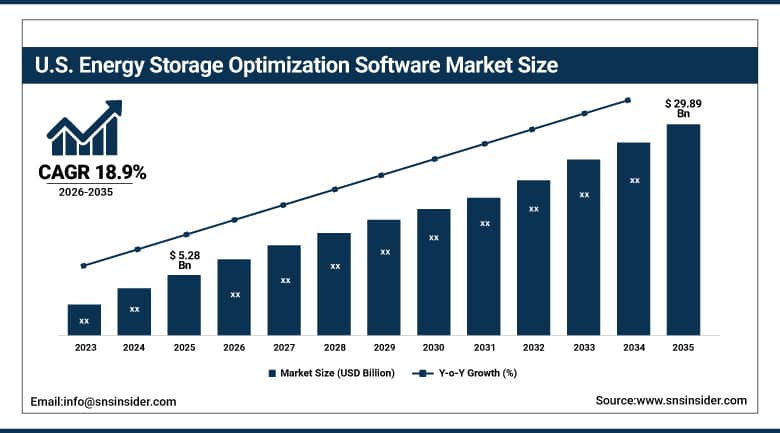
The U.S. Energy Storage Optimization Software Market was valued at approximately USD 5.28 Billion in 2025 and is projected to reach approximately USD 29.89 Billion by 2035, registering a CAGR of approximately 18.9% from 2026 to 2035.
The need in the United States has been stimulated by fast growth in utility-scale battery storage installation in ISO and RTO regions, changes in FERC-led market rules to allow energy storage involvement in ancillary services and capacity markets, and increased usage of AI-powered dispatch systems by IPPs operating several sites with energy storage facilities together with renewables.
The employment of state-of-health and revenue stacking algorithms has been essential for the dominance achievement of the U.S. energy storage optimization software market. Also, the increasing popularity of cloud-based dispatch systems in interconnection queuing and wholesale market bidding led to an additional need in the discussed product on the domestic market.
Energy Storage Optimization Software Market Segment Analysis
-
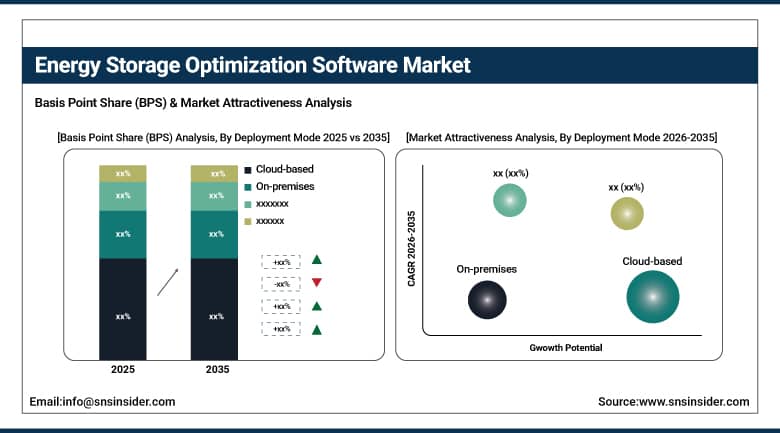
By Deployment Mode, Cloud-based segment dominated the market in 2025 with 58.70% share; Cloud-based segment is also the fastest growing segment.
-
By Application, Grid Management segment dominated the market in 2025 with 36.80% share; Energy Trading segment is the fastest growing segment, registering a CAGR of approximately 17.90%.
-
By End User, Utilities segment dominated the market in 2025 with 55.60% share; Commercial & Industrial segment is the fastest growing segment, registering a CAGR of approximately 15.60%.
By Deployment Mode, Cloud-based Leads and Grows Fastest
The Cloud-based deployment segment commanded the largest market share in 2025 at around 58.70%, owing to the tendency of storage operators to deploy subscription-based solutions that can be scaled quickly among geographically dispersed battery fleets without the requirement of site-specific infrastructure. Increasing confidence in cloud security technology that adheres to NERC CIP and regional grid-code standards has only helped increase the adoption of such workloads into the cloud managed by vendors.
Cloud-based deployment segment will continue to witness the fastest growth rate as well, as utilities and independent power producers become more inclined towards solutions that offer quick implementation, lower infrastructure investment requirements, and algorithm updates over-the-air compared to on-premise solutions. Vendors are continuously improving compatibility of their solutions with SCADA, energy management system, and third-party market bidding platforms.
By Application, Grid Management Dominates While Energy Trading Grows Fastest
The Grid Management segment occupied the largest market share in 2025 at about 36.80% because this is still the base case deployment scenario for grid operators interested in load balancing, capacity deferral, and frequency stabilization with help of dispatchable storage. Robustness and applicability of load balancing algorithms combined with the integration of these processes into existing grid management workflows make this solution the natural starting point for utility companies venturing into storage optimization software solutions.
The Energy Trading segment will grow at a CAGR of 17.90%, the fastest rate of all segments. This is driven by increased automation of energy trading with the help of bidding engines that help extract arbitrage value from day-ahead, real time, and ancillary markets. Stem’s Athena software is one such platform that combines market-bidding with dispatch optimization in one platform.
By End User, Utilities Lead While Commercial & Industrial Gain Fastest Traction
Utilities emerged as the leading end-user segment in 2025, accounting for approximately 55.60% of total revenue, owing to their responsibility toward the grid reliability, renewable generation, and the management of the large battery portfolio. Extensive use of optimization software among utilities in North America, Europe, and Asia Pacific due to their existing renewable interconnection backlogs and capacity-deferral obligations indicate a direct investment toward dispatch intelligence as part of their broader grid modernization initiatives.
The Commercial & Industrial end users are anticipated to exhibit the highest growth rate, growing at a CAGR of around 15.60%, attributed to the increasing adoption of behind-the-meter battery storage optimization to address the issues of demand charges, demand response participation, and hedging against volatile industrial electricity pricing. Availability of Software as a Service (SaaS)-based pricing model has brought down the investment requirement for the deployment of dispatch optimization solution from medium-size Commercial & Industrial organizations.
Regional Analysis:
|
Region |
Major Country |
Share within Region, 2025 (%) |
|---|---|---|
|
North America |
United States |
84.50% |
|
Europe |
Germany |
24.80% |
|
Asia Pacific |
China |
34.10% |
|
Middle East and Africa |
Saudi Arabia |
26.40% |
|
Latin America |
Brazil |
32.60% |
North America Energy Storage Optimization Software Market Insights
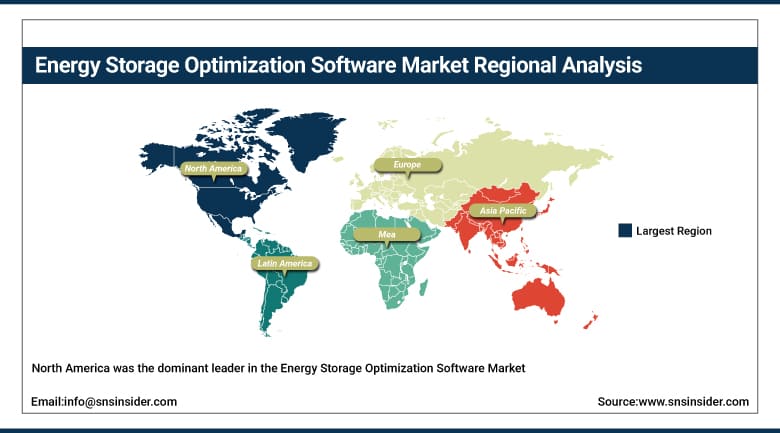
North America was the dominant leader in the Energy Storage Optimization Software Market, with the highest market share of about 36.50%. It was attributed to the fast pace of development of utility-scale battery storage, reforms in the FERC and ISO level markets that helped to participate in the capacity and ancillary services market, and high concentration of top-notch optimization software vendors from that region. Moreover, strong collaboration of storage integrators and independent power producers along with the software companies and increasing number of storage mandate policies in the state level markets bolstered the dominance of North America throughout the forecast period.
In North America, the U.S. held the largest market share of about 84.50%. The key factors responsible for its large market share include the increasing adoption of AI-based dispatch at the PJM, MISO, ERCOT, and CAISO market levels and growing incentives provided by the government for deployment of battery storage systems.
Get Customized Report as Per Your Business Requirement - Enquiry Now
Europe Energy Storage Optimization Software Market Insights
Europe held a substantial share of the Energy Storage Optimization Software Market, due to the strong renewable integration requirements, heavy investments in the international trading of electricity, and increasing adoption of dispatch optimization software among the older and congested transmission network of the region. The grid code regulations and balancing market regulations in Europe among its member states have enabled European storage companies and utility firms to invest in vendor-agnostic optimization tools that can participate in several national markets simultaneously.
Germany dominated the European market in terms of revenue due to the large storage installations associated with the Energiewende transition program of Germany and also increasing number of offshore wind interconnection projects. The United Kingdom continued to be a major revenue source for the regional market owing to the capacity market storage auctions and increasing battery installations for grid balancing services.
Asia Pacific Energy Storage Optimization Software Market Insights
The Asia Pacific is expected to be the fastest-growing region, growing at a CAGR of around 16.40% between 2026 and 2035. This growth has been largely driven by investments in grid-scale battery energy storage systems by China and India worth billions of dollars, increase in urbanization and industrialization increasing the power demand, and increasing government initiatives that promote renewables and grid modernization in the Asia Pacific.
China held the largest share of the Asia Pacific revenues at around 34.10% due to the continual support provided by the government in grid-scale battery energy storage optimization system and capacity to produce optimization software. Rapid transmission and distribution improvements in India backed by CEA reliability standards and expanding purchase obligations for renewables have largely driven growth in the Asia Pacific region.
MEA and Latin America Energy Storage Optimization Software Market Insights
Steady growth in the Middle East & Africa and Latin America was fueled by increasing investments in infrastructure modernization, governmental diversification of renewables program, and increasing partnerships between regional systems operators and foreign providers of storage optimization software solutions. Limited transmission capacity and the increasing number of renewable installations beyond the grid capacity limit make the two regions important targets for dispatch and demand response optimization platforms over the next decade.
As the Middle East & Africa is concerned, Saudi Arabia took the lead in the regional demand, stimulated by investments in storage associated with solar and renewables diversification program of Saudi Arabia, along with grid modernization projects in the UAE that contributed to the regional market growth. In Latin America, the largest market was represented by Brazil due to its highly-developed transmission network.
Market Dynamics:
Growth Drivers: Rising Battery Storage Deployment and Revenue-Stacking Demand
Market evolution is driven by the increasing adoption of utility-scale and distributed battery storage, the increasing use of AI-enabled dispatch algorithms in revenue stacking in ancillary services and capacity markets, increasing renewable integration, which increases the need for flexibility assets, and use cases ranging from transmission-scale storage to residential virtual power plants orchestration. With the growing announcements of battery storage and software procurement from utilities and independent power producers, demand for software optimization is expected to stay robust through the entire forecast period.
Supporting factors include collaborations between optimization software providers and battery original equipment manufacturers and government-supported grid flexibility and storage incentives programs. Maximizing the utilization of the installed base of batteries without adding more hardware will be yet another supporting factor through the forecast period.
Restraints: Integration Complexity and Legacy Asset Interoperability Gaps
One major factor that hinders rapid adoption of this technology is the relatively complicated nature of implementing the software into existing battery management systems and the utility SCADA systems compared to other simpler manual dispatch systems, which small storage facilities, particularly those having constrained IT budgets, find it difficult to adopt. In light of this problem, implementation of the optimization software has been adopted in phases, with its deployment being limited to large utilities and power production companies with robust storage operations.
One other problem faced by storage facility managers during adoption of AI-based dispatch systems involves validation of the predictions made by these models using historical data from their storage assets with various battery chemistries and depreciation rates.
Opportunities: Cross-Market Trading Integration and AI Model Advancement
The increasing trend towards participation in several wholesale and auxiliary service markets is a huge opportunity for vendors who can provide optimization software to optimize bidding strategies in contiguous balancing authority areas. Software services offered by vendors, such as Fluence Energy and Stem, which use automated multi-market bidding along with dispatch optimization, exemplify the opportunities available to vendors in this extended workflow.
Furthermore, increased interest shown by battery storage owners to incorporate data-driven optimization into their wholesale market bidding and interconnection queue management activities is an opportunity for vendors to prove themselves through results that show reduction in curtailments and delayed capacity expansion. Vendors who can offer data packages that reflect improved asset utilization and revenues will have no difficulty attracting investments from utility and independent power producers.
Recent Developments:
-
2025: Wärtsilä Energy Storage & Optimisation deployed an expanded version of its GEMS Digital Energy Platform across a major North American utility's grid-scale storage fleet, targeting improved dispatch coordination across multiple sites.
-
2026: Sonnen GmbH introduced upgraded fleet-management capabilities within its sonnenCommunity software, enabling residential battery aggregation for participation in regional demand response and frequency regulation programs.
-
2026: Habitat Energy expanded deployment of its Waypoint optimization platform across additional European grid-scale battery assets, adding cross-border balancing market participation functionality for storage operators.
-
2026: Sympower B.V. launched an updated demand-response and storage-dispatch module supporting automated participation in multiple European flexibility markets, aimed at commercial and industrial battery storage operators.
Energy Storage Optimization Software Market key players are:
-
ABB Ltd.
-
Siemens AG
-
GE Vernova Inc.
-
Schneider Electric SE
-
Honeywell International Inc.
-
Hitachi Energy Ltd.
-
IBM Corporation
-
Oracle Corporation
-
SAP SE
-
AutoGrid Systems, Inc.
-
Enel X S.r.l.
-
Fluence Energy, LLC
-
Stem, Inc.
-
Tesla, Inc.
-
Wärtsilä Energy Storage & Optimisation
-
Sonnen GmbH
-
Habitat Energy Ltd.
-
Sympower B.V.
-
Peak Power Inc.
-
NextEra Energy Resources, LLC
Energy Storage Optimization Software Market Report Scope:
| Report Attributes | Details |
|---|---|
| Market Size in 2025 | USD 51.80 Billion |
| Market Size by 2035 | USD 331.59 Billion |
| CAGR | 20.40% from 2026 to 2035 |
| Base Year | 2025 |
| Forecast Period | 2026-2035 |
| Historical Data | 2022-2024 |
| Report Scope & Coverage | Market Size, Segments Analysis, Competitive Landscape, Regional Analysis, DROC & SWOT Analysis, Forecast Outlook |
| Key Segments | •By Deployment Mode, Cloud-based segment dominated the market in 2025 with 58.70% share; Cloud-based segment is also the fastest growing segment. •By Application, Grid Management segment dominated the market in 2025 with 36.80% share; Energy Trading segment is the fastest growing segment, registering a CAGR of approximately 17.90%. •By End User, Utilities segment dominated the market in 2025 with 55.60% share; Commercial & Industrial segment is the fastest growing segment, registering a CAGR of approximately 15.60%. |
| Regional Analysis/Coverage | North America (US, Canada), Europe (Germany, UK, France, Italy, Spain, Russia, Poland, Rest of Europe), Asia Pacific (China, India, Japan, South Korea, Australia, ASEAN Countries, Rest of Asia Pacific), Middle East & Africa (UAE, Saudi Arabia, Qatar, South Africa, Rest of Middle East & Africa), Latin America (Brazil, Argentina, Mexico, Colombia, Rest of Latin America). |
| Company Profiles | ABB Ltd., Siemens AG, GE Vernova Inc., Schneider Electric SE, Honeywell International Inc., Hitachi Energy Ltd., IBM Corporation, Oracle Corporation, SAP SE, AutoGrid Systems, Inc., Enel X S.r.l., Fluence Energy, LLC, Stem, Inc., Tesla, Inc., Wärtsilä Energy Storage & Optimisation, Sonnen GmbH, Habitat Energy Ltd., Sympower B.V., Peak Power Inc., NextEra Energy Resources, LLC |

Frequently Asked Questions
Key players in the Energy Storage Optimization Software Market include ABB Ltd., Siemens AG, Fluence Energy, LLC, Stem, Inc., and Tesla, Inc., among others.
Key opportunities in the Energy Storage Optimization Software Market include expansion of cross-market trading integration and AI dispatch model advancement, alongside growing virtual power plant orchestration and revenue-stacking adoption across utility and commercial storage fleets.
The market is driven by rising utility-scale and distributed battery storage deployment, expanding use of AI-based dispatch and revenue-stacking software, and growing renewable energy integration requirements across utility and independent power producer portfolios worldwide.
The Software segment dominated the Energy Storage Optimization Software Market, accounting for approximately 65.40% market share.
The North America region dominated the Energy Storage Optimization Software Market in 2025 with a 36.50% share, driven by rapid utility-scale battery storage buildout and strong FERC and ISO-level market reforms.
