
Energy Storage as a Service Market Report Scope & Overview:
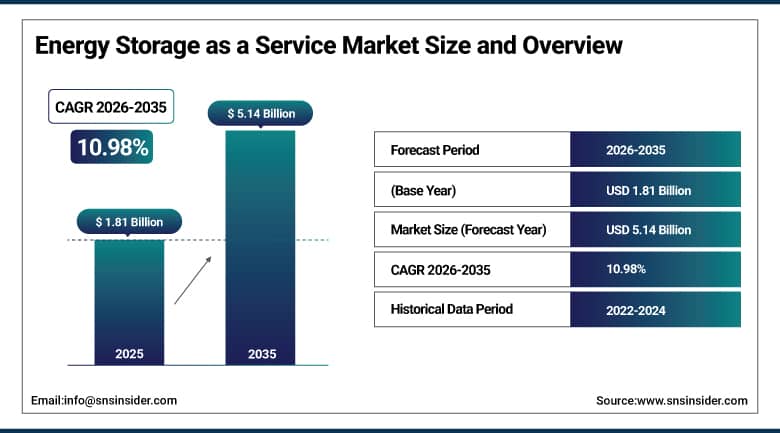
The Energy Storage as a Service Market size was valued at USD 1.81 Billion in 2025 and is projected to reach USD 5.14 Billion by 2035, expanding at a CAGR of 10.98% during the forecast period 2026–2035.
The Business Case for Energy Storage as a Service is growing in relevance as companies look for storage capacity, optimization, resilience, and flexibility without taking on all the capital and operational costs of building and operating storage facilities. Storage-as-a-service vendors have the potential to monetize storage assets through the addition of software, energy management, and participation in markets, maintenance, and optimization to deliver recurring revenue. This model is gaining increasing traction as price volatility, demand charges, renewable generation, grid limitations, and requirements around reliability drive customers to consider storage as more of a service than a capital investment.
In addition, the business model is receiving a boost as the rapidly growing amount of battery storage infrastructure and the increasingly advanced nature of energy management systems create greater opportunities. For instance, in the United States, at the end of 2024, battery storage capacity at the utility-scale level had already reached above 26 GW following 10.4 GW worth of additions in that year alone, with operators having announced plans for an additional 19.6 GW in 2025.
To Get More Information On Energy Storage as a Service Market - Request Free Sample Report
Energy Storage as a Service Market Trends
- Rising adoption of storage-based demand charge management.
- Increasing deployment of battery systems for grid flexibility.
- Growing demand for backup power and energy resilience.
- Expansion of energy arbitrage through intelligent storage optimization.
- Increasing use of storage alongside renewable generation.
U.S. Energy Storage as a Service Market Size Outlook
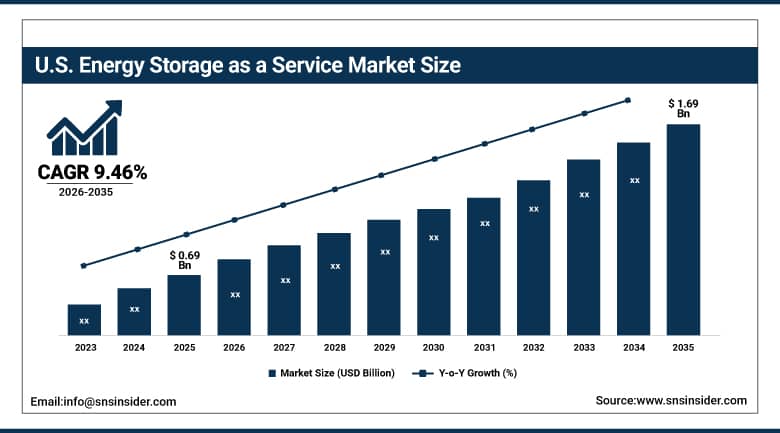
The U.S. Energy Storage as a Service Market was valued at USD 0.69 billion in 2025 and is expected to reach approximately USD 1.69 billion by 2035, expanding at a CAGR of 9.46% during 2026–2035.
In 2025, the US had 90.00% share of the North American market revenues due to the much more significant installed base of storage, better developed electricity markets, and wider adoption of energy management and grid flexibility solutions in the commercial sector. The US market is characterized by the increasing number of installations of the utility scale and behind the meter storage in the regions with the high share of renewables in power generation, electricity demand growth, and complicated tariff structures.
It is possible to monetize the batteries via such applications as demand charge reduction, resilience, energy arbitrage, and grid services which makes this approach especially appropriate for commercial buildings, industries, data centers, and utilities. According to the EIA data, the battery capacities in the US kept growing fast, and the federal energy storage initiatives helped to develop the technologies and integrate them into the grid. In February 2026, The U.S. Department of Energy launched its Beyond the Meter Prize aimed at increasing the integration of behind-the-meter resources and energy storage systems.
Energy Storage as a Service Market Segment Analysis
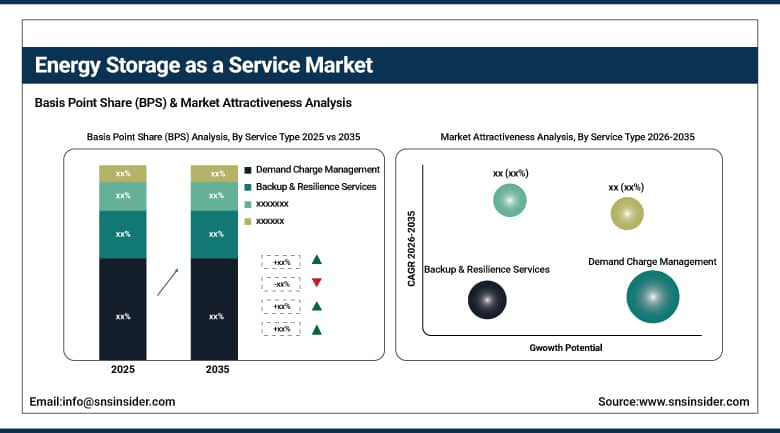
- By Service Type, demand charge management dominated the market with 31.00% share in 2025, while demand response & grid services is projected to witness the fastest growth with 13.02% CAGR during the forecast period.
- By Storage Technology, lithium-ion battery storage dominated the market with 64.00% share in 2025, while flow battery storage is projected to witness the fastest growth with 14.99% CAGR during the forecast period.
- By End User, commercial & industrial dominated the market with 42.00% share in 2025, while data centers & telecom is projected to witness the fastest growth with 13.48% CAGR during the forecast period.
By Service Type, demand charge management dominated, while demand response & grid services grows fastest.
Demand charge management captured a market share of 31.00% in the energy storage as a service market in 2025, the most significant segment in the ME structure. Commercial and industrial consumers use storage facilities more frequently to cut down electricity costs related to peak demand and to move their usage to cheaper periods. Service contracts are profitable since users can have automatic load control without buying, operating, and optimizing the entire storage solution themselves. The approach optimizes the usage of installed battery packs through coordinated scheduling of charging and discharging based on load curves and electricity prices. The service segment will be reinforced through the rise in the difficulty of electricity purchase and energy management of distributed energy systems.
The demand response & grid services segment will demonstrate the fastest growth rate at 13.02% CAGR between 2026 and 2035. This segment is being positively impacted by an increased need for flexible electricity supply that can react quickly to grid needs. Storage units can provide frequency response, load shifting, peak load capacity, capacity services, and other grid flexibility functions depending on the market policies and system setup. Ability to aggregate and remote control of distributed or utility-scale battery facilities makes service models more profitable since customers can gain from flexibility while not managing their own market participation. Commercial value of such services is increasing because of renewables and electricity demand becoming increasingly desynchronized.
By Storage Technology, lithium-ion battery storage dominated, while flow battery storage grows fastest.
Lithium-ion battery storage was the largest storage technology with a share of 64.00% of the total market of energy storage as a service market in 2025. This is due to its mature manufacturing capacity, high energy density, supply chain maturity, considerable experience in projects, and versatile applicability for commercial, industrial, utility, and distributed customers. Lithium-ion solutions are ideal for demand management, back-up power, energy arbitrage, and short-to-medium duration grid services enabling standardized deployments and operations models for several types of customers. The leading position of lithium-ion storage is also supported by ongoing investments in scaling up battery infrastructure, integration, controls, thermal management, and digitalization.
Flow battery storage is forecasted to demonstrate the highest growth rate as a technology segment with CAGR 14.99% in 2026–2035. The reasons for such a promising forecast include the growing necessity of long-duration energy storage when systems should be able to discharge not only during short peaks but over longer periods of time. This type of storage might offer the operational parameters that are suitable for applications involving frequent cycling and longer discharging duration especially in shifting renewables over longer time intervals. This technology becomes strategically important as the demands on energy storage start changing from traditional peak-shaving to multi-hour grid flexibility and renewable energy integration.
By End User, commercial & industrial dominated, while data centers & telecom grows fastest.
Commercial & industrial end users represented the largest share in the energy storage as a service market and accounted for 42.00% of the market share in 2025. There are several reasons why Commercial and Industrial facilities should be interested in service-based storage since their financial performance is affected by the electricity prices, demand charges, the need for backup, and operation continuity. ESaaS provides facilities with all of these benefits while limiting the capital expenditures on energy storage. Service providers can remotely monitor facility consumption and control storage units in real time, making implementation less complicated for clients.
Data centers & telecom are expected to show the highest CAGR at 13.48% in 2026-2035. This segment is driven by the growing digital infrastructure, AI computing, cloud computing, and telecommunications needs which require extremely reliable sources of electricity. Data centers require power systems capable of providing critical loads with electricity even when the power supply system is off as well as being able to manage increasingly large amounts of energy consumption. ESaaS enables operators to use batteries and optimize them without owning the entire energy storage system. The demand for ESaaS is expected to increase as the demand for electricity in the U.S. grows along with AI and data center infrastructure.
Regional Analysis:
|
Region |
Major Country |
Share within Region, 2025 (%) |
|---|---|---|
|
North America |
United States |
90.00% |
|
Europe |
Germany |
26.00% |
|
Asia Pacific |
China |
24.00% |
|
Middle East & Africa |
UAE |
4.00% |
|
Latin America |
Brazil |
4.00% |
North America Energy Storage as a Service Market Insights
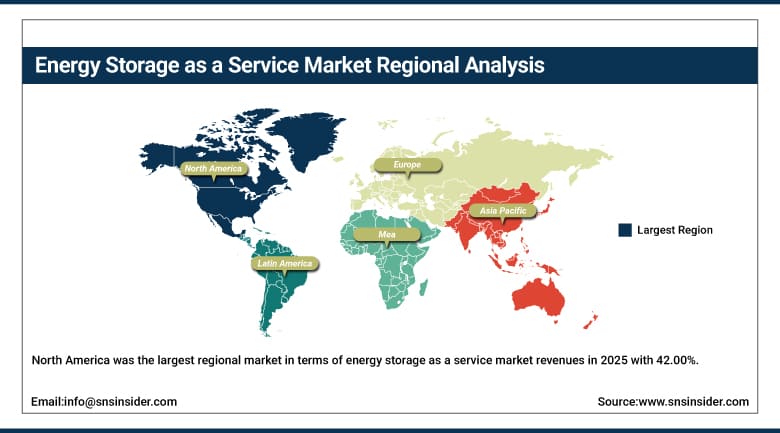
North America was the largest regional market in terms of energy storage as a service market revenues in 2025 with 42.00%. The region offers mature electricity markets, high consumption of electricity by the commercial and industrial sectors, rapid growth of utility-scale battery deployment and rising demand for grid flexibility. The U.S. is the dominant player owing to demand charge management, opportunities to provide ancillary services, need to integrate renewable sources and growing adoption of storage assets. It is an attractive business model for customers since they can outsource finance, optimization, maintenance and participation in markets while benefiting from flexible energy sources.
The regional opportunity is growing due to fast deployment of battery capacity in utilities, behind-the-meter and commercial applications. According to the report of the U.S. EIA, developers were planning to add 24 GW of battery storage capacity to utilities in 2026 compared to 15 GW which was added in 2025. More than 40 GW of battery capacity were added to the U.S. grid in the previous five years. Thus, the growing installed base expands the available opportunity for optimizing storage assets, performing demand response and other related services.
Get Customized Report as Per Your Business Requirement - Enquiry Now
Europe Energy Storage as a Service Market Insights
Europe due to increasing penetration of variable renewable power generation and flexibility requirement in electricity resources. Storage-as-a-service can assist business customers and energy suppliers in managing price volatility of electricity, intermittency of renewable energy sources, balancing needs, and grid restrictions without requiring clients to develop all the storage management capabilities. Decarburization and flexibility of the European electricity system are also the factors creating a favorable environment for companies offering storage services that include storage equipment, software optimization, and operations assistance.
The European market is becoming more inclined towards application of advanced storage technologies that include balancing, energy shifting, renewable energy integration, and flexibility management. Companies that have portfolios of storage solutions in several countries can leverage digital solutions for optimizing the assets in compliance with local market requirements, adding commercial value to the managed storage capacity. For instance, the company ENGIE reported 5.6 GW of battery storage capacity that is currently operational and under development as of June 2025 in several countries.
Asia Pacific Energy Storage as a Service Market Insights
Asia Pacific forecasted to emerge as the fastest growing region, registering a CAGR of 13.48% between 2026 and 2035. This region’s growth will be fueled by quick renewable energy adoption, growing power consumption needs, industrialization, upgrading of the grid, and increasing need for power reliability. Key markets in the Asia Pacific region include China, Japan, India, South Korea, and Australia, all of which have opportunities for renewable power storage due to various reasons including renewable intermittency, peak load management, power grid balancing, and power reliability requirements.
There is a shift towards opportunities for large renewable-plus-storage installations and flexible power infrastructure installations. In January 2026, ENGIE got their first-ever hybrid installation of solar power and storage in India. The solar plant had a capacity of 200 MW while the battery storage had a capacity of 100 MW/600 MWh of storage for up to six hours of continuous electricity supply. These installations are indicative of the fact that energy storage will soon become part and parcel of renewable power generation.
Middle East & Africa and Latin America Energy Storage as a Service Market Insights
The Middle East & Africa region's ESaaS growth potential is driven by renewable energy development, rising electricity demand, grid upgrades, and necessity of power availability for remote or energy-intensive installations. The United Arab Emirates is the primary country among all those included in the ME context. Battery systems can provide commercial value through peak load management, renewables support, backup resilience, grid flexibility, and decrease customer need to invest and manage sophisticated energy storage systems. The region also offers opportunities for provision of storage services linked to renewables projects and hybrid power systems. With the increase of solar generation installations in irradiation-rich regions, batteries will allow to move energy production to peak times and increase renewables utilization.
The Latin American market is less extensive compared to the North American, European, and Asia Pacific markets, but the area has emerging growth opportunities owing to expansion of renewable energy, isolated grids needs, variable electricity prices, and interest in reliable power generation. Brazil is the primary national market in the region under the ME concept. Services based approach will be especially valuable when commercial customers have the need for reliable storage without full burden of investment and operations. The long-term potential in the region will depend on the growing necessity to integrate intermittent renewables in the system and to increase system flexibility. Batteries can be provided along with energy management services, backup services, and renewable energy integration.
Market Dynamics
Growth Drivers: Increased need for grid flexibility and peak-demand management.
The increased need for flexible energy resources is one of the key factors driving the growth of the Energy Storage as a Service Market. Electrical networks face the problem of the increased variability of electricity generation due to solar and wind generation, while increasing electrification, the development of data centers, industries, and other high-load facilities increases the demand. Energy storage reacts promptly to changes in generation and demand and allows service providers to offer peak management, energy shifting, frequency regulation, and other types of flexibility. In February 2026, DOE launched its Beyond the Meter Prize again, awarding $3.4 million prize money plus $800,000 in laboratory vouchers to consumer-oriented integration and management of behind-the-meter resources and energy storage.
Restraints: Higher initial costs of the system and complex storage economics.
High costs of storage infrastructure, power conversion equipment, cooling systems, safety infrastructure, software, and grid interconnections are likely to limit usage. While ESaaS lowers the initial capital investment burden for the end-user, the storage companies will have to bear and manage such assets themselves, making them vulnerable to battery deterioration, financing expenses, technological obsolescence, maintenance, and changing electricity market income streams. The economics of individual projects will thus differ significantly depending on electricity pricing, payments for provision of grid services, system utilization, battery life, and regulations. Operational complexities may represent yet another restraint since the storage systems tend to be used for more than one purpose at once.
Opportunities: Long-duration storage extension and AI-based optimization.
The extension of long-duration storage is one of the major opportunities that ESaaS providers can capitalize on, as customers are increasingly demanding storage that can shift power over longer timespans. Short-duration storage is suitable for a number of peak-shaving and grid response cases, yet longer-duration storage assets can offer higher value in situations where the amount of renewables generated electricity is larger than the immediate demand or where grid conditions require longer discharges. ESaaS providers can deliver neutral-technology portfolios that include lithium-ion storage, flow batteries, thermal storage, and any other technologies depending on the needs of clients. In June 2026, Fluence reported that an independent DNV assessment proved the 99.3% availability of its reviewed battery-storage fleet exceeding 50 MW.
Recent Developments
- 2026: The U.S. Department of Energy reopened it’s Beyond the Meter Prize to accelerate integration of behind-the-meter resources and energy-storage systems. The program offers $3.4 million in cash prizes and $800,000 in laboratory vouchers, supporting turnkey solutions designed to reduce transaction costs and improve storage adoption.
- 2026: The U.S. EIA projected 24 GW of utility-scale battery-storage additions in 2026, substantially above the 15 GW added during 2025. The planned expansion reinforces the growing installed base available for storage optimization, maintenance, grid services, and other service-oriented business models.
- 2026: Fluence announced that independent DNV analysis validated 99.3% availability across reviewed battery-storage fleets of at least 50 MW. The assessment strengthens the importance of operational performance and asset availability as differentiating factors in long-term storage-service contracts.
- 2026: ENGIE secured its first hybrid solar-and-storage project in India, combining 200 MW of solar PV with 100 MW/600 MWh of battery storage. The project is designed to store and supply renewable electricity for up to six hours, demonstrating the increasing integration of storage into renewable-power infrastructure.
Energy Storage as a Service Companies are:
-
ENGIE SA
-
Stem, Inc.
-
Tesla, Inc.
-
Siemens AG
-
Honeywell International Inc.
-
AES Corporation
-
Ameresco, Inc.
-
Enel SpA
-
ABB Ltd.
-
NRStor Inc.
-
Hydrostor Inc.
-
Customized Energy Solutions Ltd.
-
Veolia Environnement S.A.
-
Johnson Controls International plc
-
Centrica plc
-
Orsted A/S
-
WGL Holdings, Inc.
-
Convergent Energy + Power
Energy Storage as a Service Market Report Scope:
| Report Attributes | Details |
|---|---|
| Market Size in 2025 | USD 1.81 Billion |
| Market Size by 2035 | USD 5.14 Billion |
| CAGR | CAGR of 10.98% From 2026 to 2035 |
| Base Year | 2025 |
| Forecast Period | 2026-2035 |
| Historical Data | 2022-2024 |
| Report Scope & Coverage | Market Size, Segments Analysis, Competitive Landscape, Regional Analysis, DROC & SWOT Analysis, Forecast Outlook |
| Key Segments | • By Service Type (Demand Charge Management, Backup & Resilience Services, Demand Response & Grid Services, Energy Arbitrage & Optimization, Others) • By Storage Technology (Lithium-Ion Battery Storage, Flow Battery Storage, Thermal Energy Storage, Flywheel & Mechanical Storage, Others) • By End User (Commercial & Industrial, Utilities & Independent Power Producers, Data Centers & Telecom, Public & Institutional Facilities, Others) |
| Regional Analysis/Coverage | North America (US, Canada), Europe (Germany, UK, France, Italy, Spain, Russia, Poland, Rest of Europe), Asia Pacific (China, India, Japan, South Korea, Australia, ASEAN Countries, Rest of Asia Pacific), Middle East & Africa (UAE, Saudi Arabia, Qatar, South Africa, Rest of Middle East & Africa), Latin America (Brazil, Argentina, Mexico, Colombia, Rest of Latin America). |
| Company Profiles | Fluence Energy, Inc., ENGIE SA, Stem, Inc., Tesla, Inc., Siemens AG, Honeywell International Inc., Wärtsilä Corporation, AES Corporation, Ameresco, Inc., Enel SpA, ABB Ltd., NRStor Inc., Hydrostor Inc., Customized Energy Solutions Ltd., Veolia Environnement S.A., Johnson Controls International plc, Centrica plc, Osted A/S, WGL Holdings, Inc., Convergent Energy + Power |
Frequently Asked Questions
The market is projected to reach USD 5.14 Billion by 2035, based on the ME estimation framework.
The market is anticipated to expand at a CAGR of 10.98% during 2026–2035.
North America dominated the global Energy Storage as a Service Market with a 42.00% share in 2025.
Asia Pacific is projected to be the fastest-growing regional market, expanding at a 13.48% CAGR during 2026–2035.
