
Luxury Hotel Market Report Scope & Overview:
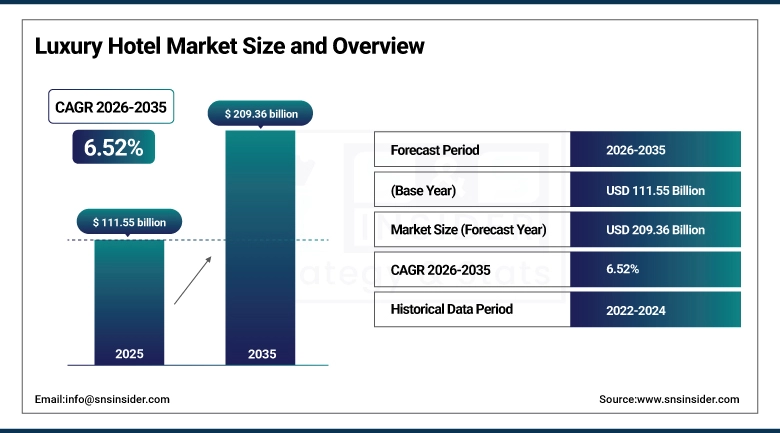
The Luxury Hotel Market was valued at USD 111.55 billion in 2025 and is expected to reach USD 209.36 billion by 2035, growing at a CAGR of 6.52% from 2026–2035.
The Luxury Hotel Market is registering consistent Global Growth due to increasing disposable income levels, high demands for luxury travel experiences, growth in International Tourism, and growing preference for customized and personalized hospitality services. Additionally, the increasing trend of Urbanization, global expansion of hotel chains into developing nations, and growth in bleisure travel trends are some other factors that are driving market growth. The increasing trend of Wellness Tourism, Eco-Luxury Hotels, and Boutique Luxury Hotels is another factor that is driving the Luxury Hotel Market.
The Adoption of technologically advanced solutions like artificial intelligence-based personalization technologies, smart check-ins using smartphones, IoT-based smart rooms, and data-driven revenue management systems will be on the increase throughout the world up to 2026.
Some of the key factors driving the market include rising demand for personalized luxury experiences, continuous innovation in hospitality services, growing investment in premium hotel infrastructure, and increasing adoption of sustainable and smart hospitality solutions to improve guest satisfaction and operational efficiency.
Market Size and Forecast
-
Market Size in 2025: USD 111.55 Billion
-
Market Size by 2035: USD 209.36 Billion
-
CAGR: 6.52% from 2026 to 2035
-
Base Year: 2025
-
Forecast Period: 2026–2035
-
Historical Data: 2022–2024
To Get more information on Luxury Hotel Market - Request Free Sample Report
Luxury Hotel Market Trends
-
Rising demand for luxury travel driven by increasing disposable incomes, global wealth creation, and expansion of high-net-worth individuals is significantly boosting occupancy and revenue in luxury hotel properties worldwide.
-
Growing inclination toward customized and experiential services in hospitality management practices is changing the way guests perceive their travel experience.
-
The quick adoption of technology solutions, including artificial intelligence-driven customization and smart rooms, is making luxury hotels more efficient and improving guests' overall experiences.
-
The growing importance of sustainability and eco-luxury initiatives are encouraging hotels to implement green building designs and sustainable energy consumption strategies.
-
Expanding wellness tourism segment is accelerating demand for integrated health-focused amenities such as spas, longevity programs, mental wellness retreats, and holistic healing services.
-
Increasing expansion of global luxury hotel chains into emerging markets and secondary cities is improving accessibility to premium hospitality services and supporting long-term market growth.
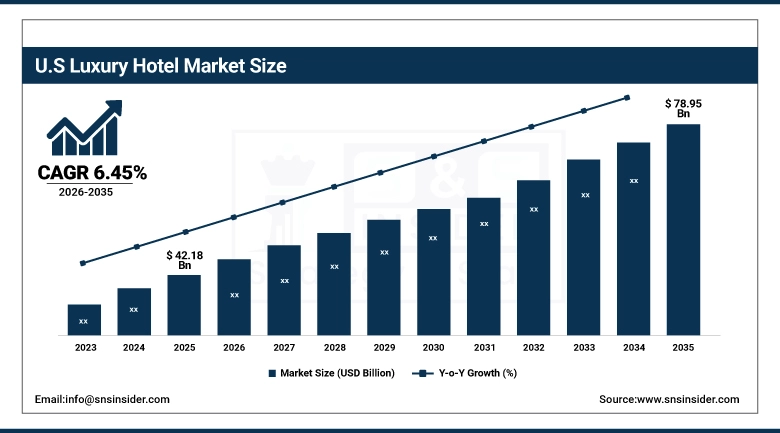
The U.S. Luxury Hotel Market was valued at USD 42.18 billion in 2025 and is expected to reach around USD 78.95 billion by 2035, growing at a CAGR of 6.45% from 2026–2035.
The U.S. Luxury Hotel Market is considered the most developed luxury hospitality market in the world because it has access to international luxury hotels, along with premium lifestyle brands, as well as tourism and business travel infrastructure. The leading companies operating within the market include Marriott International, Hilton Worldwide Holdings, Hyatt Hotels Corporation, and Four Seasons Hotels and Resorts. They are actively moving ahead with innovations in luxury hospitality experiences and branded residences.
The quality control measures established by U.S. tourism bodies, in addition to high-quality service measures within the hospitality sector, increase guests' level of trust, safety, and consistency in service delivery in luxury hotels.
Based on statistics provided by the U.S. Travel Association, as well as industry analysis, increased international visitors, leisure trips by domestic tourists, and business travels have been fueling occupancy in luxury hotels. This trend indicates that there is an increasing need for advanced guest service technology, intelligent rooms, and luxurious travel experiences within the U.S. luxury hotels industry.
Luxury Hotel Market Segment Analysis
-
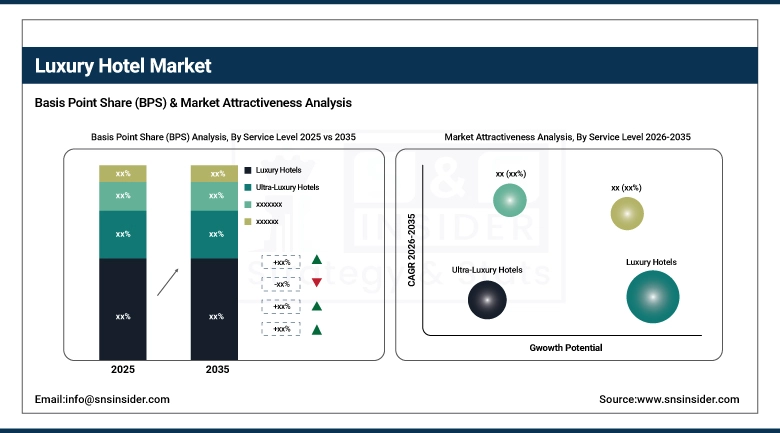
By Service Level, Luxury Hotels dominated the Luxury Hotel Market with 28.40% share in 2025; Ultra-Luxury Hotels fastest growing (CAGR).
-
By Guest Type, Leisure Travelers dominated the Luxury Hotel Market with 38.25% share in 2025; High-Net-Worth Individuals (HNWIs) fastest growing (CAGR).
-
By Operating Model, Branded Chain Hotels dominated the Luxury Hotel Market with 63.40% share in 2025; Franchise Hotels fastest growing (CAGR).
-
By Segment, Direct Booking dominated the Luxury Hotel Market with 42.70% share in 2025; Walk-in Bookings fastest growing (CAGR).
By Service Level, Luxury Hotels dominate the Luxury Hotel Market, while Ultra-Luxury Hotels is the fastest-growing segment.
Luxury Hotels segment has taken the lead in the Luxury Hotel Market because of its fair pricing structure, easy availability across the globe, and appeal among both business and leisure tourists. With their well-established brands and reliable service delivery, they achieve higher levels of occupancy and thus generate more revenues compared to other segments.
Ultra-Luxury Hotels segment will witness the fastest CAGR during the forecast period (2026-2035) due to the rising wealth across the globe and the number of high net worth individuals who seek personalized services. This includes the increase in luxury tourism, private villas, branded residencies, and experiential hospitality options.
By Guest Type, Leisure Travelers dominate the Luxury Hotel Market, while High-Net-Worth Individuals (HNWIs) is the fastest-growing segment.
Leisure Travelers segment occupied the leading position in the Luxury Hotels Market with the largest market share in terms of revenue owing to robust growth in global tourism, rising numbers of affluent travelers, and increased preference for luxurious vacations.
High Net Worth Individuals (HNWI) segment is anticipated to witness the fastest growth rate during the forecast period, which can be attributed to the growing trend of wealth creation around the world, increase in the ultra-rich population, and their preference for personalized luxury experiences.
By Operating Model, Branded Chain Hotels dominate the Luxury Hotel Market, while Franchise Hotels is the fastest-growing segment.
Branded Chain Hotels segment held the largest market share in terms of revenue because of high brand awareness worldwide, service consistency, and widespread loyalty schemes. Their mass-level functioning, superior infrastructure, and reliance on trusted customers guarantee them better occupancy rates and steady income levels.
Franchise Hotels segment is projected to record the highest CAGR during 2026–2035 owing to low capital investments, quick business expansion, and minimal business risks for the owner. The growing trend of association with brands, flexibility in property ownership, and the presence of reservation systems and marketing networks are boosting franchise uptake.
By Booking Channel, Direct Booking dominates the Luxury Hotel Market, while Walk-in Bookings is the fastest-growing segment.
Direct Booking category held the largest market share in the Luxury Hotel Market based on revenue generated owing to robust brand loyalty, individualized deals, and economies of scale for hotels and travelers alike. Exclusive amenities such as upgrades, special discounts, and loyalty programs offered by the hotels motivate visitors to make bookings directly.
Walk-in Bookings category is projected to witness the fastest growth during 2026-2035 owing to increasing impromptu travel trends, last-minute luxury vacations, and higher domestic tourism footfalls. Advanced hotel booking systems and luxurious concierge services are luring high-end tourists with flexible booking options, quick confirmation, and personalized booking services.
Regional Insights
|
Region |
Major Country |
Share (%) |
|---|---|---|
|
North America |
United States |
84.60% |
|
Europe |
Germany |
27.40% |
|
Asia Pacific |
China |
31.80% |
|
Middle East & Africa |
UAE |
19.20% |
|
Latin America |
Brazil |
23.10% |
North America Luxury Hotel Market Insights
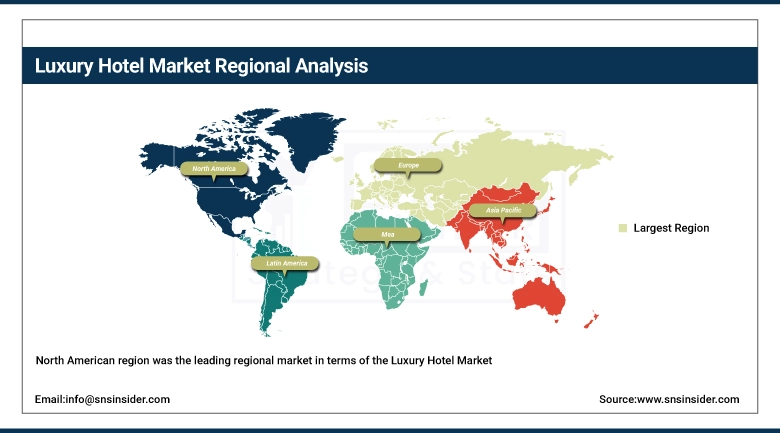
North American region was the leading regional market in terms of the Luxury Hotel Market because of its well-developed hospitality network, the prominence of international luxury hotels, and the presence of many business and leisure travelers. North America enjoys a good influx of tourists, spends a lot on luxury tourism, and adopts branded luxury hotels. The US ranks first among all the countries in the region, being the largest contributor to the market share.
The supremacy is supported by a solid framework for travel, rules and regulations, and service standards, which give assurance to the guests and guarantee the quality of luxury hospitality. Leading players such as Marriott International, Hilton Worldwide Holdings, Hyatt Hotels Corporation, and Four Seasons Hotels and Resorts are growing their business through branded residences and technology-enabled guest experiences.
Get Customized Report as per Your Business Requirement - Enquiry Now
Asia Pacific Luxury Hotel Market Insights
Asia-Pacific region is anticipated to register the highest growth rate in the Luxury Hotel Market in terms of revenue, owing to rising disposable incomes, rapid urbanization, and increasing international tourism demand. The expanding base of high-net-worth individuals, along with growing preference for premium and experiential travel, is further supporting market expansion.
China represents one of the major markets in the Asia Pacific region, owing to its robust tourism facilities, burgeoning luxury consumption, and rapid growth of international hotels. Other countries that contribute to growth include Japan, India, and Thailand, through increasing tourism, building of luxury resorts, and growing demand for boutique hospitality.
Europe Luxury Hotel Market Insights
Europe represents a very important market for Luxury Hotels due to the presence of rich heritage tourism and developed luxury hotel brands along with an influx of foreign tourists. Some key countries in this region include Germany, France, Italy, and the United Kingdom. There is a prevalence of cultural tourism and high-end leisure tourism here.
European Tourist Commission and local tourism departments have excellent hospitality standards and ensure that all luxurious accommodations provide consistent quality services to guests. Europe also witnesses growing popularity of sustainable, eco-friendly, and boutique luxury stays amosng environmentally conscious tourists and development of tourism infrastructure facilities.
Middle East & Africa and Latin America Luxury Hotel Market Insights
The Middle East and Africa region is witnessing strong growth in the Luxury Hotel Market owing to rising tourism investments, expansion of ultra-luxury hospitality projects, and development of world-class destinations. In particular, countries like UAE, Saudi Arabia, and South Africa are emerging as key luxury travel hubs, supported by mega tourism developments and increasing international visitor arrivals.
In Latin America, nations like Brazil and Mexico are making substantial contributions towards market growth because of an increase in tourist activities, development of luxury resorts, and improvements in hospitality facilities. The rise in demand for beach resorts, luxury eco-friendly hotels, and experiential travel experiences is helping boost the demand for luxury hotels.
Luxury Hotel Market Growth Drivers: Rising global wealth and expanding high-net-worth individual population driving premium hospitality demand
The increase in wealth creation worldwide along with the increased rate at which high net worth individuals are increasing in numbers has created a need for luxury hotels in different parts of the world. Due to an increase in disposable income levels in developing nations, there is a trend among consumers of preferring luxurious vacations over regular vacations. Increase in spending for business trips and vacation trips has resulted in higher occupancy levels within luxury hotels. Growth in international tourism along with business trips, along with luxurious living, have also been instrumental in driving this market growth.
In 2026, the luxury hotel market is growing due to rising global wealth and increasing high-net-worth individuals driving demand for premium stays. Higher incomes and preference for luxury travel experiences are boosting occupancy and revenue in high-end hotels worldwide.
Luxury Hotel Market Restraints: Economic uncertainty and geopolitical instability affecting global luxury travel demand
Economic and political instability highly influences travel and the demand for luxury hotels. The fluctuation of the exchange rate, the trend of inflation, and the economy’s recession cause consumers to become more cautious about discretionary spending. Political instability, travel bans, and political conflict further discourage foreign tourists from travelling overseas. This is due to the fact that luxury hotels depend heavily on tourists from abroad who have high disposable income. Corporate budget allocation for travel may also be reduced by companies during periods of economic instability, hence low occupancy levels.
Luxury Hotel Market Opportunities: Growth of sustainable and eco-luxury hospitality attracting environmentally conscious travelers
With the growing awareness about environmental sustainability, many opportunities are emerging within the luxury hotel industry. The travelers today are opting for sustainable accommodation options that focus on energy efficiency and waste management. Moreover, the concept of sustainability in luxury hotels involves green certifications, renewable energy sources, and the adoption of technology that facilitates sustainable development. The combination of sustainable luxury with the high-end hospitality experience helps in gaining brand reputation and loyalty. Government agencies and other tourism organizations are supporting sustainable tourism initiatives as well.
In 2026, the luxury hotels industry will experience growth due to an increase in the demand for eco-luxury accommodation because tourists will prefer hotels that practice environmentalism. The luxury brands have improved their value through energy efficiency and eco-friendly design and are attracting environmentally-minded guests.
Recent Developments
-
2026: Medtronic augmented its portfolio in thrombectomy by introducing innovative aspiration systems for clot retrieval in combination with AI-powered systems for treating strokes, emphasizing fast recanalization and minimally invasive neurovascular interventions.
-
2025: Penumbra Inc. introduced new-age Lightning Bolt thrombectomy systems to enhance efficiency and precision in clot aspiration for patients undergoing stroke treatment procedures.
-
2024: Stryker Corporation made substantial investments in state-of-the-art stent retrievers and thrombectomy technologies in conjunction with imaging techniques.
Luxury Hotel Market Key Players
-
Marriott International
-
Hilton Worldwide Holdings
-
Hyatt Hotels Corporation
-
InterContinental Hotels Group (IHG)
-
Four Seasons Hotels and Resorts
-
Mandarin Oriental Hotel Group
-
Rosewood Hotel Group
-
Aman Resorts
-
Oetker Collection
-
Belmond (LVMH)
-
Kempinski Hotels
-
Shangri-La Group
-
Six Senses Hotels Resorts Spas
-
The Peninsula Hotels
-
Jumeirah Group
-
Bulgari Hotels & Resorts
-
Dorchester Collection
-
Minor Hotels (Anantara)
-
Taj Hotels (IHCL – Indian Hotels Company Limited)
Luxury Hotel Market Report Scope:
| Report Attributes | Details |
|---|---|
| Market Size in 2025 | USD 111.55 Billion |
| Market Size by 2035 | USD 209.36 Billion |
| CAGR | CAGR of 6.52% From 2026 to 2035 |
| Base Year | 2025 |
| Forecast Period | 2026-2035 |
| Historical Data | 2022-2024 |
| Report Scope & Coverage | Market Size, Segments Analysis, Competitive Landscape, Regional Analysis, DROC & SWOT Analysis, Forecast Outlook |
| Key Segments | • By Service Level (Ultra-Luxury Hotels, Luxury Hotels, Upper Upscale Hotels, Boutique Luxury Hotels, Lifestyle Luxury Hotels) • By Guest Type (Business Travelers, Leisure Travelers, High-Net-Worth Individuals (HNWIs), Group & Event Travelers, Long-Stay Guests) • By Operating Model (Branded Chain Hotels, Franchise Hotels, Management Contract Hotels, Independent Hotels, Mixed Ownership Hotels) • By Booking Channel (Direct Booking, Online Travel Agencies (OTAs), Corporate / Travel Management Companies, Offline Travel Agents, Walk-in Bookings) |
| Regional Analysis/Coverage | North America (US, Canada), Europe (Germany, UK, France, Italy, Spain, Russia, Poland, Rest of Europe), Asia Pacific (China, India, Japan, South Korea, Australia, ASEAN Countries, Rest of Asia Pacific), Middle East & Africa (UAE, Saudi Arabia, Qatar, South Africa, Rest of Middle East & Africa), Latin America (Brazil, Argentina, Mexico, Colombia, Rest of Latin America). |
| Company Profiles | Marriott International, Hilton Worldwide Holdings, Hyatt Hotels Corporation, Accor S.A., InterContinental Hotels Group (IHG), Four Seasons Hotels and Resorts, Mandarin Oriental Hotel Group, Rosewood Hotel Group, Aman Resorts, Oetker Collection, Belmond (LVMH), Kempinski Hotels, Shangri-La Group, Six Senses Hotels Resorts Spas, The Peninsula Hotels, Jumeirah Group, Bulgari Hotels & Resorts, Dorchester Collection, Minor Hotels (Anantara), Taj Hotels (IHCL – Indian Hotels Company Limited). |

Frequently Asked Questions
North America dominated the Luxury Hotel Market in 2025.
The Luxury Hotels segment dominated the Luxury Hotel Market in 2025.
Rising disposable incomes, increasing luxury travel demand, growth in high-net-worth individuals, expansion of international tourism, and adoption of personalized hospitality services are the major growth drivers.
The Luxury Hotel Market was valued at USD 111.55 billion in 2025.
The Luxury Hotel Market is expected to grow at a CAGR of 6.52% from 2026 to 2035.
