
Underground Hydrogen Storage Market Report Scope and Overview:
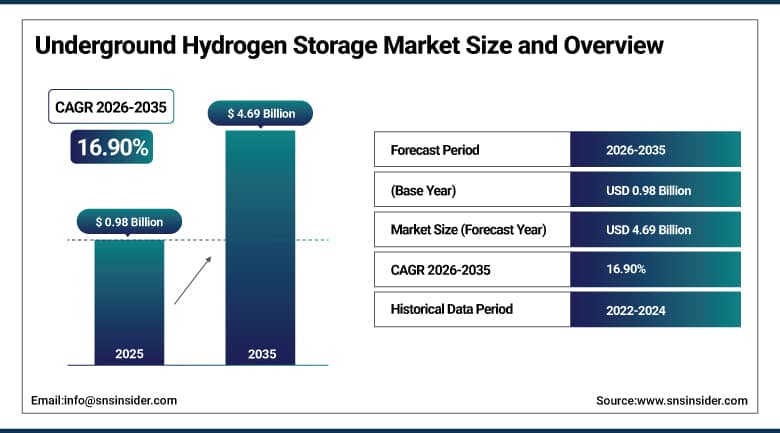
The Underground Hydrogen Storage Market was valued at USD 0.98 Billion in 2025 and is projected to reach USD 4.69 Billion by 2035, registering a CAGR of 16.90% from 2026 to 2035.
The factors that fuel the growth of the Underground Hydrogen Storage Market include increased hydrogen usage as a clean energy source, increasing hydrogen roadmaps and net-zero plans supported by governments, increased use of underground storage in green hydrogen hubs, and versatile implementation of underground hydrogen storage technologies in industries, transportation, and power generation applications globally. The development of advanced subsurface engineering, collaboration of energy companies and geological formation operators, and growth of real-time monitoring and control system capacity have resulted from extensive investments of industrial gas companies, utilities, and energy majors in scalable and long-duration hydrogen storage solutions.
The market refers to the storage of hydrogen gas in large geological formations including salt caverns, depleted oil and gas reservoirs, and aquifers, thus ensuring the regulation of supply and demand in hydrogen energy systems on a large scale. Such technology helps stabilize hydrogen supply chains by providing energy storage options that play a critical role in achieving decarbonization of energy networks.
To Get More Information On Underground Hydrogen Storage Market - Request Free Sample Report
Underground Hydrogen Storage Market Trends
-
Rising integration of underground storage into centralized green hydrogen hubs continues expanding project pipelines.
-
Growing repurposing of depleted oil and gas fields continues lowering development costs for storage operators.
-
Expanding national hydrogen strategies are broadening government-backed funding for storage infrastructure.
-
Increasing use of real-time monitoring and control systems continues improving storage safety and reliability.
-
Growing offshore storage exploration continues creating new deployment opportunities beyond onshore salt caverns.
U.S. Underground Hydrogen Storage Market Outlook
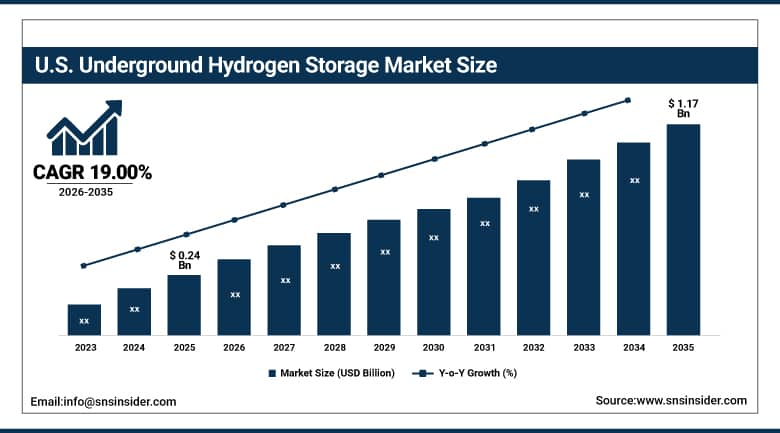
The U.S. Underground Hydrogen Storage Market was valued at approximately USD 0.24 Billion in 2025 and is projected to reach approximately USD 1.17 Billion by 2035, registering a CAGR of approximately 19.00% from 2026 to 2035.
In the U.S., demand is fueled by solid investments into infrastructure development, hydrogen hub initiatives of the Department of Energy, and natural salt dome deposits in Texas and Gulf states that provide significant technical and economic benefits for large-scale geological storage. Gas storage facilities repurposing and increasing business activity in hydrogen generation also help to develop underground storage capabilities in accordance with increased regional demand.
Application of new subsurface engineering technologies and advanced monitoring solutions was extremely crucial in terms of strengthening of the leading position of the underground hydrogen storage market in the USA. Moreover, increasing number of storage projects associated with renewable hydrogen generation facilities was the key factor increasing demand for the product.
Underground Hydrogen Storage Market Segment Analysis
-
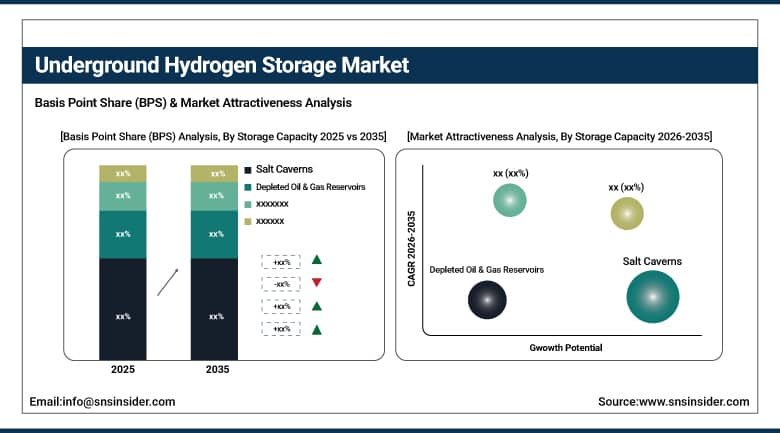
By Storage Type, Salt Caverns segment dominated the Market in 2025 with 68.40% share; Depleted Oil & Gas Reservoirs segment is the fastest growing segment, registering a CAGR of approximately 21.60%.
-
By Deployment Type, Onshore segment dominated the market in 2025 with 74.60% share; Offshore segment is the fastest growing segment, registering a CAGR of approximately 22.80%.
-
By Application, Energy Storage segment dominated the market in 2025 with 44.70% share; Industrial Usage segment is the fastest growing segment, registering a CAGR of approximately 20.40%.
-
By Technology, Advanced Compression Systems segment dominated the market in 2025 with 41.80% share; Cryogenic Storage segment is the fastest growing segment, registering a CAGR of approximately 23.60%.
By Storage Type, Salt Caverns Dominates the Underground Hydrogen Storage Market While Depleted Oil & Gas Reservoirs Grows Fastest
Salt Caverns accounted for the largest market share of the Underground Hydrogen Storage Market in 2025, which stood at about 68.40%, mainly because of their good sealing properties, cycling rates, and suitability for the high-pressure storage of hydrogen. The construction of one of Europe’s biggest underground hydrogen storages in a salt cavern in northern Germany by Air Liquide in collaboration with a consortium of European energy companies is an example of why salt formations remain top priority for large hydrogen storage solutions over other geological formations.
Depleted Oil & Gas Reservoirs are expected to record the highest growth rate in the CAGR of about 21.60% in the Storage Type category. This is because of the recognition by various players regarding the use of depleted oil and gas reservoirs for hydrogen storage. This is enabled by technological innovations and government support. Repurposing of existing underground infrastructure that was used for natural gas storage becomes easier.
By Deployment Type, Onshore Dominates the Underground Hydrogen Storage Market While Offshore Grows Fastest
The Onshore deployment segment has accounted for the largest market share in 2025 at about 74.60%, owing to the presence of pre-existing infrastructure, cost efficiencies, and regulatory systems that ease the implementation process. This deployment mode remains the preferred choice for industries seeking immediate solutions to integrate hydrogen storage into their operations.
Offshore deployment is anticipated to grow at a CAGR of about 22.80%, which is the fastest growth rate compared to other deployment types, due to technological innovations, as well as the effort towards sustainability. This deployment type becomes more attractive to investors owing to its growing popularity for utilization of large space areas in the ocean floors for storing hydrogen.
By Application, Energy Storage Dominates the Underground Hydrogen Storage Market While Industrial Usage Grows Fastest
Energy Storage accounted for the largest application share in 2025, which stood at around 44.70% due to growing demand for energy-efficient and eco-friendly options and the importance of hydrogen in balancing renewable energy resources. This application helps in storing extra energy produced at the time of production in order to utilize it in the future, thus enhancing the position of this application category among other applications.
Industrial Usage application is expected to grow at the highest CAGR of around 20.40% in comparison to other application categories as the industry is constantly looking for innovative ways to incorporate hydrogen into refineries, steel making, and chemicals.
By Technology, Advanced Compression Systems Lead the Underground Hydrogen Storage Market While Cryogenic Storage Grows Fastest
Advanced Compression Systems turned out to be the dominant technological segment by 2025 with the share of about 41.80% due to their mature and reliable nature and widespread use in various applications of underground storage systems. The technology is popular because of its efficiency in compression of hydrogen gas for underground storage for those who prefer tried and trusted solutions.
The Cryogenic Storage technology is forecasted to be the fastest growing technology with a CAGR of about 23.60% due to its ability to store hydrogen gas in liquid form at extremely low temperatures, which allows it to have dense and easy transport of large hydrogen energy projects. The rising interest from the users for such type of storage is the reason of its popularity and fast growth.
Regional Analysis:
|
Region |
Major Country |
Share within Region, 2025 (%) |
|---|---|---|
|
North America |
United States |
72.00% |
|
Europe |
Germany |
30.00% |
|
Asia Pacific |
Japan |
40.00% |
|
Middle East and Africa |
Saudi Arabia |
30.00% |
|
Latin America |
Brazil |
50.00% |
North America Underground Hydrogen Storage Market Insights
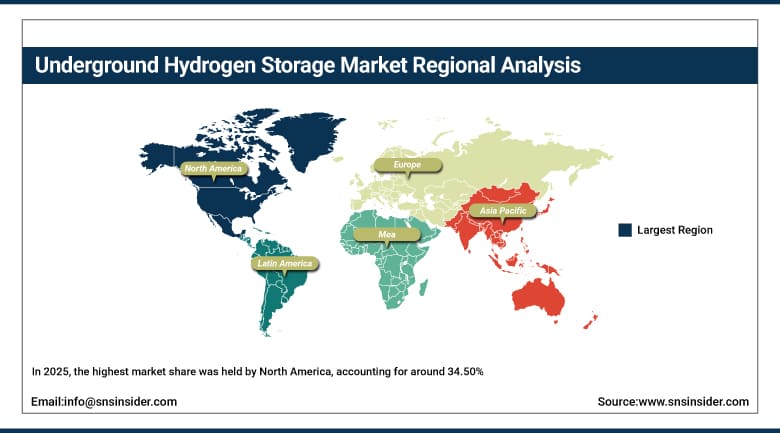
In 2025, the highest market share was held by North America, accounting for around 34.50%, owing to substantial investments being made in renewable energy, favorable regulatory policies, and high demand for clean energy solutions. The competitive analysis in the market includes prominent companies leading in developing innovative storage technology, which has been supported further by efforts undertaken by U.S. Department of Energy toward research and development of hydrogen storage technology.
The U.S. contributed about 72.00% of the total North American revenue share, mainly due to high demand for clean energy solutions along with government incentives for hydrogen projects, whereas Canada continued to remain an important contributor to regional demand due to increased hydrogen infrastructure investments.
Get Customized Report as Per Your Business Requirement - Enquiry Now
Europe Underground Hydrogen Storage Market Insights
The European share in the Underground Hydrogen Storage Market was significant due to strict climate regulations and the EU Green Deal, along with hydrogen strategy that focused on the adoption of renewable energy. Countries leading in the market have companies offering advanced technologies of underground hydrogen storage, as their efforts are supported by close collaboration between the government and private businesses in terms of implementation of hydrogen projects.
Germany and France were leaders in the European market with shares of about 30.00% and the same share, correspondingly, in regional revenues due to the aggressive pursuit of decarbonization and the development of hydrogen valleys and salt caverns at pilot scale. The Netherlands continued to be a major contributor to the regional demand due to advanced gas infrastructure and geological mapping capabilities.
Asia Pacific Underground Hydrogen Storage Market Insights
The region of Asia Pacific is estimated to emerge as the fastest-growing region, with a compounded annual growth rate of 19.80% between 2026 and 2035. The growth in the region has been significantly driven by industrialization and cleaner energy sources such as hydrogen in Japan and Australia, due to governmental efforts that help decrease carbon footprint and increase energy security.
The largest contribution to the Asia Pacific revenue was made by Japan, which made up around 40.00% share of the region, owing to its strong focus on hydrogen as an essential element of national energy policy. Similarly, the vast renewable energy resources in Australia and the hydrogen manufacturing centers in China and India have propelled the region's growth.
MEA and Latin America Underground Hydrogen Storage Market Insights
Both Middle East & Africa and Latin America had seen constant growth due to the efforts made by nations in discovering the possibilities of underground hydrogen storage thanks to natural resources and sustainability energy solutions. With more diversification programs backed up by governments and increasing production of renewable hydrogen, these two regions are set to become increasingly significant markets of underground hydrogen storage during the next ten years.
Among the Middle East & Africa countries, Saudi Arabia stood out, taking 30.00% share of the regional market owing to the region's tendency to diversify its energy sources and reduce the dependence on fossil fuels. Among Latin America countries, Brazil retained the title of the largest market with 50.00% share of the regional market due to increased interest in renewable hydrogen production.
Market Dynamics:
Growth Drivers: Accelerating Adoption of Hydrogen as a Clean Energy Carrier
Progress is made possible by the increasing adoption of hydrogen as an energy source and the pressing need for energy storage solutions on a larger scale and for longer periods of time. With more nations transitioning to renewable energy sources for electricity generation, production in the industry, and transportation, underground storage will provide the means to address seasonal fluctuations in renewable energy production.
Other factors supporting this include hydrogen roadmaps and zero-emissions policies put in place by governments within the U.S., Europe, and Asia Pacific regions that create a favorable business environment for underground hydrogen storage solutions. The ongoing global interest in storage of centralized green hydrogen hubs is yet another key point that supports growth prospects for the forecast period.
Restraints: High Upfront Costs and Technical Complexity
High initial investments, complexities involved in identifying the right geological formation, and the lack of proper infrastructure are some of the barriers to fast market acceptance. The stringent safety guidelines and regulatory requirements pose an additional barrier, especially in regions that are still trying out the technology where storage methods are not yet well-defined.
Another issue that poses a problem is that of the availability of right geological formations in the world. Availability is low, and it necessitates geological assessments before development. Uncertainty in regulations related to storage technologies is one of the barriers to investment decisions.
Opportunities: Integration with Green Hydrogen Hubs and Subsurface Innovation
Some new possibilities include leveraging underground storage as part of green hydrogen hubs, which will allow for centralized production, storage, and transportation of the resource. The product platform offered by vendors, such as Linde and Air Products, with features of advanced subsurface engineering as well as monitoring technologies, is just one example of how vendors can leverage this new workflow to distinguish themselves.
Moreover, developments in subsurface engineering, monitoring technologies, and material sciences have increased the likelihood of using different geological features, such as salt caverns, aquifers, and depleted gas fields. With growing interest in hydrogen in the sectors of mobility, steel, and ammonia manufacturing, the vendor capable of offering reliable storage services can become an attractive partner for industrial and energy companies.
Recent Developments:
-
2025: Linde unveiled new technology aimed at improving the efficiency of hydrogen storage systems, targeting lower operational costs across industrial applications.
-
2025: TotalEnergies entered a joint venture with a local government to explore underground hydrogen storage options across Europe.
-
2025: Uniper advanced a salt cavern pilot project targeting large-scale hydrogen storage integration with existing gas infrastructure in Germany.
-
2025: Equinor launched a feasibility study evaluating underground hydrogen storage potential across depleted offshore gas fields in Norway.
-
2026: Gasunie expanded its hydrogen backbone infrastructure project with new underground storage integration nodes across the Netherlands.
-
2026: RWE advanced a large-scale hydrogen storage project in Germany, targeting integration with its expanding renewable hydrogen production portfolio.
Underground Hydrogen Storage Market key players are:
-
Air Liquide S.A.
-
Air Products and Chemicals, Inc.
-
Linde plc
-
ENGIE SA
-
Uniper SE
-
Texas Brine Company, LLC
-
WSP Global Inc.
-
Shell plc
-
TotalEnergies SE
-
Centrica plc
-
Accelera by Cummins
-
Equinor ASA
-
RWE AG
-
Chevron New Energies
-
N.V. Nederlandse Gasunie
-
Snam S.p.A.
-
bp p.l.c.
-
ExxonMobil Low Carbon Solutions
-
Wintershall Dea AG
-
Hy Stor Energy LLC
Underground Hydrogen Storage Market Report Scope:
| Report Attributes | Details |
|---|---|
| Market Size in 2025 | USD 0.98 Billion |
| Market Size by 2035 | USD 4.69 Billion |
| CAGR | 16.90% from 2026 to 2035 |
| Base Year | 2025 |
| Forecast Period | 2026-2035 |
| Historical Data | 2022-2024 |
| Report Scope & Coverage | Market Size, Segments Analysis, Competitive Landscape, Regional Analysis, DROC & SWOT Analysis, Forecast Outlook |
| Key Segments | •Storage Type (Salt Caverns, Depleted Oil & Gas Reservoirs, Aquifers) •Deployment Type (Onshore, Offshore) •Application (Energy Storage, Industrial Usage, Transportation) •Technology (Advanced Compression Systems, Cryogenic Storage, Adsorption-Based Storage) |
| Regional Analysis/Coverage | North America (US, Canada), Europe (Germany, UK, France, Italy, Spain, Russia, Poland, Rest of Europe), Asia Pacific (China, India, Japan, South Korea, Australia, ASEAN Countries, Rest of Asia Pacific), Middle East & Africa (UAE, Saudi Arabia, Qatar, South Africa, Rest of Middle East & Africa), Latin America (Brazil, Argentina, Mexico, Colombia, Rest of Latin America). |
| Company Profiles | Air Liquide S.A., Air Products and Chemicals, Inc., Linde plc, ENGIE SA, Uniper SE, Texas Brine Company, LLC, WSP Global Inc., Shell plc, TotalEnergies SE, Centrica plc, Accelera by Cummins, Equinor ASA, RWE AG, Chevron New Energies, N.V. Nederlandse Gasunie, Snam S.p.A., bp p.l.c., ExxonMobil Low Carbon Solutions, Wintershall Dea AG, Hy Stor Energy LLC. |

Frequently Asked Questions
Key players in the Underground Hydrogen Storage Market include Air Liquide S.A., Air Products and Chemicals, Inc., Linde plc, ENGIE SA, and Uniper SE, among others.
Key opportunities in the Underground Hydrogen Storage Market include integration of underground storage into centralized green hydrogen hubs, alongside advancements in subsurface engineering and monitoring technologies improving the feasibility of diverse geological formations.
The market is driven by the accelerating adoption of hydrogen as a clean energy carrier, the urgent need for large-scale, long-duration energy storage solutions, and government-backed hydrogen roadmaps and net-zero targets.
The Salt Caverns segment dominated the Underground Hydrogen Storage Market, accounting for approximately 68.40% market share.
The North America region dominated the Underground Hydrogen Storage Market in 2025 with a 34.50% share, driven by significant investments in renewable energy and supportive regulatory frameworks.
