
Pumped Thermal Energy Storage Market Report Scope and Overview:
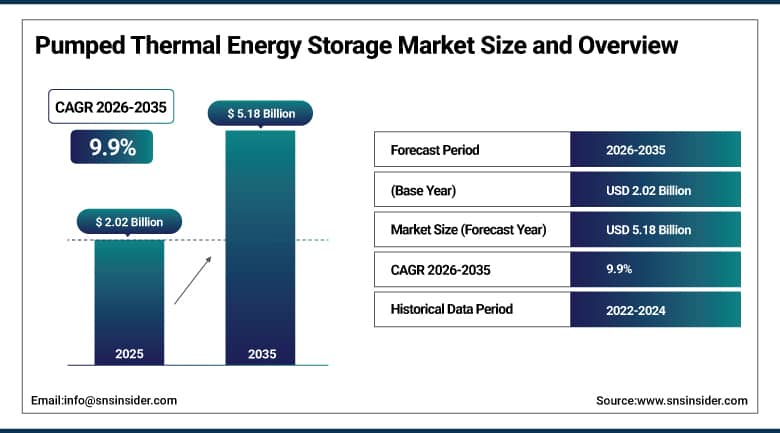
The Pumped Thermal Energy Storage Market was valued at USD 2.02 Billion in 2025 and is projected to reach USD 5.18 Billion by 2035, registering a CAGR of 9.9% from 2026 to 2035.
Pumped Thermal Energy Storage Market is becoming increasingly significant in terms of storage for power systems, where it needs a higher duration and geographic flexibility to deal with rising levels of wind and solar energy production. The PTES system works by using electricity to run a heat-pump cycle, storing energy in the form of thermal gradients in materials like molten salt, rocks, concrete, or phase-change material and converting the heat back into electricity when needed. Long-duration energy storage, falling renewable energy prices, grid congestion, renewable energy curtailment, electrification of industry, and reuse of thermal generation assets are driving commercial interest in PTES.
Further developments in higher-temperature heat pumps, compressor, expander technology, low-cost thermal storage media, and power block modularity are making the system more economic. In comparison to electrochemical battery, PTES does not have any limitations concerning the availability of storage media and can operate for several hours to days, without having to depend on any geological formation.
To Get More Information On Pumped Thermal Energy Storage Market - Request Free Sample Report
Pumped Thermal Energy Storage Market Trends
-
Growing adoption of long-duration energy storage continues supporting PTES deployment alongside wind and solar generation.
-
Increasing development of closed-loop heat-pump storage architectures continues improving geographic flexibility and grid-scale deployment.
-
Rising use of molten salt, crushed rock, and advanced phase-change materials continues reducing dependence on critical battery materials.
-
Growing integration of PTES with retired thermal power plants continues creating opportunities for infrastructure repurposing and grid stabilization.
-
Increasing industrial demand for combined power, steam, and thermal storage continues expanding PTES applications beyond electricity grids.
U.S. Pumped Thermal Energy Storage Market Outlook
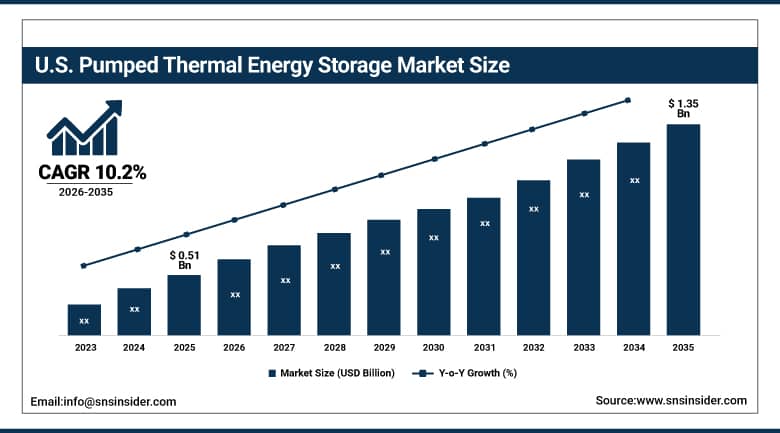
The U.S. Pumped Thermal Energy Storage Market was valued at approximately USD 0.51 Billion in 2025 and is projected to reach approximately USD 1.35 Billion by 2035, registering a CAGR of approximately 10.2% from 2026 to 2035.
The demand is fueled by new additions of renewable energy sources, rising needs for energy storage that can function beyond traditional four-hour battery storage, as well as the reinforcement of the power grid’s transmission system. PTES becomes especially appealing in regions where pumped hydro storage is limited due to geographical conditions and where long duration energy storage can help minimize renewable curtailment. The federal and state support for storage technology innovations and green infrastructure has motivated utilities, developers, and industry consumers to consider non-lithium energy storage solutions.
Furthermore, PTES presents an option for repurposing retired coal and gas-fired plants in the United States due to the potential for the reuse of their grid connection, turbine facilities, land, and some of their conventional steam cycle components. The Steam Energy Management and Storage system by Malta, for instance, has been designed on the basis of high temperature heat pumps, molten salt thermal storage, and steam-powered generation that could be compatible with the current electricity and industrial systems. This is increasing the interest in PTES for various high-load applications.
Pumped Thermal Energy Storage Market Segment Analysis
-
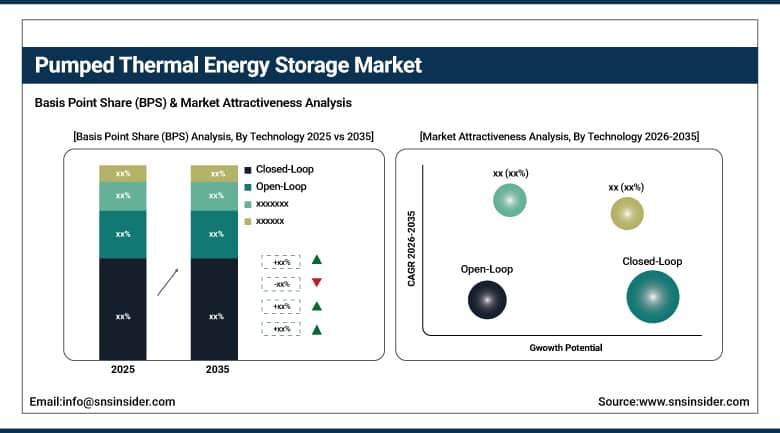
By Technology, Closed-Loop dominated in 2025 with approximately 61.4% share; Open-Loop is expected to register the fastest growth.
-
By Storage Material, Molten Salt led in 2025 with approximately 43.8% share; Phase Change Materials are expected to grow fastest.
-
By Application, Grid Energy Storage dominated in 2025 with approximately 47.6% share; Industrial applications are expected to grow fastest.
-
By End-User, Utilities led in 2025 with approximately 56.3% share; Industrial end-users are expected to register the fastest growth.
By Technology, Closed-Loop Systems Dominate, Open-Loop Systems Gain Faster Adoption
The closed-loop system accounted for about 61.4% of the total market share in 2025 owing to the ability of the technology to circulate a controlled working fluid through hot and cold energy reservoirs without any ongoing interaction with the environment. The benefits of this system include consistent thermodynamics, less environmental exposure, flexibility in location, and control over the charge/discharge cycles. The characteristics make it possible to use closed loop configurations in electricity storage where there is need for consistency in system operations and longer life span. Malta Technologies closed-loop salt and steam technology and Stiesdal's GridScale technology show increasing commercial interest in geographically independent thermal energy storage.
Open-Loop are expected to experience the highest growth rates due to the exploration of new system designs which can interact with external heat sources, heat generated by industry processes, geothermal sources, district heating systems, and other process flows. This will allow improving project economics where there is an opportunity to use existing sources of heat or cold in order to reduce the energy necessary to produce the temperature difference. Nevertheless, growth rates will be determined by many factors including site-specific conditions, environmental permits, availability of heat sources, and other engineering factors. There are many technological innovations which increase the scope of possible technical projects.
By Storage Material, Molten Salt Leads, Phase Change Materials Register Fastest Growth
The Molten Salt Technology accounted for about 43.8% in 2025 due to the development of thermal properties of the technology, higher heat capacity, lower costs of materials, thermal stability, and past operations in concentrated solar and industrial thermals. With the use of molten salt, developers of the PTES can store larger amounts of thermal energy for long periods of time before producing steam or running through a power cycle. For instance, the Malta Solar Energy Storage System (SEMS) is based on molten salt as the hot thermal storage and water as the cold storage.
Phase Change Materials are anticipated to experience the fastest growth rate, owing to their relatively higher volumetric energy density, as well as the capability to absorb and release large amounts of latent heat at specified temperature limits. Advanced Phase Change Materials are being developed for use in those cases where space occupied by storage system, efficient thermal exchange, fast thermal response time, and temperature regulation are of paramount importance. Encapsulation, thermal conductivity, cycling stability, and material compositions are expected to be improved during the forecast period, thus making the technology commercially viable. At present, the adoption rate of PCMs is relatively lower than molten salt systems; nevertheless, PCM technology has vast potential.
By Application, Grid Energy Storage Leads, Industrial Applications Grow Fastest
Grid Energy Storage held a leading position in the Pumped Thermal Energy Storage market with around 47.6% market share in 2025 due to rising demands for duration capacity, renewable energy shifting, congestion relief, reserve capacity, and grid stabilization services. PTES can be charged at times when there is excess generation from renewable sources and discharged when generation from wind or solar sources falls, thus helping to decrease renewable energy curtailment as well as fossil fuel peaking facilities. The fact that scaling of energy capacity mainly happens by increasing thermal storage capacity gives it cost benefits in cases where more than 8 hours or multiday or longer storage is needed.
The industrial sector is set for rapid growth in the coming years as manufacturers are trying to electrify process heat and boost energy flexibility. PTES technology can help in combining the functions of electricity storage, high-temperature heat generation, heat capture, steam generation, and demand response in a single energy management system. Various industrial sectors including steel, chemical, refining, food processing, pulp and paper, cement, and many others constitute a huge market for PTES technology because electricity can be bought in off-peak hours and converted to process heat/electricity.
By End-User, Utilities Dominate, Industrial Users Expand Fastest
The utilities category captured approximately 56.3% of market revenues in 2025 due to the size of utility-scale storage installations and increasing needs to accommodate a large share of variable renewable energy. PTES provides utilities an avenue of procuring long-duration energy storage capacity without relying on large amounts of lithium or geographically limited pumped hydro storage capacity. Storage systems that are able to provide services such as load shifting, reserve capacity, physical inertia, voltage regulation, frequency regulation, black start capability, and renewable energy firming can earn revenues from more than one grid service source.
The industrial consumers are expected to show the fastest rate of growth due to growing prices of electricity and fossil fuels, the decarbonization needs, as well as the need for reliable high temperature process energy. The industrial units could use thermal energy storage in order to make the operation of their electricity consumption separate from steam and heat consumption, thus charging their battery systems when there is plenty of renewable electricity available and discharging thermal energy when necessary in the course of production process. This type of operation may help to avoid peak electricity consumption and allow for the use of thermal energy from power-to-heat systems instead of fossil fueled boilers.
Regional Analysis:
|
Region |
Major Country |
Share within Region, 2025 (%) |
|---|---|---|
|
North America |
United States |
84.0% |
|
Europe |
Germany |
27.5% |
|
Asia Pacific |
China |
44.0% |
|
Middle East and Africa |
Saudi Arabia |
31.0% |
|
Latin America |
Brazil |
49.0% |
Europe Pumped Thermal Energy Storage Market Insights
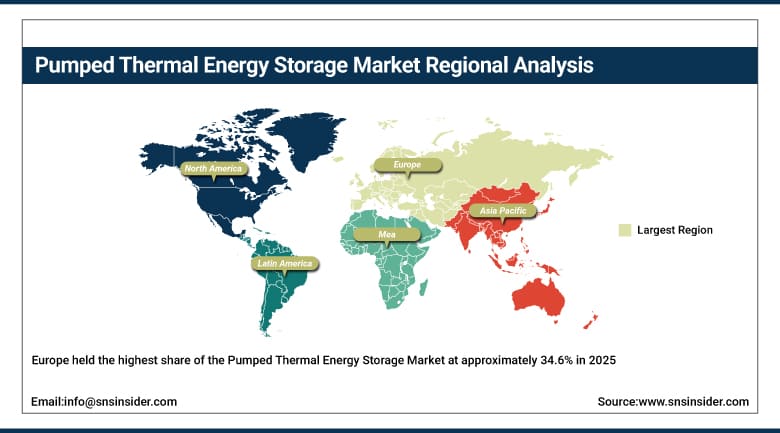
Europe held the highest share of the Pumped Thermal Energy Storage Market at approximately 34.6% in 2025, thanks to its extensive use of renewable energies like wind and solar, renewables curtailment, energy security concerns, grid congestion, industrial decarbonization needs, and mature demonstration market for long-duration storage solutions. European utility companies and developers are considering PTES as a more viable solution than lithium-ion energy storage systems for applications that need longer discharge times.
Germany contributed to about 27.5% of revenues in Europe on account of its massive industrial sector and production of renewable energy, power-to-heat solutions, and technologies that can help in de-carbonizing steam processes and heat. The UK is yet another market because of policy formation and investments in long-duration energy storage besides battery storage. Another factor contributing to Spain being a significant market is Malta Iberia's Malta-D 14 MWh commercial project at Puertollano with a closed loop of molten salt and steam design.
Get Customized Report as Per Your Business Requirement - Enquiry Now
North America Pumped Thermal Energy Storage Market Insights
North America represents a significant market for Pumped Thermal Energy Storage (PTES), supported by increasing renewable energy generation, long-duration energy storage procurement programs, grid modernization investments, and the retirement of conventional power plants. Growing requirements for storage technologies capable of maintaining grid reliability during extended periods of low renewable generation are further strengthening regional demand. In addition, the availability of retired or underutilized thermal-generation sites creates opportunities to deploy PTES systems using existing grid interconnections, steam-cycle equipment, transmission infrastructure, and experienced operating workforces, potentially reducing development complexity and supporting cost-effective project deployment.
The US accounted for about 84.0% of North American revenues in 2025 due to the larger utility market, increased deployment of renewables, developed energy-storage development ecosystem, and involvement of domestic PTES system developers like Malta Inc. Canada’s market share will grow in the future due to an increase in renewable deployment, demand for flexible grids, and industrial electrification programs. Purchasing utility-scale long duration storage, along with higher demand from data centers and heavy industry, will improve the business case in the region, especially when the PTES system can produce power, heat, capacity, and grid services instead of competing with batteries in short-duration storage applications.
Asia Pacific Pumped Thermal Energy Storage Market Insights
The Asia Pacific region is anticipated to hold the highest CAGR of about 11.5% between 2026 and 2035 due to increased development of renewable power sources, demand for electricity, congested grids, electrification of industries, and need for long-duration energy storage systems in China, Japan, India, South Korea, and Australia. China, Japan, and Australia are the three main regions where efforts towards development of advanced energy storage systems are ongoing.
China in the Asia Pacific region’s revenues reached around 44.0% in 2025 due to the significant volume of renewables installed, local production of thermal equipment, storage infrastructure development on the scale of power networks, and a big amount of industrial energy consumption. Australia represents a promising PTES market thanks to the fast implementation of solar and wind farms, the risk of renewables curtailment, great distance between generation and load centers, and interest in long-term storage. Japan is also investigating thermal and cryogenic storage within the framework of energy security and decarbonation programs.
MEA and Latin America Pumped Thermal Energy Storage Market Insights
The Middle East & Africa and Latin America represent emerging PTES markets, supported by rapid renewable capacity development, growing electricity consumption, grid-resilience requirements, industrial decarbonization, and government strategies aimed at reducing dependence on conventional power generation. PTES is particularly relevant in markets with strong solar resources because storage can absorb low-cost daytime solar electricity and provide power or heat during evening and nighttime demand periods. Industrial users in refining, petrochemicals, mining, desalination, food processing, metals, and manufacturing provide additional potential applications for combined electricity and high-temperature heat storage.
Saudi Arabia contributed 31.0% of the total MEA segment revenues in 2025, backed by massive renewable, desalination, and industrial infrastructure development plans. The January 2026 collaboration of ACWA and Malta Inc. for the assessment, testing, and possible deployment of TES solutions at all of ACWA's worldwide projects is yet another indication of regional interest. Brazil accounted for 49.0% of Latin American PTES market share, driven by the power market size, renewable generation increase, and demand for grid flexibility. Chile appears to be another attractive region because of significant solar production and increasing renewable curtailment.
Market Dynamics:
Growth Drivers: Increasing Renewable Penetration and Need for Long-Duration Grid Flexibility
Fast growth of renewable energy sources is the key growth factor for the PTES market since electrical networks need storage technologies not only to manage frequencies but also capable of transferring electricity through longer periods. The growing production from the sun results in the significant surplus of electricity in the day period, while the production from the wind changes through longer periods. PTES stores surplus energy in the form of heat energy and produces it back in the form of electricity. This technology helps utilities to cut down curtailment, optimize renewables use, to provide capacity when the share of renewables is minimal, and postpone certain investments in fossil-fuel plants.
Another important driver is the ability of PTES systems to use comparatively abundant and inexpensive storage media instead of lithium, nickel, cobalt, or other battery materials. Crushed rock, basalt, molten salt, water, concrete, and other thermal media can provide long operating lifetimes with relatively low degradation. Increasing interest in energy independence and resilient domestic supply chains is therefore improving the strategic attractiveness of thermal storage. PTES can also be installed without the reservoir elevation requirements of pumped hydro or specific geological structures required for some compressed-air systems, broadening potential project locations near renewable generation, industrial facilities, substations, and retiring thermal power stations.
Restraints: High Initial Capital Requirements and Limited Commercial Operating Track Record
High upfront project cost remains one of the primary restraints on wider PTES commercialization because systems require compressors, expanders, turbines, heat exchangers, storage vessels, high-temperature piping, thermal insulation, power electronics, and balance-of-plant equipment. Although many components are derived from established industrial technologies, integrating them into a high-efficiency electricity-to-heat-to-electricity cycle at utility scale requires significant engineering and project-development expenditure. Project economics are also highly sensitive to round-trip efficiency, electricity-price spreads, annual cycling frequency, storage duration, financing cost, and access to capacity or ancillary-service revenues, creating bankability challenges for first commercial projects.
Limited large-scale operating history represents an additional challenge compared with lithium-ion batteries and pumped hydro, which already have extensive commercial deployment records. Developers must demonstrate long-term thermal cycling behavior, compressor and turbine reliability, storage-medium stability, heat-exchanger durability, and predictable system efficiency before utilities and lenders can underwrite large projects at low financing costs. Technology designs also differ substantially across companies, creating limited standardization in performance metrics and project configurations. Competition from falling battery prices, flow batteries, compressed-air systems, liquid-air storage, pumped hydro, hydrogen, and other long-duration technologies can further delay procurement decisions when grid operators remain technology-neutral.
Opportunities: Repurposing Thermal Power Plants and Expanding Industrial Heat Applications
The decommissioning of coal and gas plants provides a significant chance for PTES systems because the developer could possibly be able to reuse transmission interconnections, steam turbines, generators, cooling systems, buildings, land, and personnel in the process. By reusing these resources, the time and cost of development would be lessened in comparison to building an entirely new plant while simultaneously having synchronous rotating generating that provides support for the stability of inertia and voltage in the grid. The Malta SEMS technology has the ability to integrate with conventional power resources using steam and standard turbomachinery.
Decarbonization in industry is yet another business opportunity due to the fact that there are some industries where heat energy is required as opposed to electric power alone. PTES can make use of low cost or surplus electricity to charge heat storage which in turn will provide process steam, heat at very high temperatures or electricity and their combinations. It gives industrial units the ability to shift their demand for electricity without affecting production processes and helps in cutting down the dependency on natural gas boilers. The presence of commercial thermal energy storage systems by ENERGYNEST and Brenmiller shows the growing trend of industries adopting electro-thermal solutions.
Recent Developments:
-
September 2026: ENERGYNEST and LEONHARD KURZ installed the power-to-heat solution at Sulzbach-Rosenberg, Germany, consisting of a 3 MW electric heater and a 12 MWhth ThermalBattery system. It is integrated into the thermal-oil system at the facility and uses renewable electricity for high-temperature process heat.
-
March 2026: Brenmiller Energy finalized construction of its first ever industrial boiler replacement system for Tempo Beverages, and started testing of the 32 MWh bGen thermal energy storage system which is capable of replacing fossil fuel fired steam generation at the site.
-
January 2026: ACWA and Malta have signed a Memorandum of Understanding (MoU) whereby they will assess, test and implement Malta’s Thermal Energy Storage (TES) system technology into the projects that ACWA is implementing in different countries, including carrying out pilot tests at an existing site.
-
November 2025: Highview Power formally commenced the construction of its Carrington long-duration energy storage project in proximity to Manchester. This energy storage project is intended for an output of 300 MWh and 50 MW capacity over a period of six hours.
Pumped Thermal Energy Storage Market key players are:
-
Siemens Energy
-
MAN Energy Solutions
-
ABB Ltd.
-
Malta Inc.
-
Stiesdal Storage Technologies
-
Highview Power
-
ENERGYNEST AS
-
RWE AG
-
GE Vernova
-
EDF Renewables
-
Brenmiller Energy Ltd.
-
Babcock & Wilcox Enterprises, Inc.
-
Echogen Power Systems
-
DNV
-
Aalborg CSP
-
Alfa Laval
-
Baker Hughes
-
Kyoto Group
-
Kraftblock
-
Turboden S.p.A.
Pumped Thermal Energy Storage Market Report Scope:
| Report Attributes | Details |
|---|---|
| Market Size in 2025 | USD 2.02 Billion |
| Market Size by 2035 | USD 5.18 Billion |
| CAGR | 9.9% from 2026 to 2035 |
| Base Year | 2025 |
| Forecast Period | 2026-2035 |
| Historical Data | 2022-2024 |
| Report Scope & Coverage | Market Size, Segments Analysis, Competitive Landscape, Regional Analysis, DROC & SWOT Analysis, Forecast Outlook |
| Key Segments | • By Technology (Closed-Loop, Open-Loop, and Others) • By Storage Material (Molten Salt, Phase Change Materials, Concrete, and Others) • By Application (Grid Energy Storage, Industrial, Commercial, Residential, and Others) • By End-User (Utilities, Industrial, Commercial, Residential, and Others) |
| Regional Analysis/Coverage | North America (US, Canada), Europe (Germany, UK, France, Italy, Spain, Russia, Poland, Rest of Europe), Asia Pacific (China, India, Japan, South Korea, Australia, ASEAN Countries, Rest of Asia Pacific), Middle East & Africa (UAE, Saudi Arabia, Qatar, South Africa, Rest of Middle East & Africa), Latin America (Brazil, Argentina, Mexico, Colombia, Rest of Latin America). |
| Company Profiles | Siemens Energy, MAN Energy Solutions, ABB Ltd., Malta Inc., Stiesdal Storage Technologies, Highview Power, ENERGYNEST AS, RWE AG, GE Vernova, EDF Renewables, Brenmiller Energy Ltd., Babcock & Wilcox Enterprises, Inc., Echogen Power Systems, DNV, Aalborg CSP, Alfa Laval, Baker Hughes, Kyoto Group, Kraftblock, Turboden S.p.A. |

Frequently Asked Questions
Key players include Siemens Energy, MAN Energy Solutions, ABB Ltd., Malta Inc., Stiesdal Storage Technologies, Highview Power, and ENERGYNEST, among others.
Key opportunities include repurposing retired thermal plants, integrating renewables, supplying industrial process heat, reducing curtailment, and scaling PTES using abundant materials.
Growth is driven by rising wind and solar generation, increasing demand for flexible, long-duration energy storage to balance renewable electricity reliably.
The Closed-Loop technology segment dominated the Pumped Thermal Energy Storage Market in 2025, accounting for approximately 61.4% of total market share.
Europe dominated the Pumped Thermal Energy Storage Market in 2025 with approximately 34.6% share, supported by renewables, policy backing, and decarbonization activity.
