
Gravity Energy Storage Market Report Scope and Overview:
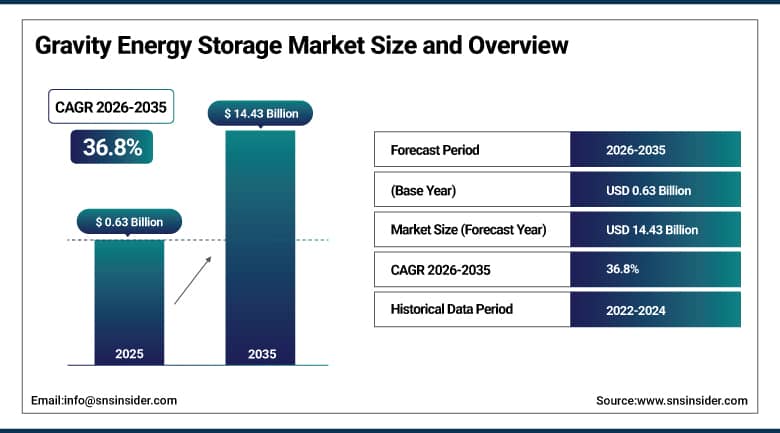
The Gravity Energy Storage Market was valued at USD 0.63 Billion in 2025 and is projected to reach USD 14.43 Billion by 2035, registering a CAGR of 36.8% from 2026 to 2035.
The Gravity Energy Storage market is increasingly being recognized as a solution for utilities and grid operators as they look to have cost-effective and dependable solutions for long-term energy storage. Lithium-ion batteries continue to be widely used for short-duration applications but can become less economical and efficient as the duration of storage gets longer. The technology works on the concept of gravity where potential energy is stored via lifting up heavy weights and generating electricity through the movement of those weights down a slope. Gravity storage systems that use technologies involving both above-ground facilities and decommissioned mine shafts can use common materials like steel and concrete, with long life spans and minimal degradation of the medium used.
Growing commercial projects and project pipeline developments are bolstering the market prospects. The commercial-scale gravity energy storage project by Energy Vault, known as EVx in Rudong, China, is rated to have an output of 25 MW/100 MWh, deliver up to four hours of energy storage, and be functional for 35 years, with an expected efficiency of more than 80%. Further, underground gravity storage projects are also under development, with Gravitricity announcing a development database containing more than 300 project locations globally and 6,000 disused mines in South Africa alone, as part of their project assessments. According to Gravitricity, the technology will be able to run at a 1 to 20 MW power range, with an estimated efficiency of 80-90%, and provide storage capacity of between 15 minutes and eight hours.
To Get More Information On Gravity Energy Storage Market - Request Free Sample Report
Gravity Energy Storage Market Trends
-
Better materials and control systems are pushing round-trip efficiency higher across newer gravity storage designs.
-
Government incentives for long-duration storage are pulling gravity-based systems into utility procurement conversations.
-
Rising renewable energy penetration is creating steady demand for storage that can run for hours, not minutes.
-
Falling capital costs for flywheel and weight-lifting systems are narrowing the gap with lithium-ion batteries.
-
Private investors are increasingly treating gravity storage as a credible alternative to batteries for grid-scale projects.
U.S. Gravity Energy Storage Market Outlook
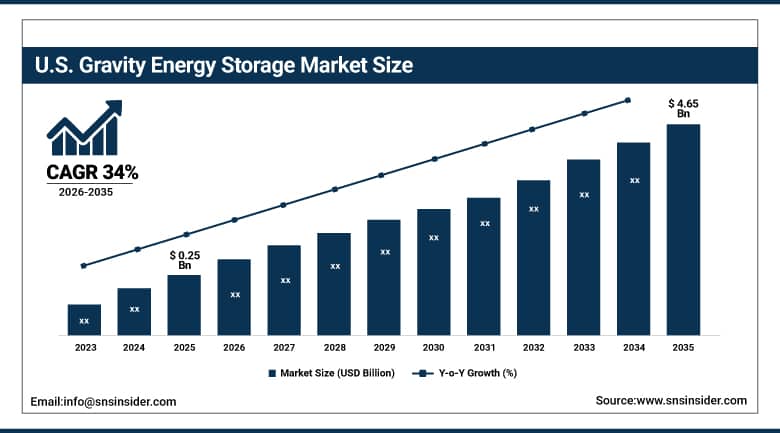
The U.S. Gravity Energy Storage Market was valued at approximately USD 0.25 Billion in 2025 and is projected to reach approximately USD 4.65 Billion by 2035, registering a CAGR of approximately 34% from 2026 to 2035.
The development of market in the US has been facilitated by the efforts made by companies in developing gravity-based and geomechanical long-duration energy storage technologies for commercial purposes. Energy Vault has taken its EVx gravity storage system to the commercial stage through the establishment of a 25 MW/100 MWh system in China and the further development of the next-generation gravity systems from its Solution Excellence Center located in Snyder, Texas. ARES North America has developed a 5 MW GravityLine system of energy storage in Pahrump, Nevada, where the mass cars will weigh around 720,000 pounds per set for the storage and generation of gravitational potential energy.
Federal support for long-duration storage, including Department of Energy demonstration funding, has given these companies room to prove their technology at scale before asking utilities to commit to full commercial contracts. That's a meaningful difference from a decade ago, when most gravity storage concepts never made it past a slide deck.
Gravity Energy Storage Market Segment Analysis
-
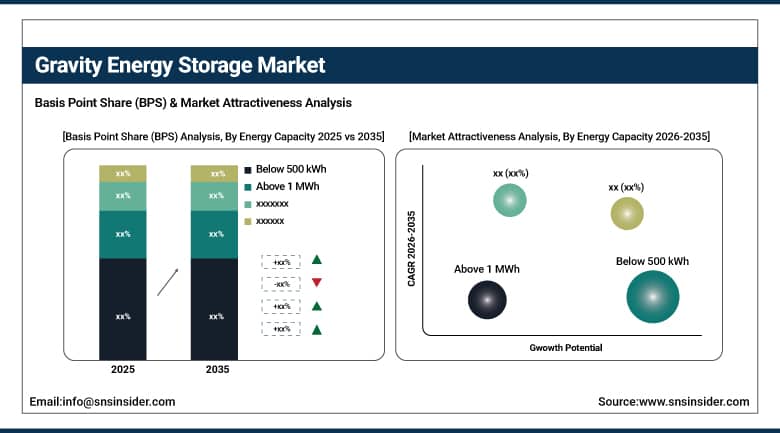
By Energy Capacity, Below 500 kWh dominated the market in 2025 with 42.3% share; Above 1 MWh is the fastest growing segment.
-
By Technology, Advanced Flywheels led the market in 2025 with 58.4% share; Grid-Scale Gravity Energy Storage is the fastest growing segment.
-
By Application, Load Balancing dominated the market in 2025 with 38.6% share; Backup Power is the fastest growing segment.
-
By End User, Utility Companies dominated the market in 2025 with 52.7% share; Industrial Facilities is the fastest growing segment.
By Energy Capacity, Below 500 kWh Leads, Above 1 MWh Grows Fastest
Systems having capacities under 500 kWh dominate the current market, facilitated by their relatively low costs of installation, simplified permissions, and ease of selection of location. The systems will be well suited for use in commercial establishments and micro-grids, where resilience in terms of power supply and backup are critical issues. Moreover, the small project sizes will facilitate quick development times relative to larger utility-scale storage projects, which would need more detailed studies in terms of interconnection, regulatory clearances, and procurement processes.
The above 1 MWh segment is projected to grow at the fastest rate, as investments are made in long-duration energy storage by utilities for renewable energy integration and peak load management and grid stability. Storage capacity needs of utility-scale projects have been increasing because the scale of the renewable energy generation project needs more energy storage capability and reduced reliance on peaking power plants. Gravity-based technologies like piston and shaft are being developed for high-capacity storage systems. More investments in demonstration and utility-scale projects are expected to boost the prospects of the above 1 MWh segment.
By Technology, Advanced Flywheels Lead, Grid-Scale Gravity Energy Storage Is Catching Up
The advanced flywheels accounted for a considerable revenue share in the segment of mechanical energy storage solutions. This was owing to the maturity of the technology and the commercial deployments of these technologies in various use cases. Flywheel energy storage systems have been deployed to stabilize grids, regulate frequencies, and provide power quality solutions for over a decade now. Their well-established characteristics include quick response time, high cycle life, and reliable maintenance. The high-power output capacity of the energy storage solution coupled with its well-proven characteristics makes its adoption favorable in applications requiring repeated charging and discharging cycles.
Gravity energy storage systems, which consist of elevated mass systems, tower-based systems, and shaft-based systems, are relatively newer compared to flywheels but are witnessing increasing traction in long-duration storage applications. These systems can operate in larger energy capacities and discharging times than flywheels. Some examples of gravity energy storage systems that have moved into commercial phase include Energy Vault's EVx platform and Gravitricity's shaft-based gravity energy storage system. Going ahead, further projects will move from demonstration phases and pilots to commercial deployment, thus driving the adoption of grid-scale gravity energy storage systems.
By Application, Load Balancing Leads, Backup Power Grows Fastest
Load balancing was the most dominant application of the gravity energy storage market, driven by the rising necessity for load balancing of electricity generation and consumption. The rising penetration of wind and solar energy sources increases the need for energy storage technologies, which are able to store excess of electricity in the periods of electricity generation peaks and release it during the periods of electricity consumption peaks. Gravity energy storage solutions fit well into this application due to the high number of cycles, long lifetime of the technology, and lower degradation of the storage medium than for some electrochemical storage solutions.
The backup power segment will grow at the highest CAGR over the forecast period due to the increasing concerns about the reliability of the grid, extreme weather conditions, aging power infrastructure, and electricity demand. More and more companies tend to install long-duration energy storage solutions that can provide reliable supply of electricity in case of grid interruption and reduce dependency on traditional fossil-fuel-based backup electricity supply.
By End User, Utility Companies Lead, Industrial Facilities Grow Fastest
Utility companies represented the largest market segment for gravity energy storage, owing to high demands for grid balancing, renewable energy, peak load reduction, and long-duration energy storage. Most commercial gravity storage solutions have been based on utility-scale applications involving the application of energy storage solutions to manage frequencies, shift capacity, and enhance the usage of renewable generation systems. The participation of companies such as Energy Vault and Gravitricity in developing commercial projects also highlights the involvement of utilities, infrastructure builders, and grid operators in deploying gravity energy storage technologies.
The fastest-growing application sector will be industrial, with energy-intensive industries increasingly focusing on reliable and long-duration electricity storage for better reliability and cost reduction. Continuous power consumption industries such as manufacturing plants, mining operations, data centers, and others might benefit from gravity energy storage technologies that can reduce peak demand charges and enhance the generation of renewable power on-site. The increased focus on low-carbon industrial power systems and energy security is expected to drive the adoption of gravity energy storage technology in the coming years.
Regional Analysis:
|
Region |
Major Country |
Share within Region, 2025 (%) |
|---|---|---|
|
North America |
United States |
88.90% |
|
Europe |
Germany |
34.50% |
|
Asia Pacific |
China |
48.60% |
|
Middle East and Africa |
South Africa |
33.40% |
|
South America |
Brazil |
36.20% |
North America Gravity Energy Storage Market Insights
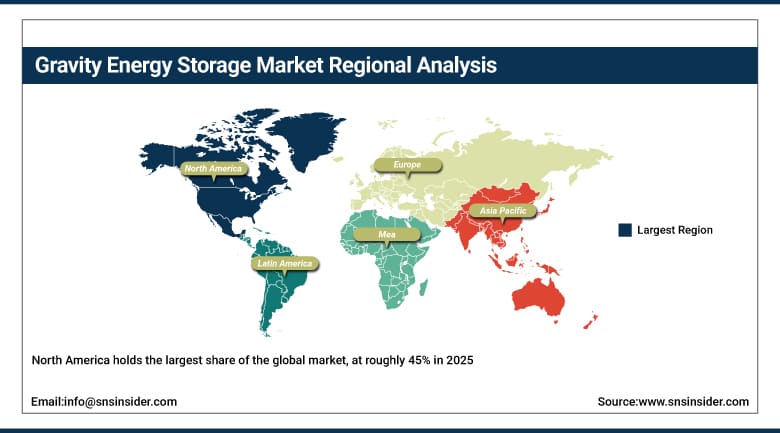
North America holds the largest share of the global market, at roughly 45% in 2025, and a lot of that comes down to simply being first. Most of the companies pushing gravity storage commercially, Energy Vault, Advanced Rail Energy Storage, Gravity Power, and Quidnet Energy among them, are headquartered here, which means the region benefits from proximity to both the innovation and the early pilot projects. Supportive federal policy, including Department of Energy funding for long-duration storage demonstrations, has reinforced that early-mover advantage rather than letting it fade.
The United States accounts for roughly 88.90% of North American revenue, which isn't surprising given how concentrated the industry's commercial activity is domestically. Canada contributes a smaller share, mostly tied to mining and remote industrial applications where gravity storage's ability to use existing infrastructure, like old mine shafts, has obvious appeal.
Get Customized Report as Per Your Business Requirement - Enquiry Now
Europe Gravity Energy Storage Market Insights
Europe was one of the biggest markets for the global gravity energy storage market based on the decarbonization targets, increase in renewable energy generation, and requirements for long-term flexibility of the grid. The European Union aims at climate neutrality until 2050, while renewable energy is expected to provide approximately 69% of electricity generation in the EU in 2030 and 80% by 2050. Moreover, electricity system flexibility requirement will total 288 TWh in 2030 according to the European Commission.
Germany is one of the key markets in Europe due to the large amount of renewable energy production, extensive power system infrastructure, and high level of engineering and industrial expertise. The UK has become one of the development centers for gravity energy storage solutions as well. The project Gravitricity completed the construction of the grid-connected gravity energy storage demonstration unit of 250 kW capacity in 2021 at the Port of Leith in Edinburgh. It used two 25-tonne weight blocks hanged from a 15 meter structure. Now Gravitricity continues the development of the commercial version of the underground GraviStore facility and performs feasibility studies in other European locations suitable for converting mine shafts into energy storage facilities.
Asia Pacific Gravity Energy Storage Market Insights
Asia-Pacific region will dominate the global market in terms of growth with a CAGR of about 43.5% until 2035, which is considerably higher than the overall average growth rate in the global energy storage systems market. The primary driver of growth in this region is the fast increase in the production of renewable energy. In particular, in China, a significant part of this growth is provided by the increase in the capacity of wind and solar power, requiring energy storage systems for balancing power generation. India will also see considerable growth due to ambitious goals in renewable energy production.
China represents the largest national market within the region, reflecting both the scale of its energy transition and government-level interest in developing domestic long-duration storage capacity rather than relying entirely on imported battery technology. Japan and South Korea contribute more modestly, with interest concentrated among utilities and industrial conglomerates exploring gravity storage as a complement to their existing pumped hydro assets.
Middle East, Africa, and South America Gravity Energy Storage Market Insights
The Middle East, Africa, and South America together account for a smaller but steadily growing piece of the global market. In the Middle East and Africa, the appeal is less about decarbonization pressure and more about energy access and reliability, particularly in regions where grid infrastructure is thin and gravity storage's minimal environmental footprint and low maintenance requirements make it a practical fit for remote deployment.
South Africa has emerged as the most active market within the Middle East and Africa region, helped along by Gravitricity's partnership with InfraCo Africa on a gravity-based storage project aimed at improving energy access in underserved communities. In South America, Brazil leads regional activity, with interest driven mainly by the country's mining sector, where abandoned shafts and pits offer a ready-made site for gravity-based systems without the permitting headaches of building something from scratch.
Market Dynamics:
Growth Drivers: Renewable Integration, Grid Stability Needs, and Rising Electricity Costs
The key driver that promotes the growth of this market is the quick adoption of intermittent renewable sources of energy into electric grids across the globe. Even though solar and wind energy can provide cheap production of electricity, their intermittent nature brings about a lot of difficulties regarding the stability of energy flow within a grid. Long-duration energy storage solutions assist in balancing out such a disparity through the storage of additional energy and its provision during times of lower generation by renewable sources. Gravity storage solutions can be considered especially suitable for such an application as a result of their ability to withstand numerous cycles of charging and discharging without losing performance.
Grid stability concerns are pushing in the same direction. Utilities need dependable sources of power during peak demand periods or when unexpected disruptions hit the grid, and gravity storage offers exactly that kind of reliability without the safety concerns that come with large-scale battery installations, like thermal runaway risk. Rising electricity costs add a third layer of motivation, since storing cheap off-peak power and releasing it during expensive peak hours is a straightforward way for utilities and large energy users to cut costs, and that arbitrage opportunity only gets more attractive as electricity prices climb.
Restraints: High Upfront Costs and Site-Specific Engineering Challenges
One of the major obstacles that hinder the success of gravity energy storage industry is the high amount of capital required at the beginning for the development of these projects. This is because the construction of towers to lift and lower loads or the use of shafts from mines for storing energy using gravity calls for huge investment in civil engineering and site preparation. Such projects may therefore fail to move beyond the pilot phase due to the high capital required.
Site selection adds another layer of complexity. Not every location has access to a suitable mine shaft, enough vertical space for a tower, or the geological stability needed for underground systems, which narrows the pool of viable project sites considerably compared to batteries, which can essentially go anywhere with a flat pad and a grid connection. Environmental concerns around traditional pumped-storage hydroelectricity, including habitat disruption from flooding valleys, add further scrutiny to projects that fall under the broader gravity storage umbrella.
Opportunities: New Technology Development, Government Support, and Emerging Market Demand
The gravity energy storage market presents significant growth opportunities as the technology continues to evolve. Ongoing advancements in flywheel systems, improved materials for weight-based storage, and hybrid solutions integrating gravity storage with complementary technologies are creating new pathways for cost reduction and performance improvement. Companies that successfully enhance system efficiency, scalability, and project economics are likely to strengthen their competitive position as commercial adoption expands. Continued investment in research, engineering optimization, and flexible system design will be critical for market participants seeking to capitalize on the technology’s long-term growth potential.
Government support is only growing, particularly as more countries formalize long-duration energy storage as a distinct policy priority separate from short-duration battery storage. That kind of targeted support tends to unlock both public funding and private investment simultaneously. Emerging markets add a third dimension of opportunity, since countries like China and India are building out renewable capacity so quickly that they need storage solutions now, not in a decade, which creates genuine first-mover advantage for companies willing to establish a presence in these markets early.
Recent Developments:
-
August 2025: Energy Vault announced a strategic partnership with a major utility provider to deploy its gravity energy storage systems across multiple sites, aimed at improving grid resilience during periods of peak demand.
-
September 2025: Gravitricity completed a pilot project in Scotland demonstrating its underground, shaft-based weight storage technology, reinforcing its position as an early mover in commercial-scale gravity storage.
-
October 2025: Highview Power secured new funding to expand its liquid air energy storage facilities in the UK, supporting the scale-up of its long-duration storage capacity.
-
February 2024: Gravitricity signed an agreement with InfraCo Africa to jointly develop a gravity-based energy storage project in South Africa, aimed at improving energy access in underserved regions.
-
March 2024: Gravity Power partnered with ABB to develop scalable, cost-effective gravity energy storage systems targeted at industrial customers that need dependable, clean power supply.
Gravity Energy Storage Market key players are:
-
Energy Vault, Inc.
-
Gravitricity Ltd.
-
Gravity Power, LLC
-
Advanced Rail Energy Storage (ARES) North America
-
Highview Power
-
RheEnergise Ltd.
-
Green Gravity Pty Ltd.
-
Sustainable Energy Solutions, LLC
-
EnergyNest AS
-
Quidnet Energy, Inc.
-
Voith Hydro
-
Andritz Hydro
-
GE Vernova (Hydro Solutions)
-
Toshiba Energy Systems & Solutions Corporation
-
Power Construction Corporation of China (PowerChina)
-
China Three Gorges Corporation
-
Statkraft AS
-
Enel Green Power S.p.A.
-
Iberdrola, S.A.
-
Electricite de France (EDF)
Gravity Energy Storage Market Report Scope:
| Report Attributes | Details |
|---|---|
| Market Size in 2025 | USD 0.63 Billion |
| Market Size by 2035 | USD 14.43 Billion |
| CAGR | 36.8% from 2026 to 2035 |
| Base Year | 2025 |
| Forecast Period | 2026-2035 |
| Historical Data | 2022-2024 |
| Report Scope & Coverage | Market Size, Segments Analysis, Competitive Landscape, Regional Analysis, DROC & SWOT Analysis, Forecast Outlook |
| Key Segments | • By Technology (Advanced Flywheels, and Grid-Scale Gravity Energy Storage) • By Energy Capacity (Below 500 kWh, 500 kWh to 1 MWh, and Above 1 MWh) • By Application (Frequency Regulation, Load Balancing, and Backup Power) • By End User (Utility Companies, Industrial Facilities, and Commercial Buildings) |
| Regional Analysis/Coverage | North America (US, Canada), Europe (Germany, UK, France, Italy, Spain, Russia, Poland, Rest of Europe), Asia Pacific (China, India, Japan, South Korea, Australia, ASEAN Countries, Rest of Asia Pacific), Middle East & Africa (UAE, Saudi Arabia, Qatar, South Africa, Rest of Middle East & Africa), Latin America (Brazil, Argentina, Mexico, Colombia, Rest of Latin America). |
| Company Profiles | Energy Vault, Inc., Gravitricity Ltd., Gravity Power, LLC, Advanced Rail Energy Storage (ARES) North America, Highview Power, RheEnergise Ltd., Green Gravity Pty Ltd., Sustainable Energy Solutions, LLC, EnergyNest AS, Quidnet Energy, Inc., Voith Hydro, Andritz Hydro, GE Vernova (Hydro Solutions), Toshiba Energy Systems & Solutions Corporation, Power Construction Corporation of China (PowerChina), China Three Gorges Corporation, Statkraft AS, Enel Green Power S.p.A., Iberdrola, S.A., Electricite de France (EDF) |

Frequently Asked Questions
Key players in the Gravity Energy Storage Market include Energy Vault, Gravitricity, Gravity Power, Advanced Rail Energy Storage (ARES), and Highview Power, among others.
Key opportunities include continued development of advanced flywheel and grid-scale gravity technologies, growing government support for long-duration storage, and rising demand from emerging markets such as China and India.
Growth is being driven primarily by the rapid expansion of intermittent renewable energy sources, the need for grid stability during peak demand periods, and rising electricity costs that make storing cheap off-peak power increasingly attractive.
The Advanced Flywheels segment dominated the Gravity Energy Storage Market, accounting for approximately 58.4% market share in 2025.
North America dominated the Gravity Energy Storage Market in 2025 with an approximate 45% share, supported by early adoption of gravity storage technologies and a concentration of leading developers headquartered in the region.
