
Subsea Energy Storage Market Report Scope and Overview:
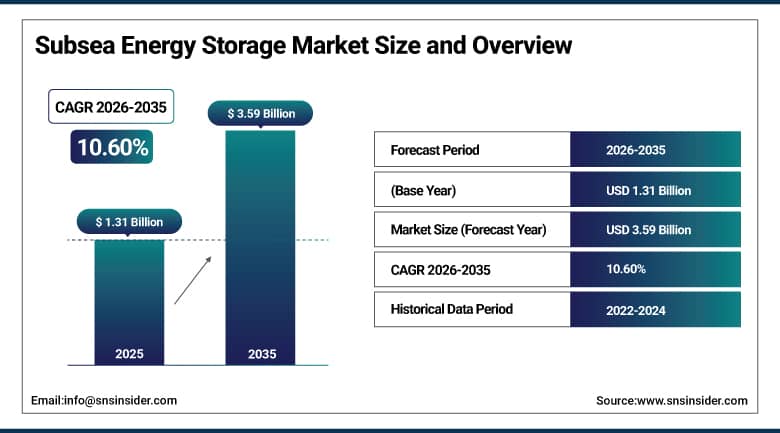
The Subsea Energy Storage Market was valued at USD 1.31 Billion in 2025 and is projected to reach USD 3.59 Billion by 2035, registering a CAGR of 10.60% from 2026 to 2035.
The Subsea Energy Storage Market has been driven by the increased complexity and size of offshore energy generation projects, increased digitalization and automation with requirement of continuous power supply for monitoring and control systems, increasing trend of hybrid energy storage that involves different energy storage techniques, and varied applications of the same in oil and gas, renewable energy and subsea production applications globally. The modular and scalable energy storage architecture, collaboration between technology providers and offshore energy producers, and development of digital twin and artificial intelligence-based control systems have been made possible due to large investments in resilient offshore energy storage solutions made by the oil and gas companies, renewable energy companies, and marine engineering companies.
To Get More Information On Subsea Energy Storage Market - Request Free Sample Report
Subsea Energy Storage Market Trends
-
Rising deployment of offshore wind and tidal projects continues accelerating subsea storage system adoption.
-
Growing digitalization and automation of offshore assets continues driving demand for uninterrupted power supply.
-
Expanding hybrid storage solutions combining multiple technologies are broadening customized system deployment.
-
Increasing deepwater and ultra-deepwater exploration continues creating demand for high-capacity subsea storage.
-
Growing adoption of digital twins and AI-based control systems continues improving system intelligence and reliability.
U.S. Subsea Energy Storage Market Outlook
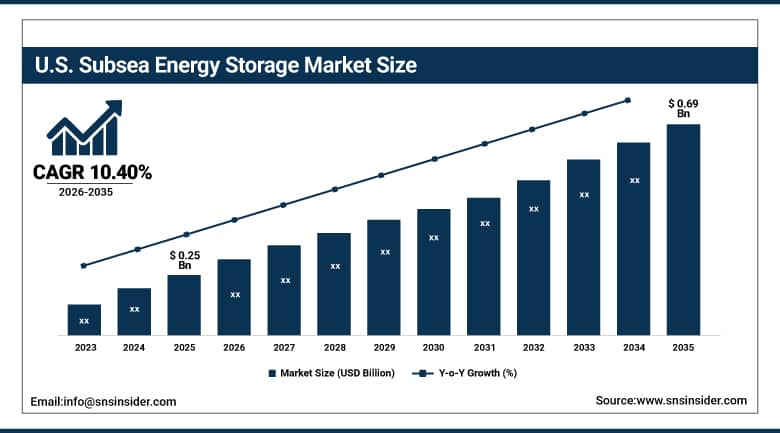
The U.S. Subsea Energy Storage Market was valued at approximately USD 0.25 Billion in 2025 and is projected to reach approximately USD 0.69 Billion by 2035, registering a CAGR of approximately 10.40% from 2026 to 2035.
The demand in the U.S. has been fueled by large investments in offshore exploration of oil and gas resources in the Gulf region, as well as the development of offshore wind power in the Atlantic and Pacific regions. This market is characterized by an established oil and gas sector, state-of-the-art technology and regulatory framework for energy innovations with a growing number of pilot projects for subsea storage.
The implementation of modular and scalable storage systems played an important role in the formation of the leading position in the market of subsea energy storage in the United States. Furthermore, integration of energy storage with subsea control and digital monitoring systems increased the demand for the product.
Subsea Energy Storage Market Segment Analysis
-
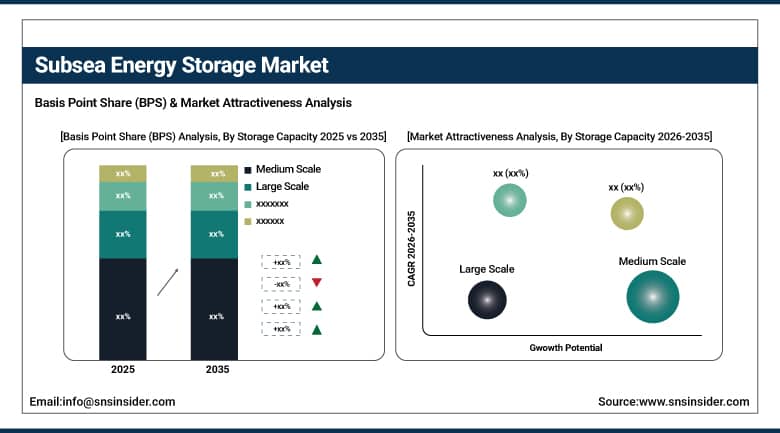
By Storage Capacity, Medium Scale segment dominated the market in 2025 with 42.70% share; Large Scale segment is the fastest growing segment, registering a CAGR of approximately 13.60%.
-
By Technology, Battery Energy Storage segment dominated the Market in 2025 with 46.80% share; Compressed Air Energy Storage segment is the fastest growing segment, registering a CAGR of approximately 13.20%.
-
By Application, Oil & Gas segment dominated the market in 2025 with 38.60% share; Renewable Energy segment is the fastest growing segment, registering a CAGR of approximately 14.80%.
-
By Component, Energy Storage Modules segment dominated the market in 2025 with 41.50% share; Control Systems segment is the fastest growing segment, registering a CAGR of approximately 13.90%.
By Storage Capacity, Medium Scale Dominates the Subsea Energy Storage Market While Large Scale Grows Fastest
The Medium Scale systems had the largest market share in terms of storage capacity in 2025 at around 42.70%, being the core systems in almost all offshore platforms and medium scale renewable energy installations. This category of storage systems provides a balance in terms of capacity, size, and cost and has enough energy capacity to provide energy supply during any power disruption and can be scaled up according to the demands.
The Large Scale systems have been predicted to grow at a rate of around 13.60% during the forecast period, which will be the highest growth rate among all categories of the storage capacity. Growth in this segment has been mainly driven by the need for large scale applications where there is a requirement of storage and discharge of huge amount of energy.
By Technology, Battery Energy Storage Dominates the Subsea Energy Storage Market While Compressed Air Energy Storage Grows Fastest
Battery Energy Storage commanded the leading share of the Subsea Energy Storage Market in 2025 at approximately 46.80%, due to high energy density, quick response time, and compatibility with different applications in the offshore environment. Innovations in battery chemistries such as lithium-ion and sodium-sulfur batteries, which have been demonstrated in the advanced battery solutions provided by companies like Saft Groupe for subsea and marine environments, have helped enhance the reliability and safety of subsea battery storage.
Compressed Air Energy Storage is projected to expand at a CAGR of approximately 13.20%, the fastest pace within the Technology segment, owing to the growing interest in this technology as an option for large-scale subsea energy storage in areas where suitable geology is available, owing to its long duration capability and efficient energy conversion. Efforts made to address the issues of pressure management and corrosion, along with increasing interest in the use of CAES in combination with offshore wind and subsea grids, have played a part in this growth.
By Application, Oil & Gas Dominates the Subsea Energy Storage Market While Renewable Energy Grows Fastest
Oil & Gas dominated the application segment in 2025 with a market share of around 38.60% due to the requirement of dependable power generation to support exploration, drilling, and production processes in deepwater and ultra-deepwater regions. The subsea energy storage systems are extremely important for achieving continuity of process and reducing dependency on power generation from surface facilities.
Renewable Energy application is expected to witness a significant CAGR of around 14.80% that is expected to be the highest among all application segments due to the world trend toward decarbonization of energy generation and increasing deployment of offshore wind energy and tidal energy generation facilities. Storage of energy becomes necessary in order to store the excess energy generated during times of high activity and distribute it during times when there are no winds or tidal flows.
By Component, Energy Storage Modules Lead the Subsea Energy Storage Market While Control Systems Grow Fastest
In 2025, Energy Storage Modules will hold the position of the dominating component segment, contributing to the market about 41.50% of the revenue share, as they constitute the main components of the subsea storage system that includes batteries, compressed air storage systems, or flywheels. Further improvement in materials science, thermal engineering, and pressure retention technologies is helping in the production of more sturdy and durable energy storage modules that can withstand subsea conditions.
The Control Systems are expected to be the fastest-growing component segment at a CAGR of around 13.90%. This is due to the increasing use of digital twins, artificial intelligence, and machine learning techniques to design control systems of unmanned or autonomous subsea facilities. Increasing need for data acquisition, failure analysis, and predictive maintenance has made this component segment an emerging and high-growing one.
Regional Analysis:
|
Region |
Major Country |
Share within Region, 2025 (%) |
|---|---|---|
|
Europe |
Germany |
24.00% |
|
North America |
United States |
78.00% |
|
Asia Pacific |
China |
30.00% |
|
Middle East and Africa |
Saudi Arabia |
28.00% |
|
Latin America |
Brazil |
55.00% |
Europe Subsea Energy Storage Market Insights
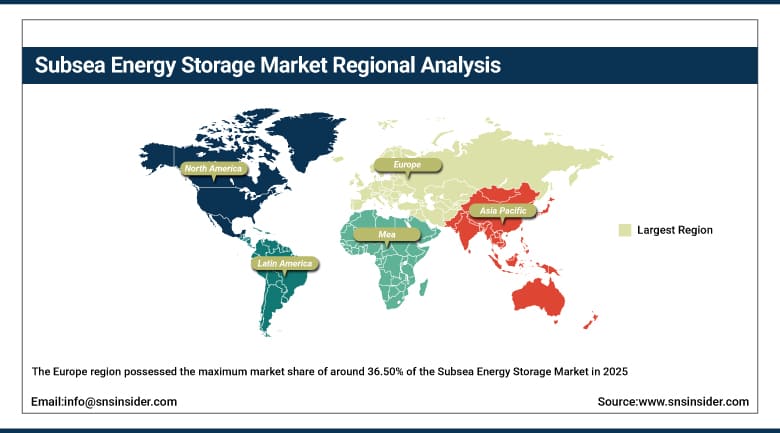
The Europe region possessed the maximum market share of around 36.50% of the Subsea Energy Storage Market in 2025 and also expected to retain its position as the fastest growing region with a growth rate of around 11.50% during the period of 2026 to 2035. Such a combination has been witnessed due to robust installation of offshore wind power projects mainly in the North Sea and Baltic Sea along with a favorable regulatory environment for clean energy innovations in which the UK, Germany, Denmark, and Netherlands have been leading.
Germany has been the leader in the European revenue share of around 24.00% due to high dedication towards offshore wind power installations and investments in the clean energy infrastructure sector. The UK and Denmark were some of the significant contributors to the regional demand due to advanced installation of North Sea offshore wind power projects.
Get Customized Report as Per Your Business Requirement - Enquiry Now
North America Subsea Energy Storage Market Insights
North America had a significant market share of around 24.50% of the Subsea Energy Storage Market in 2025 due to investments made in offshore oil and gas exploration and the increasing development of offshore wind energy projects on the Atlantic and Pacific coasts. North America is characterized by an established oil and gas sector, advanced technology, and a favorable regulatory climate for energy innovations.
The U.S. had an approximate share of 78.00% of the total revenue generated in North America due to its increased emphasis on grid upgrades and renewable energy and the increasing number of pilot projects and collaborations.
Asia Pacific Subsea Energy Storage Market Insights
The Asia Pacific region captured a considerable market share in the Subsea Energy Storage Market in 2025, representing a growing market due to increased offshore operations in China, Japan, South Korea, and Australia. The large coastlines, ample availability of renewable energy sources, and rising energy requirements in the region continue to fuel the need for subsea energy storage systems.
The largest share of revenue was accounted for by China in the Asia Pacific region with about 30.00%. This was mainly due to the huge investment in offshore wind energy, tidal energy, and oil and gas projects. Similarly, efforts taken by the governments of Japan, South Korea, and Australia to generate clean energy sources and reduce CO2 emissions were driving the growth of the Asia Pacific region.
MEA and Latin America Subsea Energy Storage Market Insights
Middle East & Africa and Latin America saw sustained growth, even though at a much lower scale, since offshore exploration and renewable energy development are increasing in both regions. With the growth of governmental investment in infrastructural development, together with growing renewable capacity additions with the need for sophisticated storage systems, both the regions will become significant consumers of subsea energy storage during the next decade.
Within the Middle East & Africa, Saudi Arabia became the leading consumer in the region, having a 28.00% share of the regional market due to offshore energy investments associated with the diversification program of the country. Within Latin America, Brazil remained the leader in the market, having a 55.00% share of the regional market due to offshore energy activities in the country and interest in subsea energy storage facilities.
Market Dynamics:
Growth Drivers: Increasing Complexity and Scale of Offshore Energy Projects
Movement of the market is facilitated by the growing sophistication and size of offshore energy projects that involve oil and gas exploration in deeper water and harsher conditions requiring efficient energy storage systems. Subsea energy storage systems allow the uninterrupted power supply for subsea production systems and, together with increased digitalization and automation of offshore activities, require uninterrupted power supplies.
Additional evidence includes the global trend toward using renewable energy sources such as offshore wind and tidal energy requiring energy storage to ensure continuity of energy production and stability of the grid. Favorable regulations and government initiatives, as well as increasing investments from government and private companies in offshore renewable energy projects, are the additional factors driving demand during the forecast period.
Restraints: High Capital Costs and Technical Complexity
Higher initial costs associated with capital expenditure, complexity involved in design and the difficulties of operations due to the subsea environment pose a big challenge for the adoption of the technology in the marketplace. There is also a challenge of meeting the safety requirements, regulations, and other standards for the technology, adding more to the cost of developing and installing the system, especially when it is large-scale and requires much engineering verification.
Another challenge that the industry faces is the exposure to changes in price levels in the oil and gas markets, which could affect the investments in the offshore projects and ultimately the demand for subsea energy storage. There is competition from the other energy storage solutions available like floating and above-water solutions.
Opportunities: Expansion of Offshore Renewable Energy and Hybrid Systems
The fast growth of offshore renewable energy installations, especially offshore wind farms and tidal installations, presents substantial opportunities for developing innovative storage technologies for stabilizing energy grids and optimizing the use of renewables. The platform solutions offered by companies like Siemens Energy and ABB, which include integrated power management solutions together with battery storage, exemplify how these vendors leverage the growing work flow to distinguish themselves in terms of offshore energy customers.
Moreover, the advent of hybrid energy systems that integrate oil & gas, renewable energy sources, and energy storage creates new possibilities for business value. Companies that can provide integrated end-to-end solutions, including storage and power conversion and control systems, will be able to attract investments continuously as the financing for clean energy infrastructure keeps growing.
Recent Developments:
-
2025: Siemens Energy expanded its integrated battery energy storage and power management systems for offshore wind applications in the North Sea.
-
2025: Aker Solutions launched a subsea energy storage and compression project supporting deepwater field development in the Norwegian Continental Shelf.
-
2025: Subsea 7 secured an installation contract for subsea energy storage modules supporting a major offshore wind interconnection project.
-
2025: Saft Groupe introduced an upgraded high-performance battery system designed specifically for subsea and marine energy storage applications.
-
2026: OneSubsea expanded its digital twin and AI-based control system portfolio to enhance predictive maintenance for subsea energy storage installations.
-
2026: Ocean Power Technologies advanced its wave energy and subsea power storage pilot program, targeting remote offshore installation applications.
Subsea Energy Storage Market key players are:
-
ABB Ltd.
-
Siemens Energy AG
-
Schneider Electric SE
-
Baker Hughes Company
-
TechnipFMC plc
-
Saipem S.p.A.
-
Oceaneering International, Inc.
-
Subsea 7 S.A.
-
Aker Solutions ASA
-
Halliburton Company
-
NOV Inc.
-
OneSubsea (SLB)
-
Blue Logic AS
-
Seatools B.V.
-
Hydro Group Plc
-
MacArtney Underwater Technology A/S
-
Ocean Power Technologies, Inc.
-
Saft Groupe S.A.
-
Stena Power & LNG Solutions
-
Kongsberg Maritime AS
Subsea Energy Storage Market Report Scope:
| Report Attributes | Details |
|---|---|
| Market Size in 2025 | USD 1.31 Billion |
| Market Size by 2035 | USD 3.59 Billion |
| CAGR | 10.60% from 2026 to 2035 |
| Base Year | 2025 |
| Forecast Period | 2026-2035 |
| Historical Data | 2022-2024 |
| Report Scope & Coverage | Market Size, Segments Analysis, Competitive Landscape, Regional Analysis, DROC & SWOT Analysis, Forecast Outlook |
| Key Segments | •Technology (Battery Energy Storage, Compressed Air Energy Storage, Flywheel Energy Storage, Others) •Application (Oil & Gas, Renewable Energy, Offshore Platforms, Subsea Production Systems, Others) •Storage Capacity (Small Scale, Medium Scale, Large Scale) •Component (Energy Storage Modules, Power Conversion Systems, Control Systems, Others) |
| Regional Analysis/Coverage | North America (US, Canada), Europe (Germany, UK, France, Italy, Spain, Russia, Poland, Rest of Europe), Asia Pacific (China, India, Japan, South Korea, Australia, ASEAN Countries, Rest of Asia Pacific), Middle East & Africa (UAE, Saudi Arabia, Qatar, South Africa, Rest of Middle East & Africa), Latin America (Brazil, Argentina, Mexico, Colombia, Rest of Latin America). |
| Company Profiles | ABB Ltd., Siemens Energy AG, Schneider Electric SE, Baker Hughes Company, TechnipFMC plc, Saipem S.p.A., Oceaneering International, Inc., Subsea 7 S.A., Aker Solutions ASA, Halliburton Company, NOV Inc., OneSubsea (SLB), Blue Logic AS, Seatools B.V., Hydro Group Plc, MacArtney Underwater Technology A/S, Ocean Power Technologies, Inc., Saft Groupe S.A., Stena Power & LNG Solutions, Kongsberg Maritime AS. |

Frequently Asked Questions
Key players in the Subsea Energy Storage Market include ABB Ltd., Siemens Energy AG, Baker Hughes Company, TechnipFMC plc, and Subsea 7 S.A., among others.
Key opportunities in the Subsea Energy Storage Market include rapid expansion of offshore renewable energy projects requiring advanced storage solutions, alongside emergence of hybrid energy systems combining oil and gas, renewables, and storage for improved operational efficiency.
The market is driven by the increasing complexity and scale of offshore energy projects, rising digitalization and automation demanding uninterrupted power, and the global shift toward offshore renewable energy sources requiring grid stability support.
The Battery Energy Storage segment dominated the Subsea Energy Storage Market, accounting for approximately 46.80% market share.
The Europe region dominated the Subsea Energy Storage Market in 2025 with a 36.50% share, driven by aggressive offshore wind deployment and strong regulatory support for clean energy infrastructure.
