
Wavefront Aberrometer Market Report Scope & Overview:
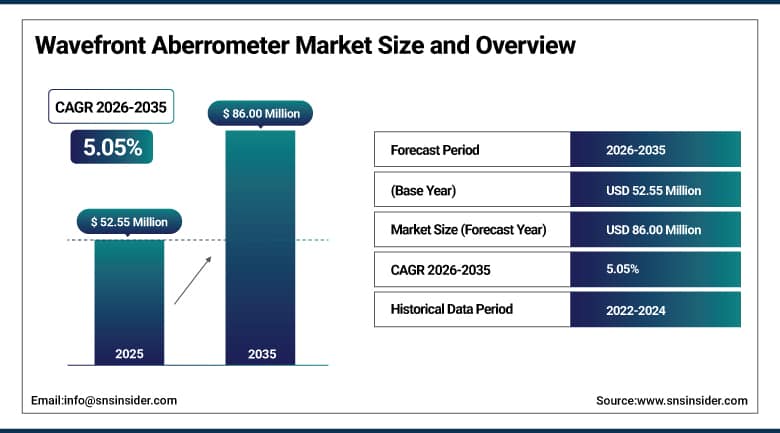
The Wavefront Aberrometer Market was valued at USD 52.55 Million in 2025 and is expected to reach USD 86.00 Million by 2035, growing at a CAGR of 5.05% from 2026 to 2035.
There is a constant growth trend in the Wavefront Aberrometer Market, supported by the growing number of uncorrected refractive errors on a global scale, increasing application of wavefront guided LASIK surgery and premium cataract surgeries, as well as development of advanced AI-driven diagnostic platforms that incorporate topography, providing greater accuracy of measurements and planning during surgery. Wavefront aberrometers are sophisticated diagnostic devices used in ophthalmology for accurate measurement of both lower- and higher-order optical aberrations of the eye, providing doctors with more detailed information for refractive surgery planning, IOL selection and specialty contact lenses fitting.
At ASCRS 2026, Carl Zeiss Meditec highlighted its refractive digital and surgical workflow platforms in Washington, D.C., illustrating the new trend in the industry towards platform-style purchases, where aberrometry belongs to an integrated ecosystem of refractive diagnosis and surgery planning.
To Get More Information On Wavefront Aberrometer Market - Request Free Sample Report
Wavefront Aberrometer Market Trends:
-
Rising integration of AI-powered analytics is improving ectasia risk prediction and surgical decision support in topography-integrated aberrometers.
-
Growing adoption of intra-operative aberrometry is reducing postoperative residual astigmatism in toric and multifocal IOL procedures.
-
Increasing convergence of wavefront-guided LASIK with topography-integrated systems is expanding diagnostic scope beyond simple refraction.
-
Expanding use of portable aberrometer units is supporting outreach screening programs in schools and underserved rural clinics.
-
Rising demand for precise ocular wavefront calibration is opening new applications in AR/VR headset fitting and sports vision testing.
U.S. Wavefront Aberrometer Market Outlook:
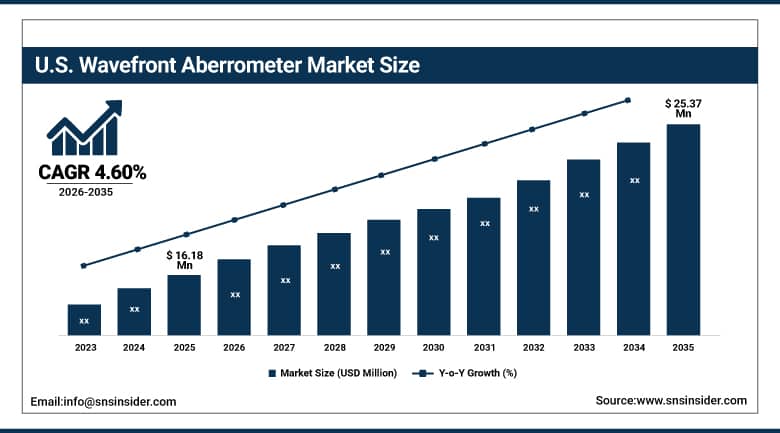
The U.S. Wavefront Aberrometer Market was valued at USD 16.18 Million in 2025 and is projected to reach USD 25.37 Million by 2035, growing at a CAGR of 4.60% during 2026–2035.
Leading ophthalmic device companies and refractive surgery networks across the U.S. are expanding the adoption of wavefront aberrometers, supported by established reimbursement, patient demand for premium IOLs, and rapid diagnostic technology adoption. Growing cataract and refractive procedures at ambulatory surgery centers, alongside intraoperative aberrometry in premium IOL cases, is strengthening demand. Meanwhile, vendors are developing AI-driven diagnostics and cloud-based analytics to remain competitive amid Medicare’s 2.93% payment reduction in 2025, encouraging smaller practices to adopt leasing and service-based purchasing models.
With the USD 430 million acquisition of LENSAR, Alcon is enhancing its portfolio of femtosecond lasers and embedding intra-operative aberrometry further into its cataract portfolio.
Wavefront Aberrometer Market Segment Analysis:
-
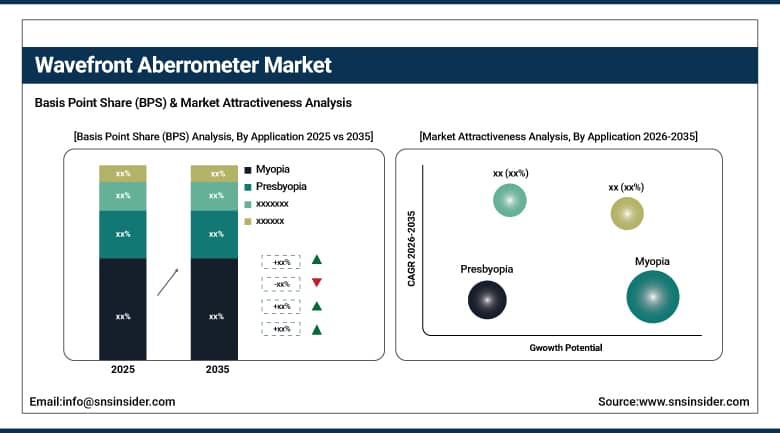
By Application, Myopia dominated the Wavefront Aberrometer Market with a 55.10% share in 2025, while Presbyopia is the fastest-growing application segment with a CAGR of 6.65% from 2026–2035.
-
By Product Type, Integrated Topography-Aberrometer Systems dominated the Wavefront Aberrometer Market with a 41.08% share in 2025, while Intra-Operative Aberrometers is the fastest-growing product type segment with a CAGR of 7.02% from 2026–2035.
-
By End User, Ophthalmology Clinics dominated the Wavefront Aberrometer Market with a 44.20% share in 2025, while Ambulatory Surgery Centers is the fastest-growing end-user segment with a CAGR of 6.31% from 2026–2035.
By Application, Myopia dominated the Wavefront Aberrometer Market, while Presbyopia is the fastest-growing segment.
Myopia was the dominant segment in the Wavefront Aberrometer Market, contributing 55.10% of market revenues in 2025. Refractive correction of Myopia will continue to represent the biggest segment in terms of applications due to the huge pool of patients suffering from myopia. It is estimated that half the global population will be suffering from myopia by 2030, with APAC being the most burdened region. As a result, governments have initiated programs to screen patients for their refractive errors using portable aberrometers in rural clinics and schools. Modules powered by AI provide a high level of accuracy and sensitivity in spotting the abnormal wavefront patterns, thereby increasing efficiency and accessibility.
The Presbyopia segment is expected to register the fastest CAGR of 6.65% during the forecast period 2026-2035. Rising demand from aging populations seeking spectacle-free vision correction is driving above-average adoption, as extended-depth-of-focus intraocular lenses rely on precise spherical aberration management that only advanced wavefront measurement can reliably deliver. Growing patient willingness to invest out-of-pocket in premium presbyopia-correcting IOL packages continues to finance device upgrades even amid tighter insurer reimbursement, positioning this segment as an increasingly important growth driver for manufacturers targeting refractive and cataract surgery practices serving an aging global patient base.
By Product Type, Integrated Topography-Aberrometer Systems dominated the Wavefront Aberrometer Market, while Intra-Operative Aberrometers is the fastest-growing segment.
The Integrated Topography-Aberrometer Systems segment was the leading contributor with 41.08% revenue share in the Wavefront Aberrometer Market. Integrated systems account for being the dominant product category due to clinician preference for single-platform corneal mapping and wavefront measurement, bundling Placido-disc topography with Hartmann-Shack sensors so that surgeons can refine ablation profiles and IOL power selections without switching between devices. Table-top standalone systems continue to serve high-volume refractive practices where workflow efficiency outweighs multi-modality requirements, while the broader trend toward software-driven differentiation has reinforced integrated platforms' central role in surgical planning.
The Intra-Operative Aberrometers segment is expected to witness the highest CAGR of 7.02% during the forecast period 2026-2035. Rising demand for real-time IOL power confirmation during cataract surgery is propelling above-average segment growth, as systems delivering live wavefront readings help reduce postoperative residual astigmatism to 0.50 diopters or less in the large majority of eyes, compared with meaningfully lower success rates when surgeons rely on pre-operative formulas alone. The benefit is most pronounced in toric, multifocal, and post-LASIK cases where conventional calculations frequently fall short, and real-time intra-operative feedback also shortens revision rates, supporting the broader shift toward outpatient cataract pathways that continues to accelerate ambulatory-surgery-center adoption of this premium diagnostic category.
By End User, Ophthalmology Clinics dominated the Wavefront Aberrometer Market, while Ambulatory Surgery Centers is the fastest-growing segment.
The Ophthalmology Clinics market segment was at the forefront of the Wavefront Aberrometer Market with 44.20% of market share in 2025. Ophthalmic Clinics have always been the predominant end user segment due to the importance they play in pre-surgical evaluation and follow up. The reason they have continued to maintain this position is their importance as the first port of call for refractive surgery and cataract surgery patients through the entire evaluation process. It is for this reason that these clinics play an important role in promoting demand for wavefront aberrometers since they already have refractive experts and long-term patient relations.
The Ambulatory Surgery Centers segment is the fastest-growing end-user category, projected to expand at a CAGR of 6.31% through 2035. Rising migration of outpatient refractive and cataract procedure volume toward cost-efficient ambulatory settings is driving above-average adoption, as ASCs increasingly favor compact intra-operative units that slot into streamlined operating-room workflows and minimize patient transfer delays. Growing tele-optometry networks contracting mobile technicians equipped with portable aberrometers, combined with software-as-a-service dashboards enabling multi-site practices to benchmark outcomes, continues to reshape purchasing criteria from pure hardware specifications toward total-cost-of-ownership evaluations that favor this rapidly expanding care setting.
Regional Analysis:
|
Region |
Major Country |
Share within Region, 2025 (%) |
|
North America |
United States |
87.00% |
|
Europe |
Germany |
26.00% |
|
Asia Pacific |
China |
38.00% |
|
Middle East & Africa |
GCC |
24.00% |
|
South America |
Brazil |
40.00% |
North America Wavefront Aberrometer Market Insights
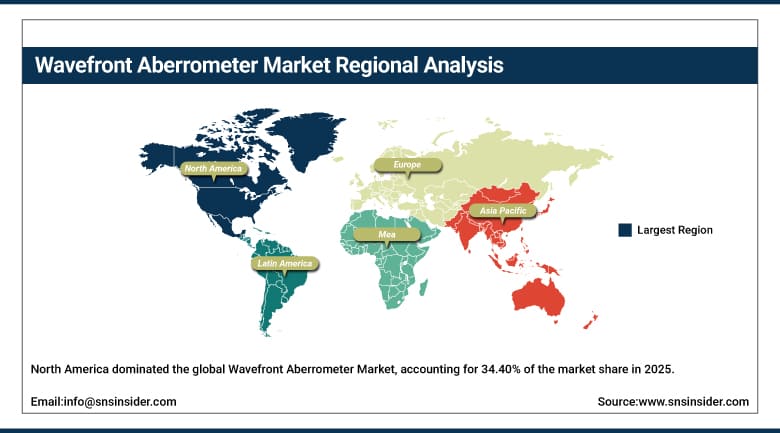
North America dominated the global Wavefront Aberrometer Market, accounting for 34.40% of the market share in 2025. The region’s leadership is supported by the strong adoption of advanced ophthalmic diagnostic technologies, increasing demand for precise vision correction, and the growing volume of cataract and refractive procedures. Established healthcare infrastructure, higher awareness of premium eye-care solutions, favorable reimbursement frameworks, and the presence of leading ophthalmic device manufacturers further strengthen regional growth. Increasing investments in advanced diagnostic equipment are also supporting broader clinical adoption.
The USA has been the leading country in terms of the North America Wavefront Aberrometer Market with 87.00% of the regional market share in the year 2025 due to established domestic refractive and cataract surgery practice networks, consumer awareness regarding premium IOLs and established domestic wavefront diagnostic system manufacturers. Canada has been making contribution to the growth of the regional market through increased private and public investments in ophthalmic diagnostic infrastructure in large metropolitan networks.
Get Customized Report as Per Your Business Requirement - Enquiry Now
Europe Wavefront Aberrometer Market Insights
Europe held a meaningful share of global revenue, supported by Wavefront Aberrometer Market in 2025, showing mature yet steady demand buoyed by evidence-based practice standards and national health insurance systems that reimburse functional vision improvements for cataract and refractive surgery patients. This is attributed to the region's growing awareness of eye-related diseases and an aging population requiring frequent ophthalmic check-ups, supported by consolidation moves among leading manufacturers that deepen integration between diagnostics and therapy across national health systems.
Germany is one of the major markets in Europe owing to its strong ophthalmic surgery infrastructure and presence of leading device manufacturers serving both domestic and international customers. Other countries such as the United Kingdom and France, home to established refractive surgery centers and growing private eye care investment, are also contributing to market growth through expanding procedure volumes and rising practitioner adoption of integrated topography-aberrometer diagnostic tools.
Asia Pacific Wavefront Aberrometer Market Insights
The Asia Pacific Wavefront Aberrometer Market is expected to witness the fastest growth rate during the forecast period 2026-2035, registering a CAGR of 8.78%. The market growth is driven by regulatory streamlining, rising private healthcare investment, and high myopia prevalence across the region, supported by China's streamlined National Medical Products Administration approval timelines and fast-track regulatory zones that allow overseas-cleared aberrometers to reach the market earlier than in prior years.
China is one of the main growth drivers in the Asia Pacific Wavefront Aberrometer Market, owing to its massive myopic patient population and streamlined regulatory pathways supporting faster product launches. India is also contributing to regional growth through its fresh device-marketing code and rising private-equity investment in eye-care chains, while Japan and South Korea, already technologically advanced, lead adoption of AI-powered diagnostic modules, reinforcing the premium tier of the regional wavefront aberrometer market.
Middle East & Africa and South America Wavefront Aberrometer Market Insights
Middle East & Africa and South American regions offer meaningful upside as private hospitals upgrade their ophthalmic imaging suites, supported by increasing government healthcare modernization initiatives and growing physician training in advanced refractive diagnostic techniques across major metropolitan eye care networks, although currency volatility and limited reimbursement continue to temper near-term scale in both regions.
Brazil is set to be a prominent South American market fueled by its expanding private ophthalmology practice network and growing patient demand for premium refractive and cataract surgery outcomes. The Middle East & Africa region has GCC countries and South Africa investing in advanced tertiary eye care infrastructure that is gradually increasing demand for wavefront diagnostic systems across their expanding hospital and specialty ophthalmology clinic networks.
Market Dynamics:
Growth Drivers: Rising refractive error prevalence and premium procedure adoption driving market growth
The increasing number of uncorrected refractive errors on a global scale, including a projected number of half of the world's population suffering from myopia by 2030, represents an important trend behind the expansion of the Wavefront Aberrometer Market. In response, governments sponsor initiatives focused on early detection programs through the use of portable aberrometers to detect refractive errors among school children and in rural facilities, while AI modules ensure the highest level of sensitivity and specificity for abnormal wavefronts, minimizing chair time and ensuring accessibility in developed and underserved regions in need of efficient screening.
The rising number of wavefront guided LASIK and premium cataract procedures further fuels the total growth of the market, with wavefront guided refractive surgery offering excellent results in terms of achieving good visual outcomes compared to traditional approaches, thus motivating patients' desire to pay for a better quality experience. Increasing number of intraoperative aberrometry procedures for optimized intraocular lens selection, further advancements in AI-based topographic diagnostic solutions, and the rising number of requests for precise ocular calibration for emerging AR/VR headsets represent additional opportunities for wavefront measurement technologies.
Restraints: High capital costs and skilled technician shortages limiting market expansion
The high cost associated with capital expenditure and procedure-specific costs remains a challenge affecting growth within the market, since integrated topography-aberrometers are expensive instruments, with each analysis also involving some cost due to consumables. The reason is that small clinics operating in areas where costs matter cannot afford such investments despite technological advances, yet lease and pay-per-use plans somewhat reduce the barrier to entry for budget-constrained practices.
In addition, there is a problem with a shortage of qualified ophthalmic technicians proficient in wavefront analysis, since complex aberrometry requires qualified operators able to align patients, interpret higher-order aberrations, and deal with AI-based work flows, while there are few accreditation programs providing sufficient number of training hours for certification. In addition, there is also a reimbursement issue with respect to intra-operative aberrometry billing codes and incompatible data formats preventing integration with practice management software.
Opportunities: Workflow-integrated diagnostics and intra-operative innovation creating new growth avenues
White space is opening around higher-precision, workflow-integrated aberrometry that reduces dependence on subjective refraction and supports premium refractive outcomes across cataract and corneal procedures. Continued clinical evaluation of open-field aberrometry designs that better manage accommodation-related measurement artifacts, while keeping subjective refraction as a clinical backstop, creates room for vendors to differentiate through measurement protocols, repeatability tooling, and decision-support software layers rather than optical hardware alone.
There is immense potential for growth in deepening intra-operative aberrometry for premium and complex IOL selection as real-world clinical evidence continues to accumulate supporting its performance advantages over standard biometry-based formulas, particularly for toric IOL implantation and long-eye monofocal cases. Continued research into binocular wavefront optometry systems offering finer refractive measurement increments for SMILE and LASIK patients, combined with rising demand for AR/VR ocular calibration applications, is expected to unlock incremental demand growth throughout the forecast period across both surgical and emerging consumer technology use cases.
Recent Developments:
-
2026: Carl Zeiss Meditec highlighted digital and surgical refractive workflow solutions at ASCRS 2026 in Washington, D.C., reinforcing the shift toward platform-style purchasing where aberrometry sits inside a unified refractive workflow.
-
2026: Advance Medical announced integration of the WaveDȳn aberrometer into the FocalPoints enVisus platform to support higher-order aberration correction in specialty lens manufacturing.
-
2025: Eaglet Eye partnered with OVITZ to distribute the xwave aberrometer in Europe for scleral lens fitting, expanding access to wavefront-guided specialty contact lens workflows.
-
2023: The U.S. FDA cleared Bausch + Lomb's TENEO laser, renewing competitive intensity and spotlighting systems that seamlessly integrate aberrometry, eye tracking, and topography measurement.
-
2022: Alcon completed a USD 430 million acquisition of LENSAR, extending its femtosecond laser franchise and folding intra-operative aberrometry deeper into its cataract surgery platform.
Wavefront Aberrometer Market Key Players are:
-
Alcon
-
Carl Zeiss Meditec
-
Johnson & Johnson Vision
-
EssilorLuxottica
-
NIDEK
-
SCHWIND eye-tech-solutions
-
Topcon
-
Tracey Technologies
-
Luneau Technology
-
Marco
-
Bausch + Lomb
-
Optikon
-
Canon Medical
-
Vmax Vision
-
WaveLight
-
i-Optics
-
AceVision Group
-
Haag-Streit
-
Heidelberg Engineering
-
Ophtec
Wavefront Aberrometer Market Report Scope:
| Report Attributes | Details |
|---|---|
| Market Size in 2025 | USD 52.55 Million |
| Market Size by 2035 | USD 86.00 Million |
| CAGR | CAGR of 5.05% From 2026 to 2035 |
| Base Year | 2025 |
| Forecast Period | 2026-2035 |
| Historical Data | 2022-2024 |
| Report Scope & Coverage | Market Size, Segments Analysis, Competitive Landscape, Regional Analysis, DROC & SWOT Analysis, Forecast Outlook |
| Key Segments | • By Product Type (Table-Top Stand-Alone Systems, Integrated Topography-Aberrometer Systems, Intra-Operative Aberrometers, Hand-Held / Portable Aberrometers) • By Application (Myopia, Hyperopia, Astigmatism, Presbyopia, Keratoconus & Ectasia, Other Applications) • By End User (Hospitals, Ophthalmology Clinics, Ambulatory Surgery Centers, Academic & Research Institutes) |
| Regional Analysis/Coverage | North America (US, Canada), Europe (Germany, UK, France, Italy, Spain, Russia, Poland, Rest of Europe), Asia Pacific (China, India, Japan, South Korea, Australia, ASEAN Countries, Rest of Asia Pacific), Middle East & Africa (UAE, Saudi Arabia, Qatar, South Africa, Rest of Middle East & Africa), Latin America (Brazil, Argentina, Mexico, Colombia, Rest of Latin America). |
| Company Profiles | Alcon, Carl Zeiss Meditec, Johnson & Johnson Vision, EssilorLuxottica, NIDEK, SCHWIND eye-tech-solutions, Topcon, Tracey Technologies, Luneau Technology, Marco, Bausch + Lomb, Optikon, Canon Medical, Vmax Vision, WaveLight, i-Optics, AceVision Group, Haag-Streit, Heidelberg Engineering, Ophtec. |
Frequently Asked Questions
Key players include Alcon, Carl Zeiss Meditec, Johnson & Johnson Vision, EssilorLuxottica, NIDEK, SCHWIND eye-tech-solutions, Topcon, and Tracey Technologies.
Key opportunities include workflow-integrated diagnostics, intra-operative innovation, premium IOL selection, binocular wavefront optometry, and AR/VR ocular calibration applications.
The market is driven by rising refractive errors, wavefront-guided LASIK, premium cataract procedures, and AI-powered diagnostic platform advancements.
The Integrated Topography-Aberrometer Systems segment dominated the Wavefront Aberrometer Market, accounting for approximately 41.08% market share in 2025.
North America dominated the Wavefront Aberrometer Market in 2025, driven by advanced ophthalmic infrastructure, premium IOL adoption, and established reimbursement pathways.
