
Weight Management Services Market Report Scope and Overview
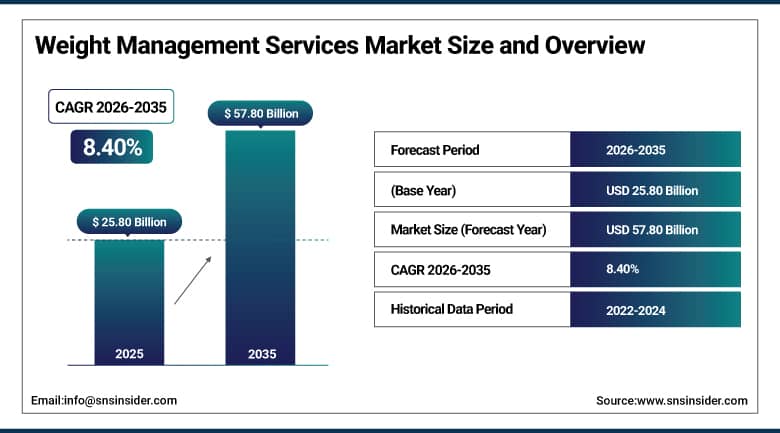
The Weight Management Services Market was valued at USD 25.80 Billion in 2025 and is estimated at USD 27.97 Billion in 2026. The market is forecast to reach USD 57.80 Billion by 2035, registering a CAGR of 8.40% from 2026 to 2035. Weight management services are programs and facilities that help people lose or maintain weight through exercise, nutrition coaching, behavioral counseling, and physician supervised care, delivered in person, online, or in hybrid form. North America accounted for the largest regional share at 36.70% in 2025, while Asia Pacific is expected to grow fastest. Demand is supported by rising obesity, clinical programs, and digital delivery.
To Get More Information On Weight Management Services Market - Request Free Sample Report
Key Market Trends and Insights
- By service type: Fitness and slimming centers held the largest market share of 31.20% in 2025.
- By delivery mode: In-person delivery held the largest market share of 56.80% in 2025.
- By end user: Individuals held the largest market share of 68.40% in 2025.
- By payment source: Out-of-pocket payments held the largest market share of 78.60% in 2025.
- North America accounted for the largest regional share of 36.70% in 2025.
- Asia Pacific is projected to register the fastest regional CAGR of 10.20% from 2026 to 2035.
- The U.S. is the leading country market in North America, supported by high obesity rates, a large commercial program sector, and new coverage of obesity medicines under Medicare.
Growth Outlook
Rising body weight across age groups is increasing the number of people who seek structured help, and many now look for programs that combine exercise, nutrition, and medical advice. Fitness and slimming centers remain the most familiar choice, while clinical programs run by physicians and dietitians are expanding quickly as new obesity medicines come into use. Employers and insurers are also paying more attention to weight related health costs, and this is encouraging them to fund coaching and supervised programs for their staff and members.
Digital delivery is changing how services are sold. Mobile coaching, remote consultations, and connected scales allow providers to serve more people at lower cost and to follow progress between visits. Telehealth companies now combine online prescribing with coaching, and long established commercial programs have restructured and added clinical offers to protect subscribers. This mix of digital reach, medical oversight, and corporate demand is expected to keep the services market expanding through 2035. Wider awareness of long term health risks also keeps new clients entering.
Market Dynamics
Driver: Rising Obesity, Clinical Care Models, and Digital Delivery Drive Demand for Weight Management Services
Higher obesity prevalence and growing awareness of related conditions such as diabetes and heart disease are pushing people toward organized programs. Providers now offer physician led plans that include medication support, dietary guidance, and behavioral counseling, and many report faster growth in clinical subscribers than in traditional diet plans. Regulators and health systems are also widening access to treatment, which brings new clients into services that monitor safety, support adherence, and help patients keep weight off. Primary care doctors increasingly refer patients to structured programs, and this referral route builds trust and raises enrollment among people who would not otherwise seek help.
Public funding is reinforcing this shift. The Medicare GLP-1 Bridge started on 1 July 2026 with a USD 50.00 copay for covered beneficiaries, and NHS England opened tirzepatide funding in specialist services in March 2025 and in primary care in June 2025. As more patients begin treatment, demand rises for nutrition, exercise, and counseling services that support medication and reduce the risk of weight regain after treatment ends. Providers that offer coaching, dietitian visits, and remote monitoring alongside treatment are well placed to win these patients, and several have reported growth in clinical subscribers in recent quarterly results. Growth appears broad based.
Restraint: Medication Substitution, Regulatory Scrutiny, and Out-of-Pocket Costs Restrain Market Growth
New obesity medicines can substitute for some traditional programs, and companies that rely on diet plans and meal delivery have reported falling revenue as customers switch to drug led care. WW International went through a prepackaged Chapter 11 process and emerged in June 2025 with its debt reduced by about USD 1.15 Billion, which shows the pressure on legacy models. Providers must therefore reposition around clinical care, which needs investment, new skills, and partnerships. Smaller operators may lack the capital to build clinical teams, and some face closure or consolidation as subscribers move to new treatment options. Such closures reduce choice.
Regulation is also tightening for telehealth based services. In March 2026 the Food and Drug Administration announced 30 warning letters to telehealth firms over the marketing of compounded GLP-1 products, and in July 2025 Eli Lilly ended the LillyDirect integration with Noom over compounded products. Most clients still pay out of pocket, so the cost of ongoing programs limits access, particularly for lower income groups and in countries with little insurance cover. Insurance coverage for lifestyle services is uneven, and public programs often favor medicines over coaching, which can leave service providers outside the main funding routes. This limits scale for many firms.
Opportunity: Employer Programs, Clinical Partnerships, and Asia Pacific Expansion Create New Revenue Pools
Employers and insurers are looking for programs that manage weight related costs, and this opens a large business to business market for coaching, medication support, and lifestyle plans. Providers that can show outcomes and adherence data can negotiate contracts with large employers and health plans. Acquisitions are one route to capability, and Noom announced the purchase of Tailor Made Compounding in April 2026, while Hims and Hers agreed to buy ZAVA in June 2025 to extend its European reach. Partnerships with pharmacies and primary care groups can also supply a steady flow of referred patients to coaching programs. These links may lift retention.
Asia Pacific offers further growth. Rising incomes, growing gym and wellness sectors, and the expiry of the semaglutide patent in India on 20 March 2026, followed by the launch of many generic brands, are expected to widen access to treatment and the services around it. Local providers and global platforms can partner with clinics and pharmacies to offer supervised programs, and lower treatment prices may raise demand for monitoring and coaching in large urban populations. Corporate wellness buyers in the region are also starting to include weight management in benefit plans, which adds business to business demand. Such steps could widen the client base.
Market Characteristics and Concentration
The Weight Management Services Market is Fragmented. Commercial program operators, fitness chains, telehealth companies, clinics, and employer wellness providers compete, and no single company controls the market, although a few well known brands are recognized across several countries. New entrants appear regularly, particularly digital coaching and telehealth firms, and acquisitions and restructurings continue to reshape the competitive field across major regions. Mergers are likely as investors seek scale and clinical capability.
The competition revolves around credibility, effectiveness, convenience, cost, and trust. Traditional commercial services depend on the number of their clients and community-oriented approach, telemedicine services offer quick and medicalized service, and fitness centers operate by offering location advantages, facilities, and personal trainer service. Pricing policies range greatly from low-cost monthly subscriptions to costly clinical programs, and more and more businesses offer different levels of care that allow clients to change them according to their needs.
Barriers to entry are moderate, as digital programs are easy to launch but clinical services require licensed staff and compliance with prescribing and advertising rules. The industry is consolidating as private equity owners, pharmacy groups, and telehealth firms buy specialist providers to build broader offers. Brand reputation also matters, since clients must trust a provider with sensitive health information and rely on its guidance for long term lifestyle change. Trust takes years to build.
Analyst Perspective
The Weight Management Services Market is expanding as the industry shifts from diet plans and gym memberships toward clinically supervised and digitally delivered care. Growth will be shaped by medication access, employer demand, and hybrid models, while substitution risk and compounding rules require providers to adapt quickly. North America leads today on value, while Asia Pacific is expected to expand fastest as incomes and treatment access improve. An SNS Insider Analyst commented, "Providers that combine medical oversight, behavioral support, and convenient digital tools will define the next phase of this market, because patients now expect services to support long term results and not only short term weight loss."
Segment Analysis
Delivery Mode Insights
In-person Delivery Mode occupied 56.80% of the market in 2025. Customers appreciate face to face coaching, supervision of exercise, and clinic based evaluation, especially during the initial phase of their program, and many providers continue to rely on their physical locations. Accountabilities associated with group sessions, personal training, and medical consultations are hard to implement with digital channels, and these remain the preferred options for older customers and people with complicated health problems. Subscription pricing and nutrition coaching are additional sources of recurring revenues for market leaders. Pricing is higher than in online programs.
The highest rate of growth is projected for the online delivery channel, with CAGR at 14.60% between 2026 and 2035. Mobile applications, video appointments, and connected devices reduce cost structure and increase accessibility of programs. Hybrid approach involving application-based tracking along with occasional physical visits becomes more popular among providers wishing to serve their customers on a larger scale but still maintaining clinical supervision and face to face contacts helping to retain them. Applications now feature features such as food tracking, connectivity with wearables, and communication with coaches, while video visits give providers the opportunity to address rural customers and people with limited mobility.
Service Type Insights
Fitness and slimming centers accounted for 31.20% of the market in 2025. Health clubs, gyms, and dedicated slimming studios provide exercise, group classes, and trainer support, and many add nutrition counseling and body composition tracking. Their strength lies in a large installed base of members, local presence, and the social motivation that helps people continue programs over many months, which keeps this service type at the center of the market despite growing competition from digital providers. Franchise networks and corporate gym chains also add scale, and loyalty programs support renewals across seasons.
Clinical weight management programs are the fastest growing service type, with a projected CAGR of 12.10% from 2026 to 2035, as physicians, dietitians, and telehealth providers deliver supervised care linked to medication. Commercial diet and behavioral programs hold a large base of subscribers, and leading operators are adding clinical tiers to retain members as demand shifts toward medical approaches and monitored results. Group classes and in-person coaching remain popular among older clients, and many centers add body composition scanning, physician partnerships, and medical grade equipment that help them stay competitive against fully digital providers.
End User Insights
Individuals accounted for 68.40% of the market in 2025. Most clients enroll on their own and pay for fitness memberships, coaching programs, or clinical plans, motivated by appearance, health concerns, or advice from a doctor. Flexible subscriptions, free trials, and online communities help providers attract and retain these customers, while social media and word of mouth influence choices strongly among younger adults and working professionals. Large employers also use wellness vendors to deliver programs at scale, and health plans add them to benefit packages. Wellness vendors also report strong renewal rates.
Corporate and employers are the fastest growing end user, with a projected CAGR of 11.30% from 2026 to 2035, as companies and health plans fund programs to manage weight related costs. Healthcare providers and payers also commission services for patients with obesity and related conditions, and contracts that tie payment to outcomes are expected to become more common over the forecast period as data on results improves. Providers that report clinical outcomes, such as weight change and improved blood markers, can win larger contracts, and many also add mental health support, sleep guidance, and chronic disease management to broaden the offer.
Payment Source Insights
Out-of-pocket payments accounted for 78.60% of the market in 2025. Most clients pay directly for gym memberships, commercial programs, and many telehealth plans, because insurance cover for weight services remains limited in most countries. Transparent pricing, monthly subscriptions, and promotional offers shape demand, and providers often segment their plans by price so that cost sensitive customers can enter at a lower level and upgrade later. Employers also subsidize part of the fees in some countries, which supports enrollment in programs among staff. Coverage rules differ widely by country and plan.
Insurance and government payers are the fastest growing payment source, with a projected CAGR of 10.70% from 2026 to 2035, as public programs widen coverage. The Medicare GLP-1 Bridge and NHS England funding of tirzepatide illustrate this shift, and as payers cover medicines they are also expected to fund monitoring, nutrition, and behavioral support, which will move a larger share of revenue away from self payment. Providers are therefore building billing and compliance capabilities to work with insurers and public programs, and partnerships with pharmacies and primary care groups are expected to grow as coverage broadens.
Regional Insights
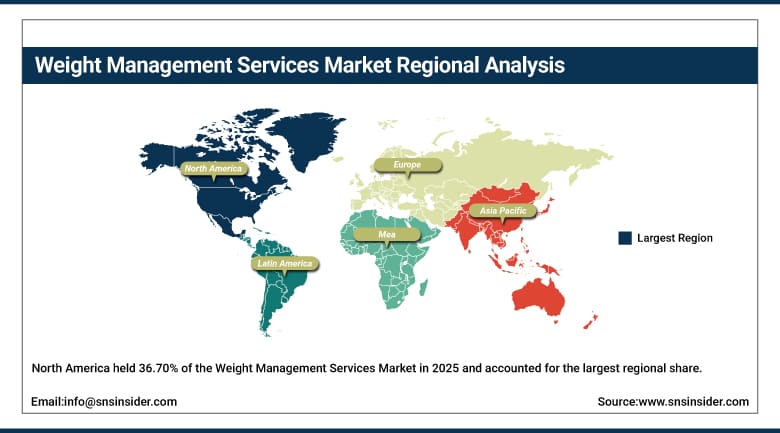
North America held 36.70% of the Weight Management Services Market in 2025 and accounted for the largest regional share. The region has high obesity rates, a large commercial program sector, advanced telehealth, and growing coverage of obesity treatment. Mexico is reported within Latin America in this analysis, so regional figures here cover the United States and Canada only, where leading providers hold their largest customer bases. Strong employer interest in wellness also supports growth across the region.
Get Customized Report as Per Your Business Requirement - Enquiry Now
U.S. Weight Management Services Market
The U.S. Weight Management Services Market was valued at USD 7.95 Billion in 2025 and is projected to expand at a CAGR of 7.60% from 2026 to 2035. High obesity prevalence, a large fitness industry, and rapid growth of telehealth programs support demand, and the country is home to leading providers such as WW International, Noom, Ro, and Hims and Hers. Large retailers and pharmacy chains also partner with providers to offer in store coaching and screening.
Policy is reshaping the sector. The Medicare GLP-1 Bridge began on 1 July 2026 with a USD 50.00 copay for covered beneficiaries, and the Centers for Medicare and Medicaid Services later extended it through 31 December 2027. The Food and Drug Administration announced 30 warning letters to telehealth firms over compounded GLP-1 marketing on 3 March 2026, and Hims and Hers settled its dispute with Novo Nordisk on 9 March 2026. Providers are adjusting their advertising and prescribing practices to comply.
Europe Weight Management Services Market
Europe accounted for 27.60% of the market in 2025, led by the United Kingdom, Germany, France, Italy, and Spain. NHS England funded tirzepatide in specialist services from 24 March 2025 and in primary care from 23 June 2025, which is creating demand for supervised programs. Telehealth providers are expanding, and Hims and Hers agreed to acquire ZAVA, which serves customers in Germany, France, Ireland, and the United Kingdom. Strong public health campaigns also encourage citizens to seek help.
Asia Pacific Weight Management Services Market
Asia Pacific held 24.80% of the market in 2025 and is projected to register the fastest regional CAGR of 10.20% from 2026 to 2035. China, Japan, India, South Korea, and Australia lead demand, supported by rising incomes, growth of fitness chains, and wider access to treatment. The semaglutide patent expired in India on 20 March 2026, and more than 35 generic brands have been launched since. Fitness chains and clinics are expanding quickly in large cities across the region.
Latin America Weight Management Services Market
Latin America held 6.70% of the market in 2025, led by Brazil and Mexico, followed by Argentina and Colombia. Rising obesity, a large gym sector, and growth in online coaching support demand, while private clinics and nutrition centers serve higher income households. Public coverage of weight programs is limited, so most services are paid for directly, and price sensitivity keeps volumes concentrated in fitness and low cost programs. Brazil also hosts a large chain based fitness sector.
Middle East and Africa Weight Management Services Market
The Middle East and Africa accounted for 4.20% of the market in 2025, led by Saudi Arabia, the United Arab Emirates, Turkey, South Africa, and Egypt. High obesity rates in Gulf countries, government wellness campaigns, and the growth of private clinics and premium fitness chains support demand, while access in much of Africa remains limited by income and by the small number of qualified providers. Government health strategies also encourage private investment. Imported brands lead.
Key Weight Management Services Market Company Insights
Competition in the Weight Management Services Market spans commercial program operators, telehealth companies, clinical providers, and corporate wellness firms. Leading participants compete on clinical credibility, outcomes, convenience, and price, and the industry is consolidating through acquisitions and restructuring. Partnerships with pharmacies and employers are common.
Key Weight Management Services Companies:
- WW International, Inc.
- Noom, Inc.
- Wellful, Inc. (Nutrisystem and Jenny Craig)
- Medifast, Inc. (OPTAVIA)
- Hims and Hers Health, Inc.
- Ro
- Teladoc Health, Inc.
- Herbalife Ltd.
Recent Developments
- In July 2026, the Medicare GLP-1 Bridge began, providing coverage of Wegovy and Zepbound for eligible beneficiaries with a USD 50.00 copay and was later extended through 31 December 2027, as the planned broader model will not start in Medicare in 2027. The program widens access to obesity treatment among older adults in the United States and is expected to increase demand for supporting nutrition, coaching, and monitoring services.
- In April 2026, Noom announced the acquisition of Tailor Made Compounding, a pharmacy, to broaden its preventive care and healthy aging offer, and on 9 April 2026 Ro began offering Lilly Foundayo to its patients at a cash price starting from USD 149.00 per month. Both moves show telehealth providers building medication access into their weight management services.
- In March 2026, the Food and Drug Administration announced 30 warning letters to telehealth firms over the marketing of compounded GLP-1 products, and Hims and Hers settled its dispute with Novo Nordisk on 9 March 2026 to offer branded products. The actions signal tighter regulation and push providers toward approved medicines and clearer advertising across the sector.
- In December 2025, the Food and Drug Administration approved the oral form of Wegovy from Novo Nordisk, with a starting dose price of USD 149.00 per month and launch in early January 2026. The approval adds a non-injectable option, which may broaden participation in medically supervised programs and increase the need for coaching to support adherence.
- In July 2025, Eli Lilly ended the LillyDirect integration with Noom over concerns about compounded GLP-1 products offered by the platform. The decision underlined the growing influence of drug makers on how telehealth weight management companies operate, and it prompted providers to review their sourcing and partnerships with pharmaceutical suppliers.
Scope and Research Methodology
This report estimates the Weight Management Services Market through a bottom-up build from revenue of fitness and slimming centers, clinical programs, commercial diet and behavioral programs, and digital coaching services by region, checked against a top-down view of wellness and healthcare spending. The scope covers services only. Medicines, surgery, diet foods, supplements, and exercise equipment are excluded from the market definition. Prices are checked against provider websites, subscription plans, and membership fee schedules in each region to confirm revenue assumptions and plan mix. Franchise and membership data are also reviewed.
Secondary research draws on company filings, regulatory notices, payer announcements, trade publications, and public health reports. Primary research includes conversations with program operators, clinicians, dietitians, telehealth executives, and fitness operators, used to confirm revenue, pricing, and subscriber patterns. Region coverage follows the five regions used throughout this report, with Mexico reported within Latin America, and country estimates consider obesity prevalence, income, and coverage. Insights from experts are cross checked with company results and payer data, so that differences between sources are tested and final estimates rest on consistent evidence across countries and years. Interviews cover several countries, so that regional patterns are tested with practitioners who work in the field every day.
Segment shares are built from revenue by service type, delivery mode, end user, and payment source, then aligned with regional totals. Forecasts apply growth assumptions for each segment and region that reflect treatment access, pricing, regulation, and channel shifts, and they are tested against alternative scenarios. Company positions are reviewed against announced results and ownership changes. Figures are reviewed at each update, and values are stated in U.S. dollars. Historical data from 2022 to 2024 is used as the base for trend analysis, and sensitivity checks on pricing, coverage, and regulation are applied before senior analysts review all results. Reports are refreshed regularly.
Weight Management Services Market Report Scope :
| Report Attributes | Details |
|---|---|
| Market Size in 2025 | USD 25.80 Billion |
| Market Size by 2035 | USD 57.80 Billion |
| CAGR | CAGR of 8.40% From 2026 to 2035 |
| Base Year | 2025 |
| Forecast Period | 2026-2035 |
| Historical Data | 2022-2024 |
| Report Scope & Coverage | Market Size, Segments Analysis, Competitive Landscape, Regional Analysis, DROC & SWOT Analysis, Forecast Outlook |
| Key Segments | • By Service Type (Fitness and Slimming Centers, Clinical Weight Management Programs, and Commercial Diet and Behavioral Programs) • By Delivery Mode (In-Person, Online, and Hybrid) • By End User (Individuals, Corporate and Employers, and Healthcare Providers and Payers) • By Payment Source (Out-of-Pocket and Insurance and Government Payers) |
| Regional Analysis/Coverage | North America (US, Canada), Europe (Germany, UK, France, Italy, Spain, Russia, Poland, Rest of Europe), Asia Pacific (China, India, Japan, South Korea, Australia, ASEAN Countries, Rest of Asia Pacific), Middle East & Africa (UAE, Saudi Arabia, Qatar, South Africa, Rest of Middle East & Africa), Latin America (Brazil, Argentina, Mexico, Colombia, Rest of Latin America). |
| Company Profiles | WW International, Inc., Noom, Inc., Wellful, Inc. (Nutrisystem and Jenny Craig), Medifast, Inc. (OPTAVIA), Hims and Hers Health, Inc., Ro, Teladoc Health, Inc., Herbalife Ltd. |

Frequently Asked Questions
The market was valued at USD 25.80 Billion in 2025 and is projected to reach USD 57.80 Billion by 2035.
The market is expected to register a CAGR of 8.40% from 2026 to 2035.
North America led the market with a 36.70% share in 2025.
Asia Pacific is expected to grow the fastest, at a CAGR of 10.20% from 2026 to 2035.
Key players include WW International, Noom, Wellful, Medifast, and Hims and Hers Health.
