
Welding Market Report Scope & Overview:
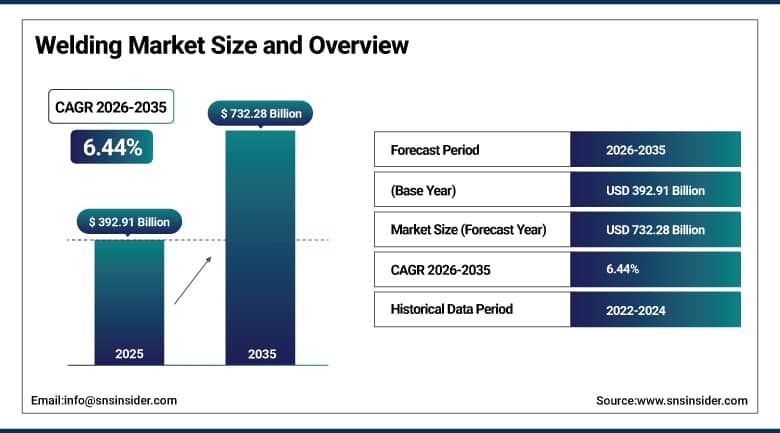
The Welding Market was valued at USD 392.91billion in 2025 and is expected to reach USD 732.28 billion by 2035, growing at a CAGR of 6.44% from 2026–2035.
Welding Market in the global industry is experiencing steady growth due to an increase in industrial manufacturing activities, rising demand from automotive production, expanding infrastructure development, and growing requirement for advanced metal joining solutions. Welding processes are essential components that ensure structural integrity in fabrication, construction, shipbuilding, oil & gas pipelines, and heavy engineering applications across both developed and emerging economies.
Moreover, the advancements made in automation technologies, increase in robotic welding systems, as well as growing adoption of laser and hybrid welding techniques, have become significant drivers of the market. Cooperation between manufacturing industries, automation solution providers, and industrial equipment manufacturers has been instrumental in improving welding efficiency, precision, and productivity globally.
In 2026, it has been reported that increased usage of AI-enabled robotic welding systems and IoT-based smart welding equipment is expected in the global manufacturing market due to Industry 4.0 adoption, smart factories, and rising demand for high-precision and defect-free production processes.
To Get More Information On Welding Market - Request Free Sample Report
Welding Market Trends
-
The welding industry is rapidly adopting robotic and automated systems across automotive and manufacturing sectors to improve precision, speed, and consistency, driven by Industry 4.0 and smart factory development.
-
In welding, there is adoption of modern welding techniques such as laser, friction stir welding, and hybrid welding which are accurate and effective.
-
Integration of IoT, AI, and real-time monitoring in welding equipment is enhancing process control, defect detection, and predictive maintenance, improving productivity and reducing downtime.
-
The growing popularity of electric vehicles is leading to increased demand for highly accurate welding procedures, such as resistance spot and laser welding.
-
The shortage of skilled welders will continue to accelerate the implementation of semi-automatic and fully automated systems in various companies.
-
Growth in construction, shipbuilding, and oil & gas sectors is boosting demand for advanced welding equipment and consumables for large-scale infrastructure projects.
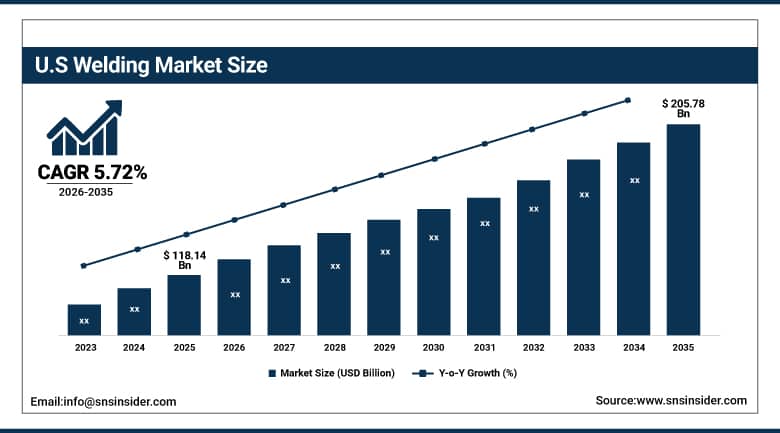
The United States Welding Market was valued at USD 118.14 Billion in 2025 and it is expected to reach USD 205.78 Billion by 2035, growing at a CAGR of 5.72% over the forecast period of 2026–2035.
United States Welding Market is one of the most advanced industrial welding markets globally due to strong presence of automotive manufacturers, aerospace industries, oil & gas infrastructure, and heavy engineering companies. Moreover, rising investments in industrial automation, robotic welding systems, and advanced manufacturing technologies are expected to support market growth in the coming years.
As far as industrial demand and adoption are concerned, increasing requirement for high-precision welding in automotive production, construction activities, shipbuilding, and energy infrastructure is expected to drive the U.S. welding market. The shift toward electric vehicle manufacturing and lightweight material usage is further increasing demand for laser and resistance welding technologies.
In 2026, reports from American manufacturing and industry automation emphasized the growing use of robotics-based welding machines powered by artificial intelligence because of Industry 4.0, the scarcity of skilled welders, and the need for efficient and faultless manufacturing processes.
Welding Market Segment Analysis
-
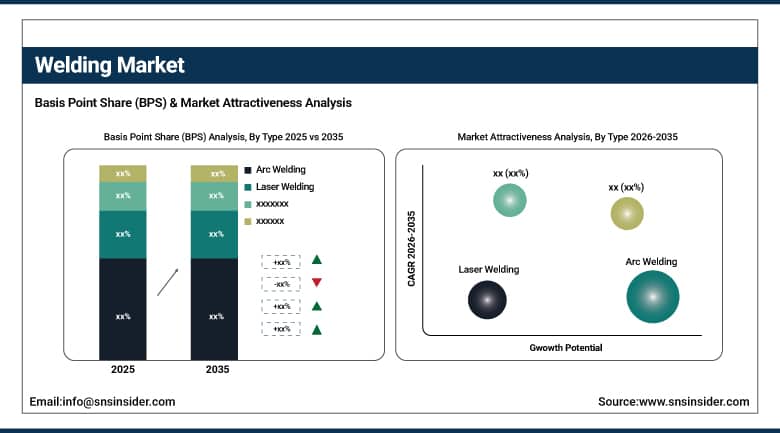
By Type, Arc Welding dominated the Welding Market with 34.50% share in 2025; Laser Welding fastest growing (CAGR).
-
By Technology, Manual Welding dominated the Welding Market with 41.20% share in 2025; Automatic & Robotic Welding fastest growing (CAGR).
-
By Application, Automobile dominated the Welding Market with 28.60% share in 2025; Others fastest growing (CAGR).
-
By End-Use, Transportation dominated the Welding Market with 31.80% share in 2025; Others fastest growing (CAGR).
By Type, Arc Welding dominates the Welding Market, while Laser Welding is the fastest-growing segment.
Arc Welding segment emerged as the leading segment in the Welding Market with the largest revenue share in 2025 owing to its extensive application in the construction, shipbuilding, and heavy engineering sectors. This segment has low-cost equipment, high flexibility, and high thickness capacity, and hence has been widely used as the best traditional method of welding around the world.
Laser Welding segment is anticipated to grow at the highest CAGR between 2026 and 2035 due to the increased need for high accuracy, less heat distortion, and fast production rates. The growth of laser welding is driven by its increased use in the manufacture of automobiles, aircraft, and electronics.
By Technology, Manual Welding dominates the Welding Market, while Automatic & Robotic Welding is the fastest-growing segment.
The Manual Welding market segment emerged as the leading segment within the Welding market with the highest market share, attributed to its cost-effective equipment, abundant availability of skilled labor, and application in construction and repair services and small scale industries. It continues to be important for flexible welding operations in many industries.
Automatic Welding & Robotic Welding market segment with the highest CAGR during the forecast period 2026-2035 owing to the growing need for automated systems due to the advent of Industry 4.0, scarcity of labor, and need for increased precision and efficiency.
By Application, Automobile dominates the Welding Market, while Others is the fastest-growing segment.
The Automobile segment dominated the Welding Market with the highest revenue share in 2025 due to high vehicle production, strong demand for lightweight structures, and extensive use of welding in body assembly, chassis, and EV manufacturing. Increasing automation and precision welding in automotive plants further strengthened dominance.
Others Category Expected to Register the Highest CAGR from 2026-2035 due to Rising Application of the Technology across Electronics, Renewable Energy Systems, Consumer Goods, and Industrial Fabrications in Specific Industries. The rising industrialization and emergence of smaller-scale manufacturing facilities using high-end welding technologies are some of the factors responsible for the swift growth of this category.
By End-Use, Transportation dominates the Welding Market, while Others is the fastest-growing segment.
Transportation segment led the Welding Market with the largest market share in terms of revenue in 2025, owing to high demand for welding in the automotive, railways, aerospace, and marine segments. High production levels, heavy use of metal joints, and consistent vehicle manufacturing cycles fuel welding usage in the transportation industry.
The Others segment is expected to grow at the fastest CAGR from 2026–2035 due to increasing applications in emerging industries such as electronics, renewable energy systems, medical devices, and precision engineering. Rising adoption of advanced micro-welding and specialized fabrication processes in niche sectors is further accelerating its growth globally.
Welding Market Regional Analysis:
|
Region |
Major Country |
Share (%) |
|---|---|---|
|
North America |
United States |
34.80% |
|
Europe |
Germany |
22.10% |
|
Asia Pacific |
China |
30.20% |
|
Middle East & Africa |
UAE |
5.50% |
|
Latin America |
Brazil |
7.40% |
North America Welding Market Insights
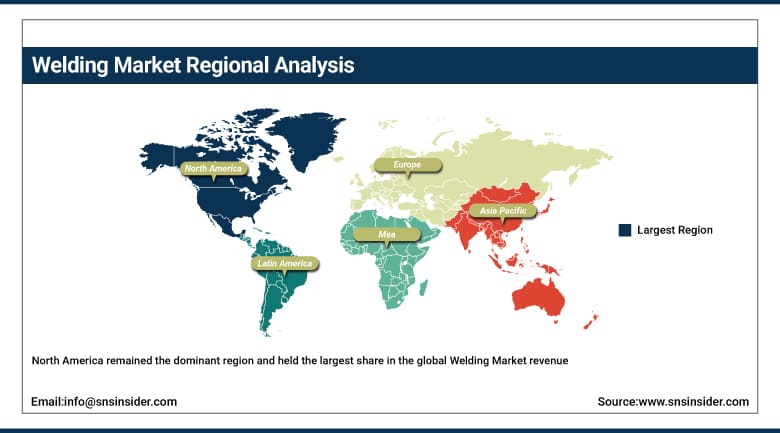
North America remained the dominant region and held the largest share in the global Welding Market revenue, owing to strong presence of automotive OEMs, advanced manufacturing industries, and high adoption of robotic welding technologies. Other factors contributing to market growth include rising demand from oil & gas infrastructure, aerospace manufacturing, and large-scale construction projects. Growing investments in industrial automation, smart factories, and advanced fabrication technologies are also supporting market expansion.
In terms of regional performance, the highest performance was demonstrated by the United States, which has strong industrial output, high penetration of automated welding systems, and increasing adoption of laser and arc welding in automotive and heavy engineering sectors.
The U.S. manufacturing industry highlights increasing demand for robotic welding systems, AI-enabled quality inspection, and precision welding technologies, supporting sustained market demand for high-efficiency and defect-free production processes.
Get Customized Report as Per Your Business Requirement - Enquiry Now
Asia Pacific Welding Market Insights
The Asia-Pacific is anticipated to have the highest growth rate over the forecast period due to fast-paced industrialization, high automobile production, and increasing infrastructure developments in the region. The countries that play a vital role in market growth are China, India, Japan, South Korea, and Southeast Asia, where China and India are the major contributors. The growing manufacturing industry, urbanization, and adoption of automation systems are the main factors driving the market.
Government supportive policies for infrastructure development, rising electric vehicle production, and investments in smart manufacturing systems are propelling market growth. In addition, welding technology suppliers and industrial automation firms in Asia are increasing their production capacities, while the rising demand for efficient manufacturing solutions is boosting regional market growth.
Europe Welding Market Insights
Europe accounted for a considerable portion of the Global Welding Market because of its robust automotive industry, industrial engineering capability, and automation in the form of robotic welding. It is home to large economies like Germany, France, the United Kingdom, and Italy, which make up a significant part of the total market demand. Germany and France are important markets in the European region due to their presence of top automotive OEMs and heavy machinery industries.
Important drivers in Europe include stringent industrial safety policies, rising electric vehicle penetration, and increased reliance on precise welding techniques.
Middle East & Africa and Latin America Welding Market Insights
The MEA region is recording continuous growth in the Welding Market due to increased infrastructure development, rising oil & gas activities, and industrialization activities taking place in this region. Countries such as UAE, Saudi Arabia, and South Africa have taken the lead in this regard, which is being driven by rising construction activities, developments in the energy sector, and increased requirement of welding in pipelines and fabrications.
Latin America is recording a moderate level of growth in the Welding Market, and this is because of the rise in construction activities, vehicle production, and increased demand for industrial repairs. Brazil and Mexico can be counted as the primary markets for this region because of the increase in their manufacturing bases and infrastructure development.
Welding Market Growth Drivers:
-
Rapid industrial automation and rising adoption of robotic welding across manufacturing industries
Rapid adoption of automation in automotive, construction, and heavy engineering sectors is leading to a marked rise in demand for advanced welding solutions. Businesses are opting for robotic and semi-robotic solutions in order to increase accuracy, efficiency, and quality of their output. Increasing implementation of Industry 4.0 and smart manufacturing concepts, along with adoption of AI-based welding systems, is also contributing to this change. Businesses are now using robotic cells to avoid human mistakes and increase efficiency for meeting demands of large-scale production operations.
In 2026, The Global welding market witnessed growth owing to an increase in the use of AI-based robotic welding and Industry 4.0 automation in various industries. The increasing need for accuracy and efficiency has driven the global growth of intelligent welding technology.
Welding Market Restraints:
-
Shortage of skilled welders and technical workforce across industrial sectors
The welding sector is experiencing a severe lack of labor that has the expertise of working with sophisticated welding machines and robotic systems. Conventional techniques are gradually being phased out because industries are moving towards digitization and automation. The inability of developing countries to establish proper training programs makes the situation even worse. It leads to reduced efficiency, increased automation dependence, and risks during the use of sophisticated welding machines. Companies have no choice but to incur significant costs to train their workers.
Welding Market Opportunities:
-
Rising adoption of advanced welding technologies in electric vehicles and lightweight material manufacturing
The growing production of electric vehicles and demand for light-weight materials like aluminum and high strength steel will pave the way for advancements in the field of welding. The use of laser, friction stir and resistance welding is witnessing a lot of interest from the market because of their accuracy and capability to weld dissimilar materials. Major automotive companies are investing extensively into advanced welding technologies to make efficient and sturdy vehicles. All these factors are opening up avenues for welding machinery and automation vendors. Rising concerns over energy efficiency and sustainability are driving adoption of innovative welding techniques.
In 2026, the welding market is experiencing high business opportunities on account of increased production of electric vehicles and rising demand for aluminum and high-strength steel. High demand for innovative welding technologies including laser and friction stir welding is on account of their precision and efficiency.
Recent Developments:
-
2026, Lincoln Electric and ESAB Corporation advanced AI-enabled robotic welding and smart automation systems across automotive and heavy industries, focusing on Industry 4.0 integration to improve precision, reduce defects, and boost productivity in large-scale manufacturing.
-
2025, Fronius International and Miller Electric expanded laser and automated welding technologies driven by strong demand from EV and aerospace sectors, emphasizing high precision, energy efficiency, and lightweight material applications.
-
2024, Lincoln Electric and Hyundai Welding Co., Ltd. maintained dominance in arc and MIG/TIG welding systems across construction and shipbuilding, with early growth in robotic welding adoption to improve efficiency and weld quality.
Welding Market Key Players
-
Lincoln Electric
-
Illinois Tool Works (ITW)
-
ESAB Corporation
-
Fronius International
-
Miller Electric
-
Panasonic Welding Systems
-
Voestalpine Böhler Welding
-
Kobe Steel (Kobelco Welding)
-
Kemppi Oy
-
Daihen Corporation
-
Hyundai Welding Co., Ltd.
-
Kiswel Ltd.
-
Air Liquide
-
The Linde Group
-
Carl Cloos Schweißtechnik
-
Polysoude S.A.S.
-
Ador Welding Limited
-
Obara Corporation
-
Jasic Technology
-
Gullco International
Welding Market Report Scope:
| Report Attributes | Details |
|---|---|
| Market Size in 2025 | USD 392.91 Billion |
| Market Size by 2035 | USD 732.28 Billion |
| CAGR | CAGR of 6.44% From 2026 to 2035 |
| Base Year | 2025 |
| Forecast Period | 2026-2035 |
| Historical Data | 2022-2024 |
| Report Scope & Coverage | Market Size, Segments Analysis, Competitive Landscape, Regional Analysis, DROC & SWOT Analysis, Forecast Outlook |
| Key Segments | • By Type (Arc Welding, MIG/TIG Welding, Laser Welding, Resistance (Spot) Welding, Others) • By Technology (Manual Welding, Semi-Automatic Welding, Automatic & Robotic Welding) • By Application (Automobile, Building & Construction, Heavy Engineering, Shipbuilding & Railway, Oil & Gas, Others) • By End-Use (Transportation, Construction, Industrial Manufacturing, Energy, Others) |
| Regional Analysis/Coverage | North America (US, Canada), Europe (Germany, UK, France, Italy, Spain, Russia, Poland, Rest of Europe), Asia Pacific (China, India, Japan, South Korea, Australia, ASEAN Countries, Rest of Asia Pacific), Middle East & Africa (UAE, Saudi Arabia, Qatar, South Africa, Rest of Middle East & Africa), Latin America (Brazil, Argentina, Mexico, Colombia, Rest of Latin America). |
| Company Profiles | Lincoln Electric, Illinois Tool Works (ITW), ESAB Corporation, Fronius International, Miller Electric, Panasonic Welding Systems, Voestalpine Böhler Welding, Kobe Steel (Kobelco Welding), Kemppi Oy, Daihen Corporation, Hyundai Welding Co., Ltd., Kiswel Ltd., Air Liquide, The Linde Group, Carl Cloos Schweißtechnik, Polysoude S.A.S., Ador Welding Limited, Obara Corporation, Jasic Technology, Gullco International. |
Frequently Asked Questions
Ans: The Welding Market is expected to grow at a CAGR of 6.44% from 2026 to 2035.
Ans: The Welding Market was valued at USD 392.91 billion in 2025.
Ans: Rising industrial automation, increasing adoption of robotic welding systems, growth in automotive production, and expanding infrastructure development are the major growth drivers.
Ans: The Arc Welding segment dominated the Welding Market in 2025.
Ans: North America dominated the Welding Market in 2025.
