
Cement Kilns Market Size Report Scope & Overview:
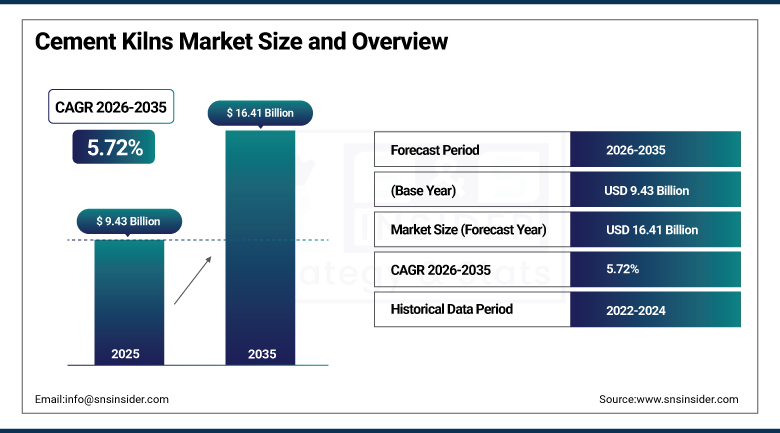
The Cement Kilns Market Size was valued at USD 9.43 billion in 2025 and is expected to reach USD 16.41 billion by 2035, growing at a CAGR of 5.72% from 2026–2035.
The factors contributing to the growth of the global cement kilns market size include increased infrastructure investments, urbanization, and demand for cement due to residential, commercial, and industrial constructions. The companies are increasingly using new technologies in their kilns to improve efficiency, decrease fuel costs, and maintain strict environmental standards. The shift from wet process to energy-efficient dry process kilns and the use of alternate fuels have been beneficial to the market. In addition, developments in automation, artificial intelligence (AI), IIoT, predictive maintenance, and waste heat recovery technologies have been contributing to market growth.
In April 2026, FLSmidth introduced an advanced rotary cement kiln solution featuring AI-enabled process optimization, predictive maintenance, and enhanced alternative fuel capabilities. The new system helps cement manufacturers improve thermal efficiency, reduce carbon emissions, optimize fuel consumption, and support sustainable cement production while lowering operating costs.
Market size and forecast
-
Market Size 2026E: USD 9.95 billion
-
Market Size 2035: USD 16.41 billion
-
CAGR: 5.72% from 2026 to 2035
-
Fastest Growing Region: Asia-Pacific
-
Largest Region: North America
To Get more information On Cement Kilns Market - Request Free Sample Report
Cement Kilns Market Size Trends
-
Increasing adoption of energy-efficient dry process kilns is reducing fuel consumption while improving production efficiency and sustainability.
-
Rising use of alternative fuels and waste heat recovery systems is enhancing energy efficiency and lowering carbon emissions in cement manufacturing.
-
Growing investments in kiln automation, AI-powered process optimization, and predictive maintenance are improving operational reliability and reducing downtime.
-
Expanding infrastructure development and urbanization are driving demand for high-capacity, technologically advanced cement kilns.
-
Increasing focus on carbon reduction and sustainable cement production is accelerating the adoption of low-emission cement kiln technologies.
U.S. Cement Kilns Market Size Outlook
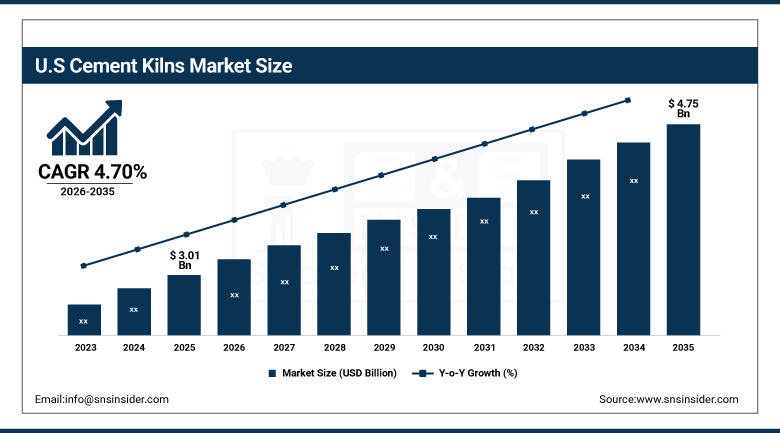
The U.S. Cement Kilns Market Size was valued at USD 3.01 billion in 2025 and is expected to reach around USD 4.75 billion by 2035, growing at a CAGR of 4.70% from 2026–2035.
Cement Kilns Market in the United States is expanding at a consistent rate due to the rise in investments in infrastructural projects, increasing demand for sustainable cement production, and upgradation of existing facilities producing cement. There is an increased adoption of energy-efficient dry kilns, alternative fuels and advanced automation systems by the manufacturers of cement to increase the efficiency of production, lower the cost of operations and meet environmental standards. Moreover, developments in AI, predictive maintenance, digital process control and waste heat recovery have added more fuel to the expansion of the cement kilns market in the U.S.
United States Lime & Minerals announced that its new high-efficiency kiln project at its Texas facility is progressing as planned and is expected to begin operations in summer 2026. The advanced kiln is designed to enhance production efficiency, improve energy performance, increase operational reliability, and support the growing demand for lime products across construction, steel, and environmental applications in the United States.
Cement Kilns Market Size Segment Analysis
-
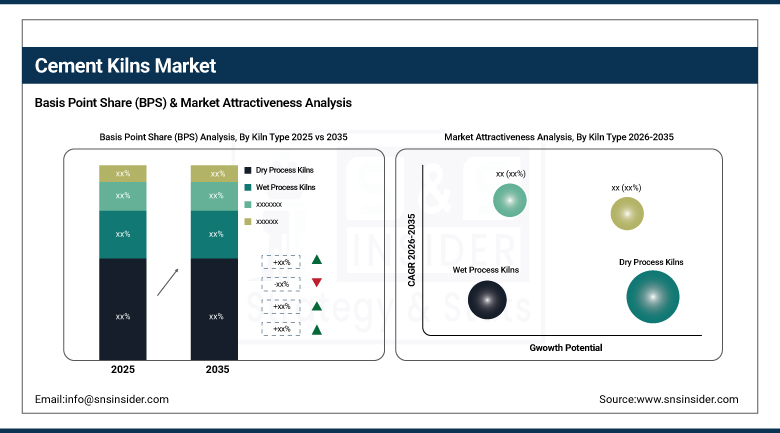
By kiln type, dry process kilns dominated the cement kilns market size with a 42.30% share in 2025; while wet process kilns are the fastest-growing segment with a 6.68% CAGR during 2026–2035.
-
By capacity, large dominated the cement kilns market size with a 58.70% share in 2025; while medium is the fastest-growing segment with an 8.60% CAGR during 2026–2035.
-
By fuel type, coal dominated the cement kilns market size with a 52.10% share in 2025; while others is the fastest-growing segment with a 28.70% CAGR during 2026–2035.
-
By application, construction dominated the cement kilns market size with a 61.20% share in 2025; while infrastructure is the fastest-growing segment with a 7.07% CAGR during 2026–2035.
-
By kiln type, dry process kilns dominated the cement kilns market size, while wet process kilns are expected to grow at the fastest rate during the forecast period.
By kiln type, dry process kilns dominated the cement kilns market size, while wet process kilns are expected to grow fastest
The dominance of dry process kilns was recorded in the year 2025 on account of their higher energy efficiency, reduced fuel consumption, and suitability for mass clinker production. The increasing adoption of preheater and precalciner technologies along with the stringent environmental norms and increased demand for economic cement production processes have fueled the dominance of the dry process kiln market segment. Dry process kilns are known to offer lower operational costs and fewer emissions in comparison with the wet process kilns.
The wet process kiln market segment is anticipated to register the fastest growth during the forecast period as a result of the modernization of the old cement factories, rising process innovations, and growing requirement for wet process in areas that have raw material sources favourable for the wet process.
By capacity, large dominated the cement kilns market size, while medium is expected to grow fastest.
Large Capacity Kiln was the dominant product segment in 2025 owing to their capability to produce clinkers on a larger scale, greater operational efficiency, and low cost of production per ton. In addition, the preference for large capacity kilns among large-scale cement manufacturers has increased owing to higher demand for clinkers in infrastructure, commercial, and residential construction applications. The growing use of advanced preheater and precalciner technology, energy efficiency, and automation are the major factors contributing to the dominance of large capacity kilns.
On the other hand, medium capacity kilns are projected to record highest growth rates over the forecast period. This is attributed to the rising investments in regional cement plants, increasing development of infrastructures in emerging economies, and increasing demand for efficient production plants.
By fuel type, coal dominated the cement kilns market size, while others is expected to grow fastest.
Coal dominated the market share in 2025 owing to its widespread availability, high calorific value, and cost-effectiveness for large-scale clinker production. It remains the primary fuel source for cement manufacturers, particularly in developing economies, due to its ability to provide consistent thermal energy and support continuous kiln operations. Established supply chains and existing kiln infrastructure have further strengthened the dominance of the coal segment.
The others segment is expected to grow at the fastest rate during the forecast period due to increasing adoption of emerging low-carbon and waste-derived fuel sources, supported by stricter environmental regulations and decarbonization initiatives. Cement manufacturers are investing in diversified fuel mixes to reduce greenhouse gas emissions, improve energy efficiency, and meet sustainability targets while lowering dependence on conventional fossil fuels.
Regional Analysis
|
Region |
Major Country |
Share within Region, 2025(%) |
|---|---|---|
|
North America |
United States |
86.74% |
|
Europe |
Germany |
24.80% |
|
Asia Pacific |
China |
44.50% |
|
Middle East & Africa |
Saudi Arabia |
31.20% |
|
Latin America |
Brazil |
487.80% |
North America Cement Kilns Market Size Insights
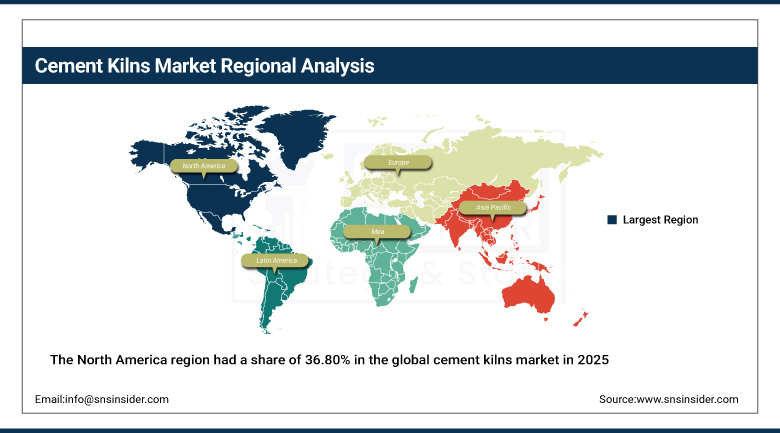
The North America region had a share of 36.80% in the global cement kilns market in 2025, owing to high capacity of cement manufacturing plants, upgrading infrastructure facilities, and demand for energy efficient kilns. Investments in the region in upgrading the kilns, adoption of alternative fuels, and reduction in emissions are being carried out to meet stringent environmental norms. The U.S. was the leader in the North America region in the global cement kilns market in 2025 and accounted for a share of 86.74% in the North America cement kilns market.
Get Customized Report as per Your Business Requirement - Enquiry Now
Europe Cement Kilns Market Size Insights
Europe continues to be a significant market for the cement kilns market owing to its well-established cement manufacturing industry, stringent environmental regulations, and ongoing investments in energy-efficient and low-emission production technologies. Germany leads the region, accounting for 24.80% of the European market in 2025 due to its advanced industrial base, strong presence of cement manufacturing facilities, and continuous investments in modern dry process kilns, waste heat recovery systems, and alternative fuel technologies. The increasing adoption of digital process automation, advanced kiln control systems, and carbon emission reduction technologies is further supporting the modernization and long-term growth of the cement kilns market across Europe.
Asia Pacific Cement Kilns Market Size Insights
The Asia-Pacific region is expected to grow at the highest CAGR of 6.88% during the forecast period due to rapid urbanization, expanding infrastructure development, increasing cement production capacity, and rising investments in energy-efficient manufacturing technologies. China accounted for the largest share of the Asia-Pacific market at 44.50% in 2025, supported by its extensive cement manufacturing base, large-scale infrastructure projects, and continuous investments in high-capacity dry process kilns and emission reduction technologies.
The growing adoption of alternative fuels, advanced kiln automation systems, waste heat recovery technologies, and low-carbon cement production processes, along with increasing government investments in infrastructure and industrial development, is expected to create significant growth opportunities for the cement kilns market across the Asia-Pacific region throughout the forecast period.
Middle East & Africa and Latin America Cement Kilns Market Size Insights
The Middle East & Africa cement kilns market is witnessing steady growth owing to increasing investments in infrastructure development, expansion of cement manufacturing capacity, and rising adoption of energy-efficient kiln technologies. Saudi Arabia dominated the regional market, accounting for 31.20% of the Middle East & Africa market in 2025, supported by large-scale construction projects, ongoing industrial diversification initiatives, and continuous investments in modern cement production facilities.
The cement kilns market in Latin America is experiencing consistent growth due to increasing infrastructure development, rising cement demand, and modernization of existing cement manufacturing plants. Brazil accounted for the largest share of the Latin American market at 47.80% in 2025, driven by its extensive cement production capacity, growing investments in energy-efficient kiln systems, and increasing adoption of alternative fuels and advanced process automation technologies.
Market Dynamics
Growth Driver: Increasing infrastructure development and demand for energy-efficient cement production
Among the factors responsible for driving the growth of the cement kilns market is the increased investments in infrastructure development and demand for cement in residential, commercial, and industrial construction projects. Urbanization and infrastructure investments by governments in the form of transportation networks, smart cities, and public infrastructure are leading cement manufacturers to enhance their production capacities and installing highly efficient kilns.
High-efficiency dry process kilns that include preheaters and proclaimers are capable of saving energy, increasing clinker production, and reducing operational costs, which make them an ideal choice for setting up a cement manufacturing facility. Moreover, the increasing focus on reducing the emission of carbon and improving energy efficiency has increased the adoption of alternative fuels, waste heat recovery systems, digitalization of process control, and kiln process technologies.
Restraint: High capital investment, energy costs, and stringent environmental regulations
High capital investment, rising energy costs, and stringent environmental regulations continue to be key factors restraining the growth of the cement kilns market. Establishing or upgrading a modern cement kiln requires substantial investment in rotary kilns, preheater and precalciner systems, pollution control equipment, and waste heat recovery technologies, making it difficult for small and medium-sized cement manufacturers to expand capacity. In addition, fluctuations in the prices of steel, refractory materials, and fuel increase project and operating costs, affecting overall profitability.
Moreover, cement kiln operations are subject to strict environmental regulations governing carbon dioxide emissions, nitrogen oxides, sulfur oxides, and particulate matter. Compliance with these standards often requires significant investments in emission control technologies, alternative fuels, and energy-efficient production processes, increasing operational complexity and limiting market growth.
Opportunity: Growing adoption of alternative fuels, digital kiln automation, and low-carbon cement production
The increasing adoption of alternative fuels, digital automation, and advanced process control technologies is creating significant growth opportunities for the cement kilns market. Cement manufacturers are investing in intelligent kiln monitoring systems, artificial intelligence (AI), machine learning, and predictive maintenance solutions to optimize kiln performance, improve fuel efficiency, minimize downtime, and reduce operating costs. These technologies enable real-time process monitoring, automated control, and enhanced production efficiency while supporting sustainability objectives.
Growing investments in low-carbon cement production, waste heat recovery systems, carbon capture technologies, and energy-efficient kiln upgrades are expected to create substantial opportunities for equipment manufacturers and technology providers over the coming years. Furthermore, increasing government initiatives to reduce industrial carbon emissions and the rising use of biomass, refuse-derived fuel (RDF), and other alternative fuels are accelerating the modernization of cement manufacturing facilities and supporting the long-term growth of the cement kilns market.
Recent Developments
-
2026: FLSmidth expanded its advanced rotary kiln portfolio with AI-enabled process optimization and energy-efficient pyroprocessing technologies, helping cement manufacturers improve clinker production while reducing fuel consumption and carbon emissions.
-
2025: thyssenkrupp Polysius strengthened its green cement technology portfolio by advancing low-carbon kiln solutions, alternative fuel integration, and digital process automation to support sustainable cement manufacturing.
-
2024: Pengfei Group introduced next-generation high-capacity rotary kiln systems equipped with advanced preheater and precalciner technologies to improve thermal efficiency and increase clinker production capacity.
-
2023: Fives Group enhanced its cement plant solutions by expanding digital kiln control, combustion optimization, and waste heat recovery technologies, enabling manufacturers to improve operational efficiency and reduce environmental impact.
Cement Kilns Market Size Key Players are:
-
FLSmidth
-
thyssenkrupp Polysius
-
Pengfei Group
-
CBMI Construction Co., Ltd.
-
Fives Group
-
KHD Humboldt Wedag International AG
-
Sinoma International Engineering Co., Ltd.
-
CITIC Heavy Industries Co., Ltd.
-
NHI Northern Heavy Industries Group Co., Ltd.
-
Henan Hongxing Mining Machinery Co., Ltd.
-
Gebr. Pfeiffer SE
-
IKN GmbH
-
CEMTEC Cement and Mining Technology GmbH
-
Loesche GmbH
-
Mitsubishi Heavy Industries, Ltd.
-
Kawasaki Heavy Industries, Ltd.
-
Metso Corporation
-
Christian Pfeiffer Maschinenfabrik GmbH
-
Beumer Group GmbH & Co. KG
-
Claudius Peters Group GmbH.
Cement Kilns Market Size Report Scope:
| Report Attributes | Details |
|---|---|
| Market Size in 2025 | USD 9.43 Billion |
| Market Size by 2035 | USD 16.41 Billion |
| CAGR | CAGR of 5.72% From 2026 to 2035 |
| Base Year | 2025 |
| Forecast Period | 2026-2035 |
| Historical Data | 2022-2024 |
| Report Scope & Coverage | Market Size, Segments Analysis, Competitive Landscape, Regional Analysis, DROC & SWOT Analysis, Forecast Outlook |
| Key Segments | • By Kiln Type (Wet Process Kilns, Dry Process Kilns, Semi-Dry Process Kilns) • By Capacity (Small, Medium, Large) • By Fuel Type (Coal, Natural Gas, Alternative Fuels, Others) • By Application (Construction, Infrastructure, Industrial, Others) |
| Regional Analysis/Coverage |
North America (US, Canada), Europe (Germany, UK, France, Italy, Spain, Russia, Poland, Rest of Europe), Asia Pacific (China, India, Japan, South Korea, Australia, ASEAN Countries, Rest of Asia Pacific), Middle East & Africa (UAE, Saudi Arabia, Qatar, South Africa, Rest of Middle East & Africa), Latin America (Brazil, Argentina, Mexico, Colombia, Rest of Latin America) |
| Company Profiles | FLSmidth, thyssenkrupp Polysius, Pengfei Group, CBMI Construction Co., Ltd., Fives Group, KHD Humboldt Wedag International AG, Sinoma International Engineering Co., Ltd., CITIC Heavy Industries Co., Ltd., NHI Northern Heavy Industries Group Co., Ltd., Henan Hongxing Mining Machinery Co., Ltd., Gebr. Pfeiffer SE, IKN GmbH, CEMTEC Cement and Mining Technology GmbH, Loesche GmbH, Mitsubishi Heavy Industries, Ltd., Kawasaki Heavy Industries, Ltd., Metso Corporation, Christian Pfeiffer Maschinenfabrik GmbH, Beumer Group GmbH & Co. KG, Claudius Peters Group GmbH. |

Frequently Asked Questions
The cement kilns market is expected to grow at a CAGR of 5.72% from 2026 to 2035.
Growth is driven by increasing infrastructure development, rising cement demand, expanding cement production capacity, and growing investments in energy-efficient, low-carbon kiln technologies.
Dry Process Kilns dominated the market in 2025 with a 42.30% share.
North America dominated the cement kilns market in 2025 with a 36.80% share.
