
The latest SNS Insider Autonomous Multifunctional Agriculture Robot Market report shows that farms are moving from trial use of robots to regular use. Growers have fewer workers, and labor costs more each season. Robots that can weed, spray, scout and harvest give these farms a practical way to keep up with fieldwork.
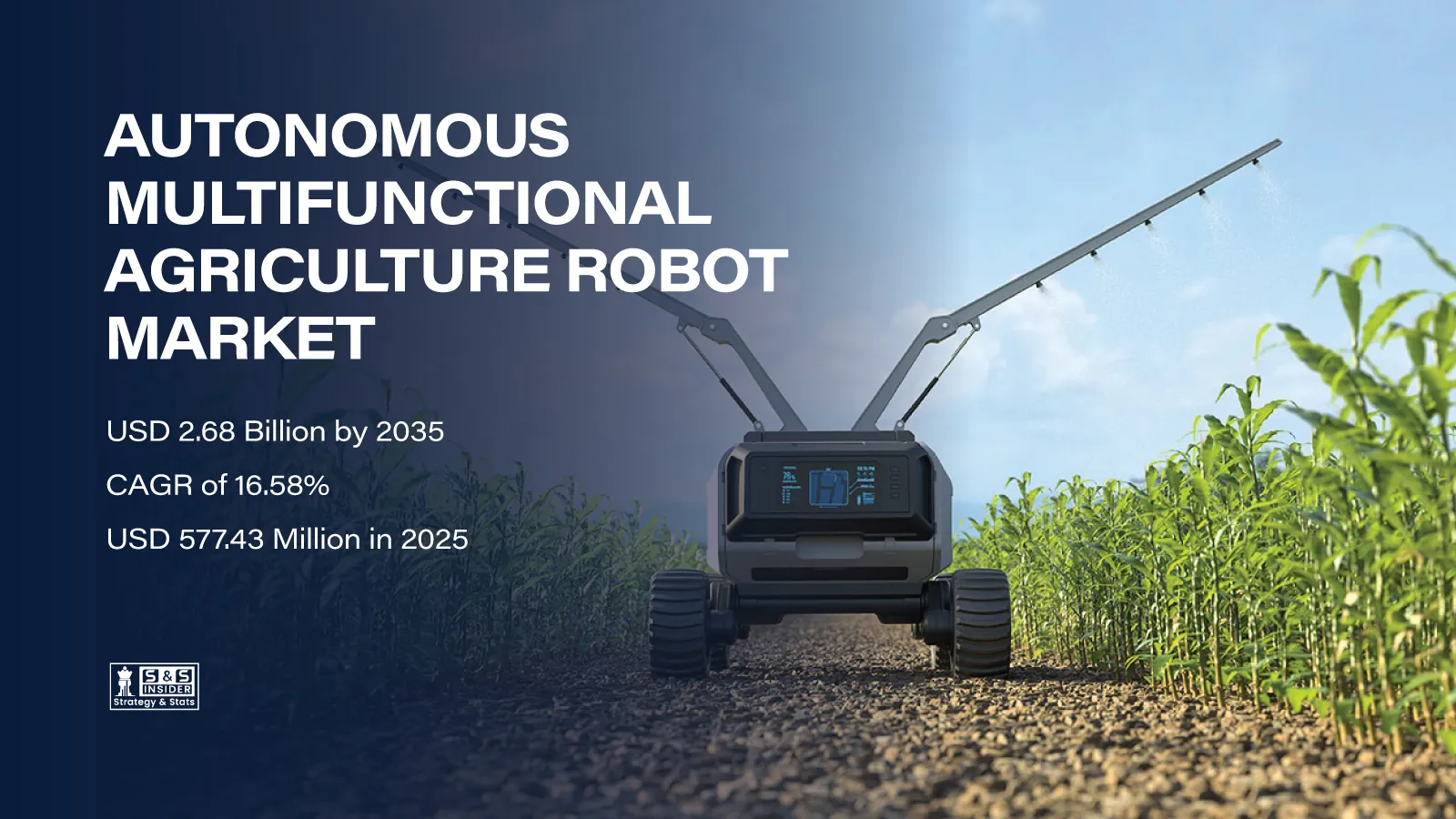
The global market was valued at USD 577.43 Million in 2025. It is estimated at USD 673.17 Million in 2026 and is expected to reach USD 2.68 Billion by 2035, a CAGR of 16.58% from 2026 to 2035.
Hardware still takes most of the spending, because every robot needs a chassis, sensors, cameras and batteries. Software is growing faster, as better vision models let one machine handle more tasks and tell crops from weeds with greater accuracy.
Weeding and crop protection is the largest application, since robots cut herbicide use and labor at the same time. Harvesting is growing fastest as picking systems become more reliable. Greenhouses and indoor farms are also adopting robots quickly, because their controlled conditions suit automation.
Europe holds the largest regional share, while Asia Pacific is growing fastest on the back of government support and aging farm workforces.
Market Size and Forecast
|
Market Indicator |
Value |
|
Market Size, 2025 |
USD 577.43 Million |
|
Market Size, 2026 |
USD 673.17 Million |
|
Market Forecast, 2035 |
USD 2.68 Billion |
|
CAGR, 2026–2035 |
16.58% |
|
Leading Region, 2025 |
Europe (30.14%) |
|
Fastest-Growing Region |
Asia Pacific (19.07% CAGR) |
Demand Drivers and Constraints
Primary Demand Drivers
-
Shrinking farm workforce: Fewer people are willing to do seasonal field work, so farms need machines that can work without a full crew.
-
Rising labor and chemical costs: Robots that weed mechanically or spray only where needed lower spending on both labor and inputs.
-
Stricter environmental rules: Limits on chemical use push growers toward precise, low-chemical methods of crop protection.
-
Better vision and machine learning: Improved cameras and plant identification models let robots act with greater accuracy in real field conditions.
-
Robot-as-a-service models: Leasing and pay-per-acre plans let mid-sized farms use robots without paying the full purchase price up front.
Potential Growth Constraints
-
High upfront cost compared with conventional farm equipment.
-
Weak rural connectivity and limited local technical support.
-
Downtime caused by rain, mud and dense crop canopy.
-
Seasonal use that lengthens the payback period.
-
Safety certification needs and unsettled insurance and liability rules.
Demand Structure by Component
Hardware (2025 Market Share: 61.74%)
Hardware accounted for 61.74% of the market in 2025. Every robot depends on physical parts such as the drive system, sensors, cameras, processors, batteries and tools for weeding or picking. These parts make up most of a machine's cost, so they take most of the spending. Prices for cameras, processors and batteries are falling, which brings robots within reach of more farms. As unit sales rise through 2035, hardware will stay the largest source of revenue, even as its share eases.
Current trend: Lighter, more rugged platforms built for longer field shifts.
Major trends: Modular tool mounts, electric drivetrains, swappable batteries, and multi-camera sensing.
Software (Forecast CAGR: 20.46%)
Software is projected to grow fastest, at a CAGR of 20.46% from 2026 to 2035. A robot's usefulness depends more and more on how well it can see, decide and move. Better plant identification models let one machine handle several crops and tasks. Fleet management tools help farms plan routes, track work and check results across fields. Many suppliers now sell software updates and analytics as subscriptions, which adds steady revenue after the first sale and raises the value of each robot over its working life.
Current trend: Plant identification models trained on very large image libraries.
Major trends: Fleet management platforms, subscription analytics, over-the-air updates, and farm data integration.
Demand Structure by Application
Weeding and Crop Protection (2025 Market Share: 34.86%)
Weeding and crop protection represented 34.86% of the market in 2025. Weed control is one of the most labor-intensive and costly jobs on a farm. Robots can remove weeds mechanically, with lasers, or with tiny targeted doses of herbicide, which cuts chemical use sharply. This matters more as herbicide resistance spreads and environmental rules get stricter. Growers of vegetables, sugar beet and other high-value row crops see clear savings, which keeps this application the largest through the forecast period.
Current trend: Wider use of laser and mechanical weeding in specialty crops.
Major trends: Spot spraying, laser weeding, herbicide reduction, and crop health scouting.
Harvesting (Forecast CAGR: 19.74%)
Harvesting is expected to grow at a CAGR of 19.74% from 2026 to 2035. Picking fruit and vegetables still needs large seasonal crews, and many farms struggle to hire enough workers at harvest time. Robotic pickers have become more reliable at finding ripe produce and handling it without damage. Strawberries, apples, tomatoes and other high-value crops are leading adoption. As picking speed improves and costs fall, more growers will use robots to protect yields when labor is short.
Current trend: Commercial pilots of robotic pickers in fruit and greenhouse crops.
Major trends: Soft grippers, ripeness detection, robots that work alongside people, and yield mapping.
Demand Structure by Farm Type
Open Field (2025 Market Share: 58.43%)
Open field farms accounted for 58.43% of the market in 2025. These farms cover the largest area and grow row crops, vegetables and cereals that need repeated weeding, spraying and scouting. Large farm equipment makers and specialist robot firms are focusing on autonomous machines for this work. Robots let growers cover more ground with fewer operators and keep working through long seasons. Labor shortages on large farms will keep open field use at the center of the market.
Current trend: Autonomous retrofits and dedicated robots for row crop work.
Major trends: Tractor autonomy, solar-powered field robots, GPS guidance, and coordinated machine fleets.
Greenhouses and Indoor Farms (Forecast CAGR: 20.12%)
Greenhouses and indoor farms are projected to grow at a CAGR of 20.12% during the forecast period 2026-2035. By providing consistent lighting, row spacing and temperatures within controlled environments, the robots can do their work more reliably. Operators work all year and the machines are used more and pay back quicker. Robots are employed in harvesting, pruning, moving plants and checking the health of crops. The demand will increase as indoor farming will continue to grow in Europe, Asia and North America.
Current trend: Rising use of robots for harvesting and crop handling in greenhouses.
Major trends: Rail-mounted robots, round-the-clock operation, climate data integration, and automated plant monitoring.
Key Market Participants
The market includes large farm equipment makers, specialist robot developers and technology firms focused on single tasks such as weeding or picking.
Key participants include Deere & Company, CNH Industrial, AGCO Corporation, Kubota Corporation, Carbon Robotics, Ecorobotix, FarmDroid, Agrobot, Burro, and Saga Robotics.
Competition centers on how accurately a robot works in the field, how many tasks one machine can handle and the total cost per acre. Suppliers that offer flexible payment plans, strong local service and regular software updates are well placed to win farms that are still weighing the move to automation.
Regional Market Dynamics
North America (2025 Market Share: 27.86%)
North America held a 27.86% share in 2025. The United States accounts for most regional demand, with a market value of USD 136.10 Million in 2025 and a projected CAGR of 16.21%. Large farms, high labor costs and strong venture funding for agricultural technology support adoption. Major equipment makers are adding autonomy to their machines, while startups target weeding and harvesting in specialty crops. Canada adds demand through greenhouse operations and large grain farms.
Direction: Steady growth supported by labor shortages, autonomy upgrades and agricultural technology investment.
Europe (Largest Regional Market, 2025 Share: 30.14%)
Europe led the global market with a 30.14% share in 2025. France, Germany, the Netherlands, Spain and the United Kingdom are the main country markets. Strict limits on chemical use and support for sustainable farming push growers toward robotic weeding and precise spraying. The Netherlands is a leader in greenhouse automation. The EU machinery regulation that applies from January 2027 will set clearer safety requirements, which suppliers with certified products are well prepared to meet.
Direction: Continued leadership supported by environmental rules, greenhouse automation and sustainable farming policy.
Asia Pacific (Forecast CAGR: 19.07%)
Asia Pacific is expected to be the fastest growing region with a CAGR of 19.07% in the forecast period 2026-2035. China is the biggest driver of regional demand, with farm drones and robots included in its 2026 policy paper to support wider adoption. Japan has a smart agriculture law to encourage robots, as the aging farming population has become a problem. Farm automation is also spreading in India, Australia and South Korea. The region is the main source of new growth, driven by government support, small and aging workforces and rising food demand.
Direction: Fastest regional growth supported by government programs and aging farm workforces.
Middle East & Africa
The Middle East and Africa held a 4.65% share in 2025. Gulf countries are investing in greenhouse and indoor farming to improve food security in dry climates, which creates demand for automation. South Africa, Kenya and Morocco are adopting robots mainly in export-oriented fruit and vegetable farming. Limited budgets, weak rural connectivity and few service networks slow wider use, so leasing and service-based models are the practical route for most buyers.
Direction: Early-stage growth supported by food security programs and controlled environment farming.
Latin America
Latin America accounted for a 7.43% share in 2025. Brazil is the largest market, supported by large-scale grain and sugarcane farming and a growing interest in precision agriculture. Mexico adds demand through export fruit and vegetable production, where labor shortages at harvest are common. High equipment costs and currency swings make buyers careful, so robot-as-a-service plans and dealer financing help farms start using automation.
Direction: Gradual growth supported by precision agriculture and flexible payment models.
Market Outlook (2026–2035)
The global autonomous multifunctional agriculture robot market is forecast to reach USD 2.68 Billion by 2035 as farms rely more on automation to keep up with fieldwork.
Labor shortages, rising input costs and stricter environmental rules will remain the main reasons farms buy robots. Software will gain importance as plant identification models improve.
Harvesting robots and greenhouse automation will widen the market beyond weeding and crop protection, bringing in more crop types and farm operators.
Europe will keep its lead in the near term, while Asia Pacific will add the most new demand through government support and aging workforces.
Overall, the autonomous multifunctional agriculture robot market is set for strong growth through 2035, with success depending on field accuracy, multi-task capability, cost per acre and reliable local service.



