
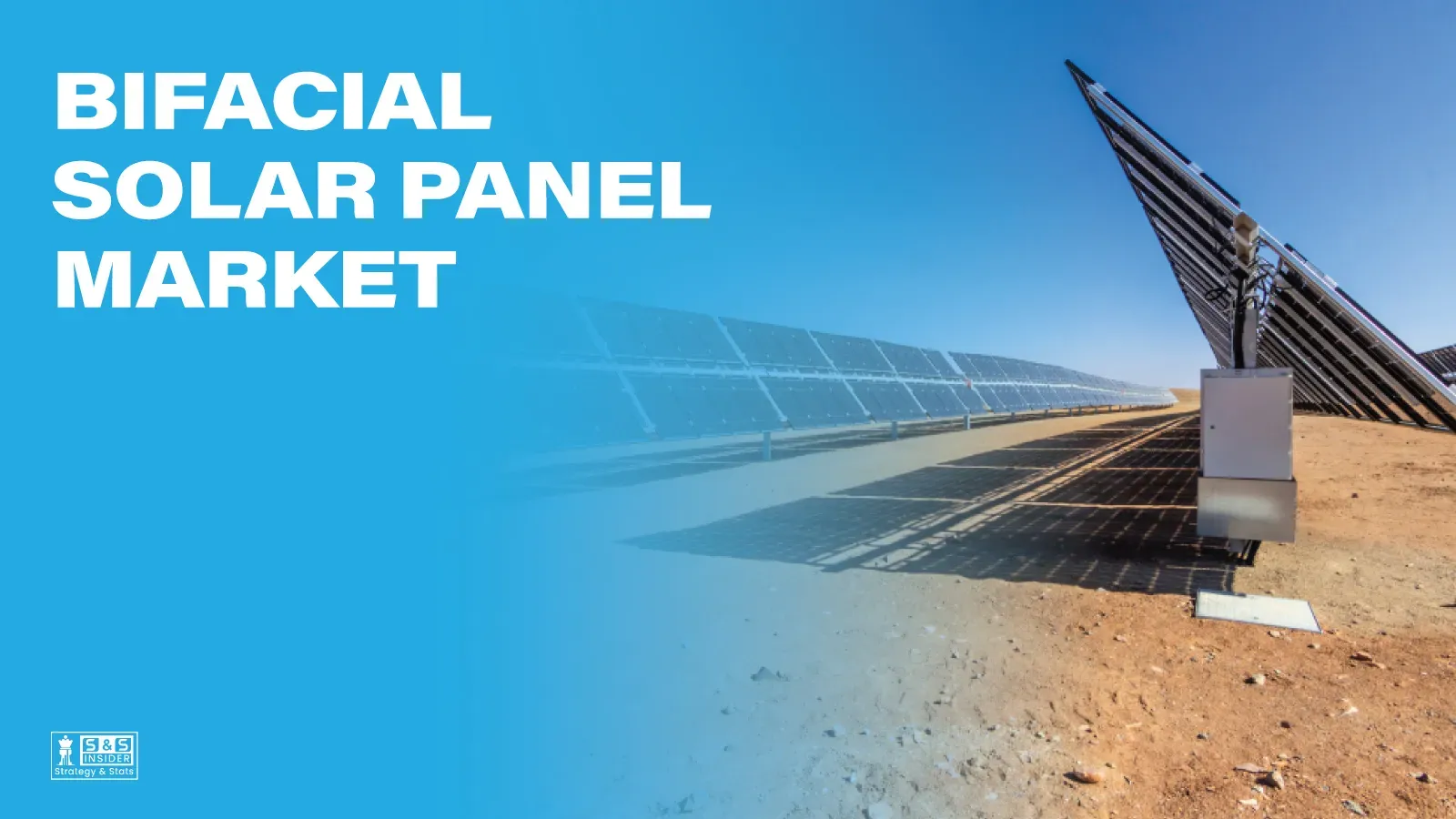
The Bifacial Solar Panels Market has been gaining traction since various stakeholders, including governments, energy providers, organizations and individuals, are making efforts towards achieving their renewable energy generation and carbon reduction goals. While traditional monofacial panels generate electricity using only the front face of the panel, bifacial panels use both the faces of the panels to absorb sunlight.
The value of the global Bifacial Solar Panel market was estimated to be USD 7.13 billion in 2024 and is anticipated to reach USD 17.30 billion by 2032, with an expected CAGR of 11.75% during the forecast period from 2025 to 2032. The growth of the Bifacial Solar Panel market can be attributed to the growth in usage of renewable energy sources, advancements in photovoltaic efficiency, installation of utility scale solar systems, and growing usage of single axis tracking systems.
Gain Actionable Intelligence on Bifacial Solar Panel Market – Request a Sample Report
Top 3 Bifacial Solar Panel Companies
1. LONGi Green Energy Technology Co., Ltd.
 LONGi continues to play a significant role within the bifacial solar panels market as a result of its emphasis on the efficiency of its monocrystalline photovoltaic products. The range of LONGi’s products is relevant for the use in utility-scale, commercial, and distributed solar systems where there is a need for efficient energy production and durability. LONGi’s innovations in the field of cell and module engineering will allow achieving the necessary power output and increase the product durability. In May 2025, the Ice-Shield bifacial module was introduced by LONGi with 3.2 mm tempered glass.
2. Trina Solar Limited
 A leading role has been established by Trina Solar owing to its photovoltaic modules, solar cells, trackers, and smart energy systems. The firm concentrates on increasing module efficiency along with better performance of the system as a whole. Development efforts of Trina Solar involve high-efficiency photovoltaic modules and tandem technologies of the new generation that may be helpful in achieving better efficiency in the future. On June 2025, Trina Solar introduced a perovskite-silicon tandem module prototype having efficiency of 841 W and 27.1%.
3. JinkoSolar Holding Co., Ltd.
 JinkoSolar is one more leading company in the field of solar energy products having a lot of experience with n-type TOPCon cells and bifacial modules. The products of this company are used for residential, commercial and utility-scale uses owing to a worldwide manufacturing and distribution network. JinkoSolar keeps on optimizing the efficiency, power density, and reliability of its modules using new cells. In June 2025, the company presented its latest model Tiger Neo 3.0 series in SNEC 2025 with n-type TOPCon bifacial technology.
What is Driving the Future of the Bifacial Solar Panel Market?
The growing move towards the use of renewable energy on a global scale has played an instrumental role in making it easier for bifacial solar panels to be adopted. Being able to harvest energy from the front as well as rear panels results in higher yields of energy than would be produced by using monofacial modules in such instances. This increased energy production will help increase the bottom line and bring down the cost of generating electricity.
Combining bifacial modules and single-axis trackers opens up yet another avenue for future development. Tracker systems constantly change the position of panels depending on the position of the sun, whereas the back surface of bifacial modules is able to collect reflected radiation. Such a combination may prove highly beneficial both in terms of system efficiency and space utilization. This solution appears especially promising for large-scale solar parks where slight gains in energy production are valuable.
The development of technology is another way through which the scope of application of the bifacial solar energy is being broadened. There is an ongoing effort to improve efficiency and performance by incorporating new technologies such as transparent back sheets, lightweight glass, advanced cell designs, encapsulation technologies, artificial intelligence for monitoring, and internet of things for trackers. Bifacial solar technology offers more scope in floating solar farms and desert regions, where the high albedo effect will increase the rear side irradiance.
Key Bifacial Solar Panel Market Trends
Monocrystalline technology comprised around 70.55% share in the market in 2024 due to its high efficiency, along with being suitable for large scale installation, whereas thin film technology would show the fastest CAGR of 13.20%. Application-wise, residential installations were the largest in terms of market share, whereas commercial applications would grow rapidly in future.
The half-cut cells accounted for about 67.80% share of the market in 2024. The shingled cells would be on the rise due to the high efficiency of their utilization of space on modules. In terms of bifaciality factors, the segment with below 80% accounted for the largest share of the market, while the 80-90% segment would grow at a higher rate.
The Road Ahead
Future success of the Bifacial Solar Panel Market would be highly dependent on advancements in module efficiency, tracking, materials, and digital monitoring. While utility scale projects would continue to gain prominence, rooftop commercial, floating solar panels and high albedo surfaces would provide further avenues. Developers would increasingly look to increase energy production from limited land availability, thereby making bifacial solar panels an increasingly essential component of modern PV technologies.
In addition, regional investments will determine the industry’s future growth prospects, with Asia-Pacific taking advantage of manufacturing capabilities and huge renewable energy projects, whereas North America and Europe are favored by favorable policies and de-carbonization programs. Firms that integrate high-efficiency cells, smart tracking systems, reliable designs, and intelligent monitoring services are set for success in the coming years up to 2032.



