
According to the latest SNS Insider Cleanroom Technologies Market report, the global market is entering a sustained expansion phase as pharmaceutical manufacturers, semiconductor fabrication facilities and biotechnology companies strengthen contamination control infrastructure.
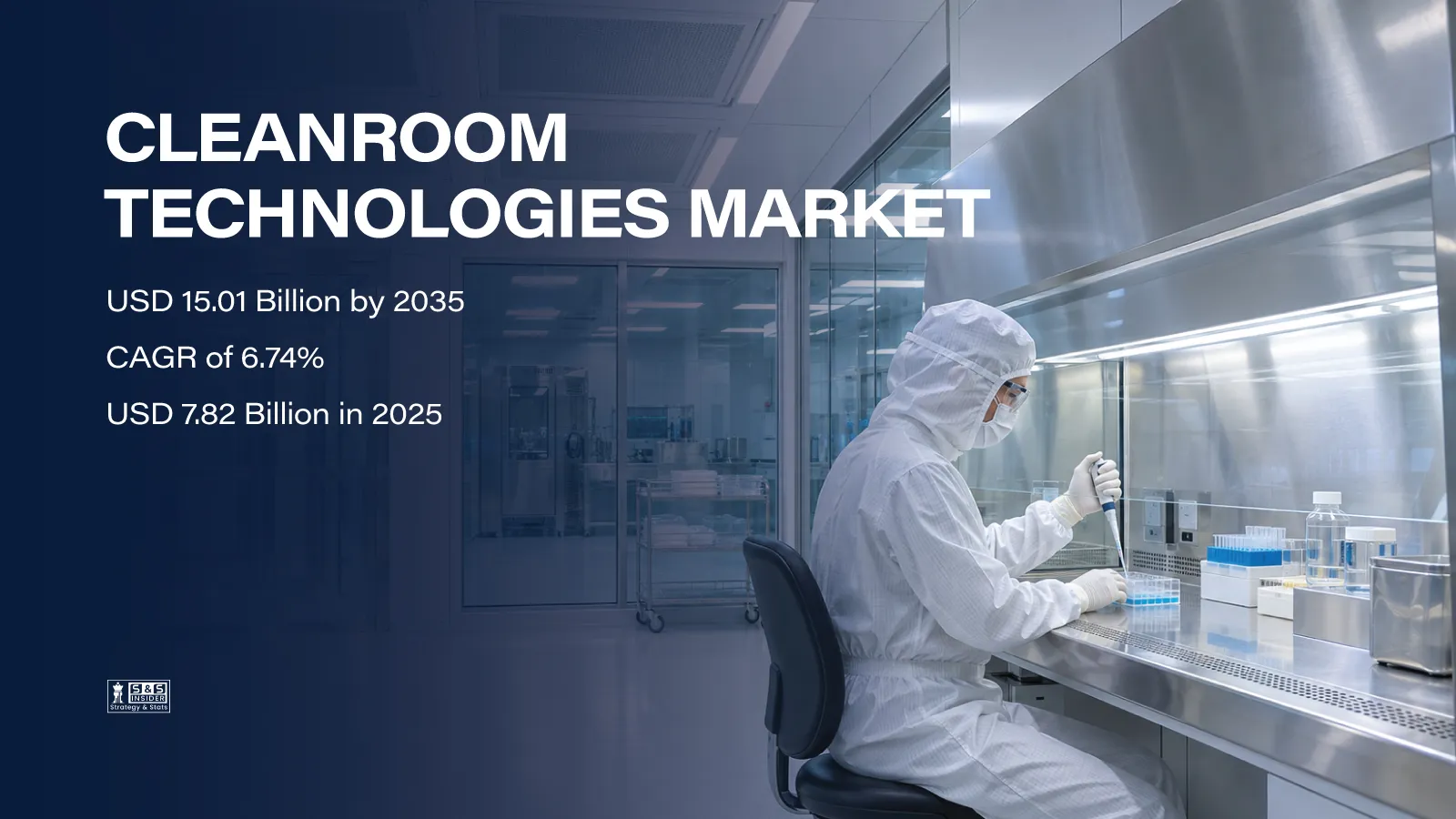
The global cleanroom technologies market was valued at USD 7.82 billion in 2025, is estimated at USD 8.35 billion in 2026 and is projected to reach USD 15.01 billion by 2035, advancing at a reported CAGR of 6.74% during 2026–2035.
Sterile drug production and advanced semiconductor fabrication and contamination control needs are driving manufacturers to focus on high-efficiency filters, modular cleanroom designs, and environmental monitoring tools.
Moreover, there is a trend towards modular cleanrooms, smart airflow control technology, and energy-efficient contamination control. Such trends open new growth prospects for equipment suppliers, cleanroom system providers, filtration experts, and consumables producers.
North America is the leading regional market today, whereas Asia-Pacific is forecast to post the fastest growth until 2035 on the back of investments in semiconductors fabrication, pharmaceuticals production, and biotechnology.
Market Size and Forecast
|
Market Indicator |
Value |
|---|---|
|
Market Size, 2025 |
USD 7.82 Billion |
|
Market Size, 2026 |
USD 8.35 Billion |
|
Market Forecast, 2035 |
USD 15.01 Billion |
|
Reported CAGR, 2026–2035 |
6.74% |
|
North America Share, 2025 |
34.57% |
|
Asia-Pacific Forecast CAGR |
7.84% |
|
Leading Product Segment |
Consumables (52.30%) |
|
Leading End User |
Pharmaceuticals (38.62%) |
Demand Drivers and Constraints
Primary Demand Drivers
-
Expanding sterile pharmaceutical production: Increasing manufacturing of injectable medicines, vaccines, biologics and advanced therapies requires controlled production environments with reliable contamination prevention systems.
-
Semiconductor fabrication investments: New chip manufacturing facilities and advanced packaging operations are generating demand for ultra-clean production environments, high-performance filtration systems and precision environmental controls.
-
Stringent manufacturing standards: ISO 14644 classifications and pharmaceutical Good Manufacturing Practice requirements encourage investment in validated cleanroom infrastructure and continuous environmental monitoring.
-
Increasing adoption of modular cleanrooms: Prefabricated systems offer faster installation, flexible facility configurations and reduced disruption during pharmaceutical and electronics manufacturing expansions.
-
Digital contamination monitoring: Connected sensors, automated particle monitoring and intelligent airflow control systems are improving operational visibility and supporting preventive maintenance.
Potential Growth Constraints
-
High capital expenditure associated with cleanroom installation and validation.
-
Significant electricity consumption from ventilation and environmental control systems.
-
Shortages of experienced cleanroom engineers and certification professionals.
-
Increasing costs of specialized filtration materials and components.
-
Project delays caused by semiconductor investment cycles and construction complexity.
Demand Structure by Product
Consumables (2025 Market Share: 52.30%)
Consumables represent the largest product segment, accounting for approximately 52.30% of market revenue in 2025.
Clean room apparel, gloves, masks, wipes, disinfectants and accessories for contamination control need regular replacements during the manufacturing process. While equipment is a one-off purchase, consumables create an ongoing requirement.
Pharmaceutical companies and semiconductor manufacturers have stringent gowning and cleanliness policies to avoid contamination. This leads to consistent purchasing of the certified consumables.
Growing utilization of manufacturing, larger clean room staff and stringent contamination avoidance practices will sustain the demand for consumables until 2035.
Current trend: Strong recurring demand for cleanroom apparel and contamination control products.
Major trends: Low-particle garments, specialized cleaning materials, disposable protective equipment and controlled-environment consumable management.
Equipment (Forecast CAGR: 7.24%)
Cleanroom equipment is projected to be the fastest-growing product segment, expanding at a CAGR of approximately 7.24% during 2026–2035.
Demand is supported by investments in new pharmaceutical plants, semiconductor fabrication plants, and modernizing existing controlled manufacturing environments.
High efficiency particle air filters, air handling systems, laminar airflow systems, and environmental monitoring equipment are examples of such investments.
Manufacturers today are investing more in equipment that reduces contaminations as well as energy usage and maintenance needs.
Current trend: Rising investment in advanced filtration and automated environmental control equipment.
Major trends: Smart air handling, connected monitoring systems, energy-efficient filtration and equipment modernization.
Demand Structure by Cleanroom Type
Modular Hardwall Cleanrooms (2025 Market Share: 53.96%)
Modular hardwall cleanrooms dominate the market, representing approximately 53.96% of revenue in 2025.
They provide a durable, encased facility in which there is control of air flow along with adjustable surfaces to enable clean up. The producers of pharmaceuticals, biotechnology as well as medical equipment are turning to hard wall modular systems when adding to their production capacity and/or altering their present setup. There is an added advantage to using prefabricated construction.
Current trend: Growing preference for adaptable, prefabricated cleanroom infrastructure.
Major trends: Modular construction, integrated ventilation, standardized components and flexible manufacturing layouts.
Mobile Cleanrooms (Forecast CAGR: 7.81%)
Mobile cleanrooms are expected to register the fastest growth among cleanroom types, with a CAGR of approximately 7.81% through 2035.
Temporary manufacturing, pilot production runs, research activities and quick deployment requirements have made portable controlled environments more popular.
The use of such systems enables establishments to create small contamination-controlled areas without immediately opting for permanent construction. The need becomes especially pertinent for research organizations and newly developing biotech firms.
Current trend: Increasing adoption of portable and rapidly deployable cleanroom solutions.
Major trends: Mobile manufacturing environments, temporary contamination control, compact filtration systems and flexible cleanroom deployment.
Demand Structure by ISO Classification
ISO 6 to 7 (2025 Market Share: 45.41%)
ISO 6 to 7 cleanrooms account for the largest classification segment, representing approximately 45.41% of the market in 2025.
They allow for pharmaceutical manufacturing processes, medical device assembly, electronics manufacture and packing that require particle-free environments.
The popularity of these environments stems from the necessity to reconcile the need for particle control with realistic construction and operating costs. As pharmaceutical manufacturing and precision manufacturing processes continue to increase, the demand will remain stable.
Current trend: Continued investment in mid-to-high-grade controlled manufacturing environments.
ISO 1 to 3 (Forecast CAGR: 8.06%)
ISO 1 to 3 represents the fastest-growing classification segment, with a projected CAGR of approximately 8.06% during 2026–2035.
Advanced semiconductor fabrication, precision optics and highly contamination-sensitive manufacturing processes require exceptionally low airborne particle concentrations.
Increasing semiconductor miniaturization and investment in advanced production technologies are strengthening demand for sophisticated filtration and environmental control systems.
Current trend: Rising requirements for ultra-clean manufacturing environments.
Major trends: Advanced semiconductor lithography, precision particle monitoring and high-performance filtration.
Demand Structure by End User
Pharmaceuticals (2025 Market Share: 38.62%)
Pharmaceuticals dominate the cleanroom technologies market, accounting for approximately 38.62% of revenue in 2025.
Sterile injectable manufacturing, vaccine production, biologics processing and advanced therapy development require contamination-controlled facilities supported by rigorous environmental monitoring.
Manufacturers are investing in cleanroom modernization to improve operational reliability and comply with applicable quality standards.
The expansion of contract manufacturing organizations and specialized pharmaceutical facilities is also supporting demand for modular environments, filtration systems and consumables.
Current trend: Strong demand for validated cleanroom infrastructure in sterile pharmaceutical manufacturing.
Semiconductors and Electronics (Forecast CAGR: 8.29%)
Semiconductors and electronics are projected to be the fastest-growing end-user segment, expanding at a CAGR of approximately 8.29% through 2035.
New semiconductor fabrication facilities, advanced chip packaging lines and precision electronics manufacturing operations require highly controlled environments.
Investments in advanced logic chips, memory technologies and electronics supply chain localization are supporting demand for contamination control systems.
Current trend: Accelerating cleanroom investment in advanced semiconductor production.
Regional Market Dynamics
North America (2025 Market Share: 34.57%)
North America leads the global cleanroom technologies market with approximately 34.57% revenue share in 2025.
The region benefits from established pharmaceutical manufacturing, advanced biotechnology research and semiconductor industry investments.
The United States represents the largest contributor to regional demand, supported by sterile drug production, semiconductor fabrication projects and stringent manufacturing quality requirements.
Increasing adoption of automation, modular cleanrooms and environmental monitoring technologies is expected to sustain regional investment.
Direction: Established market leadership supported by industrial modernization and pharmaceutical manufacturing expansion.
Asia-Pacific (Forecast CAGR: 7.84%)
Asia-Pacific is expected to be the fastest-growing regional market, registering a CAGR of approximately 7.84% during 2026–2035.
China, India, Japan, South Korea, Taiwan and Singapore are important centers for semiconductor manufacturing, pharmaceutical production and electronics assembly.
Expanding fabrication capacity, increasing biotechnology investment and pharmaceutical manufacturing modernization are creating opportunities for cleanroom equipment and consumables suppliers.
Government initiatives supporting domestic semiconductor and pharmaceutical production are also expected to strengthen long-term demand.
Direction: Fast regional expansion driven by manufacturing capacity additions and contamination control investments.
Europe
Europe maintains an established market position through its pharmaceutical industry, biotechnology manufacturing capabilities and advanced engineering expertise.
Strict sterile manufacturing requirements are encouraging facility upgrades and contamination control modernization.
Germany, France, the United Kingdom and other pharmaceutical manufacturing centers continue investing in controlled production infrastructure.
Energy efficiency is also becoming an important consideration as manufacturers seek to reduce the operating costs of cleanroom ventilation systems.
Direction: Steady growth supported by regulatory requirements and energy-efficient cleanroom upgrades.
Latin America and Middle East & Africa
Latin America and the Middle East & Africa represent developing opportunities for cleanroom technologies.
Pharmaceutical manufacturing expansion, healthcare infrastructure investments and industrial localization initiatives are supporting demand for contamination-controlled facilities.
Brazil, Mexico, Saudi Arabia and the UAE are among the markets where expanding industrial and healthcare capabilities may encourage additional cleanroom investment.
Direction: Gradual market development through pharmaceutical localization and manufacturing modernization.
Competitive Landscape
The global cleanroom technologies market includes engineering companies, filtration manufacturers, modular cleanroom specialists and contamination control suppliers.
Major participants identified in the SNS Insider report include Exyte, Ansell, Camfil, Taikisha, Illinois Tool Works, Syntegon, Terra Universal, Clean Air Products, Ardmac, Nippon Muki, G-CON Manufacturing, Cleanova, Total Clean Air and CleanSpace.
Competition increasingly focuses on installation efficiency, contamination control performance, modular system flexibility and long-term operating costs.
Suppliers are strengthening their portfolios through technology development, manufacturing expansion and strategic acquisitions.
Market Outlook (2026–2035)
The SNS Insider forecast projects the global cleanroom technologies market to reach USD 15.01 billion by 2035, supported by pharmaceutical manufacturing expansion, semiconductor investments and stricter contamination control requirements.
Modular construction, automated monitoring and energy-efficient airflow technologies are expected to become increasingly important purchasing considerations.
Consumables will continue to generate recurring demand, while equipment manufacturers may benefit from new facility development and infrastructure modernization.
North America is expected to remain a major revenue contributor, while Asia-Pacific offers the fastest regional growth opportunities.
Overall, the cleanroom technologies market is positioned for sustained expansion through 2035, with competitive advantage increasingly determined by contamination control reliability, installation flexibility, energy efficiency and advanced manufacturing requirements.



