
The global whole genome sequencing market is entering a period of rapid expansion as declining sequencing costs, growing precision medicine applications, and technological advancements make comprehensive genetic analysis more accessible. According to SNS Insider, the market was valued at USD 2.84 billion in 2025, is estimated at USD 3.38 billion in 2026, and is projected to reach USD 16.34 billion by 2035, expanding at a CAGR of 19.12% from 2026 to 2035.
Whole genome sequencing (WGS), which determines an organism's complete DNA sequence, is increasingly used in rare disease diagnosis, oncology research, newborn screening, infectious disease surveillance, and population genomics. Advances in high-throughput sequencing instruments, long-read technologies, and artificial intelligence-based analysis are improving laboratory efficiency while expanding clinical and research applications.
The market is transitioning from predominantly research-driven demand toward broader healthcare adoption. Hospitals are introducing genomic medicine programs, pharmaceutical companies are integrating genetic information into drug development, and governments are investing in national genome initiatives.
North America remains the largest regional market, while Asia-Pacific offers the fastest growth opportunities through 2035.
To Get Detailed Insights on the Whole Genome Sequencing Market – Request a Sample Report
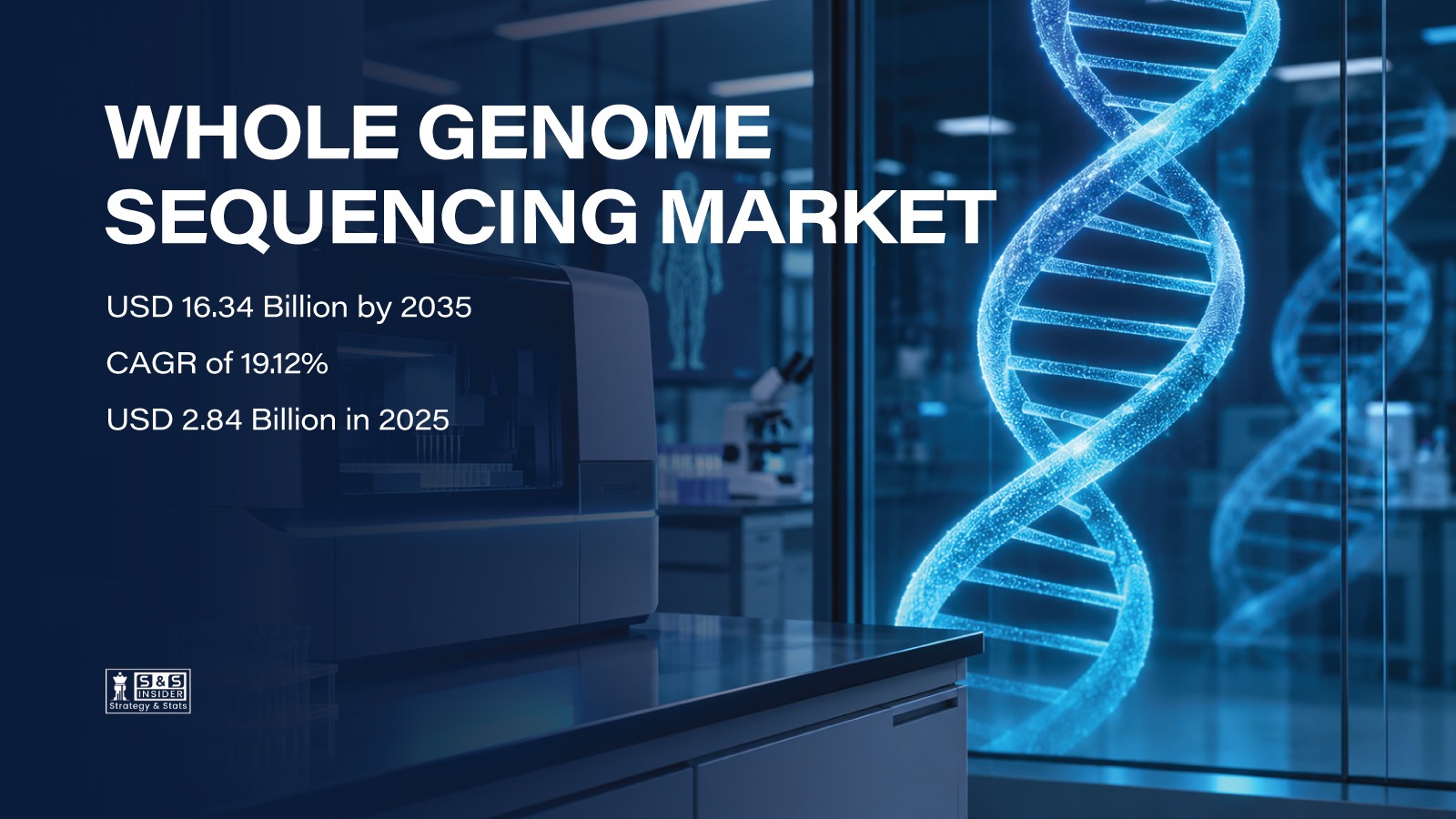
Whole Genome Sequencing Market Size and Forecast
|
Market Indicator |
Value |
|---|---|
|
Market Size, 2025 |
USD 2.84 Billion |
|
Market Size, 2026 |
USD 3.38 Billion |
|
Market Forecast, 2035 |
USD 16.34 Billion |
|
CAGR, 2026–2035 |
19.12% |
|
Leading Region, 2025 |
North America (47.28%) |
|
Fastest-Growing Region |
Asia-Pacific (21.42% CAGR) |
|
U.S. Market Size, 2025 |
USD 1.20 Billion |
|
U.S. Market CAGR |
18.84% |
Demand Drivers and Constraints
Primary Demand Drivers
- Declining sequencing costs: Improvements in instrument throughput, sample preparation, and sequencing chemistry are reducing the cost per genome, encouraging adoption among research laboratories and healthcare providers.
- Expansion of precision medicine: Growing applications in oncology, rare genetic disorders, and individualized treatment planning are strengthening demand for comprehensive genomic information.
- National genomics programs: Government-supported population sequencing initiatives are creating sustained demand for sequencing instruments, consumables, and analytical services.
- Increasing clinical applications: Hospitals are expanding genomic testing capabilities for critically ill infants, complex genetic diseases, and selected cancer applications.
- Artificial intelligence integration: AI-powered variant interpretation, automated bioinformatics pipelines, and cloud computing are improving genomic data processing.
- Pharmaceutical research: Drug developers increasingly use whole genome data for biomarker discovery, patient stratification, and genetic research.
Potential Growth Constraints
Despite technological progress, the market faces several adoption barriers. Sequencing instruments, computational infrastructure, data storage, and specialized personnel represent substantial operational expenses.
Complex genomic interpretation, inconsistent reimbursement policies, and limited access to qualified bioinformatics professionals can restrict routine clinical implementation.
Data privacy requirements and ethical concerns surrounding genetic information also create additional compliance responsibilities for healthcare organizations and research institutions.
Demand Structure by Product and Service
Consumables (2025 Market Share: 56.72%)
Consumables represented the largest product and service category, accounting for approximately 56.72% of market revenue in 2025.
Sequencing laboratories regularly purchase reagents, flow cells, library preparation kits, and other materials required to process DNA samples. Unlike instruments, which represent periodic capital investments, consumables generate recurring demand as testing volumes increase.
Expansion of population genomics projects, clinical sequencing programs, and pharmaceutical research is supporting higher consumption of sequencing materials.
Manufacturers are also improving reagent efficiency and sample preparation workflows to lower processing expenses.
Current trend: Growing demand for high-throughput sequencing consumables and integrated laboratory workflows.
Services (Forecast CAGR: 21.52%)
Sequencing services are projected to register the fastest growth, with a CAGR of approximately 21.52% through 2035.
Hospitals, biotechnology companies, and smaller research institutions increasingly outsource genome sequencing to specialized laboratories rather than investing in expensive instruments and dedicated analytical teams.
Service providers offer sample processing, sequencing, bioinformatics analysis, and genomic interpretation.
Demand is expanding as customers prioritize reliable results, faster turnaround times, and flexible testing capacity.
Current trend: Increasing outsourcing of comprehensive genome sequencing and analytical services.
Demand Structure by Workflow
Sequencing (2025 Market Share: 53.05%)
Sequencing dominated the workflow category with approximately 53.05% market share in 2025.
This stage involves generating genomic sequence data using advanced instruments and specialized reagents. Increasing demand from population studies, academic research, and clinical laboratories continues to support investment in sequencing infrastructure.
Advances in short-read and long-read technologies are improving throughput and expanding the range of genetic variations laboratories can investigate.
Higher instrument utilization and automated laboratory operations are expected to support continued market expansion.
Current trend: Increasing adoption of automated, high-capacity sequencing platforms.
Data Analysis (Forecast CAGR: 20.82%)
Data analysis is expected to be the fastest-growing workflow segment, registering a CAGR of approximately 20.82% from 2026 to 2035.
The expanding volume of genomic information is creating substantial demand for bioinformatics software, cloud computing, and advanced interpretation tools.
Artificial intelligence and machine learning are helping researchers identify genetic variants, prioritize clinically relevant findings, and reduce manual analysis workloads.
As sequencing becomes more affordable, efficient data interpretation is emerging as an increasingly important competitive differentiator.
Current trend: Rapid adoption of AI-powered genomic analysis and cloud-based bioinformatics.
Demand Structure by Application
Human Whole Genome Sequencing (2025 Market Share: 63.80%)
Human genome sequencing accounted for approximately 63.80% of the global market in 2025, making it the leading application.
Strong demand comes from rare disease research, cancer genomics, population health initiatives, and pharmaceutical development programs.
Healthcare providers increasingly use genomic information to investigate inherited disorders and support molecular diagnosis.
Government-funded genome projects and large-scale biobanks are also generating significant demand for sequencing equipment and services.
Current trend: Expanding clinical utilization of human genome sequencing for precision medicine and genetic disease investigation.
Microbial Whole Genome Sequencing (Forecast CAGR: 20.47%)
Microbial sequencing is projected to expand at a CAGR of approximately 20.47% during 2026–2035.
Public health laboratories, hospitals, and food safety organizations use microbial genomic information to investigate infectious disease outbreaks, monitor antimicrobial resistance, and trace contamination sources.
Declining sequencing costs are making genomic surveillance more practical for routine public health applications.
Current trend: Increasing adoption of pathogen genome sequencing for outbreak investigation and antimicrobial resistance monitoring.
Demand Structure by End User
Academic and Research Institutes (2025 Market Share: 46.33%)
Academic and research institutes represented the largest end-user segment, accounting for approximately 46.33% of market revenue in 2025.
Universities, genome centers, and publicly funded research laboratories conduct large sequencing projects involving population genetics, disease mechanisms, evolutionary biology, and agricultural genomics.
These institutions are frequently early adopters of new sequencing platforms and analytical technologies.
Current trend: Sustained investment in population genomics, advanced sequencing infrastructure, and collaborative genetic research.
Hospitals and Clinics (Forecast CAGR: 21.12%)
Hospitals and clinics are expected to register the fastest end-user growth, with a CAGR of approximately 21.12% through 2035.
Clinical applications are expanding as healthcare providers establish genomic medicine services for rare diseases, critically ill newborns, and selected oncology cases.
Growing clinical evidence, improved laboratory workflows, and broader access to specialized testing providers are supporting adoption.
Current trend: Transition of whole genome sequencing from specialized research environments into clinical diagnostic pathways.
Regional Market Dynamics
North America (2025 Market Share: 47.28%)
North America led the global market with a 47.28% revenue share in 2025.
Strong pharmaceutical research, established genomic laboratories, government-supported programs, and early clinical adoption support regional demand.
The United States generated approximately USD 1.20 billion in 2025 and is forecast to grow at an 18.84% CAGR through 2035.
Increasing utilization of genome sequencing in research hospitals, biotechnology companies, and population health programs is expected to sustain expansion.
Direction: Continued leadership through clinical integration and advanced sequencing technologies.
Europe — Established Genomics Research Market
Europe represents the second-largest regional market, supported by national genome initiatives, healthcare research investment, and established academic networks.
The United Kingdom accounted for approximately 27.65% of Europe's market in 2025.
Germany, France, and other European countries are expanding genomic medicine capabilities through research partnerships and healthcare initiatives.
Direction: Steady expansion supported by clinical genomics programs and public healthcare investment.
Asia-Pacific (Forecast CAGR: 21.42%)
Asia-Pacific is projected to be the fastest-growing regional market, with a CAGR of approximately 21.42% between 2026 and 2035.
China accounted for approximately 38.12% of regional revenue in 2025.
Growing investment in population genomics, biotechnology research, healthcare infrastructure, and domestic sequencing technologies is supporting expansion across China, India, Japan, and South Korea.
Direction: Rapid growth through national genome initiatives and increasing clinical sequencing capacity.
Latin America and Middle East & Africa
Latin America and the Middle East & Africa represent emerging opportunities for genome sequencing providers.
Brazil accounted for approximately 46.78% of Latin American revenue in 2025, while Saudi Arabia represented around 33.91% of the Middle East & Africa market.
Research partnerships, national genomics initiatives, and expanding diagnostic infrastructure are gradually strengthening regional demand.
Direction: Developing market opportunities driven by healthcare modernization and genomic research investment.
Competitive Landscape
The competitive environment includes established sequencing instrument manufacturers, long-read technology specialists, and genomic service providers.
Major participants include Illumina, MGI Tech, Pacific Biosciences, Oxford Nanopore Technologies, Element Biosciences, Ultima Genomics, Roche, GeneDx, Novogene, Psomagen, Macrogen, Azenta Life Sciences, Revvity, and BaseClear.
Competition increasingly focuses on reducing sequencing costs, improving genomic accuracy, expanding throughput, and integrating advanced analytical software.
Recent industry activity includes Illumina's February 2026 introduction of TruPath Genome, Ultima Genomics' February 2026 launch of its UG200 series, and Roche's June 2026 introduction of the AXELIOS 1 research sequencing platform.
These developments highlight the industry's emphasis on instrument innovation and more efficient sequencing workflows.
Market Outlook (2026–2035)
The global whole genome sequencing market is forecast to reach USD 16.34 billion by 2035, supported by continued technological innovation and wider use of comprehensive genomic analysis.
Declining sequencing costs are expected to expand access, while clinical adoption in rare diseases, oncology, and newborn care creates new opportunities for diagnostic laboratories and technology providers.
Artificial intelligence, cloud-based data processing, and advanced bioinformatics are likely to become increasingly important as genomic information volumes grow.
Consumables will continue benefiting from recurring laboratory demand, while sequencing services and data analysis represent particularly attractive growth opportunities.
North America is expected to maintain its leading market position, whereas Asia-Pacific will experience the fastest regional expansion.
However, reimbursement uncertainty, data protection requirements, infrastructure costs, and shortages of skilled professionals will remain important considerations.
Overall, the whole genome sequencing market is positioned for substantial expansion through 2035, with future competitiveness increasingly determined by affordable sequencing technologies, reliable genomic interpretation, scalable laboratory infrastructure, and successful integration into healthcare and pharmaceutical research.
About the Author

Get in touch




