
The global microprocessor industry is entering a new phase of technological development as artificial intelligence, cloud computing, connected vehicles and industrial automation increase demand for advanced processing capabilities. Microprocessors remain fundamental to computing infrastructure, enabling information processing, software execution and intelligent device functionality across consumer, enterprise and industrial applications.
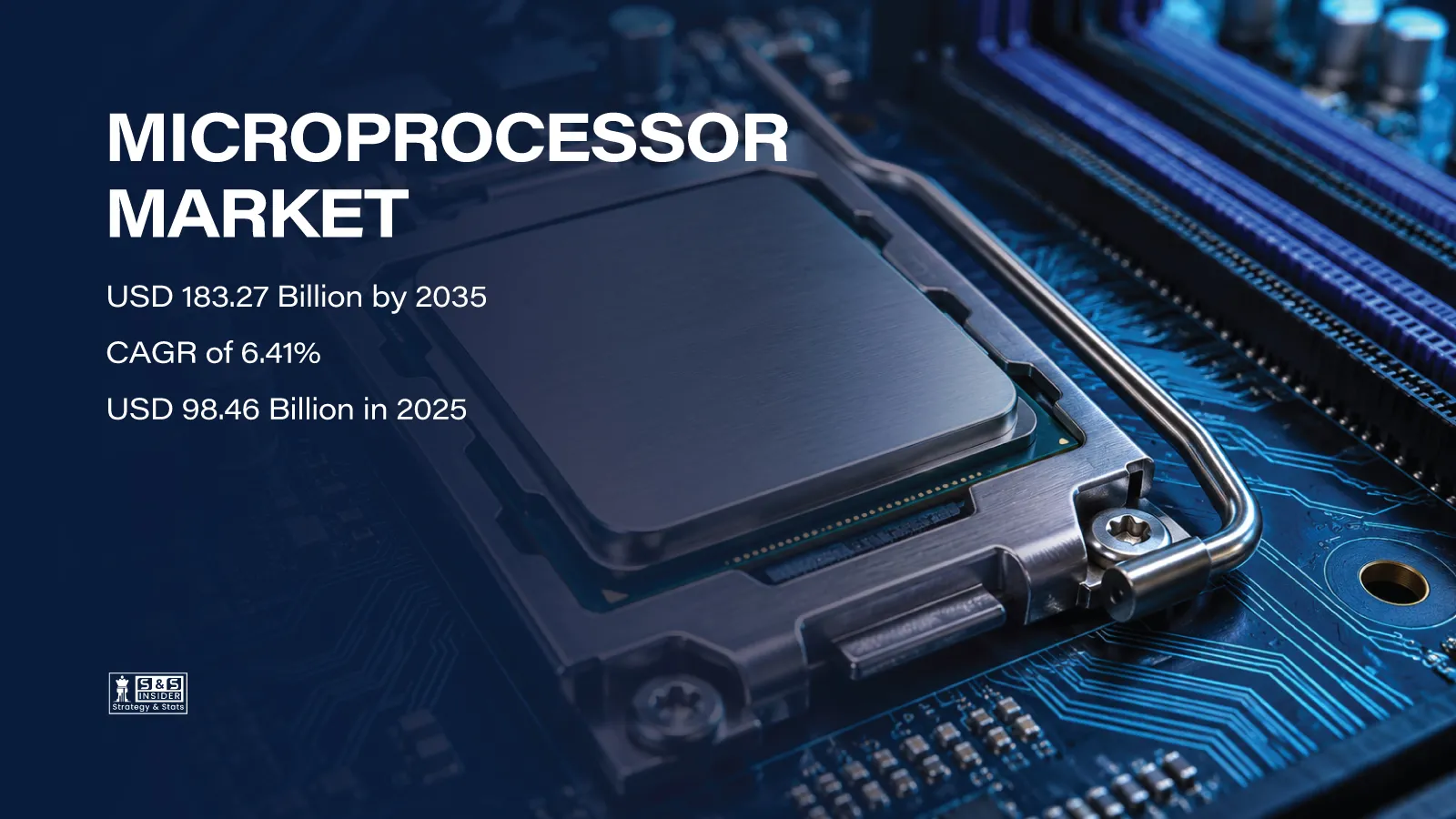
According to the latest SNS Insider Microprocessor Market report, the global market was valued at USD 98.46 billion in 2025 and is estimated to reach USD 104.77 billion in 2026. Revenue is projected to increase to USD 183.27 billion by 2035, representing a CAGR of 6.41% during 2026–2035.
Market expansion is increasingly influenced by demand for energy-efficient computing, AI-enabled personal computers, advanced server processors and specialized semiconductor architectures. Manufacturers are investing in smaller fabrication nodes, chiplet integration and embedded neural processing capabilities to improve computational performance while managing energy consumption.
Asia-Pacific dominates global demand through its extensive semiconductor manufacturing ecosystem and electronics production capabilities. Meanwhile, Latin America is expected to record the fastest regional growth, supported by expanding electronics assembly and digital infrastructure investment.
Market Size and Forecast
|
Market Indicator |
Value |
|---|---|
|
Market Size, 2025 |
USD 98.46 Billion |
|
Market Size, 2026 |
USD 104.77 Billion |
|
Market Forecast, 2035 |
USD 183.27 Billion |
|
CAGR, 2026–2035 |
6.41% |
|
Largest Region |
Asia-Pacific (41.86%) |
|
Fastest-Growing Region |
Latin America (7.11% CAGR) |
|
Leading Architecture |
x86 (57.48%) |
|
Leading Application |
Consumer Electronics (34.62%) |
Demand Drivers and Market Constraints
Primary Demand Drivers
-
Artificial intelligence infrastructure: Growing AI workloads are increasing demand for powerful server processors capable of supporting complex computing environments and accelerator coordination.
-
Cloud and data center investment: Expansion of hyperscale infrastructure and enterprise cloud services is strengthening demand for high-performance processors with improved memory bandwidth and computing efficiency.
-
AI-enabled personal computers: Integration of neural processing units into laptops and desktops is encouraging processor upgrades and supporting new product development.
-
Automotive electronics: Increasing adoption of digital cockpits, advanced driver assistance systems and centralized vehicle computing is expanding processor requirements.
-
Industrial automation: Smart factories, robotics, machine vision and connected production systems require reliable processing platforms.
-
Advanced semiconductor manufacturing: Smaller fabrication nodes and chiplet-based designs support greater transistor density, computational performance and power efficiency.
Potential Market Constraints
-
Increasing costs associated with advanced processor design and semiconductor fabrication.
-
Supply chain concentration across leading-edge foundry and advanced packaging facilities.
-
Export restrictions and geopolitical uncertainty affecting international semiconductor trade.
-
Rising cooling requirements and electricity consumption in high-performance computing environments.
-
Software compatibility challenges when migrating between processor architectures.
Demand Structure by Architecture
x86 Architecture (2025 Market Share: 57.48%)
The x86 architecture represented approximately 57.48% of global microprocessor revenue in 2025, maintaining its leadership across desktop computers, enterprise laptops and server infrastructure.
Extensive software compatibility, established operating system support and widespread enterprise deployment contribute to continued demand. Organizations operating large computing environments frequently prioritize platform stability, application compatibility and predictable hardware performance. Manufacturers continue developing x86 processors with improved core configurations, AI capabilities and power management features.
Current trend: Continued modernization of enterprise computing and high-performance processor platforms.
Major trends: AI-enabled CPUs, chiplet integration, hybrid core configurations and energy-efficient server computing.
RISC-V Architecture (Forecast CAGR: 20.84%)
RISC-V is expected to register the fastest architectural growth, with a projected CAGR of 20.84% during 2026–2035.
The open instruction set architecture allows semiconductor designers to develop customized processor implementations without traditional instruction-set licensing restrictions. This flexibility is attracting interest in embedded computing, industrial equipment, edge AI and specialized electronic systems. Expanding software development tools and processor ecosystems are improving commercial accessibility.
Current trend: Growing investment in customizable and open-standard processor architectures.
Major trends: Custom silicon development, edge AI integration, embedded computing and processor ecosystem expansion.
Demand Structure by Bit Size and Process Node
64-Bit Processors (2025 Market Share: 74.63%)
The 64-bit segment dominated the market with approximately 74.63% revenue share in 2025 and is projected to grow at a CAGR of 7.14%. Modern operating systems, data-intensive applications and high-performance computing platforms increasingly require substantial memory addressing capabilities and advanced instruction processing. Demand extends across servers, smartphones, personal computers and sophisticated industrial systems.
Current trend: Increasing standardization of 64-bit computing across advanced applications.
10 nm to 28 nm Process Nodes (2025 Market Share: 44.52%)
Processors manufactured using 10 nm to 28 nm technologies accounted for 44.52% of market revenue in 2025.
These established fabrication technologies provide an effective balance of manufacturing cost, performance and reliability, supporting automotive electronics, industrial computing and mainstream connected devices. Meanwhile, process nodes below 10 nm are projected to expand at a CAGR of 10.86% as manufacturers pursue higher processor performance and improved energy efficiency.
Current trend: Parallel investment in cost-efficient mature nodes and advanced semiconductor manufacturing technologies.
Demand Structure by Application
Consumer Electronics (2025 Market Share: 34.62%)
Consumer electronics represented the largest application segment, accounting for approximately 34.62% of global microprocessor revenue in 2025. Smartphones, laptops, desktops, tablets and gaming devices generate substantial processor demand through continuous product innovation and replacement cycles.
Integration of AI capabilities, improved graphics processing and enhanced battery efficiency is encouraging manufacturers to introduce more advanced processor configurations. The expansion of on-device AI could strengthen demand for premium processors capable of performing selected computing tasks locally.
Current trend: Growing adoption of AI-capable consumer electronics.
Major trends: Integrated neural processing, energy-efficient computing, advanced graphics and next-generation personal computers.
Data Centers and IT (Forecast CAGR: 9.31%)
Data centers and IT represent the fastest-growing application segment, with a projected CAGR of 9.31% during 2026–2035. Demand is supported by expanding cloud infrastructure, enterprise digital transformation and AI computing deployments.
Server operators increasingly require processors offering higher core density, efficient memory access and improved performance per watt. Modern data centers also depend on general-purpose CPUs to coordinate computing resources alongside specialized AI accelerators.
Current trend: Increasing investment in high-performance and energy-efficient server architectures.
Major trends: AI server modernization, hyperscale expansion, custom processors and advanced memory integration.
Demand Structure by Power Class
Above 65 W Processors (2025 Market Share: 48.72%)
Processors rated above 65 W held approximately 48.72% of global market revenue in 2025. High-performance servers, workstations and premium desktop computers require substantial computing capabilities, supporting demand for processors with higher core counts and advanced features.
Processors below 15 W are expected to grow at the fastest rate, registering a CAGR of 8.14% through 2035. Low-power computing requirements across portable electronics, industrial gateways and edge AI systems are supporting this expansion.
Current trend: Increasing emphasis on balancing computational performance with power consumption.
Regional Market Dynamics
Asia-Pacific (2025 Market Share: 41.86%)
Asia-Pacific accounted for 41.86% of global microprocessor revenue in 2025, establishing its position as the leading regional market. The region benefits from extensive semiconductor fabrication, electronics assembly and advanced packaging capabilities.
China represents a major market for electronic device manufacturing, while Taiwan, South Korea and Japan provide essential semiconductor production expertise. India and Southeast Asian economies are also expanding their electronics manufacturing and semiconductor ecosystem participation.
Direction: Continued leadership through manufacturing scale, technology investment and expanding computing demand.
North America (2025 Market Share: 27.43%)
North America accounted for approximately 27.43% of the global market in 2025. The United States remains a major center for processor design, enterprise computing, AI infrastructure and semiconductor innovation.
Demand is supported by established technology companies, hyperscale data center investments and expanding applications of advanced computing in automotive and industrial sectors. Domestic semiconductor manufacturing initiatives may also strengthen supply chain resilience.
Direction: Sustained demand supported by processor innovation and AI infrastructure development.
Europe
Europe maintains an important position in the microprocessor industry through automotive electronics, industrial automation and advanced manufacturing applications. Germany and other major European economies generate demand for reliable processors used in connected vehicles, factory automation and specialized industrial equipment. Energy efficiency, long product lifecycles and supply security remain important purchasing considerations.
Direction: Steady expansion supported by automotive digitalization and industrial modernization.
Latin America (Forecast CAGR: 7.11%)
Latin America is projected to be the fastest-growing region, registering a CAGR of 7.11% during 2026–2035. Brazil and Mexico are key markets, supported by electronics manufacturing, automotive production and expanding digital infrastructure. Growing investment in enterprise computing and data center facilities is expected to create additional opportunities.
Direction: Accelerating demand from electronics production and digital infrastructure development.
Middle East & Africa
The Middle East and Africa market is developing through investments in data centers, telecommunications infrastructure and digital transformation. Cloud services, enterprise modernization and smart infrastructure projects are creating demand for advanced computing systems.
Direction: Gradual expansion supported by digital infrastructure and technology investment.
Competitive Landscape
The global microprocessor market includes established semiconductor designers and specialized embedded processor manufacturers. Key participants include Intel, Advanced Micro Devices (AMD), Qualcomm, NVIDIA, NXP Semiconductors, Microchip Technology and Renesas Electronics.
Competition increasingly focuses on computing efficiency, processor architecture, AI integration, manufacturing partnerships and software ecosystem support. Intel and AMD maintain important positions in enterprise and consumer computing, while Qualcomm provides processing platforms for mobile and connected devices. NVIDIA participates in advanced data center computing, while NXP, Microchip Technology and Renesas serve specialized industrial, embedded and automotive applications.
Market Outlook (2026–2035)
The global microprocessor market is projected to increase from USD 104.77 billion in 2026 to USD 183.27 billion by 2035, supported by expanding artificial intelligence applications, growing data center infrastructure and increasing semiconductor integration across connected systems.
Advanced process technologies and chiplet-based architectures are expected to influence future product development, while RISC-V adoption creates opportunities for customized computing platforms. Consumer electronics will remain an important source of revenue, although data centers and IT are expected to generate faster application-level growth.
Asia-Pacific is positioned to maintain regional leadership, while Latin America presents emerging opportunities.
Overall, the microprocessor industry is expected to experience sustained expansion through 2035, with future competitiveness shaped by AI performance, power efficiency, architectural flexibility and semiconductor supply chain resilience.



