The global wireless home security camera market is entering a period of rapid expansion as homeowners increasingly prioritize property protection, remote surveillance, and connected home convenience. Growing concerns about unauthorized access, package theft, and residential security are encouraging consumers to adopt intelligent monitoring solutions that provide real-time alerts and remote video access.
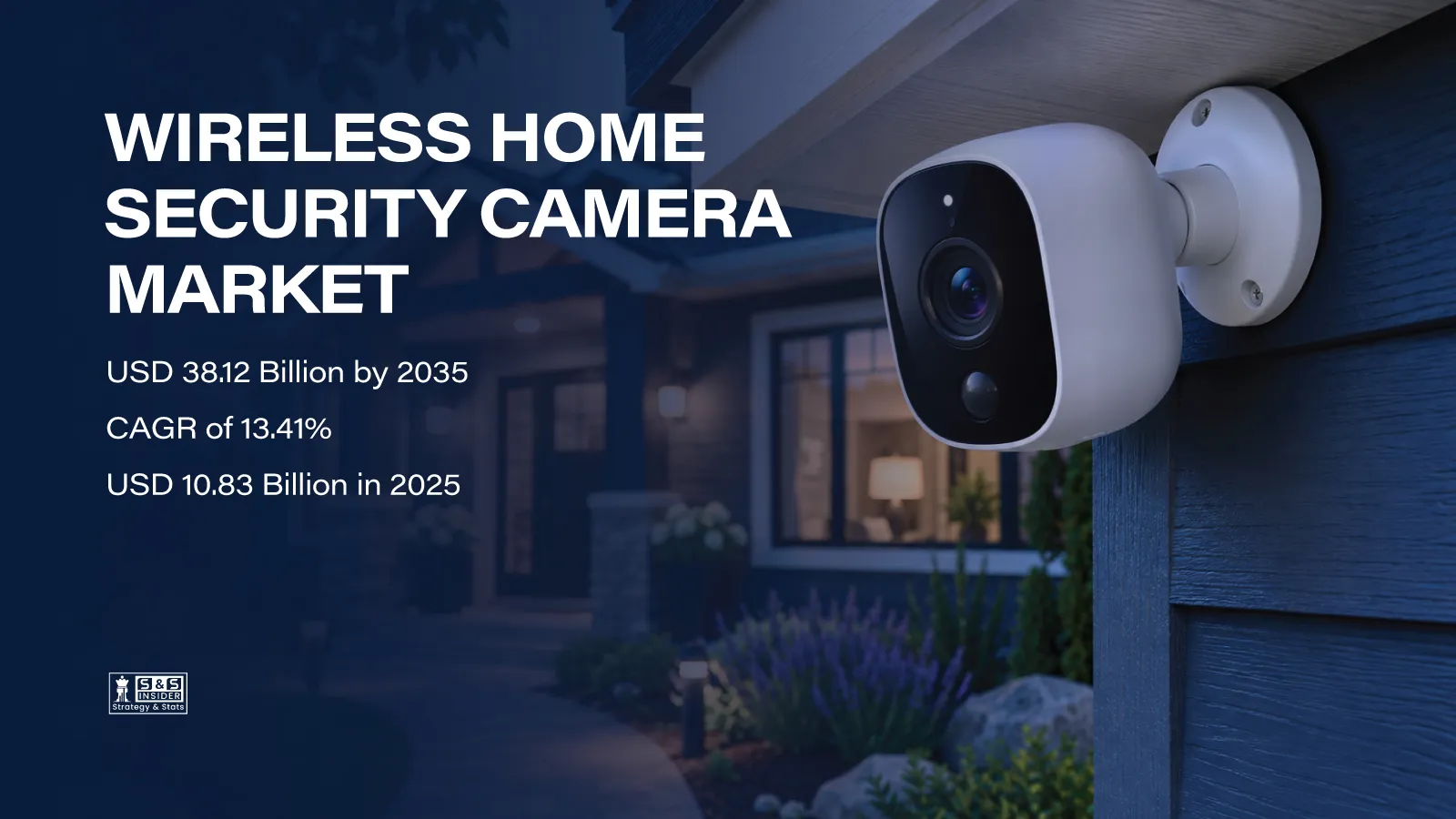
According to SNS Insider, the Wireless Home Security Camera Market was valued at USD 10.83 Billion in 2025 and is expected to reach USD 12.28 Billion in 2026, expanding to USD 38.12 Billion by 2035 at a CAGR of 13.41% during 2026–2035.
The industry is transitioning from conventional video recording devices toward intelligent surveillance ecosystems incorporating artificial intelligence, cloud storage, motion detection, and smartphone connectivity. Consumers increasingly prefer wireless systems because they simplify installation, reduce infrastructure requirements, and support flexible camera placement.
Manufacturers are responding with higher-resolution imaging, solar-powered operation, intelligent object recognition, and integrated smart home functionality. Subscription-based services are also becoming important revenue opportunities as customers seek extended video histories, advanced notifications, and remote monitoring capabilities.
North America remains the largest regional market, while Asia-Pacific offers the strongest growth potential through 2035, supported by expanding urban housing, increasing smartphone penetration, and affordable connected security technologies.
Market Size and Forecast
|
Market Indicator |
Value |
|---|---|
|
Market Size, 2025 |
USD 10.83 Billion |
|
Market Size, 2026 |
USD 12.28 Billion |
|
Market Forecast, 2035 |
USD 38.12 Billion |
|
CAGR, 2026–2035 |
13.41% |
|
Largest Regional Market |
North America (38.27%) |
|
Fastest-Growing Region |
Asia-Pacific (16.14% CAGR) |
|
Leading Product Segment |
Outdoor Cameras (40.19%) |
|
Leading Connectivity Segment |
Wi-Fi (67.38%) |
Demand Drivers and Market Constraints
Primary Demand Drivers
-
Growing residential security awareness: Concerns surrounding burglary, package theft, and unauthorized property access are encouraging households to install surveillance cameras.
-
Increasing smart home adoption: Integration with smart locks, connected lighting, voice assistants, and mobile applications is expanding the practical value of security cameras.
-
Advancements in artificial intelligence: Intelligent motion detection, package identification, and automated video analysis are improving monitoring accuracy and convenience.
-
Rising preference for wireless installation: Battery-operated cameras, solar charging, and simplified mobile setup make surveillance accessible to homeowners and renters.
-
Expanding e-commerce distribution: Online marketplaces enable consumers to compare features, prices, and subscription packages while increasing market access for manufacturers.
-
Growing demand for remote monitoring: Property owners increasingly require real-time visibility over residences, vacation homes, rental properties, and secondary entrances.
Potential Market Constraints
-
Cybersecurity vulnerabilities and concerns surrounding unauthorized video access.
-
Recurring subscription expenses associated with cloud recording and intelligent monitoring features.
-
Limited battery life and inconsistent wireless connectivity in certain locations.
-
Compatibility challenges between competing smart home ecosystems.
-
Price competition and rising product security compliance requirements.
Demand Structure by Product Type
Outdoor Cameras Dominate the Market with 40.19% Share
Outdoor cameras accounted for approximately 40.19% of global revenue in 2025, making them the largest product category. Consumers prioritize monitoring entrances, driveways, gardens, and property boundaries, supporting demand for weather-resistant devices with night vision and wide-angle recording.
Manufacturers are introducing integrated floodlights, improved low-light sensors, and solar-powered charging to strengthen outdoor surveillance capabilities. Wireless installation also allows consumers to expand coverage without extensive electrical modifications. Demand is expected to remain strong as property owners increasingly adopt multiple cameras for comprehensive residential monitoring.
Current trend: Growing installation of intelligent, weather-resistant outdoor security cameras.
Major trends: Solar charging, color night vision, AI-based motion recognition, floodlight integration, and battery-powered surveillance.
Doorbell Cameras Register the Fastest Growth at 17.21% CAGR
Doorbell cameras are projected to expand at a CAGR of 17.21% during 2026–2035. These devices combine entrance surveillance, visitor communication, and package monitoring within a compact connected system. Two-way audio, smartphone notifications, and integrated video recording are making smart doorbells increasingly appealing to residential consumers.
Apartment residents and rental property owners represent additional opportunities as manufacturers introduce flexible mounting solutions and simpler installation processes. Increasing integration with smart displays and residential access control systems is expected to support further market expansion.
Current trend: Rising adoption of video doorbells for entrance security and delivery monitoring.
Major trends: Package detection, two-way communication, smart display integration, and intelligent visitor notifications.
Demand Structure by Connectivity
Wi-Fi Leads with 67.38% Market Share
Wi-Fi represented approximately 67.38% of the wireless home security camera market in 2025. Its widespread availability in residential properties, relatively low connection costs, and compatibility with smartphone applications make Wi-Fi the preferred connectivity technology.
Manufacturers continue improving wireless performance through dual-band connectivity, better video compression, and compatibility with home mesh networks. Wi-Fi cameras are particularly attractive to first-time security system buyers because installation generally requires limited technical expertise.
Current trend: Continued preference for affordable, app-connected Wi-Fi surveillance devices.
Major trends: Dual-band connectivity, mesh network compatibility, remote video streaming, and simplified device configuration.
Cellular Cameras Expand at 21.81% CAGR
Cellular-connected security cameras are expected to register the fastest connectivity growth, with a CAGR of 21.81% through 2035. Unlike conventional Wi-Fi systems, cellular cameras can operate in locations without fixed broadband connections. This makes them useful for vacation properties, remote buildings, agricultural residences, and outdoor monitoring installations. Advancements in 4G and 5G connectivity, combined with battery and solar power, are broadening potential applications.
Current trend: Increasing demand for independent surveillance systems in remote locations.
Major trends: 4G/5G connectivity, off-grid monitoring, solar-powered cameras, and bundled mobile data services.
Demand Structure by Storage, Resolution, and Camera Technology
Cloud Storage Dominates with 48.27% Share
Cloud storage accounted for 48.27% of market revenue in 2025 and is forecast to grow at a CAGR of 14.76% during 2026–2035. Consumers increasingly value remote video access, automatic backups, and recorded footage that remains accessible if a camera is damaged or stolen.
Manufacturers are combining cloud storage with intelligent alerts, video summaries, and extended recording history through subscription services. However, ongoing fees and privacy concerns are supporting demand for hybrid systems offering both cloud and local storage.
Current trend: Growing demand for subscription-based video management and intelligent cloud services.
Major trends: AI video search, remote footage retrieval, encrypted storage, and hybrid recording solutions.
HD Cameras Lead While 4K Technology Gains Momentum
HD cameras held approximately 46.74% of global revenue in 2025, reflecting their affordability, moderate bandwidth requirements, and suitability for routine residential monitoring. However, 4K cameras are expected to achieve a CAGR of 18.37% through 2035 as consumers demand greater image detail and improved digital zoom. Advancements in imaging sensors and compression technologies are making ultra-high-definition surveillance more accessible.
Current trend: Gradual transition toward higher-resolution residential monitoring.
Major trends: 4K imaging, enhanced night vision, efficient video compression, and intelligent image processing.
IP Cameras Hold 59.48% Share as PTZ Adoption Accelerates
IP cameras represented 59.48% of market revenue in 2025, supported by convenient network connectivity and compatibility with connected home platforms. Meanwhile, pan-tilt-zoom cameras are forecast to grow at a CAGR of 15.62% during 2026–2035.
PTZ systems allow users to monitor larger areas through adjustable viewing angles and automated tracking capabilities, reducing the need for multiple fixed-position devices in some applications.
Current trend: Increasing interest in flexible and intelligent residential surveillance coverage.
Major trends: Automated object tracking, motorized camera movement, dual-lens configurations, and remote viewing controls.
Regional Market Dynamics
North America Leads with 38.27% Market Share
North America accounted for approximately 38.27% of global revenue in 2025, supported by widespread smart home adoption, strong consumer purchasing power, and established electronics distribution networks.
The United States wireless home security camera market was valued at USD 3.51 Billion in 2025, with a projected CAGR of 11.79% during 2026–2035. Demand is supported by residential property monitoring, video doorbell installations, and subscription-enabled security services.
Direction: Continued market leadership through intelligent surveillance technology and connected home integration.
Asia-Pacific Registers the Fastest Growth at 16.14% CAGR
Asia-Pacific represented 25.46% of the global market in 2025 and is projected to grow at a CAGR of 16.14% through 2035. Rapid urbanization, rising disposable income, expanding e-commerce networks, and increasing residential construction are creating opportunities across China, India, Japan, and South Korea. Affordable camera models and growing smartphone adoption are making wireless surveillance accessible to broader consumer groups.
Direction: Rapid expansion supported by urban housing growth, cost-effective devices, and smart home adoption.
Europe Maintains a Strong Market Position
Europe accounted for approximately 24.89% of global revenue in 2025. Germany, the United Kingdom, and France are important markets, supported by consumer demand for residential security and privacy-conscious connected devices. Data protection requirements and cybersecurity expectations are encouraging manufacturers to improve encryption, storage transparency, and device security.
Direction: Steady expansion supported by secure smart home technologies and regulatory compliance.
Latin America and Middle East & Africa
Latin America represented 5.74% of the market in 2025, while the Middle East & Africa accounted for 5.64%. Brazil and Mexico are important Latin American markets, supported by security concerns and expanding online electronics distribution. Meanwhile, the UAE, Saudi Arabia, and South Africa are contributing to demand through residential development and increasing adoption of connected surveillance technologies.
Direction: Emerging opportunities through affordable wireless systems, residential construction, and improving connectivity.
Competitive Landscape
The wireless home security camera market includes established consumer electronics manufacturers, smart home technology companies, and specialized surveillance providers.
Leading companies include Ring, Arlo Technologies, Google Nest, Eufy, TP-Link (Tapo), Reolink, and Hikvision.
Competition increasingly focuses on imaging quality, artificial intelligence capabilities, battery performance, cloud services, cybersecurity, and device affordability. Manufacturers are introducing advanced products combining intelligent detection, high-resolution recording, and flexible connectivity to address evolving consumer expectations.
Market Outlook (2026–2035)
The global wireless home security camera market is projected to reach USD 38.12 Billion by 2035, supported by increasing residential security awareness and continued adoption of intelligent connected devices. Artificial intelligence is expected to become an increasingly important competitive differentiator as consumers seek more accurate notifications, automated monitoring, and convenient video management.
Doorbell cameras, cellular connectivity, 4K resolution, and PTZ technology represent important growth opportunities, while subscription-based cloud services provide manufacturers with recurring revenue potential. Nevertheless, cybersecurity concerns, subscription fatigue, and product compatibility challenges will influence purchasing decisions.
North America is expected to maintain its established market position, while Asia-Pacific will provide substantial opportunities through expanding urban housing and technology adoption.
Overall, the wireless home security camera market is positioned for significant expansion through 2035, with future competitiveness increasingly shaped by intelligent surveillance, affordability, privacy protection, and seamless smart home integration.