
The global cotton yarn market is positioned for steady expansion through 2035, supported by increasing apparel production, demand for comfortable natural-fiber fabrics and investments in modern spinning technologies. Cotton yarn remains a critical raw material for textile manufacturers producing garments, bedding, towels, denim and industrial fabrics.
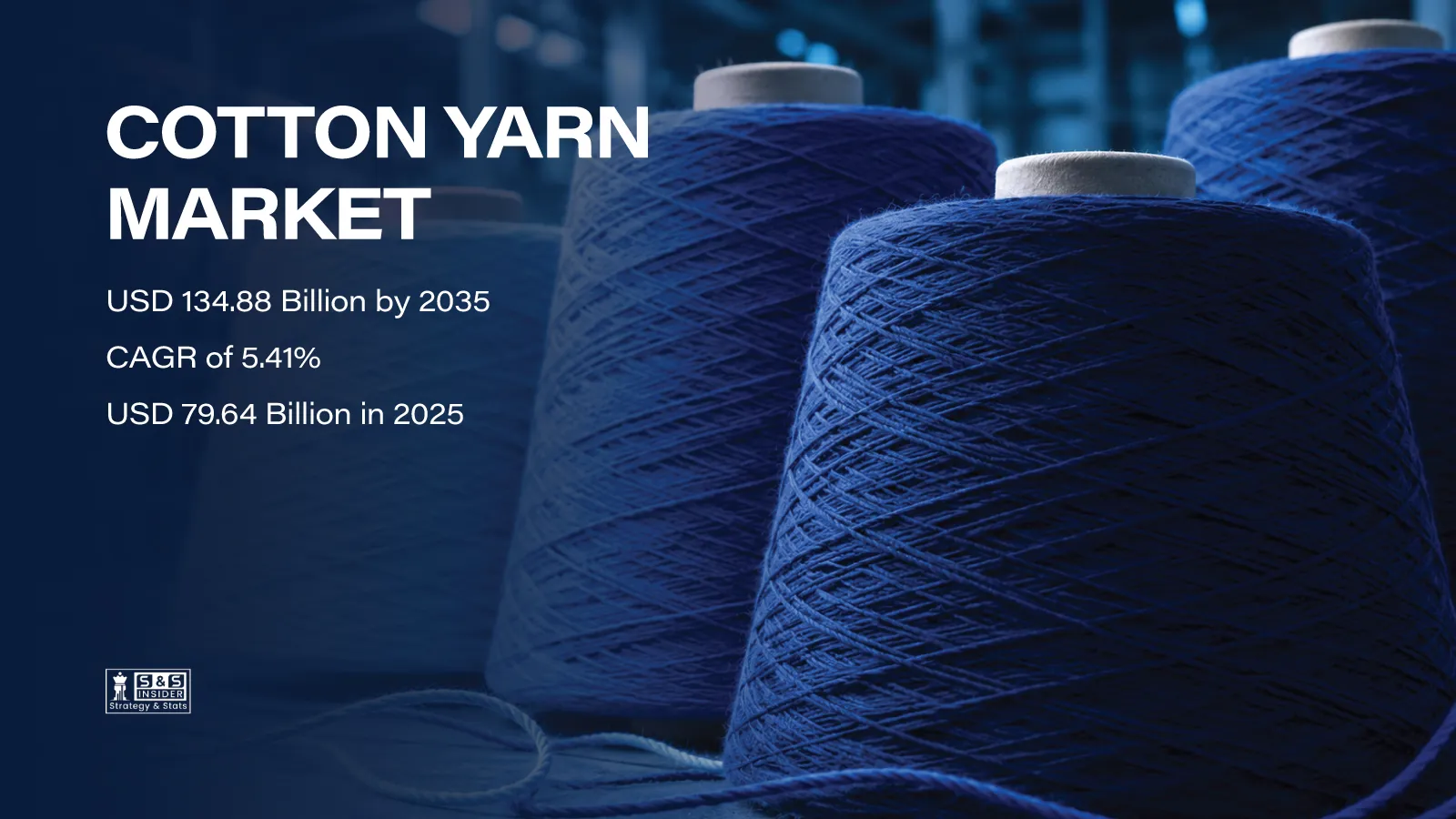
According to SNS Insider, the global cotton yarn market was valued at USD 79.64 billion in 2025, is expected to reach USD 83.95 billion in 2026 and is forecast to attain USD 134.88 billion by 2035, registering a CAGR of 5.41% during 2026–2035.
The industry is witnessing a transition toward higher-quality yarns, automated manufacturing operations and traceable cotton sourcing. Manufacturers are increasingly investing in combed yarn processing, air-jet spinning and digital quality-control systems to improve productivity and meet changing textile specifications.
Asia-Pacific remains the dominant production and consumption center, accounting for 69.48% of global revenue in 2025. The region is also expected to record the fastest growth, reflecting the extensive textile manufacturing infrastructure across China, India, Pakistan, Bangladesh and Vietnam.
Market Size and Forecast
|
Market Indicator |
Value |
|---|---|
|
Market Size, 2025 |
USD 79.64 Billion |
|
Market Size, 2026 |
USD 83.95 Billion |
|
Market Forecast, 2035 |
USD 134.88 Billion |
|
CAGR, 2026–2035 |
5.41% |
|
Leading Region, 2025 |
Asia-Pacific (69.48%) |
|
Fastest-Growing Region |
Asia-Pacific (5.79% CAGR) |
|
Leading Yarn Type |
Carded Yarn (58.37%) |
|
Leading Application |
Apparel (67.12%) |
Demand Drivers and Constraints
Primary Demand Drivers
- Expanding apparel manufacturing: Increasing garment consumption, urbanization and textile export activity are supporting cotton yarn demand across established and developing manufacturing economies.
- Preference for natural fibers: Demand for breathable, comfortable and responsibly sourced fabrics is encouraging textile manufacturers to incorporate cotton into premium and everyday clothing.
- Growth in home furnishings: Rising consumption of bedding, towels, curtains and upholstery is creating additional opportunities for cotton yarn suppliers.
- Modernization of spinning mills: Investments in high-speed spinning equipment, automated winding and digital process monitoring are improving production efficiency.
- Sustainable textile sourcing: Greater attention to cotton traceability, certified sourcing and recycled fiber content is influencing procurement strategies.
- Government manufacturing initiatives: Textile infrastructure programs and industrial incentives are supporting spinning capacity development in major producing countries.
Potential Growth Constraints
- Volatility in raw cotton prices caused by agricultural production conditions and international trade developments.
- Competition from polyester and other synthetic yarns offering lower costs in selected applications.
- Rising electricity, labor and equipment maintenance expenses.
- Increasing compliance requirements involving sustainability claims and supply chain documentation.
- Trade restrictions, currency fluctuations and unpredictable textile export orders.
Demand Structure by Yarn Type
Carded Yarn — Largest Segment (58.37% Share in 2025)
Carded yarn dominated the cotton yarn market with approximately 58.37% revenue share in 2025.
Its widespread adoption reflects comparatively economical manufacturing, versatility and suitability for high-volume textile applications. Carded yarn is commonly used in casual clothing, denim, towels, workwear and basic knitted fabrics.
Manufacturers favor this category because it accommodates a broad range of cotton fiber grades and supports cost-efficient production. Large-scale apparel manufacturers and home textile producers remain important customers, particularly in price-sensitive markets.
Current trend: Sustained demand for economical yarn used in mass-market textile manufacturing.
Major trends: Production optimization, automated spinning operations, consistent yarn quality and export-oriented manufacturing.
Combed Yarn — Fastest-Growing Segment (6.53% CAGR)
Combed yarn is projected to register the fastest growth among yarn types, expanding at approximately 6.53% annually during 2026–2035. The additional fiber preparation process produces smoother yarn with fewer short fibers, making it suitable for premium shirts, fine knitwear, hosiery and baby clothing.
Growing consumer interest in fabric softness, appearance and durability is supporting demand for higher-grade cotton yarn. Manufacturers serving premium fashion brands are therefore increasing their focus on specialized yarn production and improved fiber processing.
Current trend: Increasing demand for premium-quality cotton yarn.
Major trends: Fine-count yarn production, improved fiber uniformity, premium apparel applications and modernization of combing equipment.
Demand Structure by Spinning Technology
Ring-Spun Yarn — Largest Segment (51.76% Share in 2025)
Ring-spun yarn was the leading spinning technology segment, holding approximately 51.76% of the market in 2025.
Its established position is due to its versatility, strength, softness and compatibility with numerous textile manufacturing applications. Ring spinning is still the most common method for producing the yarns needed for shirts, knitted garments, denim and high quality fabrics.
Commercial Importance: 1. Existing manufacturing infrastructure and extensive industry expertise. But more and more producers are looking to automated material handling and monitoring systems to help them minimise production losses and maximise operating efficiency.
Current trend: Continued reliance on established ring-spinning infrastructure with increasing automation.
Major trends: Process digitization, equipment modernization, improved productivity and quality consistency.
Air-Jet Yarn — Fastest-Growing Segment (6.38% CAGR)
Air-jet spinning is anticipated to expand at a CAGR of ~6.38% through 2035. The technology allows the production of high-speed yarns by forming fibres with compressed air, offering advantages in terms of productivity and reduced manual intervention.
The commercial appeal is growing with mills seeking efficient production systems and competitive operating costs. Air-jet yarn is suitable for selected apparel, bedding and blended textile applications requiring consistent performance.
Current trend: Increasing investment in high-speed spinning technologies.
Major trends: Labor efficiency, digital monitoring, production scalability and advanced textile manufacturing systems.
Demand Structure by Application
Apparel — Largest Application (67.12% Share in 2025)
Clothing accounted for some 67.12% of the world demand for cotton yarn in 2025. Cotton yarn is still required for T-shirts, denims, shirts, underwear, children’s wear and many knitted and woven garments.
The segment is being helped by population growth, the expansion of retail networks and the demand for comfortable everyday clothing. Asian countries that produce textiles have large manufacturing capabilities. They supply both their own populations and foreign designers.
Current trend: Strong demand from established apparel production networks.
Major trends: Natural-fiber garments, sourcing diversification, improved fabric quality and traceable cotton supply chains.
Home Textiles — Fastest-Growing Application (6.27% CAGR)
The home textiles market is expected to grow at a CAGR of approx 6.27% from 2026-2035. Residential development, hospitality buying and replacement spending on bedding, towels, curtains and other household textile products underpin demand.
Cotton’s absorbency, comfort and ability to be washed frequently make it attractive for many home furnishing applications. Production of high-end bedding and sustainable textile collections is also creating openings for those manufacturers that make specialised yarn types.
Current trend: Expanding demand for cotton-based household furnishings.
Major trends: Premium bedding, hospitality textiles, e-commerce distribution and sustainable home furnishing collections.
Regional Market Dynamics
Asia-Pacific — Largest and Fastest-Growing Region
Asia-Pacific held the largest share of the global cotton yarn market in 2025, accounting for 69.48%, and is projected to grow at a CAGR of 5.79% during 2026-2035. China remains a major textile producing centre and India adds significant cotton production and spinning capacity.
Pakistan, Bangladesh and Vietnam have large garment and textile export operations that support regional demand. Growth is being supported by continued machinery upgrades, integrated textile manufacturing investments and growing domestic apparel consumption in the region.
Direction: Continued market leadership through manufacturing scale, exports and technology modernization.
Europe — 9.17% Market Share
Europe accounted for around 9.17% of global revenue in 2025. The regional demand is concentrated in speciality yarns, high-end apparels, fashion textiles and home furnishings
Textile manufacturers are increasingly focusing on traceable sourcing, the use of recycled cotton and differentiated product quality. The rising manufacturing costs force the manufacturers to compete on the basis of advanced manufacturing processes and premium textile applications.
Direction: Moderate expansion supported by sustainable sourcing and high-value textile production.
North America — 7.64% Market Share
North America occupied around 7.64% share of the global market in 2025. The United States cotton yarn market was valued at USD 5.07 billion in 2025 and is anticipated to grow at a CAGR of 4.63% during 2035.
Demand is driven by cotton availability, regional textile production and applications such as denim, hosiery, home furnishings and industrial fabrics. Manufacturers are focused on automation and traceability in the domestic supply chain.
Direction: Stable growth supported by manufacturing modernization and regional sourcing.
Middle East & Africa — 7.31% Market Share
Middle East & Africa contributed around 7.31% to the market share in 2025. Egypt remains a major producer of high quality cotton varieties, while new textile manufacturing hubs in Africa present opportunities to increase spinning capacity.
The regional outlook is improved by investment in infrastructure and support for the development of the textile industry, but challenges remain in terms of energy availability and logistics.
Direction: Gradual expansion driven by textile industrialization and value-added manufacturing.
Latin America — 6.40% Market Share
In 2025, Latin America contributed about 6.40% of the world’s revenue. Brazil is the regional leader, with large cotton farms and a domestic textile industry.
Mexico, Peru and Argentina are also part of regional textile supply chains. Opportunities in local processing, specialised yarns and regional sourcing partnerships are being looked at by manufacturers.
Direction: Steady development supported by cotton availability and textile supply chain integration.
Competitive Landscape
The global cotton yarn market remains fragmented, with manufacturers competing on yarn quality, production costs, raw material sourcing and delivery reliability.
Prominent companies covered in the SNS Insider report include Vardhman Textiles Limited, Trident Limited, KPR Mill Limited, Nitin Spinners Limited, Arvind Limited, Sanathan Textiles Limited, Recover and RE&UP.
Competitive strategies increasingly focus on spinning automation, premium yarn manufacturing, recycled cotton development and integration into downstream textile production.
Companies able to maintain consistent quality while managing cotton price volatility are better positioned to secure long-term relationships with international textile buyers.
Market Outlook (2026–2035)
The global cotton yarn market is projected to reach USD 134.88 billion by 2035, driven by sustained demand from apparel manufacturers, household textile producers and specialised fabric applications.
“Growth will increasingly be about balancing high-volume conventional yarn production against opportunities in premium, sustainable and technically-advanced products.” Investment in combing systems, air-jet spinning, automated monitoring and fibre traceability will impact manufacturing competitiveness.
The Asia-Pacific region will likely remain the driving force, with European and North American producers continuing to pursue quality differentiation and efficient manufacturing. Raw cotton prices will continue to fluctuate and costs of energy and competition from synthetic substitutes will remain important challenges.
Overall, the cotton yarn market is positioned for sustained expansion through 2035, with future competitiveness shaped by manufacturing efficiency, responsible sourcing, product specialization and changing global textile demand.



