
Apparel Market Report Scope & Overview:
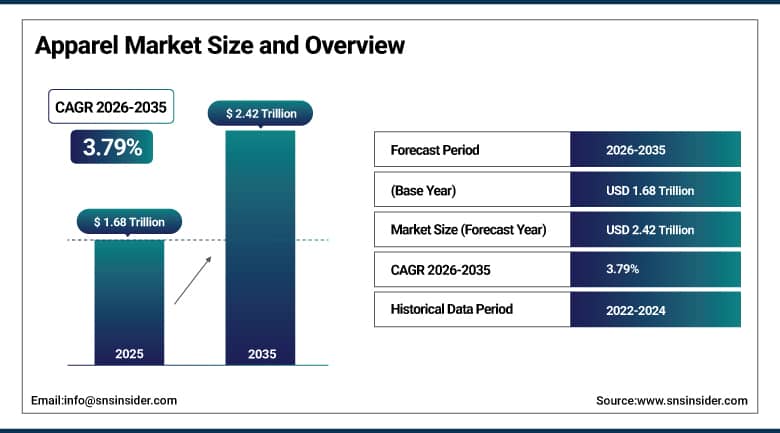
The Apparel Market was valued at USD 1.68 trillion in 2025 and is projected to reach around USD 2.42 trillion by 2035, growing at a CAGR of 3.79% from 2026–2035.
The Apparel Market is witnessing steady and structurally evolving growth driven by rising global fashion consciousness, expanding middle-class populations, and increasing disposable income levels across emerging economies. Rapid urbanization, changing lifestyle preferences, and the strong influence of social media and digital fashion trends are significantly reshaping global apparel consumption patterns. The market is further supported by the rapid expansion of organized retail, fast fashion ecosystems, and e-commerce platforms, enabling wider accessibility and faster product turnover cycles. In addition, growing demand for comfort-oriented clothing such as athleisure, casual wear, and sustainable fashion is pushing brands to innovate across fabrics, design cycles, and supply chain efficiency.
Additionally, major retail expansions by Reliance Retail and Aditya Birla Fashion & Retail, along with collaborations focused on recycled textiles, circular fashion models, and sustainable sourcing innovations, are further accelerating the transformation of the global apparel industry toward a more technology-enabled and environmentally responsible future.
To Get More Information On Apparel Market - Request Free Sample Report
Apparel Market Trends:
-
Rising fast fashion and short product life cycles are driving higher apparel consumption frequency globally.
-
Increasing adoption of AI, virtual try-on, and digital fashion tools is enhancing personalization and buying accuracy.
-
Rapid expansion of e-commerce and D2C channels is strengthening global apparel accessibility and sales growth.
-
Growing shift toward sustainable and circular fashion is boosting demand for eco-friendly and recycled textiles.
-
Rising preference for athleisure and casual wear is reshaping global apparel product demand patterns.
-
Increasing use of automation and smart manufacturing is improving production efficiency and reducing lead times.
-
Expanding influence of social media and influencer marketing is strongly driving brand visibility and consumer demand.
U.S. Apparel Market Size Outlook:
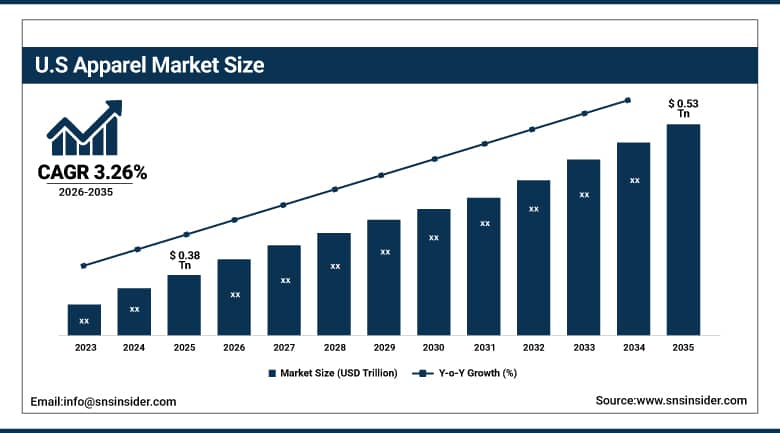
The U.S. Apparel Market was valued at USD 0.38 Trillion in 2025 and is projected to reach around USD 0.53 Trillion by 2035, growing at a CAGR of 3.26% from 2026–2035.
U.S Apparel Market is one of the most mature and high-value regional markets, driven by strong consumer spending power, high brand penetration, and rapid adoption of omnichannel retail and e-commerce platforms. The market is further supported by rising demand for premium, athleisure, and sustainable apparel, along with strong influence from global fashion brands and domestic retail giants such as Nike, Levi Strauss & Co., and VF Corporation. Increasing digitalization of retail, including AI-based personalization and virtual fitting technologies, is also reshaping how U.S. consumers discover and purchase apparel.
Recent developments highlight continued expansion of digital-first and sustainability-driven fashion strategies across major U.S. apparel players. Nike has advanced its digital ecosystem through enhanced membership-based retail and AI-powered demand forecasting to improve inventory efficiency and personalization.
Apparel Market Segment Analysis:
-
By Product Type, Casual Wear dominated the Apparel Industry with 32.36% share in 2025, while Sportswear / Activewear is the fastest-growing segment.
-
By End User, Women dominated the Apparel Industry with 46.15% share in 2025, while Women segment is also the fastest-growing across premium fashion adoption trends in emerging markets.
-
By Price Range, Economy / Mass Market segment dominated the Apparel Industry with 42.26% share in 2025, while Premium fashion segment is the fastest-growing driven by aspirational consumption trends.
-
By Fabric Type, Cotton dominated the Apparel Industry with 31.77% share in 2025, while Sustainable / Organic Fabrics are the fastest-growing segment due to eco-fashion adoption.
-
By Fashion Type, Fast Fashion dominated the Apparel Industry with 41.65% share in 2025, while Sustainable Fashion is the fastest-growing segment driven by circular fashion demand.
By End User, Women segment dominates the Apparel Market, Men segment expected to grow fastest
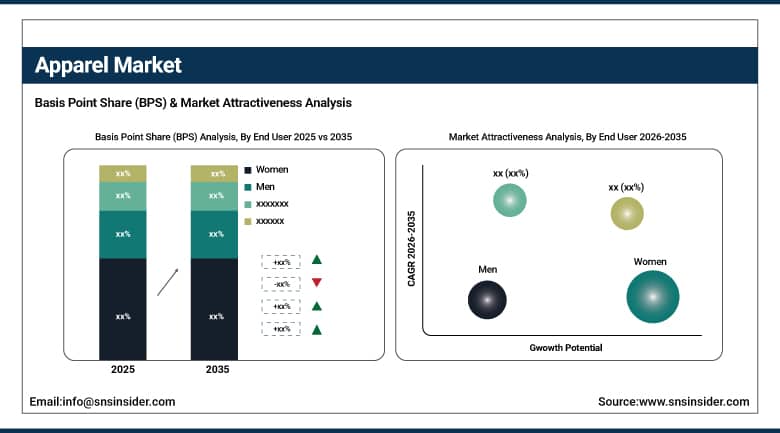
In 2025, the Women segment maintained its dominant position in the Apparel Market with a 46.15% share, driven by higher fashion engagement, faster product adoption cycles, and strong influence of seasonal and trend-based purchasing behavior. The segment continues to benefit from expanding product variety, brand targeting strategies, and rapid growth in online fashion retail platforms.
From 2026 to 2035, the Men segment is projected to record the highest CAGR, supported by rising fashion consciousness among male consumers, increasing demand for premium and athleisure apparel, and expanding grooming and lifestyle branding influence. Growth is further strengthened by digital retail penetration and rising adoption of branded casualwear.
By Product Type, Casual Wear segment dominates the Apparel Market, Sportswear / Activewear expected to grow fastest
In 2025, the Casual Wear segment maintained its dominant position in the Apparel Market, accounting for 32.36% of total revenue. This leadership is primarily driven by rising everyday clothing demand, increasing preference for comfort-oriented fashion, and strong adoption across urban and semi-urban populations globally. The segment continues to benefit from fast fashion availability, frequent wardrobe replacement cycles, and strong penetration through both offline retail and e-commerce platforms.
From 2026 to 2035, the Sportswear / Activewear segment is projected to record the highest CAGR. This rapid growth is driven by increasing health and fitness awareness, expansion of athleisure culture, and rising demand for multifunctional apparel suitable for both lifestyle and performance use. Growing sports participation and influencer-driven fitness trends are further accelerating adoption across all age groups.
By Price Range, Economy / Mass Market segment dominates the Apparel Market, Premium segment expected to grow fastest
In 2025, the Economy / Mass Market segment maintained its dominant position in the Apparel Market with a 42.26% share, supported by high-volume consumption, affordability-driven purchasing behavior, and strong penetration across developing economies. The segment benefits from large-scale retail networks, fast fashion accessibility, and frequent promotional pricing strategies.
From 2026 to 2035, the Premium segment is projected to record the highest CAGR, driven by rising disposable incomes, aspirations-based consumption behaviors, and growing inclination towards quality, branding, and lifestyle positioning. Growth in premium retail stores and digital luxury platforms is also aiding segment growth.
By Fabric Type, Cotton segment dominates the Apparel Market, Sustainable / Organic Fabrics expected to grow fastest
In 2025, the Cotton segment maintained its dominant position in the Apparel Market with a 31.77% share, powered by high levels of comfort, breathability, low costs, and extensive use in casual wear and daily wear segments. The cotton fabric is a popular choice among various apparel segments because of its versatility and global availability.
From 2026 to 2035, the Sustainable / Organic Fabrics segment is projected to record the highest CAGR.
By Fashion Type, Fast Fashion segment dominates the Apparel Market, Sustainable Fashion expected to grow fastest
In 2025, the Fast Fashion segment maintained its dominant position in the Apparel Market with a 41.65% share, It is driven by fast-moving products, trend-sensitive production cycles, and rapid growth in international retailing. This industry still profits from its affordability, marketing tactics, and effective distribution channels.
From 2026 to 2035, the Sustainable Fashion segment is projected to record the highest CAGR.
Regional Insights:
|
Region |
Major Country |
Share within Region (%) |
|---|---|---|
|
North America |
United States |
82.24% |
|
Europe |
Germany |
29.44% |
|
Asia Pacific |
China |
37.29% |
|
Middle East & Africa |
UAE |
25.19% |
|
Latin America |
Brazil |
37.59% |
Asia Pacific Apparel Market Insights
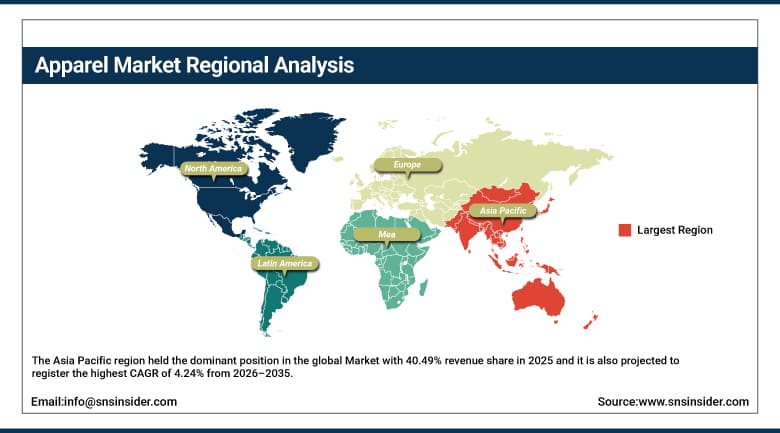
The Asia Pacific region held the dominant position in the global Market with 40.49% revenue share in 2025 and it is also projected to register the highest CAGR of 4.24% from 2026–2035, Driven by fast urbanization, rise in disposable income levels, growth in middle class population, and rise in fast fashion and e-commerce marketplaces. Countries such as China, India, Japan, South Korea, and Southeast Asia are driving demand, fueled by fashion awareness, strong textile industry, and digital fashion retailing capabilities. India and China stand out as primary drivers of growth due to significant consumption of mass fashion apparel along with growing acceptance of premium and branded fashion sectors. Furthermore, increased investment by international brands such as Inditex (Zara) and H&M to set up fast fashion operations in India and Southeast Asia as well as Reliance Retail’s omnichannel fashion strategy in India are rapidly boosting fashion penetration in the region.
Get Customized Report as Per Your Business Requirement - Enquiry Now
North America Apparel Market Insights
North America had an important place in the Apparel Market, with a high single-digit to low double-digit revenue share in 2025, due to premium fashion buying behavior, high level of organized retailing penetration, and efficient e-commerce network. North America is favored by the availability of major global apparel brands, high purchasing power, and the use of athleisure, casualwear, and premium lifestyle clothing. North America's market strength is mainly attributed to growing demand for branded fashion, digital retail transformation, and influence of social media-led fashion trends among young customers. Recent developments like the growth of Nike's AI-led digital commerce platform with personalization and membership-based retail formats and Levi Strauss & Co.'s scalable sustainable denim production through water-saving and recycled fabrics indicate leadership in innovation and sustainability in North America's apparel market.
Europe Apparel Market Insights
The continent of Europe continues to maintain a strong presence within the global market as a result of its advanced luxury fashion industry, legacy brands, and high level of emphasis placed on sustainable and premium fashion consumption. Nations like France, Italy, Germany, and the UK are at the forefront of this trend, especially when it comes to luxury fashion, sustainable textiles, and designer clothing. Consumers within Europe are now increasingly embracing sustainable fashion, circular textiles, and ethical sourcing of materials.
Latin America, Middle East & Africa (LAMEA) Apparel Market Insights
There has been a gradual increase in the demand for apparels in the LAMEA region owing to increased urbanization, increased fashion consciousness, and increased retail infrastructure in the emerging markets. Countries like Brazil, Mexico, UAE, Saudi Arabia, and South Africa have played a key role in fueling the demand in the LAMEA region especially in fast fashion, inexpensive apparel, and premium fashion segments. The growing number of youth, increased penetration of e-commerce, and global brands in urban markets are driving growth.
Market Growth Drivers:
-
Rising adoption of fast fashion ecosystems, omnichannel retail expansion, and digital-first fashion platforms is driving strong growth in the global apparel market across mass, premium, and luxury segments:
The most significant structural factor impacting the Apparel Market is the increasing move towards fashion consumption that is highly responsive, trend-based, and technologically advanced. With the rise in the preference of customers for affordable, varied, and readily available products, apparel manufacturers are adapting to quick turnaround times in designing, artificial intelligence-based demand prediction, and optimized inventory management. This structural change is resulting in increased demand for fast fashion concepts, athleisure wear, and personalized shopping in both developed and developing economies, and is also supporting e-commerce and direct-to-consumer (D2C) channels in global apparel distribution.
Additionally, recent developments such as Inditex (Zara) enhancing its AI-powered supply chain system to reduce lead times and improve inventory responsiveness across global stores and Nike expanding its digital-first retail ecosystem through membership-based personalization and predictive merchandising tools in key markets including the U.S. and Asia Pacific are reinforcing efficiency, speed-to-market, and consumer engagement across the global apparel industry.
Market Restraints:
-
Rising concerns over fast fashion overproduction, environmental sustainability, and supply chain transparency are creating structural constraints for long-term apparel market growth:
Restriction in the Apparel Market stems from increased pressure on the environment, regulatory intervention, and criticism of unsustainability in the consumption pattern of fast fashion. The growing concerns regarding environmental impact due to increased production of textiles and water usage in the production process coupled with carbon emission along the supply chain pose a threat to the global apparel market. This is further compounded by increasing consumer pressure towards ethically sourced products and sustainable production processes. The need for such changes may lead to inefficiencies in terms of cost and time involved in production. Furthermore, the growing need for compliance to regulations related to labor standards and sustainability reporting is posing challenges to global apparel companies.
Market Opportunities:
-
Rising demand for digital-first retail, personalized fashion, and sustainable apparel is creating strong growth opportunities for tech-enabled apparel brands:
The first and foremost opportunity presented by the Apparel Market is the evolution of the fashion retail sector into an extremely digital, data-oriented, and consumer-centric landscape, wherein the apparel category ceases to be simply a merchandise type but rather a fully integrated experience driven by fashion choices and identity. With AI-enabled styling services, virtual try-ons, and predictive fashion analytics gaining traction, companies can provide personalized recommendations to their customers and ensure reduced return rates along with improved consumer satisfaction. Moreover, with sustainability and ethical manufacturing becoming increasingly popular, there are ample opportunities for brands that leverage recycled materials, biodegradable fabrics, and resale or rental models.
Recent Developments:
-
2026: Inditex (Zara) advanced its AI-driven fast fashion supply chain system, enhancing real-time demand sensing and automated inventory replenishment across global markets, significantly reducing design-to-store lead times and improving stock efficiency.
-
2026: Nike expanded its digital commerce ecosystem by strengthening membership-based retail platforms and AI-powered personalization engines, improving predictive merchandising, customer engagement, and omnichannel conversion rates in key markets including North America and Asia-Pacific.
-
2025: H&M Group accelerated its circular fashion initiatives by expanding garment collection, recycling programs, and resale platforms across Europe, reinforcing its transition toward sustainable and resource-efficient fashion operations.
-
2025: Reliance Retail strengthened its omnichannel fashion infrastructure in India by scaling private label apparel expansion and integrating unified digital inventory systems, improving accessibility across Tier 1–3 cities and boosting fast fashion penetration.
Apparel Companies:
-
LVMH
-
Nike Inc.
-
Inditex S.A. (Zara)
-
Adidas AG
-
H&M Hennes & Mauritz AB
-
Fast Retailing Co. Ltd. (Uniqlo)
-
Kering S.A.
-
PVH Corp.
-
Gap Inc.
-
Levi Strauss & Co.
-
Puma SE
-
VF Corporation
-
Ralph Lauren Corporation
-
Burberry Group plc
-
American Eagle Outfitters Inc.
-
Reliance Retail Fashion & Lifestyle Ltd.
-
Aditya Birla Fashion and Retail Ltd.
-
Under Armour Inc.
-
TJX Companies Inc.
-
Ross Stores Inc.
Apparel Market Report Scope:
| Report Attributes | Details |
|---|---|
| Market Size in 2025 | USD 1.68 Trillion |
| Market Size by 2035 | USD 2.42 Trillion |
| CAGR | CAGR of 3.79% From 2026 to 2035 |
| Base Year | 2025 |
| Forecast Period | 2026-2035 |
| Historical Data | 2022-2024 |
| Report Scope & Coverage | Market Size, Segments Analysis, Competitive Landscape, Regional Analysis, DROC & SWOT Analysis, Forecast Outlook |
| Key Segments | By Product Type (Casual Wear, Formal Wear, Sportswear / Activewear, Ethnic Wear, Winter Wear, Innerwear & Loungewear) By End User (Men, Women, Kids) By Price Range (Economy / Mass Market, Mid-Range, Premium, Luxury) By Fabric Type (Cotton, Polyester, Denim, Wool, Silk, Sustainable / Organic Fabrics) By Fashion Type (Fast Fashion, Sustainable Fashion, Luxury Fashion, Athleisure) |
| Regional Analysis/Coverage | North America (US, Canada), Europe (Germany, UK, France, Italy, Spain, Russia, Poland, Rest of Europe), Asia Pacific (China, India, Japan, South Korea, Australia, ASEAN Countries, Rest of Asia Pacific), Middle East & Africa (UAE, Saudi Arabia, Qatar, South Africa, Rest of Middle East & Africa), Latin America (Brazil, Argentina, Mexico, Colombia, Rest of Latin America). |
| Company Profiles | LVMH, Nike Inc., Inditex S.A. (Zara), Adidas AG, H&M Hennes & Mauritz AB, Fast Retailing Co. Ltd. (Uniqlo), Kering S.A., PVH Corp., Gap Inc., Levi Strauss & Co., Puma SE, VF Corporation, Ralph Lauren Corporation, Burberry Group plc, American Eagle Outfitters Inc., Reliance Retail Fashion & Lifestyle Ltd., Aditya Birla Fashion and Retail Ltd., Under Armour Inc., TJX Companies Inc., Ross Stores Inc. |

Frequently Asked Questions
Asia Pacific dominated the Apparel Market in 2025.
The Casual Wear segment dominated the Apparel Market in 2025.
Rapid expansion of fast fashion ecosystems, rising digital-first apparel retail, and growing demand for athleisure and sustainable fashion is the primary growth driver of the Apparel Market
The Apparel Market was valued at USD 1.68 Trillion in 2025.
The Apparel Market is expected to grow at a CAGR of 3.79% from 2026 to 2035.
