
The global krypton market is geared for a phase of moderate, but strategically significant growth propelled by increasing demand for the rare atmospheric gas. Demand is being driven by its use in semiconductor manufacturing, high-performance building materials, and specialized industrial processing. Krypton is a tiny niche in the industrial gas market but its unique thermal and electronic properties make it useful in applications where conventional gasses have no chance of competing.
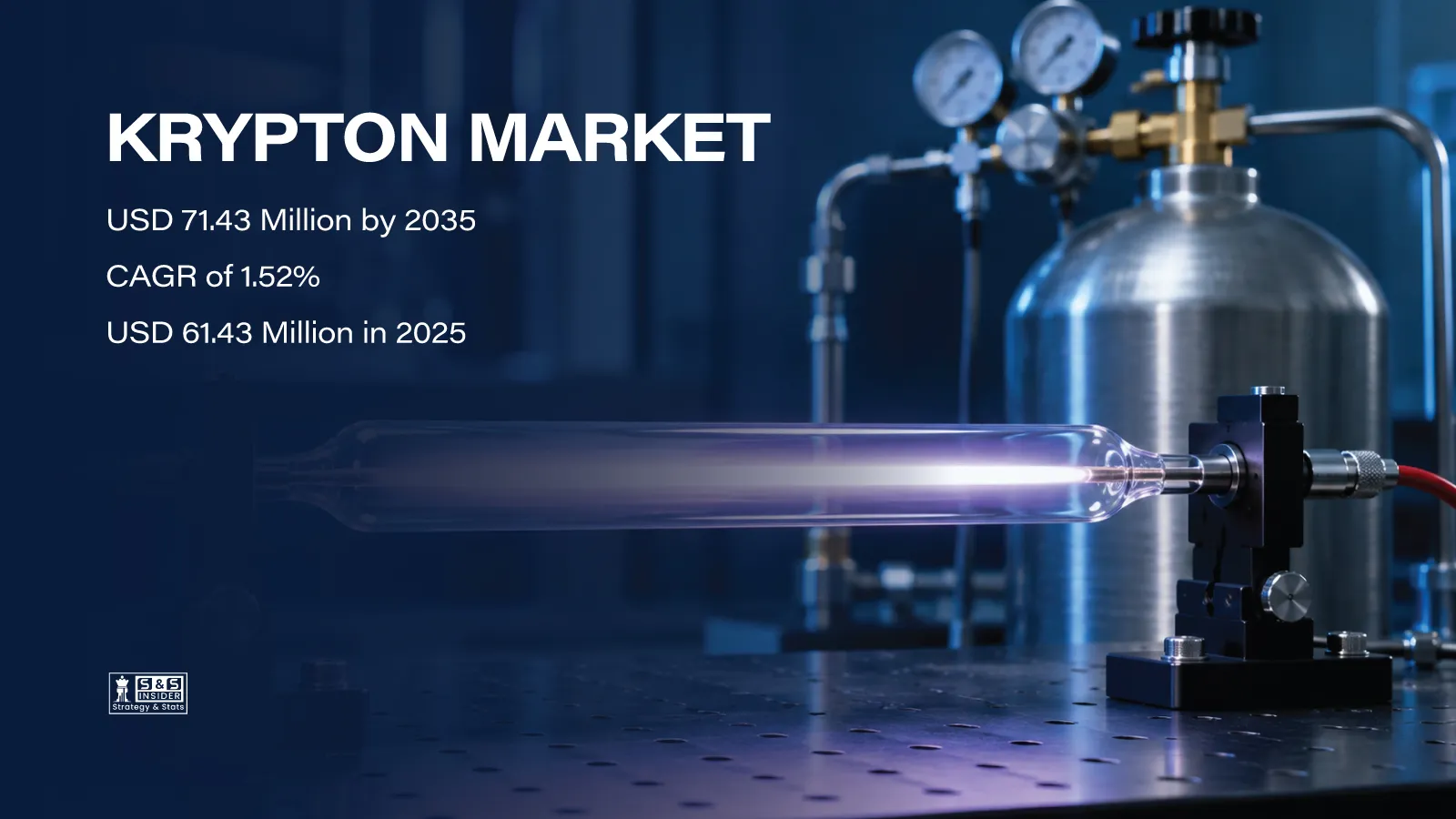
According to SNS Insider, the global krypton market was valued at USD 61.43 million in 2025, is expected to reach USD 62.36 million in 2026, and is forecast to expand to USD 71.43 million by 2035, registering a CAGR of 1.52% during 2026–2035.
Increasing demand for high-purity gasses, energy-efficient glazing requirements and semiconductor fabrication capacity have increasingly impacted the market development. At the same time, limited extraction capacity, the development of lighting technologies and competition from cheaper alternatives limit overall consumption.
The Asia-Pacific region is the largest in global demand and is expected to remain the fastest growing regional market, owing to established electronics manufacturing clusters, expanding industrial infrastructure and investment in semiconductor production.
Long-term opportunities are emerging in satellite electric propulsion, specialized laser technologies and scientific applications, creating potential demand outside the traditional insulation and lighting markets.
Market Size and Forecast
|
Market Indicator |
Value |
|---|---|
|
Market Size, 2025 |
USD 61.43 Million |
|
Market Size, 2026 |
USD 62.36 Million |
|
Market Forecast, 2035 |
USD 71.43 Million |
|
CAGR, 2026–2035 |
1.52% |
|
Leading Region, 2025 |
Asia-Pacific (38.12%) |
|
Fastest-Growing Region |
Asia-Pacific (1.94% CAGR) |
|
Dominant Type |
N3 Grade |
|
Fastest-Growing Type |
N5 Grade (2.46% CAGR) |
|
Dominant Application |
Window Insulation |
|
Fastest-Growing Application |
Laser (2.31% CAGR) |
Demand Drivers and Market Constraints
Primary Demand Drivers
- Semiconductor manufacturing expansion: Increasing fabrication capacity supports demand for high-purity krypton used in krypton fluoride excimer laser systems and specialized electronics applications.
- Energy-efficient building construction: High-performance insulated glass units use krypton to improve thermal efficiency, particularly where narrow glazing cavities limit conventional insulation options.
- Growing high-purity gas requirements: Semiconductor manufacturers and scientific equipment suppliers increasingly require tightly controlled impurity levels and documented gas quality.
- Emerging satellite propulsion applications: Krypton offers an alternative to xenon in certain electric propulsion systems, supporting interest from satellite developers.
- Industrial gas infrastructure development: Investments in air separation and purification facilities can strengthen krypton availability and regional supply reliability.
Potential Growth Constraints
- Limited atmospheric concentration restricts economical extraction and production flexibility.
- High processing and purification costs make krypton more expensive than argon.
- LED adoption continues to reduce demand from conventional lighting applications.
- Geographic concentration of rare gas recovery creates supply disruption risks.
- Competing glazing technologies can reduce krypton requirements in price-sensitive construction projects.
Demand Structure by Purity Grade
N3 Grade — Largest Market Segment
The leading product category on the world market is N3 krypton with a purity of about 99.90%. Its use in insulated glazing, specialty lighting and general industrial processes is widespread enough to support fairly stable consumption. Manufacturers favor this grade because the purity characteristics satisfy many of the standard applications' needs without the additional processing expense of ultrahigh purity products.
A significant customer segment is window manufacturers, particularly for premium glazing products that minimize thermal transmission. N3 krypton demand will be resilient through 2035, but price competition and alternative insulating gasses will impact buying decisions.
Current trend: Established industrial demand supported by energy-efficient glazing.
Major trends: Premium insulating glass, bulk gas procurement, industrial distribution networks, and cost-efficient purification.
N5 Grade — Fastest-Growing Purity Segment (2.46% CAGR)
Among the purity grades, N5 krypton is expected to register highest growth with a CAGR of about 2.46% between 2026 and 2035. It is a good choice for demanding semiconductor, laser and scientific applications where trace contamination can affect system performance due to its high purity.
As semiconductor makers add fabrication capacity, suppliers must provide consistent gas composition, reliable delivery and detailed quality documentation. As advanced electronics manufacturing becomes more important, there are opportunities for suppliers that invest in purification technologies and specialized distribution infrastructure.
Current trend: Rising demand for certified ultra-high-purity industrial gases.
Major trends: Semiconductor fabrication, excimer laser applications, advanced purification, and long-term supply agreements.
Demand Structure by Application
Window Insulation — Leading Application
The biggest use for krypton is window insulation. Krypton is used in the space between the two panes of an insulated glazing unit to reduce heat transfer. In particular, in narrow cavities its thermal properties are better than argon.
Growing focus on energy efficient buildings, high-end residential construction and renovation of aging buildings supports demand for high performance glazing products. Europe and North America are key markets due to the need for insulation in cold climates and existing energy efficiency standards.
However, the higher cost of krypton limits adoption in conventional windows, making premium glazing the principal commercial opportunity.
Current trend: Growing emphasis on high-performance thermal insulation.
Major trends: Triple glazing, energy-efficient construction, premium window systems, and building renovation.
Laser Applications — Fastest-Growing Segment (2.31% CAGR)
Laser applications are projected to witness the highest growth at a CAGR of around 2.31% during 2026-2035. Some semiconductor lithography processes and specialized industrial applications use excimer lasers of krypton fluoride. The increasing demand for semiconductor devices, the expansion of fabrication facilities and increasingly stringent process requirements support the demand for high purity krypton.
Electronics manufacturers rely on gas availability, as disruptions to critical production materials can affect manufacturing continuity. This opens doors for suppliers who can deliver consistent quality, specialized purification and reliable logistics.
Current trend: Increasing demand from semiconductor-related laser systems.
Major trends: Deep ultraviolet lithography, electronics manufacturing, certified gas purity, and localized supply infrastructure.
Regional Market Dynamics
Asia-Pacific — Largest and Fastest-Growing Market
Asia-Pacific is the largest krypton market and is projected to reach approximately 38.12% of the global market in 2025. China remains a key regional market driven by glass production, electronics production and industrial gas consumption. Japan, South Korea and Taiwan add to demand through semiconductor fabrication and specialized laser applications.
The demand for reliable high-purity gas supply is driven by regional investments in semiconductor manufacturing and industrial gas infrastructure. Emerging opportunities are also present in India and Southeast Asian economies with the growth in electronics manufacturing and premium construction activity.
Direction: Regional leadership supported by electronics production and industrial expansion.
North America — Semiconductor and Aerospace Demand
North America held a share of approximately 27.43% of the global market in 2025. The United States generated USD 14.44 million in 2025 and is anticipated to grow at a CAGR of 1.41% between 2026 and 2035. Demand in the region is supported by investments in semiconductor manufacturing, demand for insulated glazing, and specialized aerospace applications.
Also, there are additional possibilities for specialized supply of krypton to research institutions and developers of satellite propulsion.
Direction: Moderate growth supported by semiconductor investment and advanced industrial applications.
Europe — Energy-Efficient Glazing Supports Consumption
Europe accounted for about 26.58% of the total global market revenue in 2025. This sector is strongly linked to the energy-efficient construction, the high-quality insulated windows and the special industrial applications.
Germany is a major national market, backed by traditional glazing manufacturers, industrial equipment makers and semi-conductor-related activities. Demand for higher-efficiency insulation products is supported by building renovation programs and energy-performance standards.
Direction: Stable demand supported by building efficiency requirements and industrial technology.
Middle East & Africa — Emerging Construction Applications
The Middle East and Africa region accounted for about 3.96% of global revenues in 2025. Premium commercial properties, infrastructure development and specialty lighting are supporting regional demand for krypton.
Advanced glazing applications are majorly used in Saudi Arabia and United Arab Emirates. The dependence on imports is still increasing because of the limited local rare gas recovery infrastructure.
Direction: Gradual expansion associated with premium construction and industrial development.
Latin America — Developing Specialty Gas Demand
Latin America represented approximately 3.91% of the global krypton market in 2025. Brazil is a leading regional consumer, supported by glazing, specialized lighting, and research applications.
Mexico and other regional economies offer additional opportunities through industrial activity and building materials manufacturing. High import costs and competition from alternative gases continue to restrict broader adoption.
Direction: Moderate growth supported by industrial applications and improved building efficiency.
Competitive Landscape
The global krypton market is relatively concentrated because commercial production requires specialized air separation infrastructure, rare gas recovery equipment, and advanced purification capabilities.
Companies identified in the SNS Insider competitive landscape include Linde plc, Air Liquide, Air Products and Chemicals, Messer Group, Matheson Tri-Gas, Coregas, and Universal Industrial Gases.
Competitive differentiation is becoming a function of gas purity, supply reliability, purification infrastructure and the ability to support specialized electronics customers. Industrial gas suppliers are creating long-term procurement relationships, localized purification and diversified supply arrangements to minimize operational risks. The importance of incumbent producers and specialized distribution networks is expected to be protected by high barriers to entry during the forecast period.
Market Outlook (2026–2035)
The krypton market is projected to increase from USD 62.36 million in 2026 to USD 71.43 million by 2035, reflecting steady rather than rapid industry expansion. Semiconductor manufacturing and energy-efficient glazing will remain central demand drivers, while emerging aerospace and scientific applications may create additional specialized opportunities.
The market's future performance will depend on the balance between industrial demand, available rare gas recovery capacity, and the cost competitiveness of alternative materials. Suppliers investing in high-purity production, dependable distribution networks, and long-term customer relationships are positioned to benefit from increasingly specialized consumption requirements.
Overall, the global krypton market is expected to maintain positive growth through 2035, with semiconductor technology, premium insulation, and supply-chain resilience defining its long-term commercial outlook.



