
According to the latest SNS Insider Expanded Beam Cable Market report, demand is rising as defense forces, broadcasters, energy operators, and network owners need optical links that work in dirt, dust, and moisture. Expanded beam designs spread the light signal over a wider area. This makes each connection less sensitive to contamination and wear, which is why they are used where cleaning and careful handling are hard to guarantee.
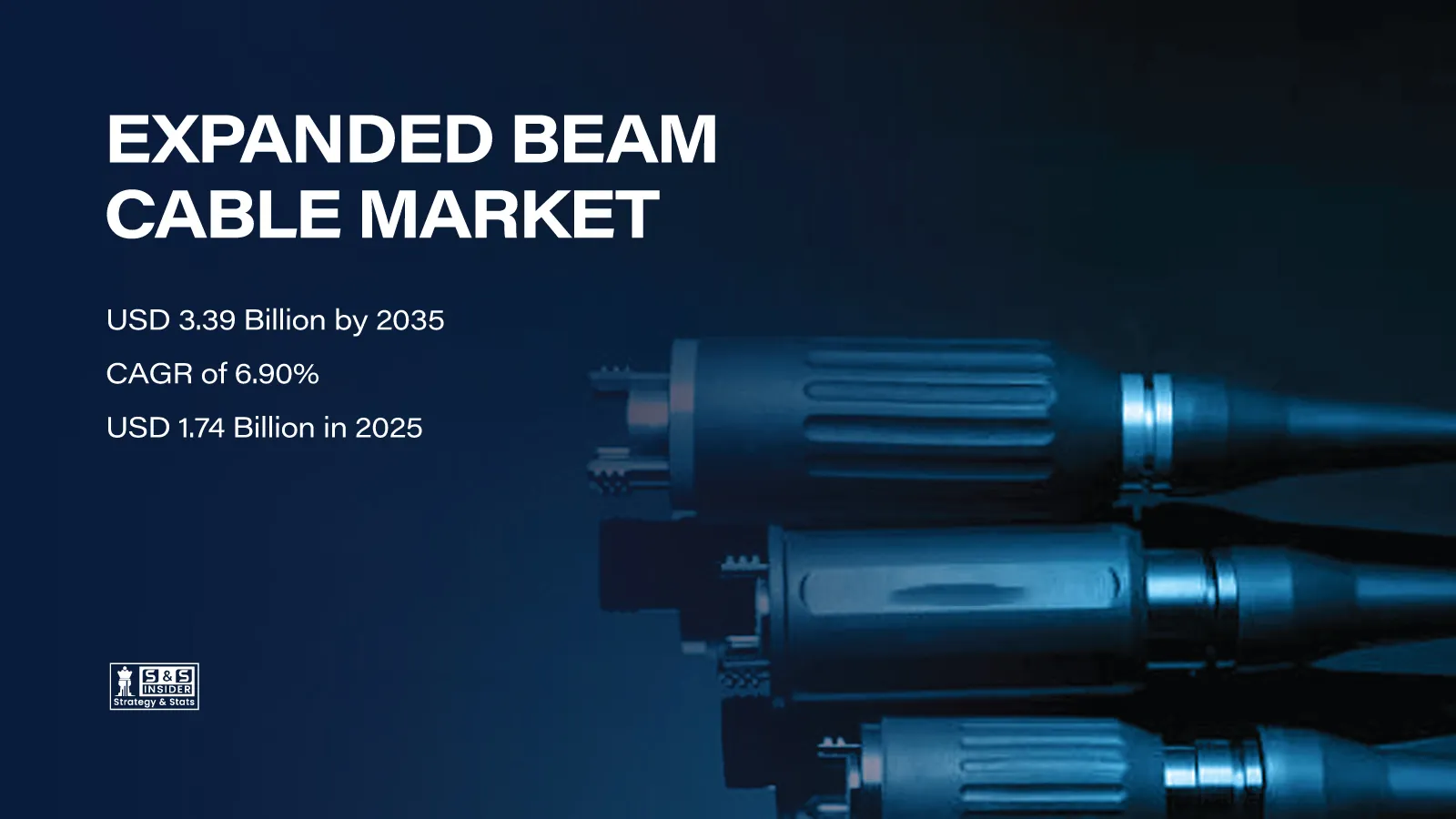
The global expanded beam cable market was valued at USD 1.74 Billion in 2025 and is estimated at USD 1.86 Billion in 2026. It is projected to reach USD 3.39 Billion by 2035, growing at a CAGR of 6.90% during 2026–2035.
Single channel connectors remain the most common choice today. Multi-channel designs are growing faster because users want to carry more fibers through one connection and save space on vehicles, aircraft, and equipment panels.
Military and defense programs still account for the largest share of demand. Telecom networks and data centers are now the fastest growing users, as operators test expanded beam connectors for remote cell sites and dense optical panels in AI computing clusters.
North America is the largest regional market, while Asia Pacific is growing fastest as defense spending, network building, and industrial projects expand across the region.
Market Size and Forecast
|
Market Indicator |
Value |
|
Market Size, 2025 |
USD 1.74 Billion |
|
Market Size, 2026 |
USD 1.86 Billion |
|
Market Forecast, 2035 |
USD 3.39 Billion |
|
CAGR, 2026–2035 |
6.90% |
|
Leading Region, 2025 |
North America (37.96%) |
|
Fastest-Growing Region |
Asia Pacific (8.83% CAGR) |
Demand Drivers and Constraints
Primary Demand Drivers
-
Defense modernization: Armed forces are upgrading tactical networks, vehicles, and aircraft, and they need optical links that keep working in the field.
-
Harsh-environment industries: Broadcast crews, oil and gas sites, mines, and rail operators use expanded beam connectors because they tolerate dust, water, and repeated mating.
-
AI data center testing: Operators are evaluating expanded beam designs for dense optical panels, where dust tolerance can reduce cleaning time and link failures.
-
Telecom field sites: Carriers use the connectors at remote cell sites, where technicians often work outdoors and conditions are hard to control.
-
Standards and policy support: Military and aviation standards such as MIL-DTL-83526 and ARINC 845 give buyers clear specifications, and the FCC's July 2026 submarine cable rule changes add attention to resilient optical infrastructure.
Potential Growth Constraints
-
Higher unit cost than standard physical contact connectors.
-
Higher insertion loss than clean physical contact interfaces.
-
Long qualification cycles, often lasting many months.
-
Limited interoperability between suppliers' designs.
-
Export controls on defense electronics and price pressure from large buyers.
Demand Structure by Connector Type
Single Channel (2025 Market Share: 54.78%)
Single channel connectors accounted for 54.78% of the expanded beam cable market in 2025. Many field systems need only one or two fibers per link, so a single channel design is simple and cost effective. These connectors are widely used in tactical communication, broadcast cameras, and outdoor sensor networks. Users also value how easy they are to clean, inspect, and replace in the field. A large installed base on defense platforms keeps replacement demand steady, and familiar designs shorten approval time for new programs.
Current trend: Steady replacement demand from installed defense and broadcast systems.
Major trends: Ruggedized single fiber links, simplified field cleaning, lightweight housings, and standard military footprints.
Multi-Channel (Forecast CAGR: 7.80%)
Multi-channel connectors are projected to grow at a CAGR of 7.80% during 2026–2035. Modern vehicles, aircraft, and data center equipment carry more sensors and more data, so users want several fibers in one connection. This saves panel space and weight and reduces the number of parts to install. Suppliers are launching compact designs with higher fiber counts for both defense and commercial use. As bandwidth needs rise on each platform, more programs are expected to choose multi-channel designs from the start.
Current trend: Rising use of high fiber count connectors on new platforms.
Major trends: Compact multi-fiber inserts, MT-based designs, weight reduction, and higher density panels.
Demand Structure by Technology
Single Mode (2025 Market Share: 44.44%)
Single mode technology held 44.44% of the market in 2025. It carries signals over long distances with little loss, which suits military networks, telecom links, and broadcast transport between sites. Many defense and carrier networks are already built on single mode fiber, so new connectors must match that base. Single mode links also support higher data rates over time, which protects the value of the investment. Buyers working on long-reach and backbone links continue to make this the leading technology choice.
Current trend: Continued use in long-distance defense and telecom links.
Major trends: Low-loss lens designs, long-reach tactical links, carrier field deployment, and higher data rate support.
Multi-Mode (Forecast CAGR: 7.50%)
Multi-mode technology is expected to expand at a CAGR of 7.50% through 2035. It is well suited to short links inside aircraft, ships, vehicles, and data center rooms, where distances are small and system cost matters. Multi-mode components are usually less expensive, which helps commercial and industrial buyers adopt expanded beam designs. Growth in onboard sensor networks and in-room data center links is adding demand. As more equipment is linked over short distances, multi-mode connectors are expected to gain a larger share of new orders.
Current trend: Wider use in short-reach onboard and in-room links.
Major trends: Cost-efficient short links, onboard sensor networks, data center panels, and industrial automation.
Demand Structure by Application
Military and Defense (2025 Market Share: 39.52%)
Military and defense applications represented 39.52% of the market in 2025. Forces need communication links that survive mud, sand, shock, and repeated connection in the field. Expanded beam connectors meet these needs and are covered by established military standards. Tactical radios, command posts, unmanned systems, and aircraft all use them. Long program lives and strict approval rules keep suppliers locked into platforms for years, and ongoing modernization budgets support new orders as well as spare parts for systems already in service.
Current trend: Modernization of tactical networks and onboard platform systems.
Major trends: Deployable fiber links, unmanned system integration, standard-compliant connectors, and lightweight cable assemblies.
Telecommunications and Data Centers (Forecast CAGR: 8.70%)
Telecommunications and data centers are projected to grow at a CAGR of 8.70% during 2026–2035. Carriers use expanded beam connectors at remote and outdoor cell sites, where dust and weather make standard connectors hard to maintain. In data centers, operators are testing these designs for dense optical panels in AI clusters, since dust tolerance can cut cleaning time and failures. Suppliers are now launching products made for this hardware, which shows that commercial demand is moving from trials toward wider use.
Current trend: Early adoption in AI data center hardware and outdoor telecom sites.
Major trends: Dust-tolerant data center optics, high-density panels, remote cell site links, and reduced maintenance designs.
Demand Structure by Form Factor
Rack and Panel (2025 Market Share: 31.00%)
Rack and panel connectors accounted for 31.00% of the market in 2025. They are used where equipment slides into racks or bays, such as avionics boxes, shipboard systems, and network cabinets. This design allows many connections to be made at once and lets technicians swap units quickly. Aviation standards such as ARINC 845 support their use on aircraft. Rising equipment density on military and commercial platforms keeps demand steady, and replacement of older electrical interfaces with optical ones adds new opportunities.
Current trend: Wider use of optical interfaces in avionics and equipment racks.
Major trends: Blind-mate connections, ARINC-compliant inserts, modular equipment bays, and higher density layouts.
In-Line Circular (Forecast CAGR: 8.00%)
In-line circular connectors are expected to grow at a CAGR of 8.00% through 2035. They join cable runs in the field and are easy to connect, seal, and protect against weather. Broadcast crews, mining sites, energy operators, and defense units use them for temporary and mobile networks. New compact designs with more fibers widen their use in robotics and industrial equipment. Demand for fast setup and teardown in outdoor work is expected to keep this form factor growing faster than the overall market.
Current trend: Growing use in mobile, temporary, and outdoor networks.
Major trends: Sealed field connectors, compact high-density circular designs, quick deployment cables, and industrial robotics links.
Key Market Participants
The expanded beam cable market includes interconnect manufacturers, defense and aerospace component suppliers, and makers of professional audio and broadcast connectivity.
Key participants include Molex LLC, Amphenol Corporation (Amphenol Fiber Systems International), TE Connectivity plc, and Neutrik Group.
Competition centers on optical performance, durability, fiber density, and compliance with military and aviation standards. Molex strengthened its position by completing its purchase of Smiths Interconnect in April 2026. Suppliers with proven qualification records, compact multi-fiber designs, and support services such as cleaning kits and training are well placed to win new programs.
Regional Market Dynamics
North America (2025 Market Share: 37.96%)
North America led the global expanded beam cable market with a 37.96% share in 2025. The United States is the leading country market, valued at USD 0.58 Billion in 2025 and projected to grow at a CAGR of 7.40%. Large defense budgets, active aerospace programs, and a strong base of interconnect suppliers support demand. U.S. data center operators are also early testers of expanded beam optics for AI hardware. Canada adds demand through defense and resource industry projects.
Direction: Continued leadership supported by defense modernization and early data center adoption.
Europe (Second-Largest Regional Market)
Europe held 28.36% of the market in 2025, making it the second largest region. Germany, the United Kingdom, France, and Italy lead demand. Rising defense spending across the region is renewing orders for rugged tactical networks. The region also has a strong broadcast industry and many rail and industrial operators that need durable field connections. Local suppliers and strict qualification rules shape purchasing, and long-term defense programs support steady demand.
Direction: Steady growth driven by higher defense budgets, broadcast use, and industrial networks.
Asia Pacific (Forecast CAGR: 8.83%)
Asia Pacific is expected to register the fastest regional growth, with a CAGR of 8.83% through 2035, from a 27.23% share in 2025. Countries across the region are expanding defense programs, building telecom networks, and adding data center capacity. Mining, energy, and rail projects add demand for rugged optical links. Growing local manufacturing of cables and connectors also lowers costs and makes these products easier to buy for commercial users.
Direction: Fastest regional expansion supported by defense spending, network building, and industrial projects.
Middle East & Africa
The Middle East and Africa held 2.56% of the market in 2025. Demand comes mainly from defense procurement, oil and gas operations, and mining sites, where equipment must work in heat, sand, and dust. Gulf countries are investing in military systems and new digital infrastructure. Adoption in Africa is slower because of budget limits, but resource industries continue to need durable field links.
Direction: Gradual growth driven by defense purchases and harsh-environment energy and mining projects.
Latin America
Latin America accounted for 3.89% of the market in 2025, led by Brazil and Mexico. Oil and gas, mining, and broadcast operators are the main users of expanded beam connectors in the region. Telecom carriers expanding networks into remote areas also add demand. Currency swings and price sensitivity slow adoption, so buyers tend to focus on applications where durability clearly lowers maintenance costs.
Direction: Moderate growth supported by resource industries and network expansion into remote areas.
Market Outlook (2026–2035)
The global expanded beam cable market is forecast to reach USD 3.39 Billion by 2035, supported by steady demand for optical links that work in difficult conditions.
Defense modernization will remain the base of demand, while telecom and data center use is expected to add the fastest new volume as operators look for dust-tolerant, low-maintenance connections.
Multi-channel and in-line circular designs will gain share as users want more fibers in less space and faster setup in the field.
North America will keep its lead, while Asia Pacific offers the strongest growth as defense, telecom, and industrial investment rises across the region.
Overall, the expanded beam cable market is set for steady expansion through 2035, with success depending on durability, fiber density, standards compliance, and the ability to serve both defense and fast-growing commercial buyers.



