
The worldwide market for RF GaN semiconductor devices is growing because of high demand for components that deliver more power, higher efficiency, and better heat handling than older silicon and GaAs parts. Telecom operators, defense contractors, and satellite firms use these devices in base stations, radar systems, and communication links. Rising 5G deployment, defense modernization, and new satellite networks are some of the factors that have led to greater use of RF GaN devices. Manufacturers are also improving wafer quality and moving to larger, lower-cost substrates, which will support market growth.
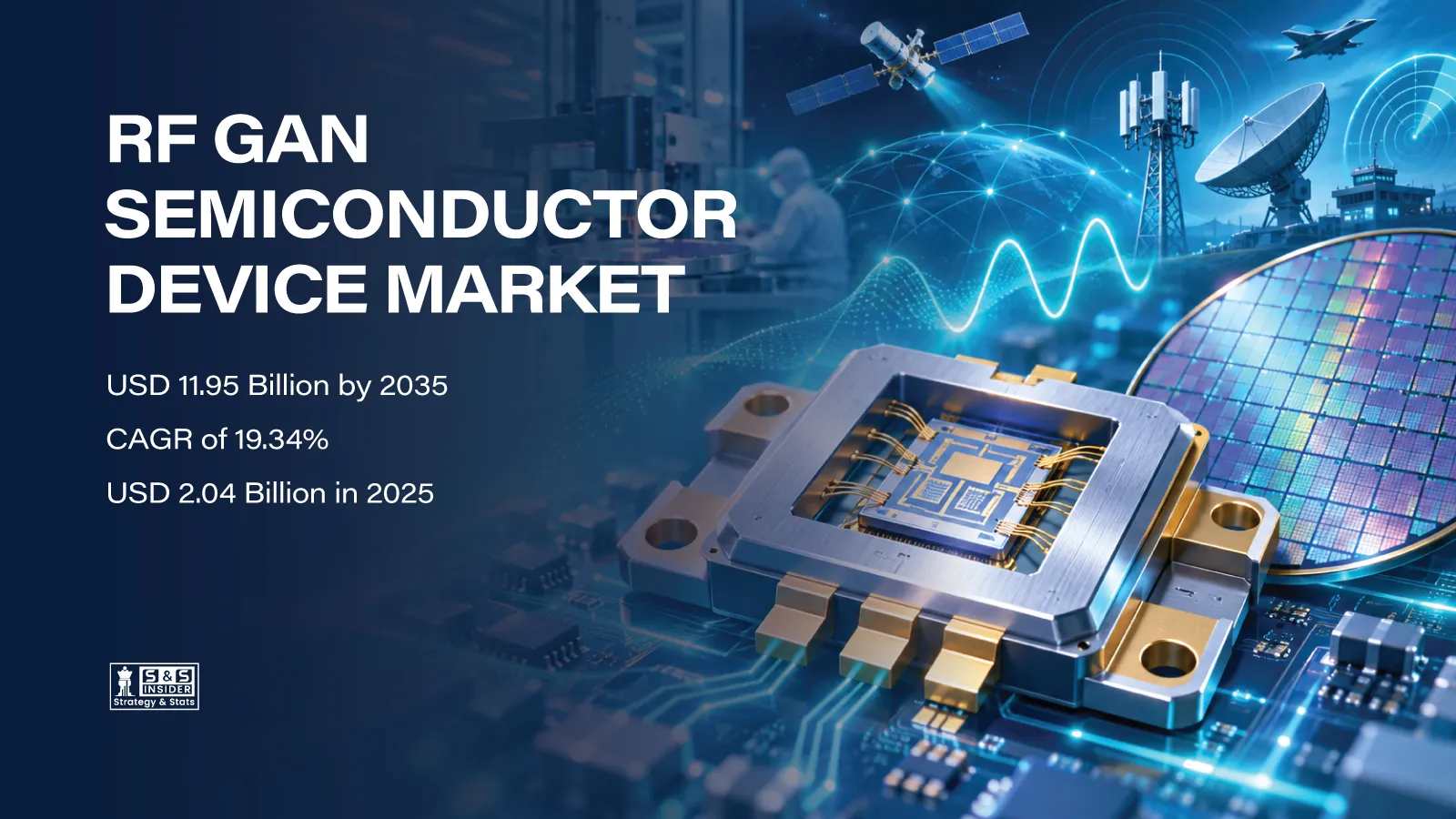
The RF GaN Semiconductor Device Market value stood at USD 2.04 billion in 2025 and is anticipated to grow to USD 11.95 billion by 2035, growing at a CAGR of 19.34% in the forecast period of 2026-2035. GaN-on-SiC held around 66.60% of the market by material, while RF power amplifiers accounted for 48.20% of device demand in 2025.
Unlock exclusive market insights download the brochure to explore global RF GaN Semiconductor Device Market trends, emerging opportunities, competitive developments, and forecasts through 2035.
Regional Analysis of the RF GaN Semiconductor Device Market
The RF GaN semiconductor device market is expanding across North America, Europe, Asia-Pacific, Latin America, and Middle East & Africa. North America dominated the market with around 39.80% share in 2025 owing to high defense spending, a strong base of radar and electronic warfare programs, and the presence of leading GaN foundries. North America is dominated by the US, which had a market valuation of USD 633.30 million in 2025 and is forecasted to grow at a CAGR of 18.62%. Europe accounted for around 17.60%, and Germany, France, and the UK were leading in defense electronics and telecom equipment.
Asia-Pacific will register the highest CAGR of 21.46% due to large-scale 5G rollout, growing semiconductor manufacturing capacity, and rising defense budgets, and the leading countries in Asia-Pacific include China, Japan, and South Korea. Latin America and Middle East & Africa are witnessing stable growth due to telecom network upgrades, satellite connectivity projects, and defense procurement.
Top 10 Trends in the RF GaN Semiconductor Device Market
-
Continued leadership of GaN-on-SiC for high-power and high-frequency use.
-
Fast growth of GaN-on-Si, at a CAGR of 21.84%, as firms seek lower-cost wafers.
-
Rising use of MMICs, the fastest-growing device type at a CAGR of 21.12%.
-
Telecom infrastructure remaining the largest application area.
-
Strong growth in satellite communication, at a CAGR of 21.68%.
-
Wider use of GaN in active electronically scanned array radars.
-
Industry consolidation as suppliers merge to gain scale.
-
Research focus on heat removal and reliability in GaN chips.
-
Expansion of captive and domestic foundries for defense supply security.
-
Shift to higher frequency bands, including millimeter-wave and W-band.
RF GaN Semiconductor Device Market Growth Drivers and Opportunities
Growth prospects for the market are due to rising demand for efficient, high-power RF parts in 5G base stations, radar, and electronic warfare systems. GaN devices handle higher voltages and temperatures, which helps equipment makers build smaller and lighter systems. Defense programs are also placing large orders for GaN-based radars. For example, in December 2025, Analog Devices launched the ADPA1113, a 2–6 GHz GaN power amplifier delivering 44.70 W.
The growing potential is evident in satellite communication, defense electronics, and next-generation wireless networks. For example, in May 2026, MACOM said its defense revenue was trending toward growth of more than 20.00% for the year, supported partly by its GaN fab in Lowell. High wafer costs, complex manufacturing, export controls, and competition from mature silicon and GaAs technologies are some challenges in this market.
Top 10 Companies in the RF GaN Semiconductor Device Market
The RF GaN semiconductor device industry is made up of semiconductor manufacturers, defense contractors, and specialty foundries. The competitive advantage for these companies lies in wafer and process know-how, captive fabrication capacity, long-term defense contracts, and strong relationships with telecom equipment makers.
-
Skyworks Solutions, Inc.
-
Mitsubishi Electric Corporation
-
RTX Corporation
-
Northrop Grumman Corporation
-
BAE Systems plc
-
MACOM Technology Solutions
-
Analog Devices, Inc.
-
Sumitomo Electric Device Innovations
-
Infineon Technologies AG
-
Ampleon
-
Skyworks Solutions, Inc.
Skyworks Solutions, Inc. is a U.S.-based semiconductor company that designs RF and analog chips for mobile, infrastructure, and defense markets. Its portfolio covers amplifiers, front-end modules, and connectivity solutions. In October 2026, the company completed its combination with Qorvo, adding Qorvo's GaN products for defense and infrastructure.
-
Mitsubishi Electric Corporation
Mitsubishi Electric Corporation is a Japanese electronics and electrical equipment maker headquartered in Tokyo. The company produces GaN transistors and amplifiers for satellite, radar, and base station use. In November 2026, it presented research on crystal defects that cause frequency dispersion in GaN transistors and showed how GaN substrates can suppress them.
-
RTX Corporation
RTX Corporation is a U.S. aerospace and defense company that builds radars, missiles, and avionics. It runs a captive GaN foundry that supplies devices for its radar systems. In June 2026, RTX received a USD 515.00 million sole-source U.S. Navy contract for SPY-6 radars using GaN devices from this foundry.
-
Northrop Grumman Corporation
Northrop Grumman Corporation is a U.S. defense and aerospace firm active in space, mission systems, and advanced electronics. The company operates its own semiconductor foundry in Redondo Beach. In June 2026, it unveiled a W-band GaN chip developed in less than six months.
-
BAE Systems plc
BAE Systems plc is a British defense, security, and aerospace company. Its electronic systems unit develops GaN-based RF components for military communication and electronic warfare. In August 2026, the company advanced to Phase 2 of DARPA's THREADS program, which focuses on heat removal in GaN RF electronics.
Company Profile
A detailed company profile can cover:
-
Business overview and company snapshot
-
Product portfolio and application coverage
-
Market position and competitive analysis
-
Financial performance, where available
-
Recent developments, mergers, and acquisitions
-
SWOT analysis
The remaining companies can be assessed using the same framework in a comprehensive market research report.
Future Outlook of the RF GaN Semiconductor Device Market
Growth in the RF GaN semiconductor device industry is set to continue, driven by demand for high-power and efficient RF parts in telecom, defense, and satellite systems. Rising 5G and satellite network deployment, along with fast growth in Asia-Pacific, will widen the customer base. Companies that invest in lower-cost GaN-on-Si wafers, better heat management, and secure foundry capacity may gain a competitive edge. As radar and communication systems move to higher frequencies, GaN devices will likely remain a key technology in RF design.



