
The SCARA Robot Market is growing as manufacturers look for fast, precise, and space-saving automation for assembly, handling, and packaging tasks. SCARA robots move quickly on a horizontal plane, which makes them a good fit for small-part assembly in electronics, semiconductors, and automotive components. Labor shortages, rising wage costs, and the need for consistent product quality are pushing factories to automate repetitive work. Robot makers are also adding AI vision, easier programming, and compact controllers, which will lead to market growth.
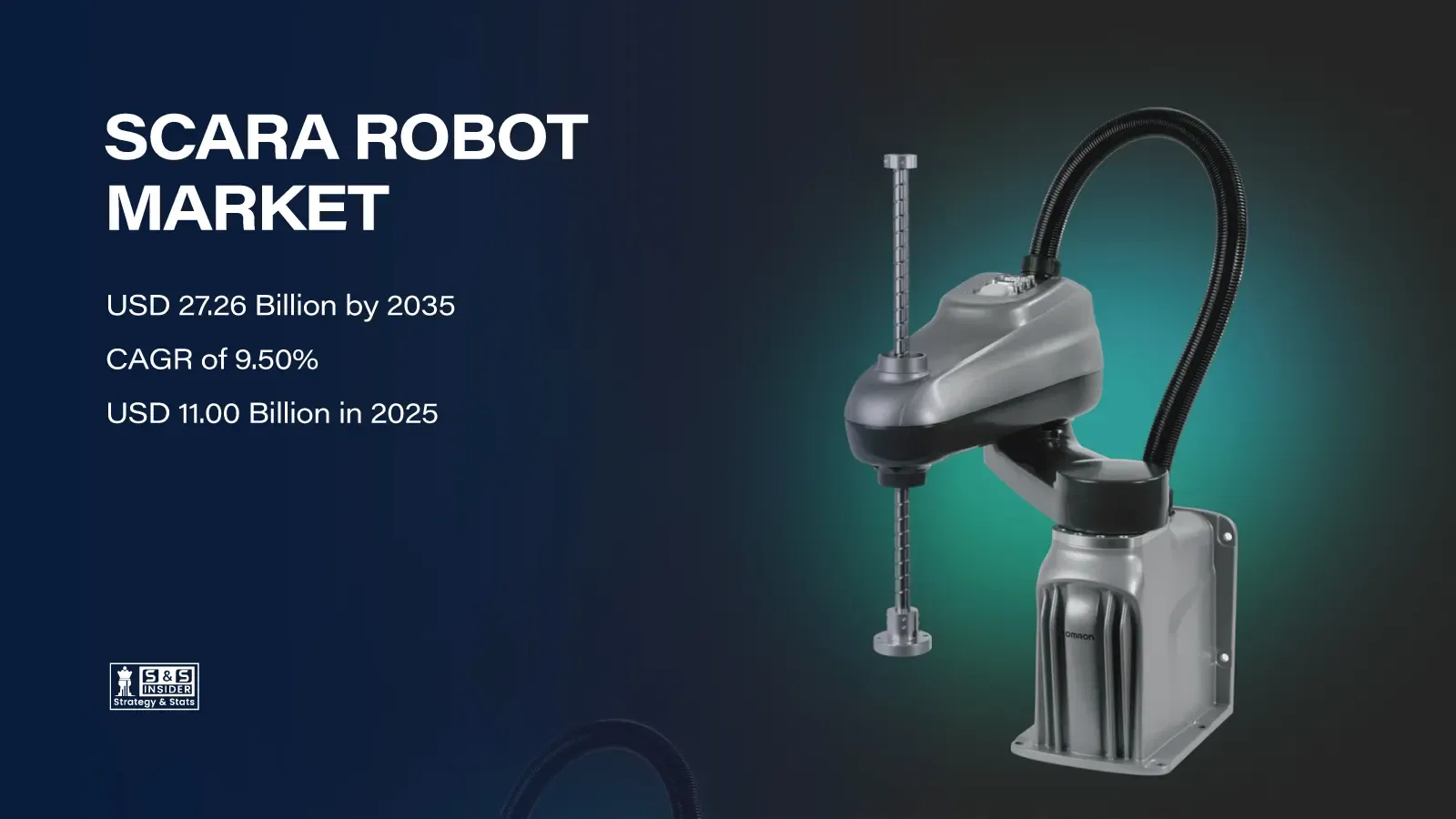
The SCARA Robot Market value stood at USD 11.00 billion in 2025 and is anticipated to grow to USD 27.26 billion by 2035, growing at a CAGR of 9.50% in the forecast period of 2026-2035. Four-axis robots held around 64.60% of the market by axis count, while the electronics and semiconductor industry accounted for 40.10% of total demand in 2025.
Unlock exclusive market insights download the brochure to explore global SCARA Robot Market trends, emerging opportunities, competitive developments, and forecasts through 2035.
Regional Analysis of the SCARA Robot Market
The SCARA robot market is expanding across North America, Europe, Asia-Pacific, Latin America, and Middle East & Africa. Asia-Pacific dominated the market with around 60.40% share in 2025 owing to its large electronics manufacturing base, strong presence of leading robot makers, and high factory automation rates. Europe accounted for around 17.60%, and Germany, Italy, and France were leading in automotive and precision manufacturing uses. North America held around 15.80%, led by the US, which had a market valuation of USD 1.23 billion in 2025 and is forecasted to grow at a CAGR of 9.10%.
Asia-Pacific will also register the highest CAGR of 11.40% due to rising semiconductor investment, growing electric vehicle production, and government support for smart factories, and the leading countries in Asia-Pacific include China, Japan, and South Korea. Latin America and Middle East & Africa are witnessing stable growth due to expanding automotive assembly, growing consumer goods production, and gradual adoption of automation by local manufacturers.
Top 10 Trends in the SCARA Robot Market
-
Rising use of SCARA robots in electronics and semiconductor assembly lines.
-
Fast growth in automotive applications, with a CAGR of 11.20%.
-
Continued leadership of four-axis robots for simple, high-speed tasks.
-
Growing demand for five- and six-axis models for more complex motion.
-
Integration of AI vision for part recognition and quality checks.
-
Increasing use in dispensing and soldering, the fastest-growing application.
-
Shift toward heavier payload models above 20 kg for larger parts.
-
Launch of compact controllers that save floor and cabinet space.
-
Wider use of stainless and hygienic designs in food and medical production.
-
Adoption by small and mid-size manufacturers due to easier programming.
SCARA Robot Market Growth Drivers and Opportunities
Growth prospects for the market are due to increasing demand for high-speed, accurate automation in electronics, semiconductors, and automotive parts production. Rising labor costs and worker shortages are leading factories to automate pick and place, screw driving, and inspection tasks. Robot makers are refreshing product lines with better speed and simpler controls. For example, in July 2026, Yamaha Motor launched the YE4 and YE10 SCARA robots with the RCX440 controller.
The growing potential is evident in heavier payload tasks, AI-based inspection, and new uses in food and medical device production. For example, in May 2026, Denso Wave announced it would show its HSR SCARA robot with AI vision at ROBOT TECHNOLOGY JAPAN 2026. High upfront costs, limited reach compared to articulated robots, integration complexity, and a shortage of skilled operators are some challenges in this market.
Top 10 Companies in the SCARA Robot Market
The SCARA robot industry is made up of industrial robot makers, factory automation groups, and motion control suppliers. The competitive advantage for these companies lies in speed and precision, controller software, broad product ranges, and long-term relationships with electronics and automotive manufacturers.
-
Seiko Epson Corporation
-
Yamaha Motor Co., Ltd.
-
Mitsubishi Electric Corporation
-
Denso Wave Incorporated
-
Kawasaki Heavy Industries, Ltd.
-
FANUC Corporation
-
Omron Corporation
-
Shibaura Machine Co., Ltd.
-
Yaskawa Electric Corporation
-
Stäubli International AG
-
Seiko Epson Corporation
Seiko Epson Corporation is a Japanese technology company known for printers, precision devices, and industrial robots. The company is one of the largest suppliers of SCARA robots used in electronics and small-part assembly. In June 2026, Epson announced the LS-C series, which replaces its LS-B models.
-
Yamaha Motor Co., Ltd.
Yamaha Motor Co., Ltd. is a Japanese manufacturer of motorcycles, marine products, and factory automation equipment. Its robotics unit offers SCARA robots, single-axis robots, and controllers for assembly lines. In July 2026, the company launched the YE4 and YE10 SCARA robots with the RCX440 controller.
-
Mitsubishi Electric Corporation
Mitsubishi Electric Corporation is a Japanese electrical and electronics company with a strong factory automation business. Its MELFA robot range covers SCARA and articulated models for electronics and automotive uses. In August 2025, the company introduced the MELFA RH-CRH series, with 10 kg and 20 kg payloads.
-
Denso Wave Incorporated
Denso Wave Incorporated is a Japanese company within the Denso Group that makes industrial robots, barcode readers, and automation systems. Its SCARA robots are widely used in automotive parts and electronics assembly. In May 2026, the company announced it would exhibit its HSR SCARA robot with AI vision at ROBOT TECHNOLOGY JAPAN 2026.
-
Kawasaki Heavy Industries, Ltd.
Kawasaki Heavy Industries, Ltd. is a Japanese industrial group active in aerospace, energy, and robotics. Its robotics division supplies industrial robots for assembly, handling, and painting tasks. In June 2026, Kawasaki Robotics previewed its RL030N physical AI platform ahead of Automate 2026.
Company Profile
A detailed company profile can cover:
-
Business overview and company snapshot
-
Product portfolio and application coverage
-
Market position and competitive analysis
-
Financial performance, where available
-
Recent developments, mergers, and acquisitions
-
SWOT analysis
The remaining companies can be assessed using the same framework in a comprehensive market research report.
Future Outlook of the SCARA Robot Market
Growth in the SCARA robot industry is set to continue as manufacturers automate more assembly, handling, and inspection tasks. Rising semiconductor and electric vehicle production will add strong demand, especially in Asia-Pacific. Robots with AI vision, higher payloads, and simpler controls will widen the range of possible uses. Companies that focus on speed, ease of use, and service support may gain a stronger competitive position over the forecast period.



