
According to the latest SNS Insider Specialty PACS Market report, demand is rising as hospitals and imaging centers need better ways to store, view and share images across clinical departments. Radiology, cardiology, ophthalmology and pathology each produce large image files. Each also needs its own viewing and reporting tools, which a general system often cannot provide.
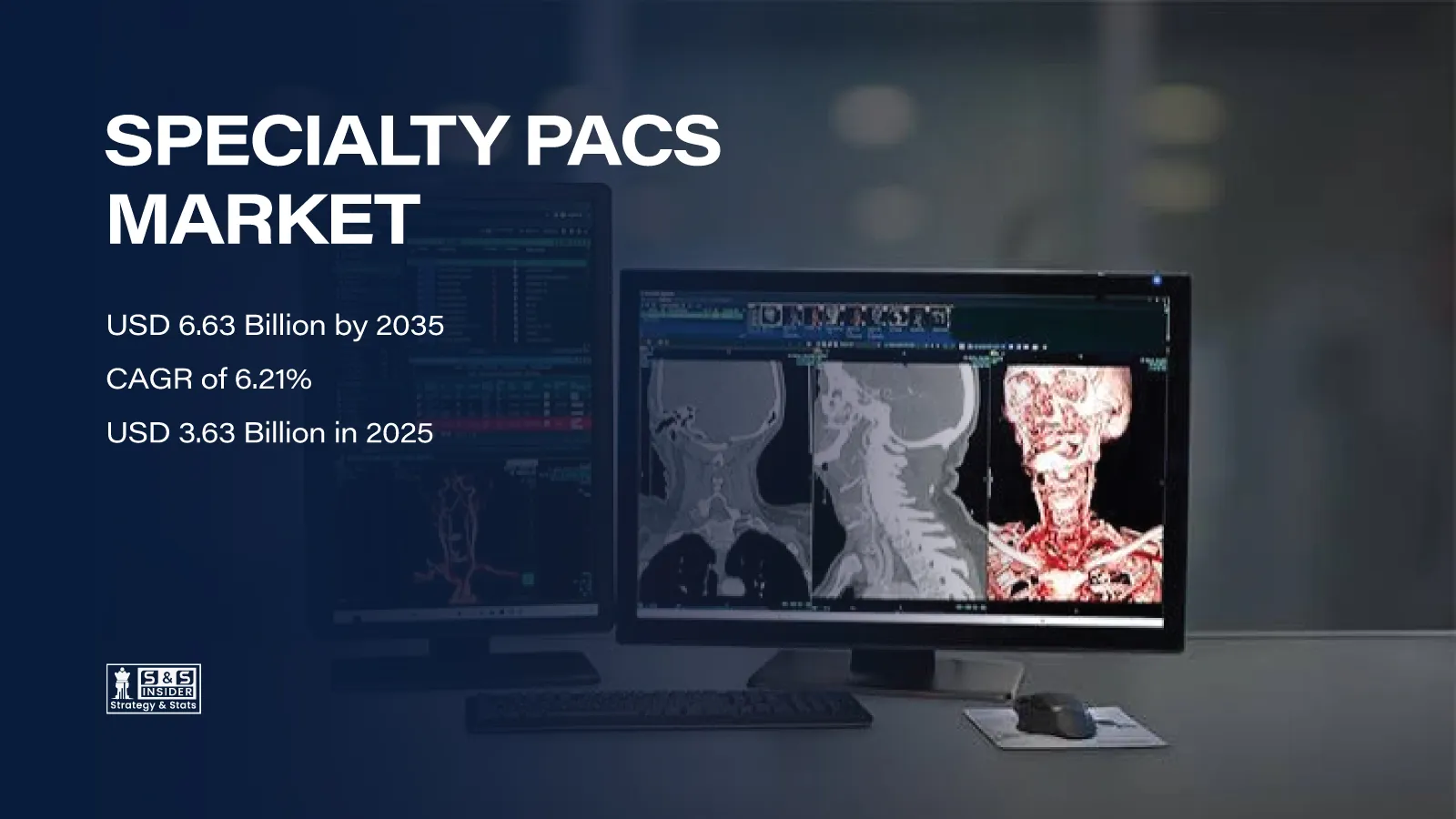
The global specialty PACS market was valued at USD 3.63 Billion in 2025 and is estimated at USD 3.86 Billion in 2026. It is projected to reach USD 6.63 Billion by 2035, growing at a CAGR of 6.21% during 2026–2035.
Cloud platforms are now the main deployment choice. They let providers add capacity as image volumes grow and give doctors access to studies from any site. This lowers the need for large upfront hardware purchases.
AI tools for image analysis and automated measurements are becoming part of daily reporting work. Teleradiology and remote reading also widen the use of these systems beyond the hospital walls.
North America remains the largest regional market, while Asia Pacific offers the fastest growth as hospitals in the region expand their digital imaging capacity.
Market Size and Forecast
|
Market Indicator |
Value |
|
Market Size, 2025 |
USD 3.63 Billion |
|
Market Size, 2026 |
USD 3.86 Billion |
|
Market Forecast, 2035 |
USD 6.63 Billion |
|
CAGR, 2026–2035 |
6.21% |
|
Leading Region, 2025 |
North America (38.46%) |
|
Fastest-Growing Region |
Asia Pacific (8.33% CAGR) |
Demand Drivers and Constraints
Primary Demand Drivers
-
Rising imaging volumes: More cases of chronic disease lead to more scans and every scan must be stored, read and kept for later comparison.
-
Shift to cloud and enterprise imaging: Providers are moving departmental archives onto shared platforms to reduce hardware costs and improve access.
-
AI-enabled analysis and reporting: Automated measurements and image analysis shorten reading time and make results more consistent.
-
Teleradiology and remote diagnostics: Remote reading lets specialists review studies from other sites, which raises demand for connected systems.
-
Government digital health programs: Public funding for digital records and imaging networks supports new installations.
Potential Growth Constraints
-
Data security and regulatory compliance requirements.
-
High implementation and maintenance costs.
-
Difficulty connecting new systems with older hospital software.
-
Shortage of trained IT staff and the risk of vendor lock-in.
Demand Structure by Specialty
Radiology (2025 Market Share: 43.48%)
Radiology accounted for 43.48% of the specialty PACS market in 2025. It handles the largest share of hospital imaging, including X-ray, CT, MRI and ultrasound studies. Each study must be stored for years and retrieved quickly when doctors need to compare results. Radiology departments were also among the first to adopt digital image systems, so the installed base is large. Replacement of older systems and the move to cloud viewers keep demand steady. Higher scan volumes and larger file sizes from newer scanners add to capacity needs.
Current trend: Upgrading older radiology systems to cloud-connected viewers.
Major trends: Cloud reading, AI-assisted reporting, remote access and archive consolidation.
Ophthalmology (Forecast CAGR: 6.85%)
Ophthalmology is projected to grow at a CAGR of 6.85% during 2026–2035. Eye clinics use retinal cameras, optical coherence tomography and other devices that each produce their own image formats. Clinics need a single system that brings these images together so doctors can track changes in a patient’s eyes over time. Rising rates of diabetes and age-related eye disease increase the number of exams. Vendors now offer dedicated eye-care software that links devices from several makers, which makes adoption easier for clinics.
Current trend: Growing use of systems that combine images from several eye-care devices.
Major trends: Multi-device integration, disease-progression tracking, cloud storage and AI screening tools.
Demand Structure by Component
Software (2025 Market Share: 54.27%)
Software held 54.27% of the market in 2025. The viewing, reporting and workflow tools are the core of any specialty PACS and they decide how fast doctors can read and report a study. Providers pay for licenses and subscriptions and they upgrade often as new features arrive. Specialty modules for cardiology, pathology and eye care add to software spending. AI functions are also usually sold as software add-ons, which increases the value of each contract.
Current trend: Wider adoption of subscription software with built-in specialty modules.
Major trends: Web-based viewers, AI add-ons, structured reporting and workflow automation.
Services (Forecast CAGR: 7.75%)
Services are expected to grow at a CAGR of 7.75% through 2035. Installing and running a specialty PACS takes careful planning, data migration, training and ongoing support. Many hospitals lack staff with these skills, so they rely on vendors and partners. Moving old image archives to new platforms is slow and must keep patient links and records intact. Managed services, where the vendor runs the system for the hospital, are also becoming more common, especially among smaller providers.
Current trend: Rising demand for migration support and managed services.
Major trends: Data migration, managed hosting, staff training and remote technical support.
Demand Structure by Deployment
Cloud-Based (2025 Market Share: 57.38%; Forecast CAGR: 8.43%)
Cloud-based deployment accounted for 57.38% of the market in 2025 and it is also the fastest-growing deployment at a CAGR of 8.43%. Providers choose cloud systems to avoid buying servers ahead of demand and to pay for capacity as they use it. Doctors can view studies from any location, which supports remote reading and multi-site health systems. Vendors handle updates and backups, which reduces the load on hospital IT teams. Security tools built into cloud services also help providers meet data protection rules.
Current trend: Steady migration of specialty archives and viewers to cloud platforms.
Major trends: Cloud-native viewers, remote access, vendor-managed updates and built-in backup.
Demand Structure by End User
Hospitals (2025 Market Share: 59.84%)
Hospitals accounted for 59.84% of the market in 2025. They run several imaging departments under one roof and produce most of the specialty images in a health system. Large hospitals often operate radiology, cardiology and pathology systems side by side and now want to manage them through one platform. They also carry legal duties to keep images secure and available for years. Regular system upgrades and spending on security keep hospital demand steady.
Current trend: Consolidating separate departmental systems into one hospital-wide platform.
Major trends: Enterprise imaging, unified archives, secure access and AI-assisted workflows.
Diagnostic Imaging Centers (Forecast CAGR: 7.62%)
Diagnostic imaging centers are projected to grow at a CAGR of 7.62% through 2035. More scans are moving from hospitals to outpatient centers because they cost less and patients can book faster. These centers need systems that are quick to set up and simple to run. Cloud-based PACS suits them well because it removes the need for local servers and large IT teams. Remote reading also lets centers work with radiologists in other locations.
Current trend: Growing adoption of cloud PACS among outpatient imaging centers.
Major trends: Cloud deployment, remote reading, fast setup and subscription pricing.
Key Market Participants
The specialty PACS market includes medical imaging companies, healthcare software firms and specialty-focused vendors.
Key participants include Philips, GE HealthCare (Intelerad), Merative, Agfa HealthCare, Sectra, Fujifilm Healthcare, Topcon Healthcare, PathPresenter, Novarad, INFINITT Healthcare and Visage Imaging.
Vendors compete on specialty depth, cloud options, AI features and how easily their systems connect with existing hospital software. Suppliers that offer several specialties on one platform, along with strong migration and support services, are well placed as providers consolidate their imaging systems.
Regional Market Dynamics
North America (2025 Market Share: 38.46%)
North America led the specialty PACS market with a 38.46% share in 2025. The United States accounts for 87.34% of regional demand. The U.S. market was valued at USD 1.22 Billion in 2025 and is projected to grow at a CAGR of 5.87%. The country has high imaging volumes, a large base of digital hospitals and early adoption of AI tools. Recent FDA clearances for cloud cardiology and digital pathology viewers support further upgrades.
Direction: Continued leadership supported by cloud migration and AI-enabled reporting.
Europe (Second-Largest Regional Market)
Europe is the second-largest regional market. Germany leads with a 24.87% share of the region, supported by hospital modernization and a large base of imaging equipment. Public health systems often run shared imaging platforms across many hospitals, which favors large enterprise systems. Strict data protection rules lead many buyers to choose local or hybrid hosting. University hospitals are adding pathology and eye-care modules to their existing platforms.
Direction: Steady growth driven by enterprise imaging projects and data protection requirements.
Asia Pacific (Forecast CAGR: 8.33%)
Asia Pacific is the fastest-growing region, with a CAGR of 8.33% through 2035. China leads with a 38.16% share of the region, supported by large hospital networks and rising scan volumes. Japan, South Korea and Australia add demand through advanced hospitals. India and Southeast Asian countries are building new digital facilities and many of them start with cloud systems instead of local servers.
Direction: Fastest regional growth supported by hospital expansion and cloud-first designs.
Middle East & Africa
The Middle East & Africa holds a smaller share but is investing in digital health. Saudi Arabia leads with a 29.43% share of the region, supported by national programs that link hospitals through shared platforms. Gulf countries prefer locally hosted systems that keep patient data inside the country. In Africa, budgets and network access limit adoption, so cloud and managed services offer a practical path for smaller providers.
Direction: Gradual growth driven by national health programs and local hosting.
Latin America
Latin America is an emerging market for specialty PACS. Brazil leads with a 43.71% share of the region, supported by its large public health system and growing private imaging chains. Hospitals in Mexico, Chile and Colombia are upgrading imaging systems in major cities. Currency swings and uneven infrastructure lead buyers to prefer subscription pricing and regional cloud services.
Direction: Gradual expansion supported by private imaging growth and cloud-based offers.
Market Outlook (2026–2035)
The global specialty PACS market is forecast to reach USD 6.63 Billion by 2035, reflecting steady investment in digital imaging across clinical departments.
Rising imaging volumes, cloud adoption and AI-based reporting will remain the main growth drivers. Services will gain importance as providers move old archives to new platforms.
Ophthalmology and outpatient imaging centers will add new demand beyond the traditional hospital radiology base.
North America will keep the largest share, while Asia Pacific will offer the strongest growth.
Overall, the specialty PACS market is set for steady growth through 2035. Success will depend on cloud readiness, specialty depth, AI integration and ease of connection with existing hospital systems.



