
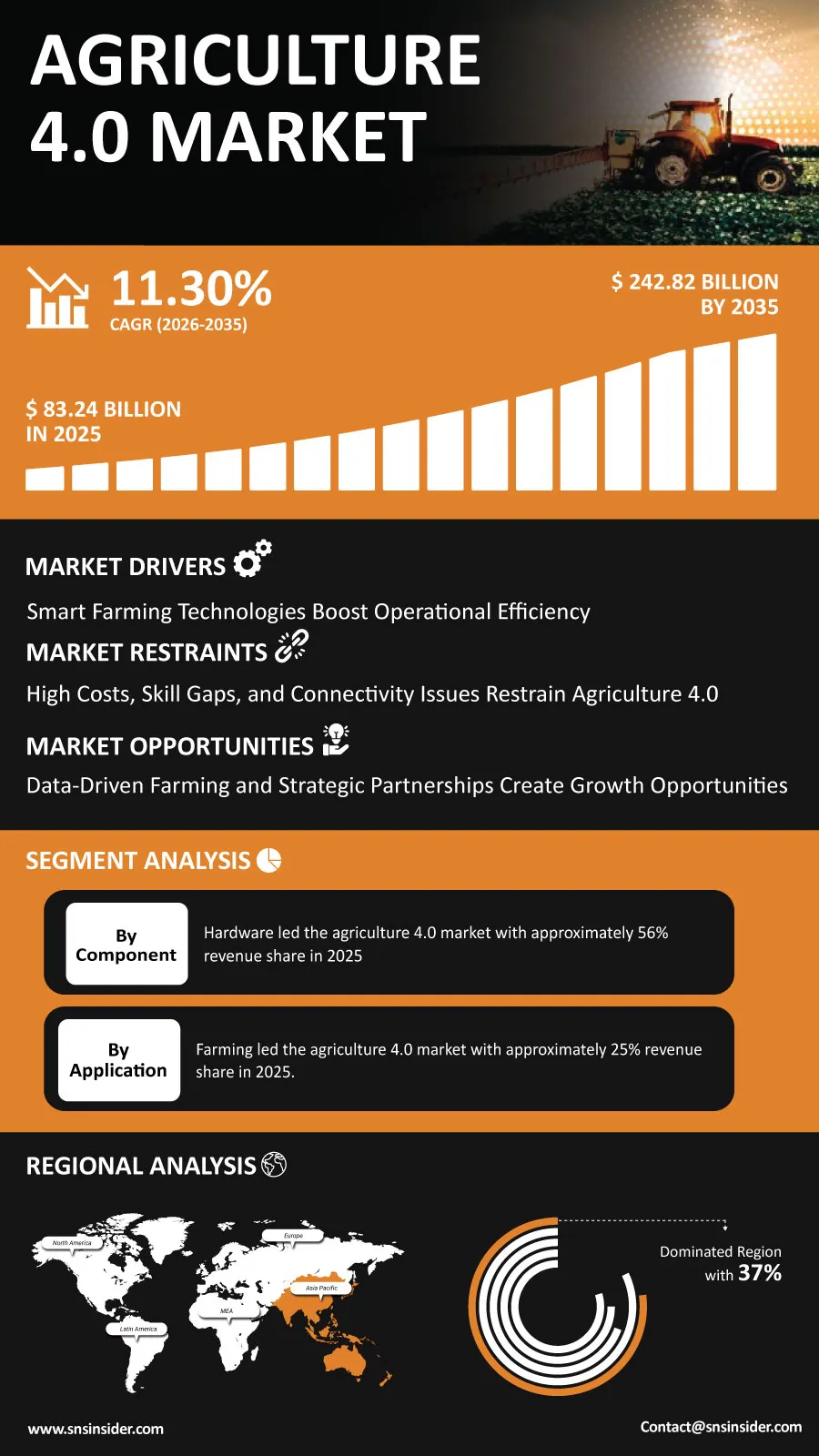
The global Agriculture 4.0 Market is entering a transformative phase as farmers and agribusinesses accelerate the adoption of connected equipment, intelligent analytics, automation, and precision farming technologies. According to a recent study by SNS Insider, the global Agriculture 4.0 Market size valued at USD 83.24 billion in 2025, is anticipated to grow to USD 242.82 billion by 2035, registering a CAGR of 11.30% over the 2026–2035 forecast period.
The modernization of agricultural practices will be facilitated by the increasing demands for productivity, along with efficient management of water, fertilizers, energy, and labor. As a result of the use of connected field devices and digital farms, farmers will be able to assess crop performance and make more accurate decisions regarding their operations.
Meanwhile, automation, robotics, remote sensing, and artificial intelligence are going beyond pilot applications and gaining increasing relevance to commercial agriculture. They are assisting farmers in tackling labor issues, ensuring more consistent outcomes, and reacting faster to changes in the field environment.
To Get Detailed Insights on the Agriculture 4.0 Market – Request a Sample Report
Smart Farming Investment Creates New Growth Opportunities
The economic justification of Agriculture 4.0 is increasing, with the evidence of increased efficiency leading to a growing tendency for farmers to shift from traditional methods to those involving assistance through data. Precision technologies have the potential to improve the accuracy of inputs, decrease the waste of resources, and detect problems before crops are adversely impacted.
Furthermore, government initiatives and cooperation between the tech sector, agriculture groups, and the producer community increase the availability of advanced agricultural solutions. In emerging markets, such an approach would allow small producers to get rid of some of the economic restrictions on advanced machinery and software.
Another driver for adoption comes from the rising demands for sustainability. The food industry needs more efficient management of natural resources, and producers have to prove it.
Key Market Insights Highlight Shifting Demand Patterns
By component, hardware was expected to account for approximately 56% of global market revenue in 2025, supported by continued investment in sensors, drones, GPS-enabled equipment, automated irrigation systems, and agricultural robotics. The services segment is projected to record the fastest growth at a CAGR of approximately 13.37% through 2035 as farmers require system integration, technical support, training, analytics, and maintenance.
Based on application, farming was anticipated to represent approximately 25% of market revenue in 2025 as producers increasingly deploy digital technologies to improve crop management and productivity. Smart greenhouse applications are forecast to experience the fastest growth, with a CAGR of approximately 13.77% through 2035, driven by demand for controlled growing environments and precise management of water, nutrients, temperature, and crop conditions.
By end use, agro-forestry was expected to hold approximately 40% of market revenue in 2025 as digital monitoring and remote sensing technologies support large-scale land management and integrated production systems. The fishing segment is projected to expand at the fastest CAGR of approximately 13.00% through 2035 as aquaculture operators adopt connected monitoring and automation technologies to improve production efficiency.
Automation and Data Analytics Reshape Farm Management
The rise in the adoption of artificial intelligence technology is reshaping the process of making agricultural decisions. Predictive analytics can integrate data from field sensors, production history, weather, and crop models in order to deliver useful insights in respect of planting, watering, insect control, and harvesting.
Moreover, autonomous tractors, robotics, and unmanned aerial vehicles are becoming important as well as an alternative to the use of laborious practices. The convergence of machine intelligence and interconnected machinery is building integrated environments for agriculture where the data collected in the fields could be immediately transferred into farm management systems.
Asia Pacific Leads with 37% Revenue Share as Europe Advances at a 13.02% CAGR
The Asia Pacific region will continue to be the largest regional market with a revenue share of about 37% in 2025. The extensive agricultural sector, emphasis on food security, increased connectivity and digital farming projects being undertaken by governments have encouraged investments in agricultural operations across the region.
Europe is anticipated to be the fastest growing regional market growing at a CAGR of about 13.02% between 2026 to 2035. Policies related to sustainability, agricultural traceability, environmental concerns and efficient research infrastructure are driving adoption of precision agriculture and automated farming.
North America will be enjoying the presence of large agricultural farms, advanced agricultural research and already existing adoption of precision farming equipment. Latin America will be seeing growth through use of technology in agriculture in economically important agricultural countries while the Middle East and Africa will be focusing more on efficient water usage through smart irrigation systems and farming techniques.
Industry Participants Focus on Connected Agriculture Innovation
The business environment has changed with an increasing number of products offered by companies dealing with farm equipment, IT businesses, crop science companies, and specialized agriculture digital solutions businesses. They have started focusing on the development of autonomous farm equipment, precision input management systems, analysis based on artificial intelligence, and farm management systems.
Key companies operating in the global Agriculture 4.0 Market include AGCO Corporation, Bayer AG, CNH Industrial, Corteva Agriscience, CropX Inc., Deere & Company, IBM, Kubota Corporation, Saga Robotics AS, Syngenta Crop Protection AG, Trimble Inc., Yara International, AG Leader Technology, BASF SE, Raven Industries, Valmont Industries, Topcon Positioning Systems, Lemken, Dole Food Company, and PrecisionHawk.
An SNS Insider analyst Sushant Kadam commented, “The next phase of agricultural modernization will be shaped by the convergence of automation, artificial intelligence, connected equipment, and precision resource management. As technology becomes more accessible and sustainability requirements intensify, Agriculture 4.0 solutions that demonstrate measurable productivity and cost benefits are expected to gain broader adoption across global farming operations.”
About the Author

Get in touch




