
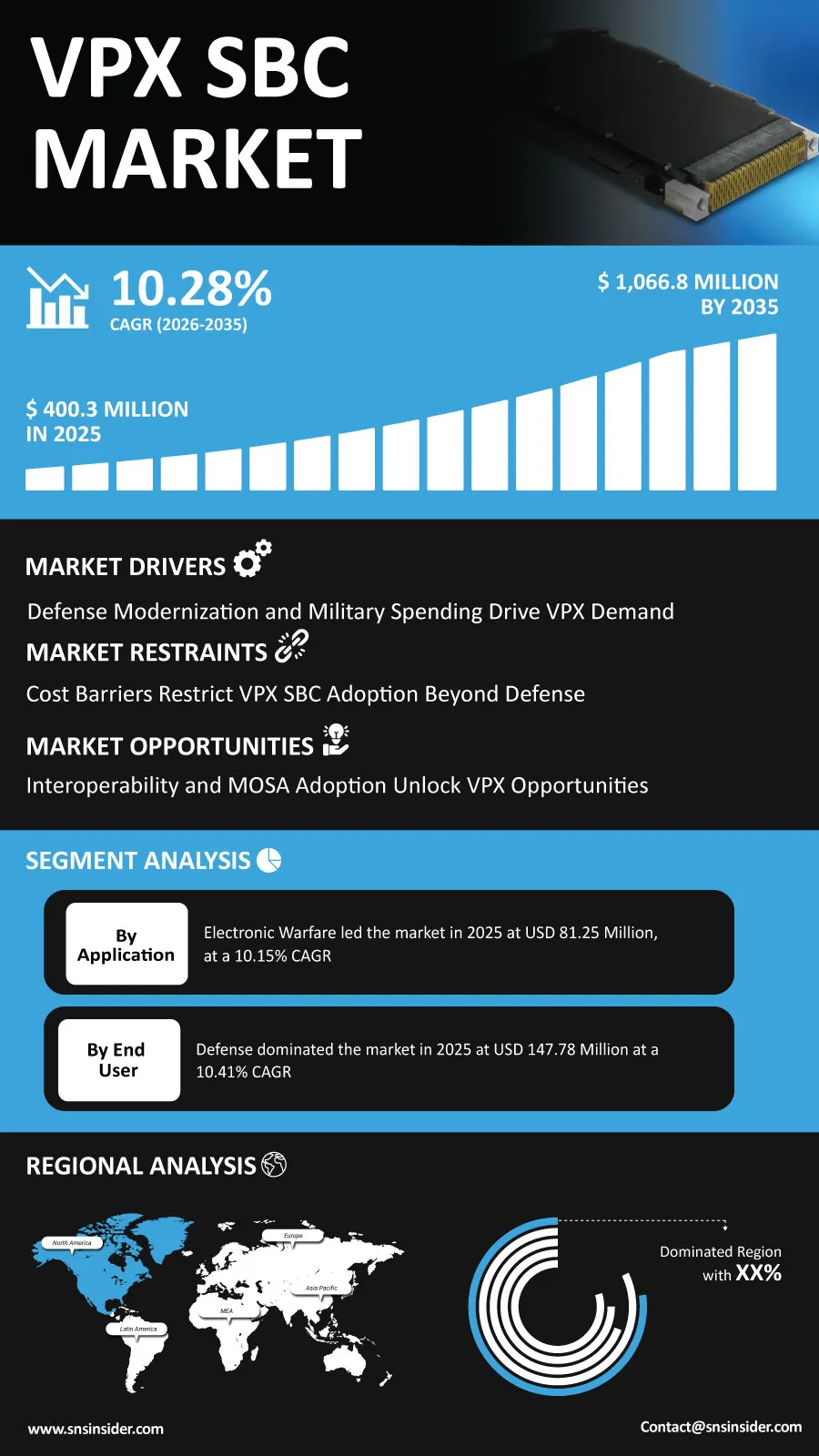
The global VPX SBC Market is entering a strong growth phase as defense organizations, aerospace manufacturers, and industrial technology developers demand compact computing platforms capable of handling complex workloads in demanding environments. According to a recent study by SNS Insider, the global VPX SBC Market size valued at USD 400.3 million in 2025, is anticipated to grow to USD 1,066.8 million by 2035, registering a CAGR of 10.28% over the 2026–2035 forecast period.
The increasing use of radars, electronic warfare, avionics, surveillance, and automation technologies has raised the requirement for highly performing embedded computers capable of handling huge amounts of data without any delay. VPX-based single board computers have gained prominence due to their rugged nature and capability to provide modularity within the system.
Open architectures have become an important consideration during the procurement process. Open architectures provide an advantage to defense and aerospace companies in terms of upgrading processor, storage, network, and accelerator modules of the system without re-designing the entire system.
To Get Detailed Insights on the VPX SBC Market – Request a Sample Report
Defense Modernization Creates New Growth Opportunities
The investment in sophisticated military electronics systems around the world will be creating ample demand for the VPX SBC suppliers. Today, defense systems are increasingly dependent upon real-time computing for sensor processing, mission control, communication, threat detection, and decision-making capabilities.
The emergence of the Modular Open Systems Approach (MOSA), OpenVPX, and the Sensor Open System Architecture (SOSA) is further enhancing the possibilities for those vendors who manufacture the interoperable computing systems. These standardized architectures are less likely to require proprietary hardware while ensuring easier upgrades and integration of technologies in future times.
Moreover, Artificial Intelligence (AI) is another area that provides great opportunities. The AI enabled VPX computing systems are increasingly under development for edge computing, sensor fusion, computer vision, electronic warfare, and autonomous systems, which create demand for high performance processors and accelerators.
Key Market Insights Highlight Shifting Demand Patterns
By processor architecture, NXP Power Architecture was expected to remain the leading segment, generating approximately USD 109.30 million in revenue in 2025 and expanding at a CAGR of 9.78% through 2035. Intel Architecture is projected to be the fastest-growing category as defense and industrial applications increasingly require AI acceleration, advanced edge processing, and energy-efficient computing.
Based on application, Electronic Warfare was anticipated to lead the market with revenue of approximately USD 81.25 million in 2025, reflecting increasing requirements for high-speed signal processing and mission computing. Radar Systems are expected to register the fastest growth at a CAGR of 10.97% as next-generation radar platforms incorporate advanced data processing, sensor fusion, and AI-supported situational awareness.
By end user, Defense segment was projected to dominate with revenue of USD 147.78 million in 2025 and a CAGR of 10.41%. Aerospace is expected to be the fastest-growing segment, advancing at a CAGR of 10.43% as aircraft, satellite, and avionics programs incorporate increasingly sophisticated onboard computing capabilities.
AI and Open Architecture Reshape Embedded Computing
AI in rugged embedded systems is driving the demand for rapid processing capabilities at the network edge. Military vehicles require local analysis of sensor input and operational data, improving response time and decreasing dependence on remote computing facilities.
At the same time, open architecture standards are driving a push towards modular VPX environments. This allows system integrators to use multiple vendors' hardware and upgrade computing capability with changing mission needs.
Nevertheless, expensive development, validation, thermal management, and system integration hinder the wider implementation of VPX technology. Special VPX systems frequently need validation of signal integrity, environmental resistance, and EMC.
North America Reaches USD 140.30 Million in 2025 as Embedded Computing Market Grows at a 9.38% CAGR
It is predicted that North America will continue being the dominant regional market with an expected valuation of around USD 140.30 million in 2025 at a CAGR of 9.38%. Favorable factors driving demand include active defense modernization initiatives, aerospace sector growth, investment in AI technologies, and adoption of open computing architectures. The USA constitutes around 83.4% of the North American revenues.
Asia Pacific is forecasted to grow at the fastest pace, generating revenues of around USD 80.40 million in 2025 with a CAGR of 12.93% till 2035. Factors contributing to the demand include defense modernization, aerospace growth, industrial digitalization, and growing investment in radar and C4ISR solutions and autonomous systems. These are prevalent in China, India, Japan, and South Korea.
Industry Participants Focus on AI and Modular Computing
Competition in the VPX SBC market is intensifying as manufacturers develop higher-performance processors, AI accelerators, advanced networking capabilities, and ruggedized architectures. Companies are increasingly aligning their portfolios with MOSA and SOSA requirements while focusing on thermal efficiency, interoperability, and long-term platform scalability.
Key companies operating in the global VPX SBC Market include Abaco Systems, Extreme Engineering Solutions, Connect Tech Inc., Kontron AG, Aitech Defense Systems, Curtiss-Wright Corporation, Mercury Systems Inc., Acromag Inc., Advantech Co. Ltd., Concurrent Technologies Inc., GE Aviation Systems, Ecrin Systems, ADLINK Technology Inc., Mistral Solutions Pvt. Ltd., Cornet Technology Inc., Elma Electronic Inc., General Micro Systems Inc., Pixus Technologies Inc., General Dynamics Mission Systems Inc., and Wolf Advanced Technology.
An SNS Insider analyst Sushant Kadam commented, “The convergence of defense modernization, AI-enabled edge processing, and open-system architectures is strengthening demand for rugged VPX computing platforms. Vendors that combine high computational performance with interoperability, thermal efficiency, and long-term upgradeability will be well positioned to capture emerging opportunities across defense, aerospace, and industrial applications.”
About the Author

Get in touch




