
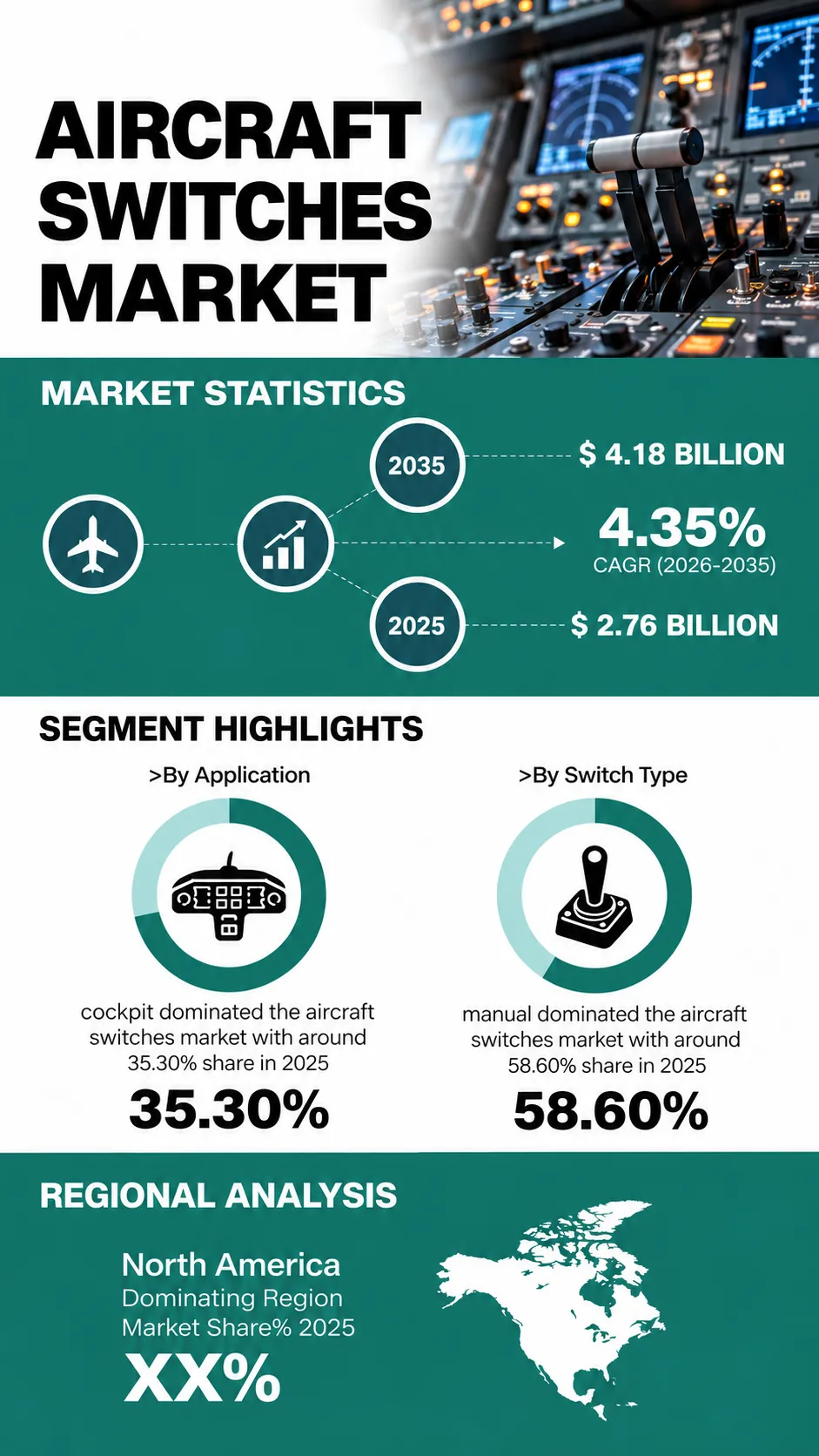
The global Aircraft Switches Market is set for steady expansion as fleet renewal cycles and more-electric architecture adoption continue to reshape aerospace component procurement worldwide. “According to a recent study by SNS Insider, the global Aircraft Switches Market size valued at USD 2.76 billion in 2025, is anticipated to grow to USD 4.18 billion by 2035, registering a CAGR of 4.35% over the 2026–2035 forecast period.”
There have been notable changes within aircraft switch technology over time, due to which many manufacturers who aim at improving reliability and digital integration of their products can take advantage of this trend. This includes the need for more advanced LED pushbutton and automatic relay techniques that will provide aircraft OEMs with the ability to enhance cockpit human-machine interface design. This applies in situations where aircraft switches support cockpit, avionics, engine, and cabin applications. Manufacturers are constantly working hard to ensure that their switch products perform better than before in order to meet various safety and digitization requirements.
To Get Detailed Insights on the Aircraft Switches Market – Request a Sample Report
More-Electric Architecture and Smart Switch Integration Create New Demand
The aircraft switches market has evolved from basic mechanical toggle components to increasingly sophisticated, digitally networked switching systems. The growing investment in LED pushbutton technology, automatic relay development, and predictive-maintenance data integration across manufacturers of all sizes has required the development of more capable and reliable switch products.
New switch and sensor technologies can increase reliability, improve dispatch efficiency, and allow for expansion into increasingly demanding cockpit, avionics, and unmanned aerial vehicle applications. This gives aircraft OEMs and airlines the possibility to reduce pilot workload while maintaining the stringent safety standards required across the industry.
Switch manufacturers, avionics companies, and aircraft OEMs are increasingly cooperating thanks to the growing interest in developing future solutions for digitally networked, reliable aircraft switching technology.
Key Market Findings Highlight High-Growth Segments
The cockpit segment dominated all categories in the aircraft switches market share with 35.30% of 2025 revenue due to pilots relying on tactile pushbuttons, toggles, and rotary selectors for flight-critical tasks. The fastest growing category is expected to be avionics installations which will grow at a 4.89% CAGR, owing to multi-function displays and flight-management computers demanding high-density automatic relays.
By switch type, manual designs dominated the market due to regulatory requirements for physical backup control lines. Automatic switches will see the fastest growth in revenue generation at a CAGR of 6.20%, driven by growing demand for pressure and limit switches improving engine efficiency.
Based on platform, fixed-wing aircraft dominated the market thanks to the substantial scale of global commercial, military, and general aviation fleets. On the other hand, unmanned aerial vehicles will be the segment recording the fastest revenue growth at a 7.80% CAGR, supported by growing military and commercial UAV deployment.
Distributive end-user trends are changing as well. OEM procurement accounted for the largest revenue share owing to sustained new aircraft production driven by fleet renewal cycles. But aftermarket demand will turn out to be the fastest-growing end-user category through 2035, on the back of aging fleet switch replacement and cockpit modernization needs.
Reliability, Digital Integration, and Predictive Maintenance Gain Importance
In this regard, aircraft OEMs and airlines have been looking at switch products that would deliver more consistent reliability while requiring greater digital integration and predictive-maintenance capability.
Innovation in LED pushbutton technology, automatic relay development, and Ethernet-based backbone integration has been making it possible for companies to come up with products that can operate effectively across increasingly demanding cockpit and avionics applications. In addition to that, increasing emphasis on more-electric aircraft architecture is also making it possible for manufacturers to find solutions that support the industry's ongoing transition from legacy mechanical and hydraulic components. Such trends are likely to become even more prominent in the future.
North America Emerges as the Largest Market Amid Strong Fleet Renewal Activity
The North America region represented the largest share of regional market revenue in 2025, driven by fleet renewal cycles at major airlines and sustained defense modernization budgets. On the other hand, the Asia Pacific region is expected to witness the fastest growth rate during the forecast period through 2035, propelled by China's projected strong 5.8% CAGR and rapidly expanding domestic aviation manufacturing capacity.
Leading Companies Drive Innovation and Competition
The environment continues to stay very dynamic since players continue innovating on LED pushbutton technology and smart switch integration as well as forming partnerships in order to enhance their position in the industry. Some of the major companies that operate in the global aircraft switches market are Honeywell International, Collins Aerospace, AMETEK, Eaton Corporation, Safran, Hydra-Electric Company, Unison Industries, ITT, TE Connectivity, and Electro-Mech Components.
An SNS Insider analyst Santosh Bhul commented, "The growing convergence of more-electric aircraft architecture and predictive-maintenance data integration is creating sustained demand for advanced, digitally networked switch technology. Manufacturers that successfully combine LED pushbutton innovation, automatic relay development, and smart switch capability will be best positioned to capitalize on emerging opportunities across cockpit, avionics, and unmanned aerial vehicle segments."
About the Author

Get in touch




