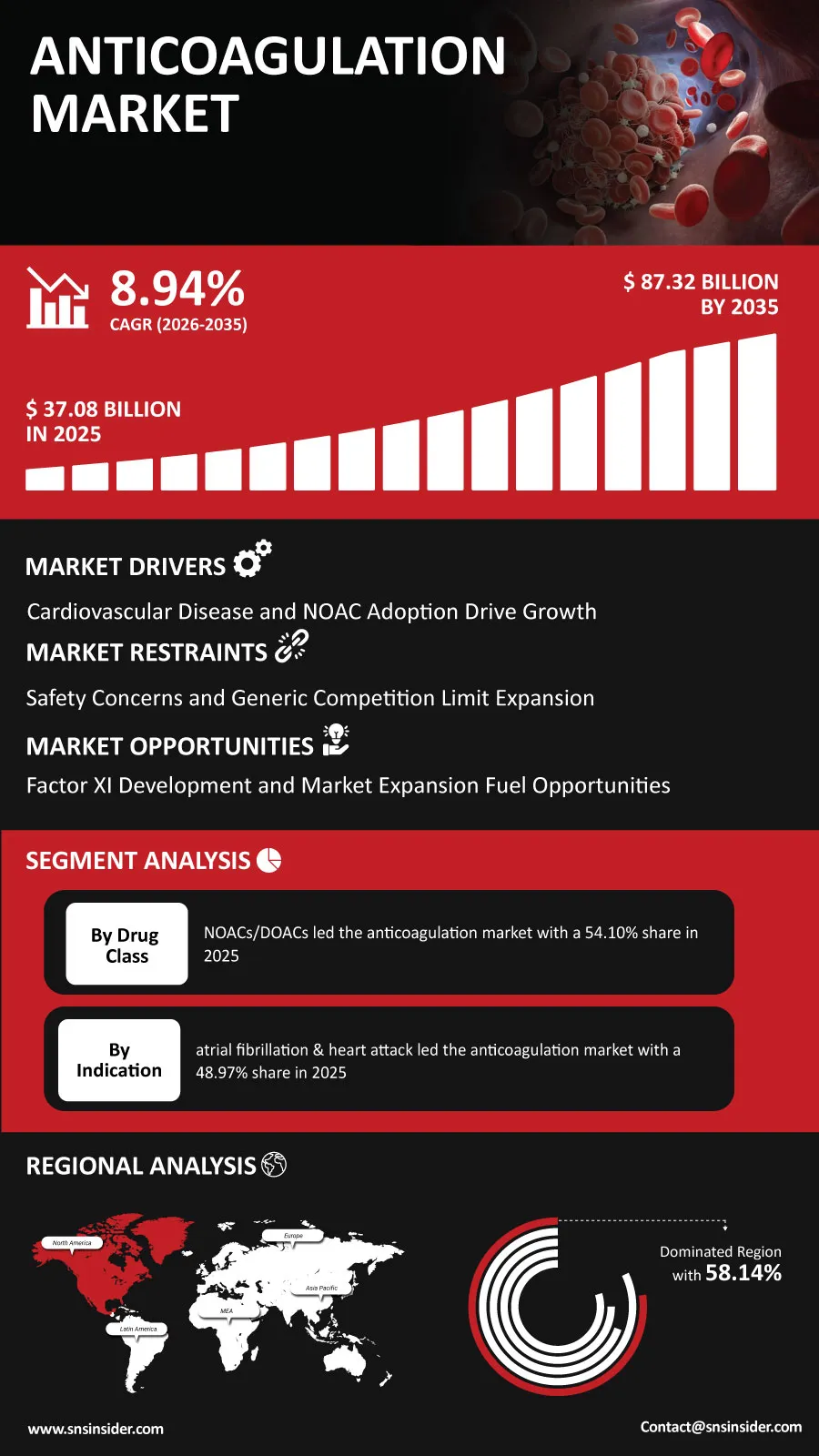
The global Anticoagulation Market is set for significant expansion as healthcare providers worldwide continue managing rising cardiovascular disease burden. "According to a recent study by SNS Insider, the global Anticoagulation Market size valued at USD 37.08 billion in 2025, is anticipated to grow to USD 87.32 billion by 2035, registering a CAGR of 8.94% over the 2026-2035 forecast period."
There have been tremendous changes within anticoagulant drug technology over time due to which many pharmaceutical companies who aim at improving bleeding safety profiles can take advantage of this trend. This includes the need for more targeted, patient-friendly therapies that will provide clinicians with the ability to prevent thrombotic events while minimizing bleeding risk. This applies in situations where anticoagulants are used for atrial fibrillation, deep vein thrombosis, and pulmonary embolism management.
Pharmaceutical companies are constantly working hard to ensure that their anticoagulant therapies perform better than before in order to meet various needs of cardiovascular and thrombosis patients.
To Get Detailed Insights on the Anticoagulation Market – Request a Sample Report
Next-Generation Blood Thinner Ecosystems Create New Demand
The anticoagulation market has evolved from basic vitamin K antagonists to more advanced NOAC and Factor XI inhibitor use cases. The growing investment in reduced-bleeding-risk mechanisms, generic manufacturing capacity, and direct-to-consumer access platforms for a variety of applications has required the development of more efficient and reliable therapeutic systems.
New designs of anticoagulant therapies can increase safety, reduce monitoring burden, and allow for more convenient dosing regimens. This gives patients and healthcare providers the possibility to be more effective when preventing thrombotic events and doing better long-term disease management.
Pharmaceutical companies, healthcare providers, and pharmacy platforms are increasingly cooperating thanks to the growing interest in developing future solutions for safer anticoagulation therapy.
Key Market Findings Highlight High-Growth Segments
The NOACs/DOACs segment dominated all categories in the anticoagulation market share with a market revenue share of 54.10% in 2025 due to simplified dosing regimens and safety in elderly populations.
The fastest growing category is expected to be others/generics which will grow at a CAGR of 12.40% through 2035. This will be possible owing to the increasing impending patent expirations introducing affordable alternatives.
By route of administration, oral anticoagulants held the largest share of total market revenue of 68.60% in 2025 due to enhanced patient compliance. The injectable segment will see the fastest growth in revenue generation at a CAGR of 9.80%.
Based on indication, atrial fibrillation and heart attack generated a share of 48.97% of market revenue in 2025 thanks to increasing diagnostic rates. On the other hand, pulmonary embolism will be the segment recording the fastest revenue growth at a CAGR of 10.40%.
Distributive trends are changing as well. Hospital pharmacies accounted for a 46.60% revenue share in 2025. But online pharmacy will turn out to be the fastest-growing distribution channel through 2035, on the back of prescription refill convenience, direct-to-consumer partnerships, and increased demand from cost-conscious patients.
Safety, Convenience, and Access Gain Importance
In this regard, healthcare providers have been looking at anticoagulant therapies that would make treatment safer and require less monitoring burden and be more accessible.
Innovation in Factor XI inhibitor mechanisms, generic manufacturing scale-up, and direct-to-consumer pharmacy partnerships has been making it possible for companies to come up with therapies that can meet increasingly demanding clinical and affordability expectations. In addition to that, increasing emphasis on bleeding risk reduction and patient access is also making it possible for companies to find solutions that optimize therapeutic outcomes.
Such trends are likely to become even more prominent in the future.
North America Emerges as the Largest Market with 58.14% Revenue Share Amid Rising Cardiovascular Disease Burden
The North America region represented 58.14% share of global market revenue in 2025 and was the largest regional market, owing to strong healthcare infrastructure, high cardiovascular disease prevalence, and advanced reimbursement mechanisms. In addition, Asia Pacific is expected to be the fastest-growing market during the forecast period, propelled by rising cardiovascular disease prevalence and applications across the region's fast-growing pharmaceutical manufacturing industries.
On the other hand, Europe represented a meaningful share of global market revenue in 2025, aided by a dense concentration of leading pharmaceutical companies and strong regulatory frameworks.
Leading Companies Drive Innovation and Competition
The environment continues to stay very dynamic since players continue innovating on products and technologies as well as forming partnerships in order to enhance their position in the industry.
Some of the major companies that operate in the global anticoagulation market are Bristol-Myers Squibb Company, Pfizer Inc., Bayer AG, Boehringer Ingelheim International GmbH, Johnson & Johnson, Sanofi S.A., Daiichi Sankyo Company Limited, AstraZeneca plc, Leo Pharma A/S, and Sandoz Group AG.
An SNS Insider Analyst Parry Kardani commented, "The rapid commercialization of next-generation anticoagulant technology is creating unprecedented demand for high-performance, safer blood thinner therapies. Companies that successfully combine bleeding safety, dosing convenience, patient access, and advanced clinical development capabilities will be best positioned to capitalize on emerging opportunities across atrial fibrillation, DVT, and pulmonary embolism applications.
About the Author

Get in touch