
Pulmonary Embolism Market Report Scope & Overview:
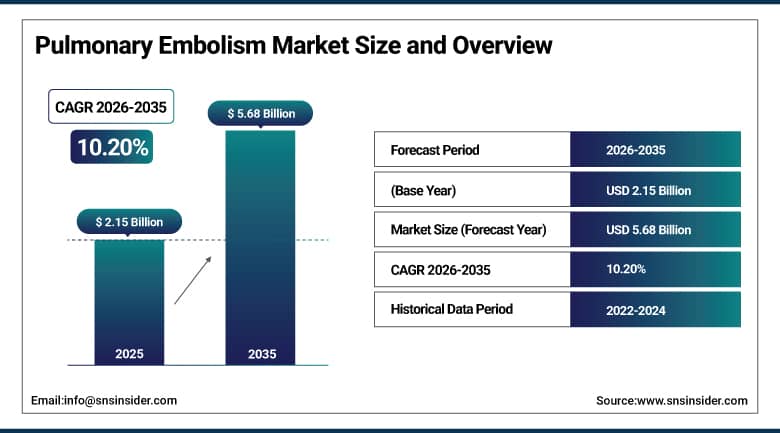
The Pulmonary Embolism Market was valued at USD 2.15 Billion in 2025 and is projected to reach USD 5.68 Billion by 2035, expanding at a CAGR of 10.20% during the forecast period 2026–2035.
The growth in PE is primarily driven by growing occurrences of VTE, rapidly aging demographic across all developing countries, increase in incidence of cardiovascular diseases, obesity, thrombosis associated cancer, & prolonged periods of hospitalization; PE being the no 2 most common cause for prevention of hospital death worldwide have led to stronger early diagnose &quick treatment approaches. Enhanced medical attention among physicians regarding evidence-based anticoagulation guidelines, more effective regency services, and broader uptake of multidisciplinary PE Response Teams (PERTs) lead to significantly reduced patient mortality rates and will in the long term expand demand for advanced innovative treatment & diagnosis.
Hospitals are investing more and more into o state-of-the-art imaging tech including CT, with real-time assist s w o re that help clinicians. AI enables clinicians to optimize therapy and achieve more precise medical treatment through advanced clinical workflow solutions .and image-guided in tertive systems that reduces patients LOS. In 2025, the ACC provided increased clinical education on PERTs and catheter equipped intervention approaches for high-risk PE patients in US. Hospitals. This reflects increasing clinical consensus to diagnose and intervene quicker to stratify risk.
To Get More Information On Pulmonary Embolism Market - Request Free Sample Report
Pulmonary Embolism Market Trends
-
Increasing adoption of direct oral anticoagulants across pulmonary embolism management.
-
Rising utilization of catheter-directed thrombectomy for high-risk patients.
-
Growing integration of AI-assisted CT imaging for rapid diagnosis.
-
Expansion of Pulmonary Embolism Response Teams across tertiary hospitals.
-
Increasing investments in minimally invasive vascular intervention technologies.
The U.S. Pulmonary Embolism Market Size Outlook
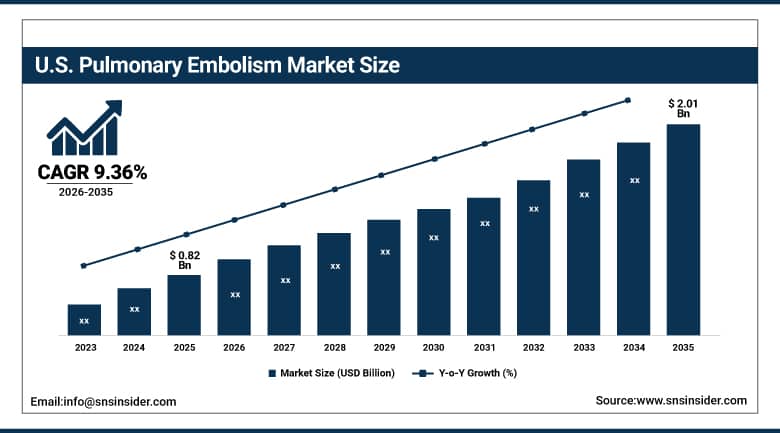
The U.S. Pulmonary Embolism Market was valued at USD 0.82 billion in 2025 and is expected to reach approximately USD 2.01 billion by 2035, expanding at a CAGR of 9.36% during 2026–2035.
The United States maintains its dominance in the North American pulmonary embolism market, due to an infrastructure for advanced cardiovascular care, widespread emergency imaging availability, beneficial reimbursement policies and ongoing uptake of evidence-based anticoagulation treatments. The US experience a large annual venous thromboembolism burden, and these factors drive investment from hospital networks into fast diagnostic streams, catheter-directed intervention, and interdisciplinary Pulmonary Embolism Response teams. Additionally, high physician awareness, ongoing clinical trials and broad adoption of oral anticoagulants further support favorable therapeutic outcomes and ensure consistent product sales in both the pharma and interventional space.
Investments are steadily flowing into the United States market, driving the development of AI imaging analytics, mechanical thrombectomy, and the next generation of catheter-based solutions-all aiming to provide increased procedural throughput and minimize procedural complications such as bleeding. Leading academic centers continue to ramp up minimally invasive PE programs with support from leading diagnostic imaging and cardiovascular departments. Medical and technological innovation continues to gain traction, with ongoing device approvals via the United States Food and Drug Administration (FDA) throughout 2025, helping introduce even newer solutions for the minimally invasive treatment of thromboembolic events.
Pulmonary Embolism Market Segmentation Analysis
-
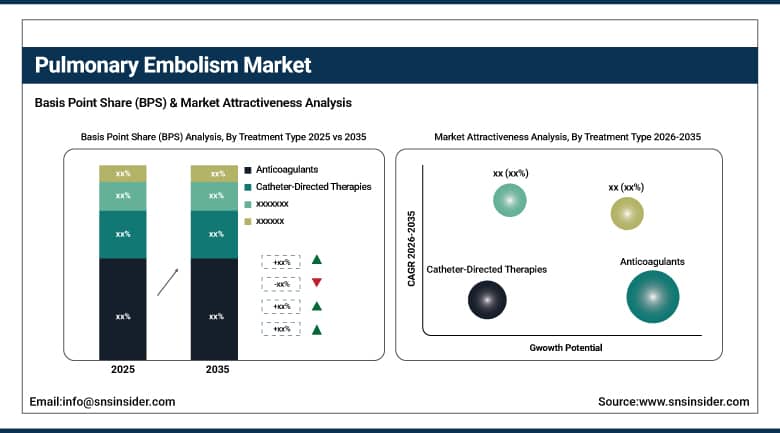
By Treatment Type, anticoagulants dominated the market with 48.00% share in 2025, while catheter-directed therapies are projected to witness the fastest growth with 14.76% CAGR during the forecast period.
-
By Drug Class, direct oral anticoagulants dominated the market with 39.00% share in 2025, while catheter-based devices are projected to witness the fastest growth with 13.88% CAGR during the forecast period.
-
By Patient Type, acute pulmonary embolism dominated the market with 58.00% share in 2025, while high-risk pulmonary embolism is projected to witness the fastest growth with 11.83% CAGR during the forecast period.
-
By End User, hospitals dominated the market with 52.00% share in 2025, while cardiac & vascular centers are projected to witness the fastest growth with 12.58% CAGR during the forecast period.
By Treatment Type, anticoagulants dominated, while catheter-directed therapies grows fastest.
The anticoagulant segment dominated the pulmonary embolism market in 2025, at 48.00% of the share. First-line therapy, in acute management as well as recurrence prevention of pulmonary embolism has been widely prescribed in anticoagulant form. Growing trends towards direct oral anticoagulants and low-molecular-weight heparins are a primary factor improving treatment compliance, shortening hospitalization length and eliminating need for regular tests and monitoring. In 2025, ASH continued encouraging guideline-driven anticoagulation treatment of venous thromboembolic disorders and promoting use of direct oral anticoagulants on more pulmonary embolism patients eligible for such treatment.
Catheter Directed Therapies is expected to exhibit the highest growth, at aCAGRof14.76% in 2026-2035 as their application in patients with moderate and high risk for pulmonary embolism with requirement of quick removal of clots with lower risks than systematic lytic therapy is increased among physicians. Advancements in aspiration thrombectomy, catheter directed lytic therapies, and image-directed therapy for vascular diseases has become important to manage cases of Pulmonary Embolism efficiently. As of 2025, Inari MedicalInc. continued to enhance clinical usage of FlowTriever system with more robust evidence from real world application for mechanical thrombectomy in pulmonary embolism.
By Drug Class, direct oral anticoagulants dominated, while catheter-based devices grows fastest.
The direct oral anticoagulants (DOACs) market was the largest market and captured a share of 39.00% in 2025 due to convenience in handling, predicted kinetics of DOACs, requirement for minimal coagulation monitoring and favorable international guidance for the management of pulmonary embolism. The global use of DOACs is accelerating at a faster rate due to growing clinician inclination toward the outpatient approach, favorable risk-benefit ratio, better compliance and the broadening insurance cover. The latest recommendations from ESC reaffirmed the role of DOACs over oral anticoagulants in most hemodynamically stable pulmonary embolism patients in 2025.
Catheter-based devices would be the fastest growing market, with a growth rate of 13.88% during the forecast period due to the ongoing innovative techniques for minimally invasive thrombectomy technologies, growing success rate of the procedure, development of better clinical evidence regarding catheter-assisted interventions. The adoption of multidisciplinary treatment protocols for pulmonary embolism and technological advancements by top-notch medical device players are expected to drive immense market growth in this category by 2035. Boston Scientific continued enhancing its interventional cardiovascular portfolio with R&D investments, for minimally invasive vascular intervention technology for thromboembolic diseases in 2026.
By Patient Type, acute pulmonary embolism dominated, while high-risk pulmonary embolism grows fastest.
In 2025 acute pulmonary embolism captured 58.00% of global pulmonary embolism market. Higher numbers of emergency care admission required urgent management with anticoagulant and further diagnosis for the Pulmonary Embolism. Furthermore growing numbers of incidence rates for Venous thromboembolism in aged populations, immobilization for prolonged duration, orthopedic surgeries, chronic cardiovascular disease, cancer and increasing obesity rates is fueling demand for quick diagnosis via imaging. In 2025 the American college of chest physicians (CHEST) also continues developing ongoing and updated educational platforms targeting pulmonary embolism diagnosis, anticoagulant treatment in the early stages, and best practices on PE risk and prognostic assessment to support clinician decision making.
In 2025 high-risk pulmonary embolism market is estimated to exhibit the strongest CAGR during the projected forecast period of 2026 to 2035. However this category, has started developing at a swift pace of 11.83% CAGR due to escalating demand for the introduction of latest catheter guided interventions and mechanical trombectomy, external cardiopulmonary circulatory assist devices and also multidisciplinary Pulmonary Embolism Response Teams. In 2025, Inari Medical’s continues to publish additional data from a real-world setting, supporting the use of mechanical thrombectomy to Treat high and intermediate risk pulmonary embolism, this further supports faster recovery times, decrease ICU length stay of stays of PE patients as against anticoagulant use.
Regional Analysis:
|
Region |
Major Country |
Share within Region, 2025 (%) |
|---|---|---|
|
North America |
United States |
93.00% |
|
Europe |
Germany |
29.00% |
|
Asia Pacific |
China |
23.00% |
|
Middle East & Africa |
UAE |
4.00% |
|
Latin America |
Brazil |
3.00% |
North America Pulmonary Embolism Market Insights
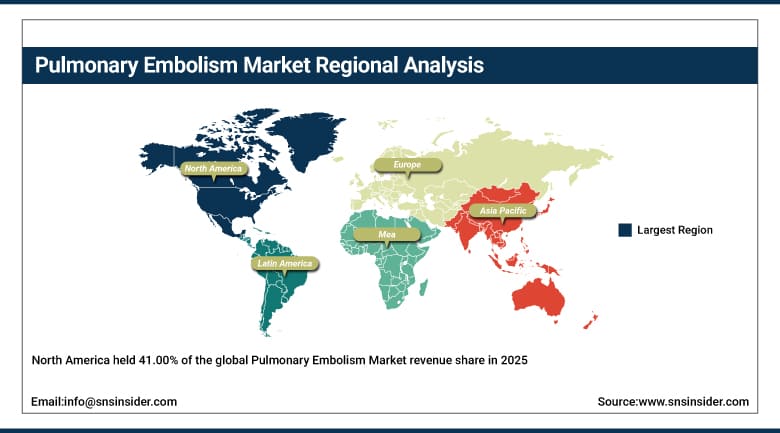
North America held 41.00% of the global Pulmonary Embolism Market revenue share in 2025, retaining its leadership due to the high incidence of venous thromboembolism, a sophisticated cardiovascular healthcare infrastructure, readily available CT pulmonary angiography and good implementation of evidence-based anticoagulation treatments across the continent. The market is boosted by ongoing investments in catheter-directed therapy, AI-empowered imaging diagnostics, and minimally invasive thrombectomy procedures that help improve the clinical outcomes while simultaneously catering to the commercial needs of the pulmonary embolism market.
Favorable clinical research studies, rapid product adoption of novel vascular devices enhance North America's role in the global market. In January 2026, Inari Medical unveiled encouraging clinical results from their PEERLESS trial, indicating favorable outcomes associated with mechanical thrombectomy of pulmonary embolism patients and thereby propelling the implementation of catheter based treatments of pulmonary embolism across North American healthcare systems.
Get Customized Report as Per Your Business Requirement - Enquiry Now
Europe Pulmonary Embolism Market Insights
Europe has been augmented by universal public healthcare system, growing consciousness of venous thromboembolism prevention, as well as standardization of clinical treatment in many countries. Besides Germany, France, UK, Italy, and Spain still continue to invest in developing cardiovascular imaging techniques, ER facility and endovascular therapy with minimally invasive approach. The widespread application of direct oral anticoagulants, the increased application of catheter-directed therapy in the intermediate-risk patients as well as continuous collaboration on clinical trials have all contributed to expanding accessibility of treatments.
Long-term growth will be stimulated by government initiative of in-hospital thrombosis prevention policies and continuous product development by European medical devices providers. In 2025, ESC continued to disseminate revised treatment recommendations for pulmonary embolism by scientific congresses stressing risk stratification, multidisciplinary treatment and advanced treatment approaches including percutaneous intervention of PE.
Asia Pacific Pulmonary Embolism Market Insights
The market for pulmonary embolism in Asia Pacific is anticipated to grow most rapidly, which a CAGR of 12.78% has expected during the forecast years. Rapid urbanization, better healthcare infrastructure, increase in cardiovascular diseases, cancer, obesity and the aging population is leading to higher rates of diagnosis of pulmonary embolism across China, Japan, India, South Korea and Southeast Asian countries. The government and private players are increasing investment in diagnostics imaging systems, interventional cardiology departments and emergency care.
The awareness among physicians about evidence based anticoagulation treatment and the increasing access of direct oral anticoagulants, along with the rise in usage of less invasive methods such as thrombectomy are expected to provide significant business prospects to the medical device and pharmaceutical companies in the region. Penumbra, Inc. Stepped up physician education programs in Asia Pacific in 2025 and is aimed at hastening the adoption of novel aspiration thrombectomy devices for the treatment of acute vascular disease including pulmonary embolism.
Middle East & Africa and Latin America Pulmonary Embolism Market Insights
The Middle East & Africa market in is slowly expanding owing to successive developments in infrastructure and technology for cardiovascular care, rising capital expenditure and rise in investments in tertiary hospitals across Saudi Arabia, South Africa and the UAE. That is a result of governments strengthening facilities for emergency care, widening access to sophisticated CT imaging, anticoagulation and interventional radiology. In 2025, Saudi Heart Association continued to expand the cardiovascular education program emphasizing on early diagnosis and evidence-based management of thromboembolic disorders in the medical institutions of the region.
Market growth across Latin America is stable with development driven by expanding hospital infrastructure, modifications to emergency CV care and rising diagnosis of venous thromboembolism in the region (domestically in Brazil, Mexico, Argentina and Chile). Adoption of DOACs is increasing, as is physician knowledge of treatment options, and interventional cardiology services will only continue to be slowly increasing over this timeline. In 2025, Boston Scientific has continued to extend physician training, education programs throughout Latin America to enhance utilization of advanced minimally invasive cardiovascular and vascular intervention applications.
Growth Drivers: Increased adoption of catheter-directed therapies leading to better outcomes in the pulmonary embolism patients.
One of the key driving factors speeding up the Pulmonary Embolism Market is the increasing clinical application of catheter-directed therapies (CDT) and direct oral anticoagulants (DOA's). Current standard systemic thrombolysis has serious bleeding risk and hence moving forward, physicians have preferred minimally invasive thrombectomy procedures and catheter-directed thrombolysis procedures in intermediate and high risk patients. Similarly, DOA's have revolutionized long-term anticoagulation in pulmonary embolism patients and are preferred due to their predictable pharmacokinetics, reduced dietary interactions and no routine coagulation monitoring. The year 2025 observed continued strong positive real-world data for Inari Medical's FlowTriever mechanical thrombectomy device. Inari reported on lower intensive care usage and earlier recovery in Pulmonary Embolism patients receiving catheter-based thrombectomy.
Restraints: High cost of treatment modalities in developing health systems.
Though there has been an enormous therapeutic development in various pulmonary embolism (PE) treatment modalities, the PE market suffers from high costs associated with advanced treatment technologies and restricted access to high-tech cardiovascular care. Investment on mechanical thrombectomy systems, catheter-directed thrombolysis platforms, hybrid OR, and High-resolution CT pulmonary angiography is substantial, and thereby prevents their availability in most of the developing nations. In 2025, the World Health Organization (WHO) continues to emphasize the need to upgrade emergency and cardiovascular health systems infrastructure in the low and middle income countries to enhance timely diagnosis and management of life-threatening cardiovascular diseases including PE.
Opportunities: Increasing AI-based diagnostic technologies hold significant future market potential.
High growth potential in markets will come from incorporating artificial intelligence within diagnostic imaging, risk stratification tools, and decision support for patients with pulmonary embolism. The implementation of AI in the interpretation of CT pulmonary angiography will reduce diagnostic times while also lessening the workload of both radiologists and emergency physicians. The increasing amount of investment in digital healthcare by various health providers, growing popularity of PE Response Teams, and continued medical device R&D could add further major commercial upsides. In 2026, Boston Scientific remained to be the leader in investing in next generation endovascular and device training method.
Recent Developments
-
2026: Inari Medical announced additional positive clinical outcomes from the PEERLESS study demonstrating the effectiveness of the FlowTriever System for treating intermediate-risk pulmonary embolism patients, supporting wider adoption of catheter-based thrombectomy procedures in clinical practice.
-
2025: Boston Scientific Corporation continued expanding its peripheral interventions portfolio and physician education initiatives to strengthen minimally invasive endovascular treatment capabilities applicable to thromboembolic diseases, including pulmonary embolism.
-
2025: Penumbra, Inc. expanded physician training programs and clinical education focused on advanced aspiration thrombectomy technologies, supporting broader utilization of minimally invasive treatment approaches for acute vascular occlusions and pulmonary embolism management.
-
2025: The American College of Cardiology (ACC) continued promoting multidisciplinary Pulmonary Embolism Response Team (PERT) implementation and updated educational resources emphasizing early risk stratification, catheter-directed interventions, and evidence-based pulmonary embolism management across U.S. healthcare institutions.
Pulmonary Embolism Market Key Players are:
-
Johnson & Johnson
-
Boston Scientific Corporation
-
Inari Medical, Inc.
-
Penumbra, Inc.
-
Abbott Laboratories
-
Siemens Healthineers AG
-
GE HealthCare Technologies Inc.
-
Koninklijke Philips N.V.
-
Teleflex Incorporated
-
AngioDynamics, Inc.
-
Argon Medical Devices, Inc.
-
Medtronic plc
-
Cook Medical LLC
-
Cordis Corporation
-
Terumo Corporation
-
Becton, Dickinson and Company
-
Merit Medical Systems, Inc.
Pulmonary Embolism Market Report Scope:
| Report Attributes | Details |
|---|---|
| Market Size in 2025 | USD 2.15 Billion |
| Market Size by 2035 | USD 5.68 Billion |
| CAGR | CAGR of 10.20% From 2026 to 2035 |
| Base Year | 2025 |
| Forecast Period | 2026-2035 |
| Historical Data | 2022-2024 |
| Report Scope & Coverage | Market Size, Segments Analysis, Competitive Landscape, Regional Analysis, DROC & SWOT Analysis, Forecast Outlook |
| Key Segments | • By Treatment Type (Anticoagulants, Catheter-Directed Therapies, Systemic Thrombolytics, Mechanical Thrombectomy, Others) • By Drug Class (Direct Oral Anticoagulants, Heparins (LMWH & UFH), Catheter-Based Devices, Thrombolytic Drugs, Others) • By Patient Type (Acute Pulmonary Embolism, High-Risk Pulmonary Embolism, Cancer-Associated Pulmonary Embolism, Chronic Thromboembolic Disease) • By End User (Hospitals, Cardiac & Vascular Centers, Ambulatory Surgical Centers, Specialty Clinics, Others) |
| Regional Analysis/Coverage | North America (US, Canada), Europe (Germany, UK, France, Italy, Spain, Russia, Poland, Rest of Europe), Asia Pacific (China, India, Japan, South Korea, Australia, ASEAN Countries, Rest of Asia Pacific), Middle East & Africa (UAE, Saudi Arabia, Qatar, South Africa, Rest of Middle East & Africa), Latin America (Brazil, Argentina, Mexico, Colombia, Rest of Latin America). |
| Company Profiles | Bristol Myers Squibb, Bayer AG, Pfizer Inc., Johnson & Johnson, Boston Scientific Corporation, Inari Medical, Inc., Penumbra, Inc., Abbott Laboratories, Siemens Healthineers AG, GE HealthCare Technologies Inc., Koninklijke Philips N.V., Teleflex Incorporated, AngioDynamics, Inc., Argon Medical Devices, Inc., Medtronic plc, Cook Medical LLC, Cordis Corporation, Terumo Corporation, Becton, Dickinson and Company, Merit Medical Systems, Inc. |
Frequently Asked Questions
The Pulmonary Embolism Market was valued at USD 2.87 Billion in 2025.
The market is anticipated to expand at a CAGR of 10.20% during the forecast period.
North America dominated the global Pulmonary Embolism Market in 2025 with a 41.00% revenue share.
Anticoagulants accounted for the largest revenue share of 48.00% in 2025.
