
High Bandwidth Memory Market Report Scope and Overview:
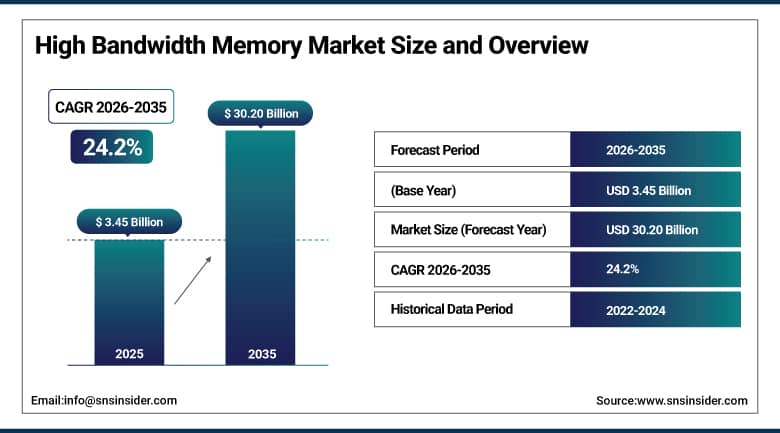
The High Bandwidth Memory Market size was valued at USD 3.45 Billion in 2025 and is projected to reach USD 30.20 Billion by 2035, registering a CAGR of 24.2% from 2026 to 2035.
The High Bandwidth Memory (HBM) Market is transitioning from a specialty component niche into a foundational pillar of artificial intelligence infrastructure by delivering the extreme bandwidth and power efficiency required by modern GPU and AI accelerator platforms. The market is characterized by rapid transition from HBM3 to HBM3E and emerging HBM4 stacks, growing adoption of advanced 2.5D and 3D packaging techniques, and expanding deployment of four-to-eight-stack configurations per accelerator in hyperscale data centers. Significant growth is being witnessed in generative AI training clusters, high-performance computing systems, and automotive centralized compute platforms, considering that hyperscalers and chip designers are investing heavily in securing constrained, supply-limited HBM capacity to keep pace with exploding AI model complexity.
SK Hynix began mass production of its HBM4 memory throughout 2025, delivering over 2 terabytes per second of bandwidth per stack for next-generation AI accelerator and GPU customers worldwide.
To Get More Information On High Bandwidth Memory Market - Request Free Sample Report
High Bandwidth Memory Market Trends
-
Rapid transition from HBM3 to HBM3E and emerging HBM4 stacks continues raising per-stack bandwidth for next-generation AI accelerators.
-
Growing deployment of four-to-eight-stack HBM configurations per GPU continues driving sustained demand from hyperscale AI training clusters.
-
Rising adoption of advanced 2.5D and 3D packaging techniques continues expanding capacity bottlenecks into a genuine competitive differentiator.
-
Increasing automotive adoption of centralized compute domains continues broadening HBM demand beyond traditional data center and GPU applications.
-
Growing government subsidy support across Asia Pacific and North America continues underwriting rapid HBM fabrication capacity expansion.
U.S. High Bandwidth Memory Market Size Outlook
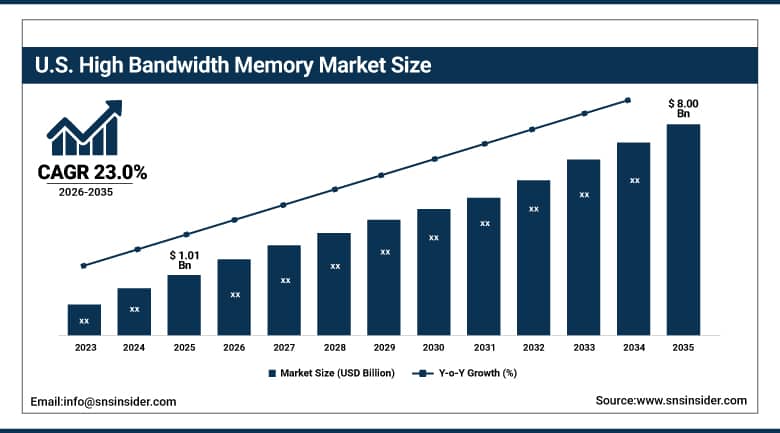
The U.S. High Bandwidth Memory Market was valued at approximately USD 1.01 Billion in 2025 and is projected to reach approximately USD 8.00 Billion by 2035, registering a CAGR of approximately 23.0% from 2026 to 2035.
The United States continued to progress by concentrated hyperscaler procurement from major cloud providers, sustained AI accelerator design activity among domestic GPU and custom silicon developers, and growing federal emphasis on securing resilient memory supply chains. Rising deployment of HBM-equipped AI training and inference infrastructure by domestic hyperscale data center operators continued reinforcing the country's position as both the largest demand center and a genuine innovation driver for next-generation memory architectures. Growing adoption across generative AI, high-performance computing, and defense computing applications added further layers of sustained domestic demand well beyond the technology's original graphics processing use case.
Micron Technology began volume shipments of its HBM3E 8-layer memory throughout 2025 for integration into leading GPU manufacturers’ next-generation AI accelerator platforms serving U.S.-based hyperscale data center customers.
High Bandwidth Memory Market Segment Analysis
-
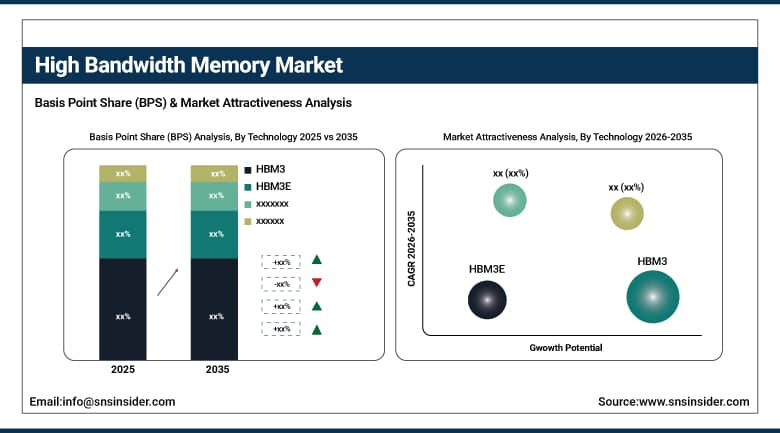
By Technology, HBM3 dominated the High Bandwidth Memory Market with a 49.00% share in 2025, while HBM3E is the fastest-growing technology segment with a CAGR of 27.10% from 2026–2035.
-
By Application, Servers dominated the market with a 65.00% share in 2025, while Automotive & Transportation is the fastest-growing application segment with a CAGR of 29.30% from 2026–2035.
-
By Processor Interface, GPU dominated the market with a 58.00% share in 2025, while AI Accelerator/ASIC is the fastest-growing processor interface segment with a CAGR of 28.50% from 2026–2035.
-
By Memory Capacity per Stack, 16 GB dominated the market with a 36.00% share in 2025, while 24 GB and More is the fastest-growing memory capacity segment with a CAGR of 30.20% from 2026–2035.
By Technology, HBM3 Leads While HBM3E Grows Fastest
The HBM3 segment dominated the High Bandwidth Memory Market in 2025 owing to its established position as the current-generation standard integrated across the majority of deployed AI accelerator and GPU platforms. Hyperscalers and chip designers continue relying on HBM3 for its proven yield, qualified supply chains, and broad compatibility with existing accelerator designs. Continued volume ramp among memory manufacturers has kept HBM3 the largest single revenue contributor within the current technology landscape tracked in this report.
The HBM3E segment is the fastest growing in the High Bandwidth Memory Market owing to accelerating adoption among next-generation GPU platforms requiring higher per-stack bandwidth and improved power efficiency for increasingly large AI model training workloads. Memory manufacturers are racing to qualify HBM3E capacity to capture premium-priced customer commitments from leading GPU and AI accelerator developers. Growing hyperscaler demand for maximum memory bandwidth per accelerator continues accelerating the ramp of HBM3E production capacity across leading memory suppliers.
By Application, Servers Dominate While Automotive Records Fastest Growth
The Servers segment dominated the High Bandwidth Memory Market in 2025 due to sustained hyperscale data center demand for GPU-dense server configurations requiring four to eight HBM stacks per node to support increasingly large transformer-based AI models. Cloud providers continue prioritizing server-class HBM deployment given the segment’s scale and recurring AI infrastructure refresh cycles. Sustained global AI training cluster expansion has kept this application the largest overall revenue contributor across the market.
The Automotive & Transportation segment is the fastest growing in the High Bandwidth Memory Market owing to rising adoption of centralized compute domains that consolidate sensor fusion and path planning workloads onto single system-on-chip platforms requiring extreme memory bandwidth. Automakers increasingly demand HBM integration to support autonomous driving and advanced driver assistance compute requirements. Accelerating global autonomous vehicle development continues driving sustained growth in automotive-oriented HBM demand.
By Processor Interface, GPU Leads While AI Accelerator/ASIC Grows Fastest
The GPU segment dominated the High Bandwidth Memory Market in 2025 due to sustained demand for graphics processing units as the primary compute engine for generative AI training and inference workloads across hyperscale data centers. GPU manufacturers continue integrating increasing numbers of HBM stacks per device to maximize memory bandwidth for large language model workloads. Sustained global GPU shipment growth has kept this processor interface the largest overall revenue contributor across the market.
The AI Accelerator/ASIC segment is the fastest growing in the High Bandwidth Memory Market owing to rising hyperscaler investment in custom-designed AI accelerator silicon intended to reduce dependence on merchant GPU suppliers. Cloud providers increasingly design proprietary AI accelerators integrating HBM to optimize cost and performance for their specific internal workloads. Growing hyperscaler custom silicon investment continues accelerating growth in AI accelerator and ASIC-oriented HBM demand.
By Memory Capacity per Stack, 16 GB Dominates While 24 GB and More Grows Fastest
The 16 GB segment dominated the High Bandwidth Memory Market in 2025 due to its status as the current mainstream stack capacity integrated across the majority of deployed HBM3-based AI accelerator and GPU platforms. Memory manufacturers continue optimizing yield and cost efficiency around this capacity tier given its broad current-generation compatibility. Sustained deployment of 16 GB stack configurations has kept this capacity tier the largest overall revenue contributor across the market.
The 24 GB and More segment is the fastest growing in the High Bandwidth Memory Market owing to rising demand for maximum memory capacity per stack among next-generation AI accelerators supporting increasingly large model parameter counts. Memory manufacturers are accelerating development of higher-capacity stacks to meet hyperscaler requirements for greater memory density per device. Growing generative AI model complexity continues driving sustained growth in demand for higher-capacity HBM stack configurations.
Regional Analysis
|
Region |
Major Country |
Share within Region, 2025 (%) |
|---|---|---|
|
North America |
United States |
90.00% |
|
Europe |
Germany |
24.00% |
|
Asia Pacific |
South Korea |
52.00% |
|
Middle East and Africa |
Israel |
28.50% |
|
Latin America |
Brazil |
31.00% |
Asia Pacific High Bandwidth Memory Market Insights
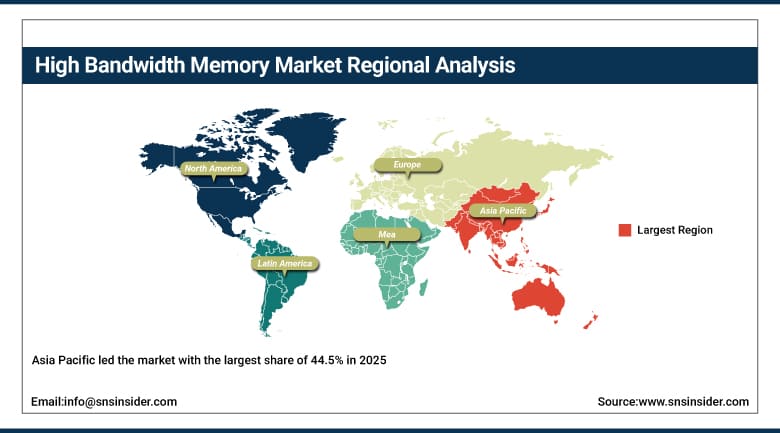
Asia Pacific led the market with the largest share of 44.5% in 2025 and is also advancing at the fastest pace among all regions tracked in this report, registering a CAGR of 24.9% from 2026 to 2035, driven by concentrated memory fabrication capacity, deep semiconductor manufacturing expertise, and sustained government-backed investment in domestic advanced memory capability across the region’s largest economies. That combination of manufacturing scale and deeply entrenched process technology leadership kept the region’s revenue base well ahead of every other region tracked in this report, even as North America’s hyperscaler-driven demand continues growing rapidly in parallel.
South Korea led the pack, supported by its unmatched HBM fabrication capacity and deep process technology leadership among global memory manufacturers. Taiwan contributed substantial additional demand through its advanced packaging and interposer capability, with China’s expanding domestic memory ambitions and Japan’s renewed semiconductor manufacturing investment both reinforcing the region’s position as the largest and fastest-growing HBM market tracked in this report.
Get Customized Report as Per Your Business Requirement - Enquiry Now
North America High Bandwidth Memory Market Insights
Concentrated hyperscaler procurement from major cloud providers, sustained AI accelerator design activity among domestic GPU and custom silicon developers, and growing federal emphasis on securing resilient memory supply chains continued reinforcing the region’s strong position. Rising deployment of HBM-equipped AI training and inference infrastructure across hyperscale data centers further strengthened North America’s standing as the largest demand center and a genuine innovation driver tracked in this report, with continued hyperscaler capital expenditure expected to sustain regional demand through the forecast period.
The United States anchored by its concentration of leading hyperscale cloud providers and GPU and custom AI accelerator developers. Canada added further regional demand through its own growing AI infrastructure investment, and that combined strength kept the continent the largest demand-side addressable market for HBM suppliers through the forecast period, with continued generative AI infrastructure buildout expected to sustain regional demand.
Europe High Bandwidth Memory Market Insights
Europe held a modest but strategically important share of global revenue, supported by growing sovereign AI infrastructure investment and continued expansion of high-performance computing capability across the region’s major economies. Regulatory momentum around European Chips Act-backed semiconductor investment continued shaping regional development priorities without meaningfully altering the region’s relatively limited HBM demand footprint relative to hyperscale AI infrastructure leaders, while sustained automotive and industrial computing demand kept the region a genuinely relevant, if smaller, HBM market tracked in this report.
Germany led demand of European revenue, supported by planned sovereign AI computing investment and its substantial automotive and industrial semiconductor demand base. The UK and France contributed additional demand, and continued European investment in sovereign AI infrastructure should keep regional demand for HBM technology climbing steadily through the forecast period.
MEA and Latin America High Bandwidth Memory Market Insights
The Middle East and Africa and Latin America both remained comparatively nascent markets, constrained by limited existing AI infrastructure investment and continued reliance on imported computing hardware. As sovereign wealth funds and multinational operators explore expanded local AI data center investment, HBM-equipped computing capacity proved a genuinely emerging rather than immediate opportunity in most of these markets during the period tracked in this report.
Israel led Middle East and Africa demand, supported by the country’s established semiconductor design presence and growing sovereign AI computing investment. Saudi Arabia and the UAE contributed further demand through large-scale AI data center announcements. In Latin America, Brazil accounted for the largest share of regional revenue, with growing cloud computing and AI infrastructure investment continuing to anchor limited regional demand for HBM-equipped computing hardware.
Market Dynamics
Growth Drivers: Surging Generative AI Infrastructure and GPU Accelerator Investment
The industry is driven by surging demand for generative AI training and inference infrastructure, rapid transition from HBM3 to HBM3E and emerging HBM4 stacks, growing adoption of advanced 2.5D and 3D packaging techniques, and expanding deployment of multi-stack HBM configurations per AI accelerator. As hyperscalers and chip designers increasingly prioritize maximum memory bandwidth and power efficiency, the need for expanded HBM production capacity continues driving sustained capital investment across the memory industry.
Rising government subsidy support across Asia Pacific and North America continues reinforcing this driver, underwriting rapid fabrication capacity expansion among leading memory manufacturers. Growing automotive demand for centralized compute domains continues defining a further layer of sustained demand, and that combination of AI infrastructure investment and automotive semiconductor content growth is exactly what keeps overall demand climbing at such a steady, sustained pace.
Restraints: Advanced Packaging Capacity Bottlenecks and Extreme Capital Intensity
Advanced 2.5D packaging capacity constraints continue posing a genuine restraint on faster market-wide expansion, as interposer and through-silicon-via manufacturing capability has not scaled as quickly as underlying memory demand, giving memory suppliers significant pricing power while limiting overall market throughput. That bottleneck has kept supply meaningfully constrained relative to hyperscaler demand across the period tracked in this report.
The extraordinary capital investment required to construct and equip advanced HBM fabrication and packaging facilities continues posing a further restraint, as new entrants face genuine barriers to competing against the three established global memory manufacturers with decades of process technology expertise. That cost profile has kept HBM production concentrated among a very small number of globally significant suppliers.
Opportunities: Custom AI Silicon Design and Automotive Compute Expansion
Rising hyperscaler investment in custom-designed AI accelerator silicon represents a genuinely significant opportunity, as cloud providers increasingly seek to reduce dependence on merchant GPU suppliers while optimizing memory configurations for proprietary workloads. Vendors positioned early in flexible, customer-specific HBM integration stand to capture meaningful share as this capability continues expanding from merchant GPU designs into broader custom silicon architectures.
Expanding automotive centralized compute adoption offers a second substantial opportunity, as vehicles increasingly consolidate sensor fusion and autonomous driving workloads onto single high-bandwidth-memory-equipped platforms. Vendors with proven, automotive-qualified HBM technology stand to capture meaningful share as global autonomous vehicle development continues scaling across established and emerging automotive markets alike.
Recent Developments:
-
2026: SK hynix unveiled iHBM, an integrated thermal-management solution that embeds cooling elements within HBM packages and reduces thermal resistance by approximately 30%, targeting next-generation AI memory applications.
-
2026: SK hynix began mass shipments of HBM4 in Q2 2026, with plans to ramp production in the second half of the year as demand for AI memory continues to accelerate.
-
2025: Samsung Electronics qualified its HBM3E 12-layer stack for a leading GPU manufacturer’s next-generation AI accelerator platform, expanding advanced packaging capacity at its South Korean facilities.
High Bandwidth Memory Companies are:
-
Samsung Electronics Co., Ltd.
-
Micron Technology, Inc.
-
NVIDIA Corporation
-
Advanced Micro Devices, Inc. (AMD)
-
Intel Corporation
-
Taiwan Semiconductor Manufacturing Company Limited (TSMC)
-
Amkor Technology, Inc.
-
ASE Technology Holding Co., Ltd.
-
JCET Group Co., Ltd.
-
Synopsys, Inc.
-
Cadence Design Systems, Inc.
-
Rambus Inc.
-
Marvell Technology, Inc.
-
Alphabet Inc. (Google LLC)
-
Amazon.com, Inc.
-
Microsoft Corporation
-
Meta Platforms, Inc.
-
Cerebras Systems Inc.
High Bandwidth Memory Market Report Scope:
| Report Attributes | Details |
|---|---|
| Market Size in 2025 | USD 3.45 Billion |
| Market Size by 2035 | USD 30.20 Billion |
| CAGR | CAGR of 24.2% From 2026 to 2035 |
| Base Year | 2025 |
| Forecast Period | 2026-2035 |
| Historical Data | 2022-2024 |
| Report Scope & Coverage | Market Size, Segments Analysis, Competitive Landscape, Regional Analysis, DROC & SWOT Analysis, Forecast Outlook |
| Key Segments | • By Technology (HBM2, HBM2E, HBM3, HBM3E, HBM4) • By Application (Servers, Networking, High-Performance Computing, Consumer Electronics, Automotive & Transportation) • By Processor Interface (GPU, CPU, AI Accelerator/ASIC, FPGA, Other Interfaces) • By Memory Capacity per Stack (4 GB, 8 GB, 16 GB, 24 GB and More) |
| Regional Analysis/Coverage | North America (US, Canada), Europe (Germany, UK, France, Italy, Spain, Russia, Poland, Rest of Europe), Asia Pacific (China, India, Japan, South Korea, Australia, ASEAN Countries, Rest of Asia Pacific), Middle East & Africa (UAE, Saudi Arabia, Qatar, South Africa, Rest of Middle East & Africa), Latin America (Brazil, Argentina, Mexico, Colombia, Rest of Latin America). |
| Company Profiles | SK Hynix Inc., Samsung Electronics Co., Ltd., Micron Technology, Inc., NVIDIA Corporation, Advanced Micro Devices, Inc. (AMD), Intel Corporation, Broadcom Inc., Taiwan Semiconductor Manufacturing Company Limited (TSMC), Amkor Technology, Inc., ASE Technology Holding Co., Ltd., JCET Group Co., Ltd., Synopsys, Inc., Cadence Design Systems, Inc., Rambus Inc., Marvell Technology, Inc., Alphabet Inc. (Google LLC), Amazon.com, Inc., Microsoft Corporation, Meta Platforms, Inc., Cerebras Systems Inc. |
Frequently Asked Questions
The major growth factor is surging generative AI infrastructure investment, rapid HBM3E and HBM4 technology transition, and expanding GPU accelerator deployment.
The HBM3 segment dominated the High Bandwidth Memory Market by technology, representing the largest share of revenue in 2025.
Asia Pacific dominated the High Bandwidth Memory Market in 2025, holding an estimated 44.5% share of total global market revenue.
