
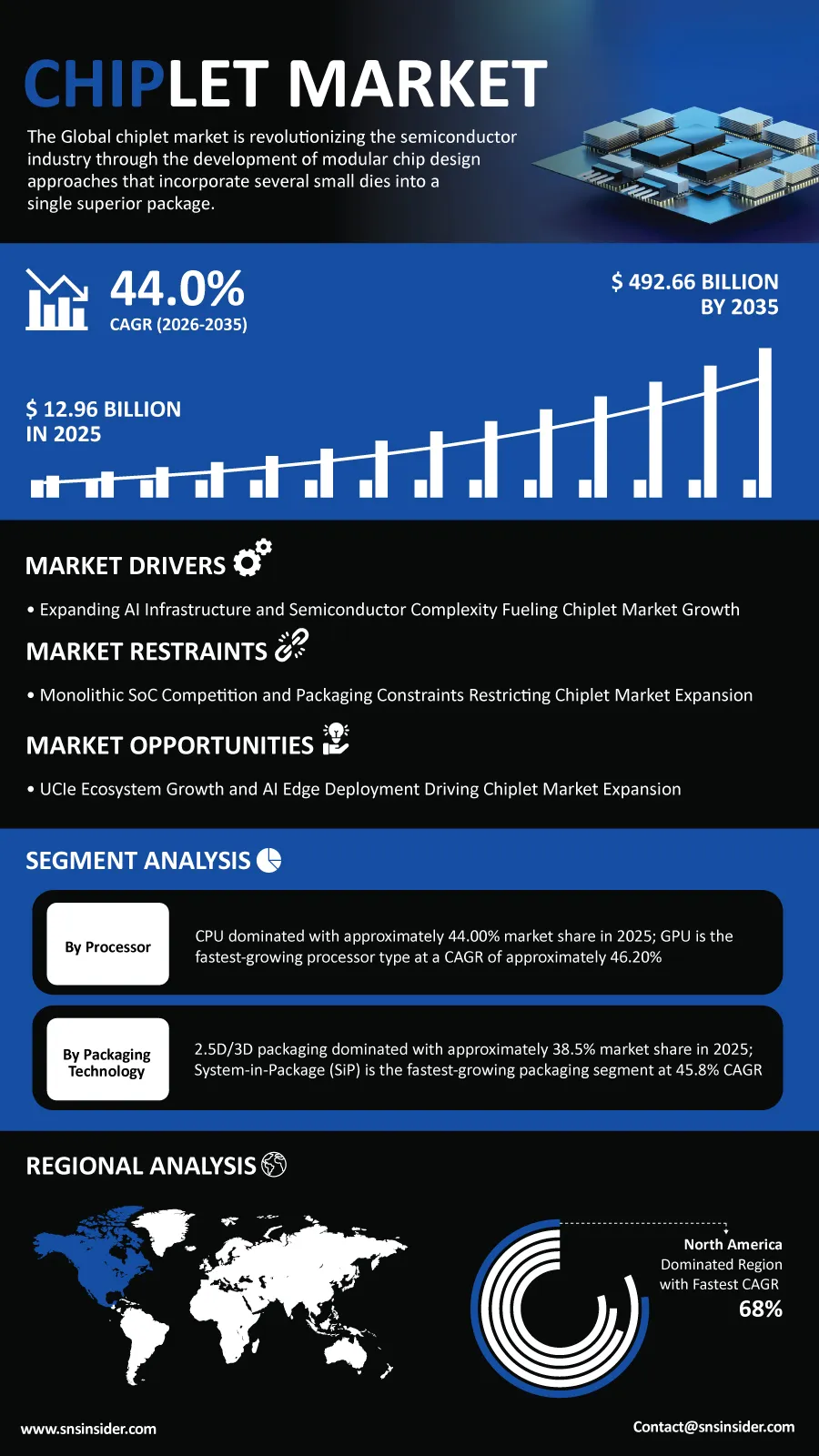
The global Chiplet Market is entering a transformative phase as semiconductor companies are adopting modular architecture designs to cater to the increasing needs for computational power and energy efficiency. According to a recent study by SNS Insider, the global Chiplet Market size valued at USD 12.96 billion in 2025, is anticipated to grow to USD 492.66 billion by 2035, registering a CAGR of 44.0% over the 2026–2035 forecast period.
As a result of the fast growth of the field of artificial intelligence, hyperscale data centers, self-driving cars, and high-performance computing, there is an increased demand for semiconductor technology that could provide improved processing power without being dependent entirely on bigger monolithic chips. The design of chiplets provides the ability to integrate diverse pieces of hardware into one unit.
Furthermore, increasing levels of complexity for advanced semiconductor devices and increased costs of fabricating at the leading edge are also prompting firms to consider modular integration. Advancements in high bandwidth memory, advanced packaging, and die-to-die interconnects continue to bolster the business case for chiplets.
To Get Detailed Insights on the Chiplet Market – Request a Sample Report
Advanced Packaging Innovation Creates New Growth Opportunities
The semiconductor industry is gradually shifting towards heterogeneous integration, with manufacturers integrating computing, memory, connectivity, and acceleration capabilities into compact packaging. Chiplet technology provides the chance for designers to make dies optimal for certain loads and manufacturing technologies and thereby boost the flexibility of development and economic efficiency of production.
Industry-wide interoperability standards are yet another factor that drives the process. More widespread use of chiplet interconnects will enable designers to use elements from various companies and develop a diverse ecosystem of intellectual property chips.
Increased investments in computing infrastructures for artificial intelligence are forecasted to generate particular interest since future processors would need enhanced computing power and memory throughput. Besides data centers, chiplet technology adoption is being extended to automotive electronics, telecommunications, industrial automation, and edge AI systems.
Key Market Insights Highlight Shifting Demand Patterns
By processor type, CPUs held around 44.00% share of global market revenue in 2025, supported by widespread adoption of modular processor architectures in enterprise and high-performance computing. GPUs are projected to be the fastest-growing processor category, expanding at a CAGR of approximately 46.20% through 2035 as AI training and inference workloads increase demand for highly scalable accelerated computing platforms.
Based on packaging technology, 2.5D/3D packaging segment held approximately 38.5% share of market revenue in 2025, driven by growing integration of high-performance computing dies and high-bandwidth memory. System-in-Package (SiP) technology segment is expected to register the fastest growth at approximately 45.8% CAGR as compact connected devices, IoT systems, and consumer electronics increasingly require high levels of functional integration.
By end-use application, automotive segment held around 32.00% share in 2025, supported by increasing semiconductor requirements for electric vehicles, advanced driver assistance systems, and intelligent vehicle platforms. Enterprise electronics segment is expected to be the fastest-growing application, advancing at a CAGR of 46.10% as cloud computing, AI infrastructure, and data center modernization accelerate demand for advanced chiplet-based processors.
AI Computing and Data Center Expansion Strengthen Market Momentum
The fast growth of applications built on AI technologies is putting forward an increasing need for processor capabilities to support such complex loads. The adoption of chiplets provides additional flexibility for semiconductor manufacturers in assembling different processing units, accelerators, memory interfaces, and connectivity modules while overcoming physical constraints inherent to extremely big monolithic dies.
The hyperscale cloud vendors are also spending huge amounts of money on custom-designed computer hardware for better performance-per-watt and less reliance on commodity hardware. This has led to the design of specialized chiplet processors suited for particular applications, such as artificial intelligence and networking.
Asia Pacific Leads the Chiplet-Based Processor Market as North America Accelerates AI Infrastructure Investments
The Asia Pacific is forecasted to remain the leading regional market in 2025 owing to the region’s semiconductor manufacturing network and advanced packaging technologies as well as robust consumer electronics, automotive and computing demands. Taiwan, China, South Korea and Japan are key players in the regional semiconductor supply chain.
North America is forecasted to grow at the fastest pace in terms of regional market owing to investments in AI technologies, domestic semiconductor manufacturing and advanced packaging as well as high-performance computing. The U.S. will continue to be benefitted owing to its major processor companies and government support for domestic semiconductor technology.
As investments in AI data centers and next-generation computing systems accelerate, demand for chiplet-based architectures is expected to expand rapidly across both established and emerging technology markets.
Industry Participants Focus on Advanced Chiplet Ecosystems
The competitive landscape is evolving quickly due to the increasing investment in semiconductor firms and technologists towards developing advanced packaging, die-to-die connections, interoperability of chiplets, and dedicated processor architectures. There is growing emphasis on collaborations and eco-systems within industry players aimed at hastening the adoption of modular semiconductor designs.
Key companies operating in the global Chiplet Market include Intel Corporation, Advanced Micro Devices, Inc. (AMD), Apple Inc., IBM, Marvell, MediaTek Inc., NVIDIA Corporation, Achronix Semiconductor Corporation, Ranovus, Netronome, Cadence Design Systems, Inc., SiFive, Inc., ALPHAWAVE SEMI, Eliyan, Ayar Labs, Inc., Tachyum, X-Celeprint, Kandou Bus SA, NHanced Semiconductors, and Tenstorrent.
An SNS Insider analyst Sushant Kadam commented, “The accelerating AI computing cycle and growing complexity of semiconductor systems are creating a powerful foundation for chiplet adoption. As advanced packaging capacity expands and interoperability standards mature, chiplet architectures are expected to move beyond premium processors into a wider range of automotive, enterprise, edge computing, and industrial applications.”
About the Author

Get in touch




