According to the latest SNS Insider Chlor-Alkali Market report, the global market is set for steady growth. Chlorine, caustic soda and soda ash are basic inputs for construction, metals, paper, water treatment and consumer goods. Demand for these products follows activity in each of those industries.
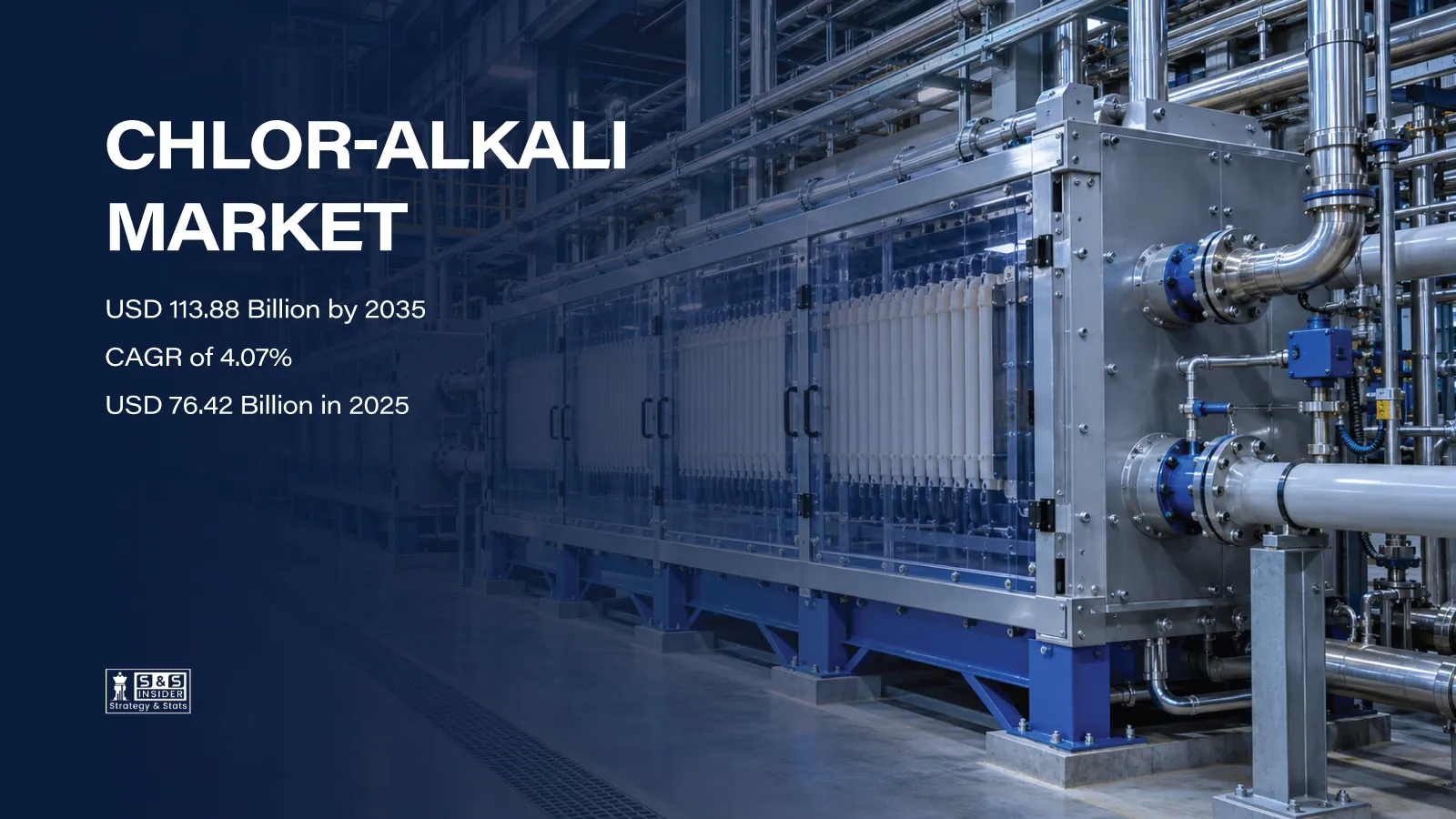
The global chlor-alkali market was valued at USD 76.42 Billion in 2025 and is estimated at USD 79.53 Billion in 2026. It is projected to reach USD 113.88 Billion by 2035, growing at a CAGR of 4.07% during 2026–2035.
Producers are moving their plants to membrane cell technology because it uses less power and avoids mercury. Older diaphragm units are being closed or replaced. Electricity is often the largest production cost, so lower power use has a direct effect on margins.
PVC remains the largest outlet for chlorine, and caustic soda demand comes from alumina refineries, pulp mills, and soap and textile makers. Hydrogen, a by-product of chlor-alkali cells, is also becoming a source of extra revenue.
Asia Pacific is the largest region and also the fastest growing one. North America is second, supported by low-cost power and feedstock on the U.S. Gulf Coast.
To Get Detailed Insights on the Chlor-Alkali Market – Request a Sample Report
Demand Drivers and Constraints
Primary Demand Drivers
-
PVC for construction: Building and water infrastructure projects in Asia, the Middle East, and Africa use large volumes of PVC, which keeps chlorine demand high.
-
Alumina and pulp production: Refineries and pulp mills need steady supplies of caustic soda for their main processes.
-
Water treatment: Growing cities and stricter safety rules raise demand for chlorine-based disinfection.
-
Consumer and specialty uses: Hygiene products, pharmaceutical intermediates, and battery materials add new sources of demand.
-
Hydrogen by-product value: Plants can sell the hydrogen they produce as a fuel or as a feedstock, which improves plant returns.
Potential Growth Constraints
-
High electricity costs, especially where power prices are high, such as parts of Europe.
-
Large capital costs and long permit timelines for new membrane plants.
-
Linked output: each ton of chlorine yields about 1.1 tons of caustic soda.
-
Trade measures, such as EU anti-dumping duties on suspension PVC.
-
Mixed demand cycles across construction, paper, and metals.
Demand Structure by Product
Caustic Soda (2025 Market Share: 55.37%)
The global chlor-alkali market was dominated by caustic soda, accounting for 55.37% in 2025. It is used in alumina refineries to pull alumina out of bauxite. Pulp mills use it to break down wood fiber , soap makers and textile makers use it for their daily production . These buyers run plants that run 24 hours a day, so demand is fairly steady. Growth in the use of aluminum for vehicles and packaging is expected to support caustic soda volumes through 2035.
Current trend: New caustic soda capacity is being added on the U.S. Gulf Coast and in Southeast Asia.
Major trends: Membrane-grade caustic, long-term supply contracts, export-oriented capacity, and regional supply balancing.
Chlorine (Forecast CAGR: 4.63%)
Chlorine is projected to register the fastest product growth at a CAGR of 4.63% during 2026–2035. Most chlorine goes into PVC, which is used for pipes, window frames, and cables. Organic chemicals and water treatment take much of the rest. Chlorine is hard to transport, so producers often use it on site or sell it to nearby plants. Construction activity and water projects in developing economies are expected to drive steady growth.
Current trend: More chlorine is being used inside integrated vinyl complexes.
Major trends: Integrated PVC chains, on-site consumption, water disinfection, and specialty chemical intermediates.
Demand Structure by Process
Membrane Cell (2025 Market Share: 59.74%)
Membrane cell technology held 59.74% of the market in 2025 and is the leading process. It uses less electricity than older diaphragm and mercury cells and produces high-purity caustic soda. Environmental rules have nearly ended mercury cell use, and diaphragm capacity continues to shrink. Because power is the largest production cost, producers see clear savings from membrane upgrades. Most new plants now use this design.
Current trend: Older diaphragm units are being replaced with membrane electrolyzers.
Major trends: Energy-efficient electrolyzers, membrane retrofits, renewable power supply, and hydrogen recovery.
Other Processes (Forecast CAGR: 4.38%)
Other processes, including newer electrolyzer concepts, are projected to grow at a CAGR of 4.38% through 2035. Developers are testing designs that cut power use further and work better with variable renewable energy. Some producers are running pilot units to see whether these designs can lower costs at full scale. Adoption will depend on proven reliability and on the cost of renewable power in each region.
Current trend: Trials of advanced electrolyzer designs at existing sites.
Major trends: Low-energy cell designs, flexible operation, renewable integration, and modular units.
Demand Structure by Application
Pulp & Paper (2025 Market Share: 29.18%)
The pulp and paper was the largest application of the chlor-alkali market in 2025, with a share of 29.18%. Mills use caustic soda in pulping and chlorine-based chemicals in bleaching. Mills have seen strong output driven by higher demand for packaging board from online retail. “Printing paper has fallen off, but that has been offset to a large extent by packaging and tissue products.” The big pulp projects in South America and Asia will still require steady chemical supplies.
Current trend: Pulp capacity is shifting toward packaging and tissue grades.
Major trends: Packaging board growth, tissue demand, bleaching chemical supply, and integrated mill sites.
Alumina (Forecast CAGR: 4.96%)
Alumina is expected to be the fastest growing application with a CAGR of 4.96% during the period 2026-2035. Bauxite processing consumes large volumes of caustic soda in refineries. Demand for aluminum is growing for lightweight vehicles, power lines and packaging, which increases alumina output. New refineries in Asia and other bauxite rich areas will cater to the rising demand for caustic soda. Long term supply contracts between refiners and chlor-alkali producers are becoming more frequent.
Current trend: Refinery expansion near bauxite sources.
Major trends: Lightweight vehicle demand, grid expansion, long-term caustic contracts, and regional refinery growth.
Key Market Participants
The chlor-alkali market includes integrated chemical companies, vinyl producers, and regional chlor-alkali makers.
Key participants include Olin Corporation, Occidental Chemical Corporation (OxyChem), Westlake Corporation, The Dow Chemical Company, INEOS Inovyn, Formosa Plastics Corporation, Shin-Etsu Chemical Co., Ltd., AGC Inc., Tosoh Corporation, Nobian, Ercros, S.A., Bondalti, Hanwha Solutions Corporation, Xinjiang Zhongtai Chemical Co., Ltd., Grasim Industries Limited, and Gujarat Alkalies and Chemicals Limited.
Companies compete on power costs, plant efficiency, and how well their chlorine and caustic output is matched to downstream demand. Producers with low-cost energy, membrane technology, and integrated vinyl operations are best placed to protect their margins.
Regional Market Dynamics
North America (2025 Market Share: 17.94%)
North America held a 17.94% share of the global market in 2025. The United States leads the region, with a market value of USD 11.02 Billion in 2025 and a projected CAGR of 4.31%. Low-cost natural gas and power on the Gulf Coast support large, integrated plants. Producers are closing older diaphragm units while adding modern capacity. Exports of caustic soda and PVC also support regional output.
Direction: Stable growth supported by low-cost energy and plant modernization.
Asia Pacific (Forecast CAGR: 5.71%)
Asia Pacific dominated the market, holding a 57.86% share in 2025, and is expected to grow at the fastest CAGR of 5.71% through 2035. China has the largest production base and continues to add membrane capacity. India, Indonesia and Thailand are building new plants to meet growing demand from construction and manufacturing. Alumina refining and PVC use in the region are continuing to grow.
Direction: Fastest growth driven by industrial expansion and new capacity.
Overall, the chlor-alkali market is set for steady growth through 2035. Energy efficiency, integrated operations, and a good balance between chlorine and caustic soda sales will decide which producers succeed
About the Author

Get in touch