
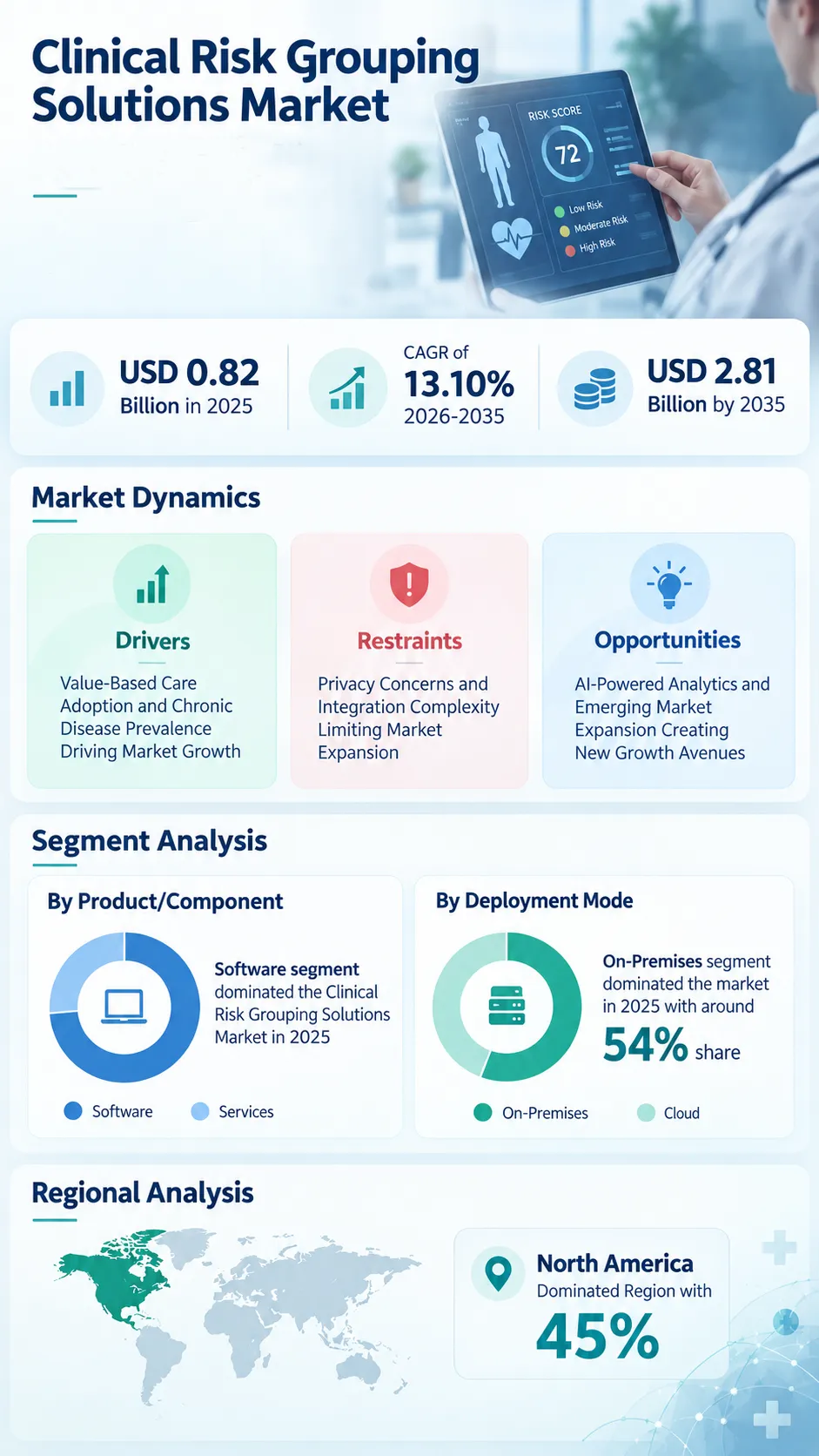
The global Clinical Risk Grouping Solutions Market is set for significant expansion as payers and providers worldwide continue embracing data-driven patient risk stratification. “According to a recent study by SNS Insider, the global Clinical Risk Grouping Solutions Market size valued at USD 0.82 billion in 2025, is anticipated to grow to USD 2.81 billion by 2035, registering a CAGR of 13.10% over the 2026-2035 forecast period.”
There have been notable changes within clinical risk grouping technology and application over time, due to which many vendors aiming at improving predictive accuracy and workflow integration can take advantage of this trend. This includes the need for more AI-powered, purpose-built platforms that will provide payers and providers with the ability to meet value-based care requirements without relying on outdated retrospective analytics. This applies in situations where clinical risk grouping is used for population health management, chronic disease management, and fraud detection purposes.
Vendors are constantly working to ensure that their clinical risk grouping platforms perform better than before in order to meet various needs of health plans and provider organizations.
To Get Detailed Insights on the Clinical Risk Grouping Solutions Market – Request a Sample Report
Value-Based Care Analytics Ecosystems Create New Demand
The clinical risk grouping solutions market has evolved from basic retrospective claims-based grouping to more advanced predictive and real-time analytics use cases. The growing investment in artificial intelligence, cloud-native architecture, and interoperability standards for a variety of applications has required the development of more efficient and reliable analytics platforms.
New approaches to clinical risk grouping can increase predictive accuracy, improve workflow integration, and allow for broader application versatility across payer and provider use cases. This gives vendors the possibility to be more effective when reaching health plans and provider organizations and doing better platform differentiation.
Health IT vendors, health systems, and payer organizations are increasingly cooperating thanks to the growing interest in developing future solutions for value-based care analytics.
Key Market Findings Highlight High-Growth Segments
The software category has been dominant in the Clinical Risk Grouping Solutions Market, contributing a revenue share of 62% in 2025, as it is well accepted by payers and providers and has high scalability across large patient populations.
The services category has been forecasted to experience the highest rate of growth because of increasing organizational demand for implementation support and analytics consulting.
On the basis of application, population health management was the biggest revenue contributor in 2025, accounting for 34%, because of its foundational role in patient stratification programs. Fraud detection & prevention is anticipated to show the highest growth as more payers invest in analytics to protect risk-adjusted reimbursement programs.
By end-user, healthcare payers accounted for 56% of market revenue in 2025, owing to their long-standing use of risk grouping for premium setting and reimbursement. On the other hand, the healthcare providers segment is expected to grow at the highest rate driven by expanding participation in value-based care arrangements.
Predictive Accuracy, Interoperability, and Innovation Gain Importance
In this regard, vendors have been looking at platforms that would make their products more predictive, more interoperable, and less burdensome to implement.
Innovation in machine learning model development, cloud-native architecture, and interoperability standards has been making it possible for companies to come up with products that can meet increasingly demanding regulatory and customer expectations. In addition to that, increasing emphasis on real-time analytics and fraud detection expansion is also making it possible for companies to find solutions that optimize customer trust.
Such trends are likely to become even more prominent in the future.
North America Emerges as the Largest Market Amid Rising Value-Based Care Adoption
The North America region represented the largest share of global market revenue in 2025, owing to the region’s advanced value-based care ecosystem and well-established risk-adjusted reimbursement programs. In addition, Asia Pacific is expected to be the fastest-growing market during the forecast period, propelled by rising healthcare expenditure and expanding digital health adoption across the region’s large population base.
On the other hand, Europe represented a significant share of global market revenue in 2025, aided by growing national health system emphasis on population health management.
Leading Companies Drive Innovation and Competition
The environment continues to stay dynamic since players continue innovating on analytics capabilities and platform architecture as well as forming partnerships in order to enhance their position in the industry.
Some of the major companies that operate in the global clinical risk grouping solutions market are 3M Company, Optum Inc., Conduent Incorporated, Oracle Health (Cerner Corporation), Change Healthcare, Health Catalyst, Inc., Lightbeam Health Solutions, HBI Solutions, Inc.
An SNS Insider Analyst Parry Kardani commented, “The rapid evolution of AI-powered, cloud-native clinical risk grouping technology is creating unprecedented demand for high-quality population health analytics platforms. Vendors that successfully combine predictive accuracy, interoperability, real-time analytics, and advanced deployment flexibility will be best positioned to capitalize on emerging opportunities across payer and provider applications.”
About the Author

Get in touch




