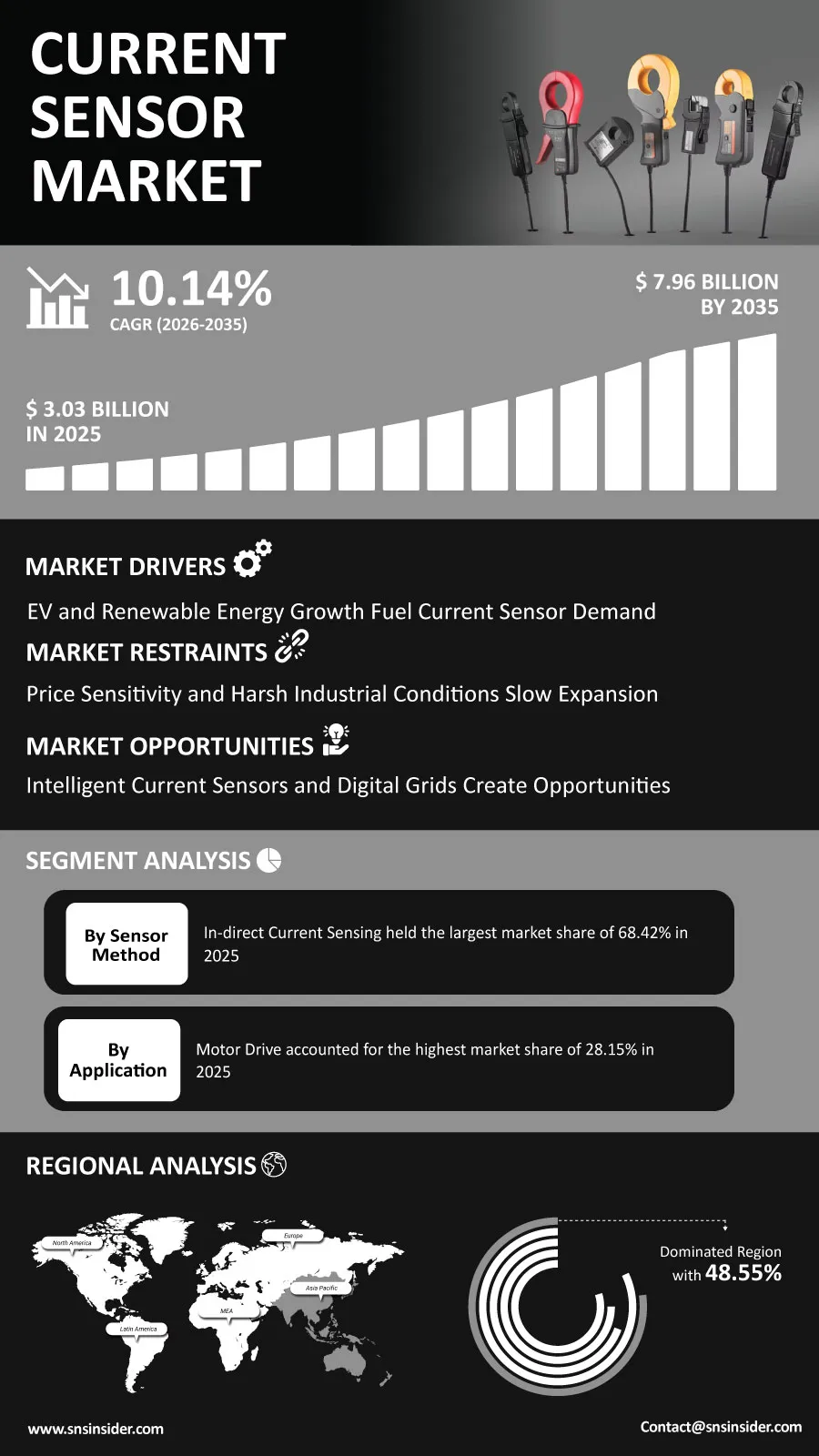
The global Current Sensor Market is entering a strong growth phase as electrification, automation, and intelligent power management reshape automotive, industrial, and energy systems. According to a recent study by SNS Insider, the global Current Sensor Market size valued at USD 3.03 billion in 2025, is anticipated to grow to USD 7.96 billion by 2035, registering a CAGR of 10.14% over the 2026–2035 forecast period.
The fast growth of electric vehicles, renewable energy technologies, robots, and connected gadgets has generated a need for precise measuring systems of current. The significance of current sensors is to monitor the amount of energy consumed, protect components from damages, improve energy efficiency, and enable real-time control of electronic gadgets.
The manufacturers are also making efforts towards the change towards miniaturized power electronics that work at faster speeds. The implementation of silicon carbide and gallium nitride components creates a need for sensors that give accurate readings at faster frequencies and under harsher temperatures.
To Get Detailed Insights on the Current Sensor Market – Request a Sample Report
Electrification and Smart Energy Infrastructure Create New Growth Opportunities
The fast-growing trend towards electric mobility opens several new opportunities for the current sensor manufacturers globally. Battery management systems, traction inverters, chargers, and power electronics that are part of the car need reliable current sensors to work efficiently and safely.
The renewable energy sector is also creating new opportunities for growth. Solar inverters, wind power generation systems, energy storage solutions, and smart grids are all increasingly using current sensors for their functioning.
The increasing use of connected industrial machinery will further shape the competitive environment. Digital output sensors with diagnostics and communication capability are increasingly important for manufacturers who wish to have a better understanding of the performance of their machinery.
Key Market Insights Highlight Shifting Demand Patterns
By sensor method, indirect current sensing was estimated to capture about 68.42% of worldwide market revenue in 2025 due to its electrical isolation properties and other characteristics, such as safety and suitability for applications with high currents. However, direct current sensing is expected to experience the highest growth rate, growing at a CAGR of 10.89% by 2035 as demand increases for precise and cost-efficient measurement in battery systems and power electronics.
Based on application, motor drives segment was dominating the market share in 2025 with a market revenue share of 28.15%. Monitoring is very important for the management of torque, overload, and energy in industrial machines and automation. The battery management system will be growing at the highest rate of 13.27% due to EVs and stationary energy storage systems.
By loop, open loop systems segment contributed about 55.60% of the market revenues in 2025 because of its compact design and cost efficiencies. The closed loop systems segment is expected to witness the fastest growth rate of 11.05% CAGR because of the need for precision in high-power drive and servo system applications.
By technology, Hall Effect sensors segment led with 52.75% share in 2025. Shunt-based technology is anticipated to grow fastest at a CAGR of 10.98%, particularly across applications requiring high measurement accuracy at competitive costs.
By output, analog sensors segment held around 61.30% share in 2025. Digital output technology is projected to grow at the fastest pace, with a CAGR of 12.18%, as connected equipment increasingly requires direct communication with processors and control platforms.
Intelligent Sensing Strengthens Energy and Automation Performance
The convergence of current sensing technology with the IoT and Industry 4.0 trends opens up more applications of these sensors in maintenance and energy efficiency. Sensors with a digital interface can provide measurement data directly to the controller, thus allowing users to detect any unusual electrical condition before breakdowns happen.
In automobiles, complex batteries have led to an increase in need for accurate current measurement. In industry, the automation process and data centers have generated need for sensors that can operate in environments with high power and electrical noise.
Asia Pacific Holds 48.55% Current Sensor Market Share in 2025 as North America Grows at an 11.87% CAGR Through 2035
The Asia Pacific market was forecasted to continue being the leading regional market, contributing 48.55% to the global revenue share by 2025. The Asia Pacific region is favored by its large number of electronics and automobile manufacturing plants, fast-growing production of EVs, growing renewable energy capacity, and growing automation in industry.
North America will be the fastest-growing regional market over the forecast period with a CAGR of 11.87%. The factors responsible for growth include the manufacture of electric vehicles, batteries, data centers, grids, aerospace products, and industrial reshoring.
Industry Participants Focus on Precision and High-Performance Solutions
Competition remains active as semiconductor and sensor manufacturers strive to produce smaller, faster, and more precise products for electrical systems. The manufacturers have been concentrating on better isolation, temperature resistance, bandwidth, diagnosis, and integration into power management platforms.
Key companies operating in the global Current Sensor Market include Allegro MicroSystems, Inc., Texas Instruments Incorporated, LEM Holding SA, Infineon Technologies AG, TDK Corporation, Asahi Kasei Microdevices Corporation, Melexis NV, ACEINNA Inc., Kohshin Electric Corporation, Sensitec GmbH, Vishay Intertechnology, Inc., STMicroelectronics N.V., Analog Devices, Inc., Honeywell International Inc., NXP Semiconductors N.V., Murata Manufacturing Co., Ltd., Silicon Laboratories Inc., ROHM Co., Ltd., MagnaChip Semiconductor Corp., and TT Electronics plc.
An SNS Insider analyst Sushant Kadam commented, “The transition toward electric mobility, renewable power, and intelligent industrial systems is creating sustained demand for accurate and dependable current measurement. Sensor manufacturers that combine precision, compact integration, digital connectivity, and high-temperature performance will be well positioned to benefit from the next phase of electrification.”
About the Author

Get in touch